
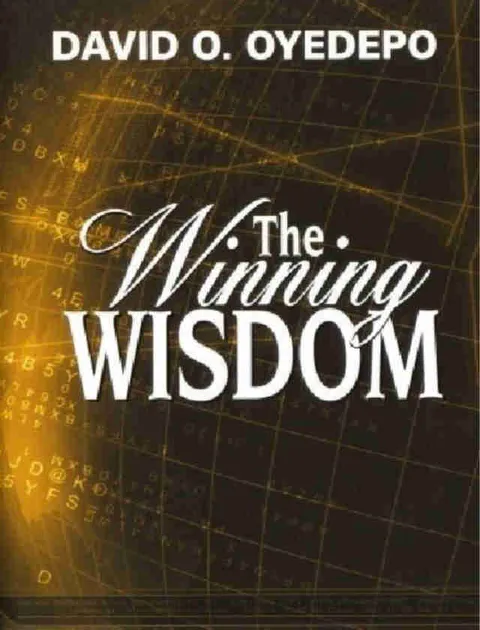

Others like the winning wisdom Features >>





About the Book
"The Winning Wisdom" by David O. Oyedepo is a motivational book that discusses the principles of success and prosperity based on biblical teachings. The author emphasizes the importance of faith, positive thinking, and taking action to achieve one's goals. Oyedepo shares personal experiences and practical advice to inspire readers to unlock their potential and live a fulfilling life.
Sophie Scholl

my times are in your hand - learning to trust the speed of god
Did you know your head ages faster than your feet? Scientists have confirmed this, proving again that Albert Einstein was spot-on in his theories of relativity: the speed of time is relative to a particular frame of reference. For us terrestrials, that frame of reference is earth’s gravitational force. The higher up from the earth something is, the weaker the gravitational pull and the faster time moves. An implication of this is that we frequently put our trust in a frame of reference on time different from the one we experience. For instance, the Global Positioning System (GPS) we rely on to accurately and safely guide us as we pilot our cars, ships, planes, and spaceships only works because it’s programmed, based on Einstein’s theories of relativity, to compensate for the distance between earth and space. Without those formulas, our computers and smartphones would soon get disastrously out of sync with the GPS satellites, which orbit in a different time. Stick with me; I am going somewhere with this. How we experience time depends on our frame of reference. And our particular frame of reference is not always the one we should trust. In fact, sometimes it’s critically important that we trust another framing more than our own. One Day with the Lord For Christians, this concept is nothing new. Over three millennia ago, Moses wrote, A thousand years in your sight are but as yesterday when it is past, or as a watch in the night. (Psalm 90:4) And some two millennia ago, Peter wrote, Do not overlook this one fact, beloved, that with the Lord one day is as a thousand years, and a thousand years as one day. (2 Peter 3:8) In other words, time in God’s eyes moves at different speeds from time in our ours. And in the life of faith, it’s critically important that we learn to rely on God’s timing more than our own — to learn to trust the speed of God. How Long, O Lord? Learning to trust God’s timing is not easy, to say the least. This is partly due to our sin and unbelief. But it’s also because trusting a frame of reference different from ours is, by definition, counterintuitive. Since we can’t calculate God’s time, his timing often doesn’t make sense to us. That’s why after Peter described one God-day as being like a thousand years for us, he went on to say, “The Lord is not slow . . . as some count slowness” (2 Peter 3:9). The “some” he referred to were “scoffers” who mocked Christians’ hope in the return of Christ (2 Peter 3:3–4). But the truth is that all of us fit into the “some” category at times. I don’t mean as scoffers, but as children of God painfully perplexed by our heavenly Father’s apparent slowness. We cry out, “How long, O Lord?” (Psalm 13:1), wondering when he will finally fulfill some promise to which we’re clinging. So, Peter exhorts us, the “beloved” of God, not to “overlook” the fact that God-time is not man-time; therefore, God “is not slow” as man counts slowness (2 Peter 3:8–9) — as I sometimes count slowness. Indeed, he is not. God Is Not Slow Someone who has created such a thing as light speed, and who knows what’s happening in every part of a universe spanning some 93 billion light-years across, is clearly not slow. “It’s critically important that we learn to rely on God’s timing more than our own.” It’s also clear, however, that such a being as God operates on a very different timeline than we do — if timeline is even the right word. For God is not constrained by time. He is the Father of time (Genesis 1:1; Colossians 1:16). He is “the Ancient of Days” (Daniel 7:9), existing “from everlasting to everlasting” (Psalm 90:2). God is not in time ; time is in God (Acts 17:28; Colossians 1:17). The “thousand years” of Psalm 90:4 and 2 Peter 3:8 is just a metaphor, using a timeframe we can somewhat comprehend to communicate a reality we can’t. So, when the speed of God seems slow to us, or when his timing doesn’t make sense, we must “not overlook this one fact”: God-time is different from man-time. God-time is relative to his purposes, which is his frame of reference. And God, according to his wise purposes, makes everything beautiful in its time — the time he purposefully chooses for it. Time for Everything Everything beautiful in its time . I get that from Ecclesiastes 3:11: [God] has made everything beautiful in its time. Also, he has put eternity into man’s heart, yet so that he cannot find out what God has done from the beginning to the end. This verse captures like no other both the mysterious nature of our experience of time, and the pointers God has placed within our frame of reference to help us trust the wisdom of his timing. In designing us with eternity in our hearts, the “eternal God” made us to know him (Deuteronomy 33:27). But in limiting the scope of our perspective and comprehension, he also made us to fundamentally trust him and not ourselves (Proverbs 3:5–6). This is how he means for us to know him: I am God, and there is no other; I am God, and there is none like me, declaring the end from the beginning and from ancient times things not yet done, saying, “My counsel shall stand, and I will accomplish all my purpose.” (Isaiah 46:9–10) He is “the everlasting God” (Isaiah 40:28), “who works all things,” including all time everywhere, “according to the counsel of his will” (Ephesians 1:11). One clear way he reveals the wisdom of his purposes is how he has created, in our frame of reference, “a time for every matter under heaven” (Ecclesiastes 3:1): a time to be born, and a time to die; a time to plant, and a time to pluck up what is planted; a time to kill, and a time to heal; a time to break down, and a time to build up; a time to weep, and a time to laugh; a time to mourn, and a time to dance. (Ecclesiastes 3:2–4) God “made everything beautiful in its time.” The Hebrew word translated “beautiful” means appropriate , fitting , right . God’s “invisible attributes” can be “clearly perceived” in the created order we observe and experience (Romans 1:20). They reveal the wisdom of his purposes — a wisdom far beyond ours. And God intends them to teach us that his “beautiful” timing can be trusted, even when we don’t understand it. In the Fullness of Time God did not merely leave us to deduce his character and wisdom from nature. For “when the fullness of time had come, God sent forth his Son” (Galatians 4:4). In Jesus, the Creator of all stepped into terrestrial time, into our frame of reference (John 1:2). In fully human form, he “dwelt among us,” directly revealing the divine attributes with a “glory as of the only Son from the Father, full of grace and truth” (John 1:14). “Time in God’s eyes moves at different speeds than time in our ours.” While here, he performed many signs and wonders and proclaimed, “The time is fulfilled, and the kingdom of God is at hand; repent and believe in the gospel” (Mark 1:14–15). As he did so, he displayed the marvelous wisdom of the timing of God, often in ways that surprised and confused his followers (John 4:1–42; 11:1–44). Then, when his time had come (John 12:23), Jesus obeyed his Father to the point of death on a cross, “offer[ing] for all time a single sacrifice for sins.” And then he was raised from the dead and “sat down at the right hand of God, waiting from that time until his enemies should be made a footstool for his feet” (Hebrews 10:12–14). As his followers, we also wait. We wait for the Father to “send the Christ appointed for [us], Jesus, whom heaven must receive until the time for restoring all the things about which God spoke by the mouth of his holy prophets long ago” (Acts 3:20–21). Trust the Speed of God As we wait, two thousand years later (or two God-days), we help each other remember, The Lord is not slow to fulfill his promise as some count slowness, but is patient toward [us], not wishing that any should perish, but that all should reach repentance. (2 Peter 3:9) Yes, we must frequently help each other remember: God-time moves at different speeds than ours. God works all things, at all times, in all places, in all dimensions, after the counsel of his will to accomplish all his purpose. God has a purposeful time for everything, and he makes everything beautiful in its time. However God chooses to use our times, it’s critically important that we learn to trust his timing over the relative and unreliable earthbound perspective that shapes our expectations. Our times, like all times, are in God’s hand (Psalm 31:15). This is what it means to live by faith in relation to time. In choosing to trust the speed of God, we humble ourselves under his mighty, time-holding hand. According to 1 Peter 5:6–7, the amazing reward of choosing to embrace such joyful, peaceful, childlike trust in God is that he will exalt us at the proper time.

-480.webp)