

Others like waging spiritual warfare Features >>

Dressed To Kill (Spiritual Warfare And Armour)
Saints At War: Spiritual Warfare
Spiritual Hunger And Other Sermons

Spiritual Authority

The Holy Spirit — The Missing Ingredient
-160.webp)
Spiritual Direction (Wisdom For The Long Walk Of Faith)
-160.webp)
The Gift Of Prophecy

Who Am I, Why Am I Here
-160.webp)
Uprooting The Spirit Of Fear
%20%7B%20%5Bnative%20code%5D%20%7D-160.webp)
Destiny Clinic
About the Book
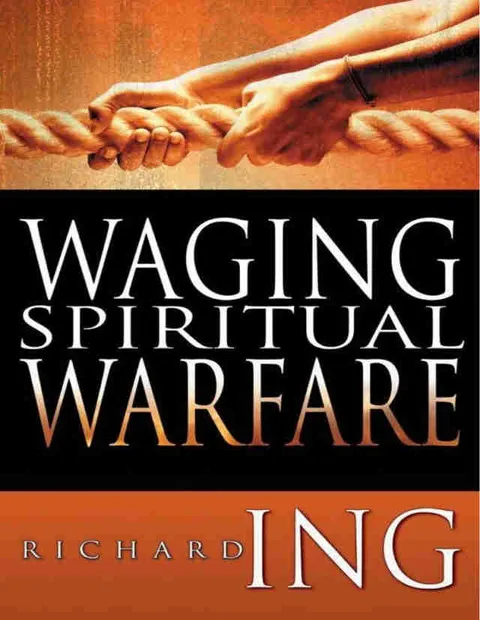
"Waging Spiritual Warfare" by Richard Ing is a guide to understanding and confronting spiritual battles. It explores the importance of spiritual warfare in the Christian faith, provides practical strategies for recognizing and overcoming spiritual attacks, and offers biblical wisdom for strengthening one's spiritual defenses. Overall, the book aims to empower readers to stand firm in their faith and actively engage in spiritual warfare.
John Newton
The Very First Prayer
From the opening chapters of the Bible, God makes it clear that humanity was created to enjoy life with God, and God in life — to experience the radiance of his presence and listen to him speak “close up.” Adam and Eve walked with God in the garden, which God himself has provided for this very purpose. And they are charged to turn the whole of creation into a place where God can be known and enjoyed (see Genesis 1:28 and 2:15–16). Relating to God, for them, was natural and unhindered. After the events of Genesis 3, of course, everything gets so much harder. “From the opening chapters of the Bible, God makes it clear that humanity was created to enjoy life with God.” God’s grand plan for his people and his world remains the same, but suddenly the way to God is littered with obstacles, as the ease of relating to God is replaced with struggle. In fact, it’s not altogether clear how our first parents are supposed to relate to God as they leave the now inaccessible garden behind (Genesis 3:24). The task they were commissioned to do in Genesis 1:28 remains, but it now will be tackled against the grain of a broken creation and without the immediate presence of the Creator. Which brings us to Genesis 4. First Recorded Prayer After the exclusion of the original couple from Eden, the narrative immediately jumps to the birth of Cain and then Abel. The intriguing note of Genesis 3:15 has set us up to expect an individual who is able to undo the recently created chaos of sin. Both brothers are pictured bringing offerings to God (the awareness of our obligation to the one who made us remains intact), but the violent events which follow do little beyond showing that the hope of humanity must be found elsewhere — and yet, remarkably, God has continued to speak to his people. Cain’s evil quickly spirals further out of control, as he settles down in a city (Genesis 4:17), rather than continuing to “fill the earth and subdue it,” and then fathers a dynasty of self-reliant men, culminating in the brutality of Lamech, who boasts to his wives that if anyone messes with him, he will exact disproportionate revenge (Genesis 4:24). At this point in the tragic narrative, we find these words: And Adam knew his wife again, and she bore a son and called his name Seth, for she said, “God has appointed for me another offspring instead of Abel, for Cain killed him.” To Seth also a son was born, and he called his name Enosh. At that time people began to call upon the name of the Lord. (Genesis 4:25–26) Initially, Genesis 4:25 raises our hopes. Cain and Abel are not to be the sole heirs of Adam — there is another son, Seth. Eve’s own words, highlighting that he is another “offspring” (same word in Genesis 3:15), lead us to expect more detail, and hopefully a bright counterpoint to the darkness of Cain and his line. However, we get no details whatsoever about Seth. He is born, and then his sole contribution to the unfolding plan of God is to sire a son, Enosh. Like his father, Enosh makes no contribution to the narrative beyond providing a descendant. All this makes it doubly puzzling when the birth of Enosh leads people to begin calling on the name of the Lord, apparently for the first time. Why Pray Now? The phrase “at that time” in the first five books of the Bible tends to introduce significant incidents (for example, Genesis 12:6; 38:1; Deuteronomy 1:9). In this case, the striking nature of the action (calling on the name of the Lord) is a further signal that something important is going on. But it is puzzling — what could possibly have occasioned this “new start” in humanity’s relationship with God? Seth is born, but does nothing else. Now Enosh is born, and similarly, there appears to be nothing remarkable about his birth. So what are we to make of this? What prompted them to seek God in this way now? It’s theoretically possible that this is simply a chronological note. Given the fact, however, that not one word is wasted in the opening chapters of the Bible, and every phrase seems loaded with significance for the unfolding narrative, this seems highly unlikely. Rather, it seems that starting to “call on the name of the Lord” is the right response to the fact that Cain and Abel, Seth and Enosh have all shown up, but there is, as yet, no sign of the promised Serpent-Crusher of Genesis 3:15. The waiting — and the appealing to God to act — has begun. We Ask for What He Promised This is the first address to God after the fall — and it is a cry to God to act by fulfilling his promises. In the Institutes, John Calvin says, “Just as faith is born from the gospel, so through it our hearts are trained to call upon God’s name” (III XX.21). I think that’s what’s going on here in Genesis 4. The announcement of Genesis 3:15 has brought gospel hope to life, which in turn leads God’s people to ask God to act. The gospel gives birth to gospel-shaped prayer. “Prayer is a means of communion with God, but far more often it is simply asking God to do what he has promised to do.” As we look at prayers throughout the Bible, it becomes increasingly apparent that they are dominated by this single concern: to see God act to fulfill his promises as he advances his plan of redemption in our world. That’s not to say, of course, that our relationship with God can be reduced to this one thing. There are lots of activities that we are invited or commanded to engage in as part of our relationship with God (like praise, or repentance, or intercession, or lament, or thanks). When it comes to prayer, however, the Bible seems to have a much narrower focus than we would normally allow. Prayer is a means of communion with God, but far more often it is simply asking God to do what he has promised to do. Until Prayer Is Unnecessary This simple observation, which flows naturally from Genesis 4:25–26, does cut through much of the guilt and confusion we often feel about prayer. Prayer begins with asking God to do his gospel work. This is presumably why Jesus can encourage us to pray unhypocritical, to-the-point kingdom prayers (Matthew 5:5–14). Prayer isn’t primarily communing with God, let alone twisting his arm, but asking God to do what he is already committed to doing (see Luke 11:5–13). It is easy to miss the significance of Genesis 4:25–26, but that doesn’t mean that it isn’t a beautifully gospel-shaped clue to how people like you and me are to relate to the God who loves us this side of the fall. We are to pray — asking God to do what he has promised — until that day when prayer is no longer needed, because all things have already been made new and all his promises have been brought to perfect fruition. But until then? We keep praying like people of the day of Seth and Enosh, asking God to act for our good and his glory. Article by Gary Millar

-480.webp)