





GIP Library icon

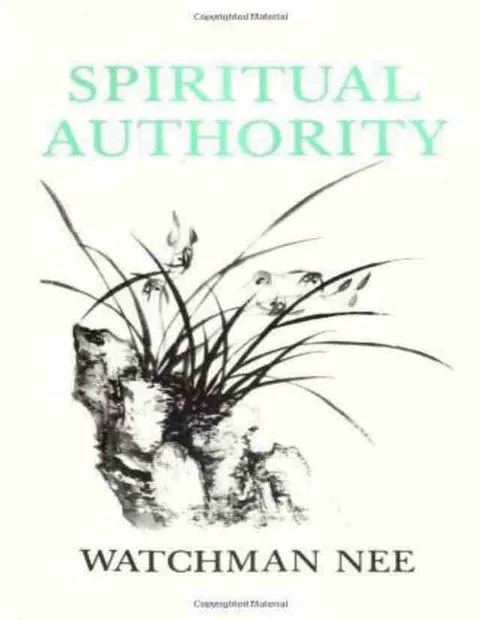
Spiritual Authority Spiritual Authority

Spiritual Authority Order Printed Copy

  • Author: Watchman Nee
  • Size: 714KB | 198 pages
  • |
Continue with
Google Twitter
LOG IN TO REVIEW
About the Book


"Spiritual Authority" by Watchman Nee explores the principles of spiritual authority and the importance of submitting to God-given authority in the church. Nee emphasizes the need for leaders to exercise authority in love and humility, while followers are encouraged to respectfully submit to spiritual authority. The book offers practical guidance on how to properly exercise spiritual authority and the consequences of rebelling against it. Ultimately, Nee argues that true spiritual authority comes from God and is rooted in servanthood and sacrifice.

John Bunyan

John Bunyan "I saw a man clothed with rags … a book in his hand and a great burden upon his back." Successful English writers were, in John Bunyan's day, nearly synonymous with wealth. Men like Richard Baxter and John Milton could afford to write because they didn't need to earn a living. But Bunyan, a traveling tinker like his father, was nearly penniless before becoming England's most famous author. His wife was also destitute, bringing only two Puritan books as a dowry. "We came together as poor as poor might be," Bunyan wrote, "not having so much household-stuff as a dish or spoon betwixt us both." What allowed Bunyan to become the bestselling author of one of the most beloved books in the English language was when things actually got worse: an imprisonment of 12 years. Early temptations >Born in Elstow, Bedfordshire, Bunyan married at age 21. Those books his wife brought to the marriage began a process of conversion. Gradually, he gave up recreations like dancing, bell ringing, and sports; he began attending church and fought off temptations. "One morning as I did lie in bed," he wrote in his autobiography, "I was, as at other times, most fiercely assaulted with this temptation, to sell and part with Christ; the wicked suggestion still running in my mind, Sell him, sell him, sell him, sell him, sell him, as fast as a man could speak." Bunyan was drawn to the Christian fellowship he saw among "three or four poor women sitting at a door ... talking abut the things of God." He was also befriended by John Gifford, minister at a Separatist church in Bedford. The tinker joined the church and within four years was drawing crowds "from all parts" as a lay minister. "I went myself in chains to preach to them in chains," he said, "and carried that fire in my own conscience that I persuaded them to beware of." Prison: a mixed blessing >Bunyan's rise as a popular preacher coincided with the Restoration of Charles II. The freedom of worship Separatists had enjoyed for 20 years was quickly ended; those not conforming with the Church of England would be arrested. By January 1661, Bunyan sat imprisoned in the county jail. The worst punishment, for Bunyan, was being separated from his second wife (his first had died in 1658) and four children. "The parting ... hath oft been to me in this place as the pulling the flesh from my bones," he wrote. He tried to support his family making "many hundred gross of long tagg'd [shoe] laces" while imprisoned, but he mainly depended on "the charity of good people" for their well-being. Bunyan could have freed himself by promising not to preach but refused. He told local magistrates he would rather remain in prison until moss grew on his eyelids than fail to do what God commanded. Still, the imprisonment wasn't as bad as some have imagined. He was permitted visitors, spent some nights at home, and even traveled once to London. The jailer allowed him occasionally to preach to "unlawful assemblies" gathered in secret. More importantly, the imprisonment gave him the incentive and opportunity to write. He penned at least nine books between 1660 and 1672 (he wrote three others—two against Quakers and the other an expository work—before his arrest). Profitable Mediations, Christian Behavior (a manual on good relationships), and The Holy City (an interpretation of Revelation) were followed by Grace Abounding to the Chief of Sinners, considered the greatest Puritan autobiography. But from 1667 to 1672, Bunyan probably spent most of his time on his greatest legacy, The Pilgrim's Progress. Pilgrim's success >Charles II eventually relented in 1672, issuing the Declaration of Indulgence. Bunyan was freed, licensed as a Congregational minister, and called to be pastor of the Bedford church. When persecution was renewed, Bunyan was again imprisoned for six months. After his second release, Pilgrim's Progress was published. "I saw a man clothed with rags ... a book in his hand and a great burden upon his back." So begins the allegorical tale that describes Bunyan's own conversion process. Pilgrim, like Bunyan, is a tinker. He wanders from the City of Destruction to the Celestial City, a pilgrimage made difficult by the burden of sin (an anvil on his back), the Slough of Despond, Vanity Fair, and other such allegorical waystations. The book was instantly popular with every social class. His first editor, Charles Doe, noted that 100,000 copies were already in print by 1692. Samuel Taylor Coleridge called it, "the best Summa Theologicae Evangelicae ever produced by a writer not miraculously inspired." Every English household that owned a Bible also owned the famous allegory. Eventually, it became the bestselling book (apart from the Bible) in publishing history. The book brought Bunyan great fame, and though he continued to pastor the Bedford church, he also regularly preached in London. He continued to write. The Life and Death of Mr. Badman (1680) has been called the first English novel (since it is less of an allegory than Pilgrim's Progress), and was followed by another allegory, The Holy War. He also published several doctrinal and controversial works, a book of verse, and a children's book. By age 59 Bunyan was one of England's most famous writers. He carried out his pastoring duties and was nicknamed "Bishop Bunyan." In August 1688, he rode through heavy rain to reconcile a father and son, became ill, and died.

There Is a Name

In a world of tolerance and pluralism, few truth claims taste as sour as this one: Jesus is the only way to God. Or as the apostle Peter so boldly says, There is salvation in no one else, for there is no other name given under heaven by which we must be saved. (Acts 4:12) Just one name for eight billion people? Just one Savior for almost seven thousand people groups? Just one heavenward path for men and women, young and old, urban and rural, Asian and American and African and European? Peter, apparently, felt unashamed of the claim. “Let it be known to all of you,” he began (Acts 4:10). But what Peter proclaimed, many of us whisper, especially among those who take offense. “No other name” may sound fine in small group, but our voices can crack at a neighbor’s kitchen table. Embarrassment, not boldness, might mark even the lovers of Jesus’s name. “Into this world of curse and sin, where half our house hangs over the cliff edge of judgment, God has given a name.” Perhaps, then, we need help feeling the wonder that there is any name at all. Into this world of curse and sin, where half our house hangs over the cliff edge of judgment, God has given a name. World with No Name By all just reckonings, we ought to live in a world with no name. We ought to walk east of Eden, with no promise of a coming son. We ought to toil under Pharaoh, with no outstretched arm to rescue. We ought to tremble before Goliath, with no David to sling his stones. We ought to hang our harps in Babylon, with no hope of a future song. On our own, of course, we struggle to consent to such dismal oughts. We feel, even if we do not speak, not that we ought to perish, but that God ought to save. We sense that heaven, not hell, is humanity’s default destination. We talk of a hundred paths up the mountain because we assume, deep down, that most (if not all) deserve to reach the top. Yet we feel, sense, and assume like this only when we feel, sense, and assume that our sin is smaller than God says. To those with slight views of sin, little could be more offensive than there being only one name. But for those who, like Job (Job 42:6), or Isaiah (Isaiah 6:5), or Peter (Luke 5:8), or John (Revelation 1:17), have found themselves thrust into the presence of the Holy One, little could be more wonderfully surprising. Why should God send a sunrise to pierce our chosen darkness? Why should the Father rise and race to meet his wayward son? Why should Christ become our Hosea to redeem us from the brothel? Why should heaven’s blood be shed to win back heaven’s haters? Why should Jesus give his name to rescue crucifiers? Only because the reckonings of heaven reach beyond mere justice. There Is a Name Now, hear again the words that so often offend or embarrass: There is salvation in no one else, for there is no other name under heaven given among men by which we must be saved. (Acts 4:12) The exclusivity of Jesus Christ does indeed sit at the center of Peter’s words, like a stone of stumbling or a rock of offense (Acts 4:11; Romans 9:33). Yet strewn around that stone are jewels so beautiful that Peter’s claim, so far from offending or embarrassing, ought to break the hearts of sinners and unloose the tongues of saints. NAME GIVEN There is . . . [a] name . . . given. When the Son of God was born in Bethlehem, he was born into a world without a saving name. No name among Greece’s wise philosophers could save. No name in Rome’s expansive pantheon could save. Israel, of course, had long taken refuge in the name of Yahweh (Exodus 34:6–7). Yet even Yahweh waited for the day when he would give his name in a new way — and through it, a salvation far beyond the Jews’ imagination (Jeremiah 23:5–6; Joel 2:32). Then on that lonely night, the God of heaven gave a name to lost and dying sinners. Unto us was born that day in the city of David a Savior, named Jesus Christ the Lord (Luke 2:11). Take heart, exiles of Eden. Have courage, slaves of Pharaoh. Lift up your heads, soldiers of Israel. Play your harps, prisoners of Babylon. Your God has come, and he has given you a name. UNDER HEAVEN There is . . . [a] name under heaven given among men. God could have given this name to the Caesars and Herods of the world. He could have handed it to the wise and powerful. Or most likely of all, he could have entrusted it to the Jews alone. Instead, he gave a name under (all) heaven, among (all) men. “Jesus’s name will meet the eastern sunrise. Jesus’s name will watch the western sunset.” Wherever men and women live under heaven, however far the image of God has wandered, there this name must go. It must run beyond Jerusalem; it must reach past Judea; it must fly outside Samaria to find the ends of the earth (Acts 1:8). As the psalmist sings, “From the rising of the sun to its setting, the name of the Lord is to be praised!” (Psalm 113:3). So it is and will be in Jesus. His name will meet the eastern sunrise. His name will watch the western sunset. And everywhere in between, all people “will be blessed in him, all nations call him blessed” (Psalm 72:17). FOR SALVATION There is . . . [a] name under heaven given among men by which we must be saved. God has given a name. This name is for everyone under heaven. And here is God’s purpose, God’s desire, in giving that universal name: my people must be saved (Acts 2:21). God saw fit to wrap salvation in the syllables of this name. “You shall call his name Jesus,” the angel told Mary, “for he will save his people from their sins” (Matthew 1:21). “God sees,” “God sympathizes,” “God strengthens” — any of these names would have been wonderful. But Jesus, “God saves” — or more literally, “Yahweh saves”? No wonder Mary marveled (Luke 1:46–55). God did not send this name into the world to condemn the world, but in order that the world might be saved through it (John 3:17). What a Glorious Name So then, in Jesus, we hear the only name that saves. We can, if we want, nurture offense or embarrassment about God’s giving only one name. Or we can thank God for that name, treasure that name, and join God himself in spreading that name wherever it is not sung. If we do, we join a mission that cannot fail. Hear God Almighty take up the longing of Psalm 113:3 and turn it into a prophetic promise, sealed twice over: From the rising of the sun to its setting my name will be great among the nations, and in every place incense will be offered to my name, and a pure offering. For my name will be great among the nations, says the Lord of hosts. (Malachi 1:11) His name will be great: in Zambia and New Zealand, in India and Iceland, in China and Colombia, and in the darkened streets of our own cities. And to that end, God has made us stewards of his sacred name. In Christ, we can shine the light that splits the darkness (Luke 1:78–79), lower the hand that lifts the fallen (Psalm 40:2), raise the snake that heals the bitten (John 3:14–15), and say the name that saves the sinner. There is no other name given among men by which we must be saved. And oh what a glorious name it is. Article by Scott Hubbard

Feedback
Suggestionsuggestion box
x