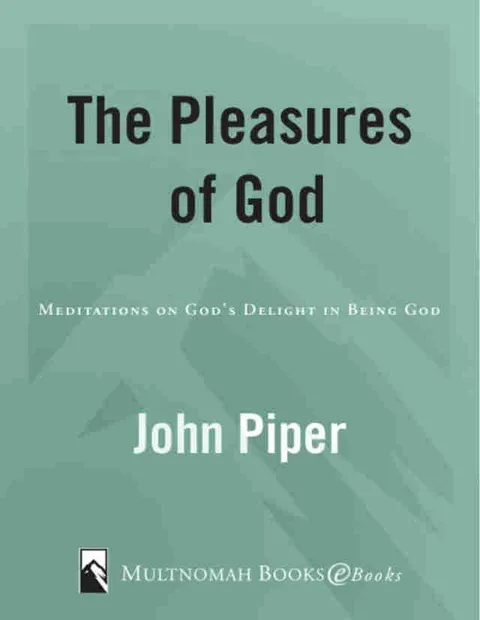

The Pleasures Of God: Meditations On God’s Delight Order Printed Copy
- Author: John Piper
- Size: 1.81MB | 356 pages
- |
Others like the pleasures of god: meditations on god’s delight Features >>

The Passion Translation
The Missing Link Of Meditation
The Desires Of Ages
The Pursuit Of God

The Power Of God's Names
-160.webp)
The Pursuit Of His Presence

The Shelter Of The Most High
The Seven Words Of Our Lord On The Cross
7 Days Behind The Veil: Throne Room Meditations
Knowing The Heart Of God - A Year Of Daily Readings
About the Book
"The Pleasures of God: Meditations on God’s Delight" by John Piper explores the deep and mysterious joy that God takes in Himself and in His creation. Piper delves into the theological concept of God’s pleasure, demonstrating how His delight in His own glory is the foundation of all true human joy and fulfillment. Through scripture, philosophy, and personal reflection, Piper invites readers to delve deeper into the divine pleasures of God and find ultimate satisfaction in Him.
John and Betty Stam
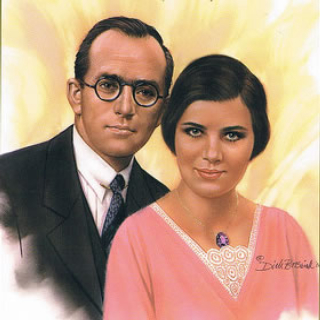 The year 1934. Americans John and Betty Stam were serving as missionaries in China. One morning Betty was bathing her three-month-old daughter Helen Priscilla Stam when Tsingteh's city magistrate appeared. Communist forces were near, he warned, and urged the Stams to flee.
So John Stam went out to investigate the situation for himself. He received conflicting reports. Taking no chances, he arranged for Betty and the baby to be escorted away to safety if need be. But before the Stams could make their break, the Communists were inside the city. By little-known paths, they had streamed over the mountains behind government troops. Now gun shots sounded in the streets as looting began. The enemy beat on the Stams' own gate.
A faithful cook and maid at the mission station had stayed behind. The Stams knelt with them in prayer. But the invaders were pounding at the door. John opened it and spoke courteously to the four leaders who entered, asking them if they were hungry. Betty brought them tea and cakes. The courtesy meant nothing. They demanded all the money the Stams had, and John handed it over. As the men bound him, he pleaded for the safety of his wife and child. The Communists left Betty and Helen behind as they led John off to their headquarters.
Before long, they reappeared, demanding mother and child. The maid and cook pleaded to be allowed to accompany Betty.
"No," barked the captors, and threatened to shoot.
"It is better for you to stay here," Betty whispered. "If anything happens to us, look after the baby."
[When we consecrate ourselves to God, we think we are making a great sacrifice, and doing lots for Him, when really we are only letting go some little, bitsie trinkets we have been grabbing, and when our hands are empty, He fills them full of His treasures. --Betty Stam]
Betty was led to her husband's side. Little Helen needed some things and John was allowed to return home under guard to fetch them. But everything had been stolen. That night John was allowed to write a letter to mission authorities. "My wife, baby and myself are today in the hands of the Communists in the city of Tsingteh. Their demand is twenty thousand dollars for our release. . . . We were too late. The Lord bless and guide you. As for us, may God be glorified, whether by life or by death."
Prisoners in the local jail were released to make room for the Stams. Frightened by rifle fire, the baby cried out. One of the Reds said, "Let's kill the baby. It is in our way." A bystander asked, "Why kill her? What harm has she done?"
"Are you a Christian?" shouted one of the guards.
The man said he was not; he was one of the prisoners just released.
"Will you die for this foreign baby?" they asked. As Betty hugged Helen to her chest, the man was hacked to pieces before her eyes.
Terror in the Streets
The next morning their captors led the Stams toward Miaosheo, twelve miles distant. John carried little Helen, but Betty, who was not physically strong, owing to a youthful bout with inflammatory rheumatitis was allowed to ride a horse part of the way. Terror reigned in the streets of Miaosheo. Under guard, the foreign family was hustled into the postmaster's shop.
"Where are you going?" asked the postmaster, who recognized them from their previous visits to his town. "We do not know where they are going, but we are going to heaven," answered John. He left a letter with the postmaster. "I tried to persuade them to let my wife and baby go back from Tsingteh with a letter to you, but they would not let her. . . ."
That night the three were held in the house of a wealthy man who had fled. They were guarded by soldiers. John was tied to a post all that cold night, but Betty was allowed enough freedom to tend the baby. As it turned out, she did more than that.
Execution
The next morning the young couple were led through town without the baby. Their hands were tightly bound, and they were stripped of their outer garments as if they were common criminals. John walked barefoot. He had given his socks to Betty. The soldiers jeered and called the town’s folk to come see the execution. The terrified people obeyed.
On the way to the execution, a medicine-seller, considered a lukewarm Christian at best, stepped from the crowd and pleaded for the lives of the two foreigners. The Reds angrily ordered him back. The man would not be stilled. His house was searched, a Bible and hymnbook found, and he, too was dragged away to die as a hated Christian.
John pleaded for the man’s life. The Red leader sharply ordered him to kneel. As John was speaking softly, the Red leader swung his sword through the missionary’s throat so that his head was severed from his body. Betty did not scream. She quivered and fell bound beside her husband’s body. As she knelt there, the same sword ended her life with a single blow.
Betty
Betty Scott was born in the United States but reared in China as the daughter of missionaries. She came to the United States and attended Wilson College in Pennsylvania. Betty prepared to follow in her parents’ footsteps and work in China or wherever else the Lord directed her.
But China it proved to be. At a prayer meeting for China, she met John Stam and a friendship developed that ripened into love. Painfully they recognized that marriage was not yet possible. “The China Inland Mission has appealed for men, single men, to work in sections where it would be impossible to take a woman until more settled work has commenced,” wrote John. He committed the matter to the Lord, whose work, he felt, must come before any human affection. At any rate, Betty would be leaving for China before him, to work in an entirely different region, and so they must be separated anyhow. As a matter of fact, John had not yet even been accepted by the China Inland Mission whereas Betty had. They parted after a long tender day, sharing their faith, picnicking, talking, and praying.
Betty sailed while John continued his studies. On July 1, 1932, John, too, was accepted for service in China. Now at least he could head toward the same continent as Betty. He sailed for Shanghai.
Meanwhile, Betty found her plans thwarted. A senior missionary had been captured by the Communists in the region where she was to have worked. The mission directors decided to keep her in a temporary station, and later ill-health brought her to Shanghai. Thus without any choice on her part, she was in Shanghai when John landed in China. Immediately they became engaged and a year later were married, long before they expected it. In October, 1934 Helen Priscilla was born to them. What would become of her now that her parents John and Betty were dead?
In the Hills
For two days, local Christians huddled in hiding in the hills around Miaosheo. Among them was a Chinese evangelist named Mr. Lo. Through informants, he learned that the Communists had captured two foreigners. At first he did not realize that these were John and Betty Stam, with whom he had worked, but as he received more details, he put two and two together. As soon as government troops entered the valley and it was safe to venture forth, Mr. Lo hurried to town. His questions met with silence. Everyone was fearful that spies might report anyone who said too much.
An old woman whispered to Pastor Lo that there was a baby left behind. She nodded in the direction of the house where John and Betty had been chained their last night on earth. Pastor Lo hurried to the site and found room after room trashed by the bandits. Then he heard a muffled cry. Tucked by her mother in a little sleeping bag, Helen was warm and alive, although hungry after her two day fast.
The kindly pastor took the child in his arms and carried her to his wife. With the help of a local Christian family, he wrapped the bodies that still lay upon the hillside and placed them into coffins. To the crowd that gathered he explained that the missionaries had only come to tell them how they might find forgiveness of sin in Christ. Leaving others to bury the dead, he hurried home. Somehow Helen had to be gotten to safety.
Pastor Lo's own son, a boy of four, was desperately ill -- semi-conscious after days of exposure. Pastor Lo had to find a way to carry the children a hundred miles through mountains infested by bandits and Communists. Brave men were found willing to help bear the children to safety, but there was no money to pay them for their efforts. Lo had been robbed of everything he had.
From Beyond the Grave
But from beyond the grave, Betty provided. Tucked in Helen's sleeping bag were a change of clothes and some diapers. Pinned between these articles of clothing were two five dollar bills. It made the difference.
Placing the children in rice baskets slung from the two ends of a bamboo pole, the group departed quietly, taking turns carrying the precious cargo over their shoulders. Mrs. Lo was able to find Chinese mothers along the way to nurse Helen. On foot, they came safely through their perils. Lo's own boy recovered consciousness suddenly and sat up, singing a hymn.
Eight days after the Stams fell into Communist hands, another missionary in a nearby city heard a rap at his door. He opened it and a Chinese woman, stained with travel, entered the house, bearing a bundle in her arms. "This is all we have left," she said brokenly.
The missionary took the bundle and turned back the blanket to uncover the sleeping face of Helen Priscilla Stam. Many kind hands had labored to preserve the infant girl, but none kinder than Betty who had spared no effort for her baby even as she herself faced degradation and death.
Kathleen White has written an excellent and very readable biography John and Betty Stam, available from Bethany House Publishers (1988). She reports that Betty's alma mater, Wilson College in Pennsylvania, took over baby Helen's support and covered the costs of her college education. She added: "Helen is living in this country (USA) with her husband and family but does not wish her identity and whereabouts to be made known."
Resources:
Huizenga, Lee S. John and Betty Stam; Martyrs. Zondervan, 1935.
Pollock, John. Victims of the Long March and Other Stories. Waco, Texas.: Word Publishing, 1970.
Taylor, Mrs. Howard. The Triumph of John and Betty Stam. China Inland Mission, 1935.
The year 1934. Americans John and Betty Stam were serving as missionaries in China. One morning Betty was bathing her three-month-old daughter Helen Priscilla Stam when Tsingteh's city magistrate appeared. Communist forces were near, he warned, and urged the Stams to flee.
So John Stam went out to investigate the situation for himself. He received conflicting reports. Taking no chances, he arranged for Betty and the baby to be escorted away to safety if need be. But before the Stams could make their break, the Communists were inside the city. By little-known paths, they had streamed over the mountains behind government troops. Now gun shots sounded in the streets as looting began. The enemy beat on the Stams' own gate.
A faithful cook and maid at the mission station had stayed behind. The Stams knelt with them in prayer. But the invaders were pounding at the door. John opened it and spoke courteously to the four leaders who entered, asking them if they were hungry. Betty brought them tea and cakes. The courtesy meant nothing. They demanded all the money the Stams had, and John handed it over. As the men bound him, he pleaded for the safety of his wife and child. The Communists left Betty and Helen behind as they led John off to their headquarters.
Before long, they reappeared, demanding mother and child. The maid and cook pleaded to be allowed to accompany Betty.
"No," barked the captors, and threatened to shoot.
"It is better for you to stay here," Betty whispered. "If anything happens to us, look after the baby."
[When we consecrate ourselves to God, we think we are making a great sacrifice, and doing lots for Him, when really we are only letting go some little, bitsie trinkets we have been grabbing, and when our hands are empty, He fills them full of His treasures. --Betty Stam]
Betty was led to her husband's side. Little Helen needed some things and John was allowed to return home under guard to fetch them. But everything had been stolen. That night John was allowed to write a letter to mission authorities. "My wife, baby and myself are today in the hands of the Communists in the city of Tsingteh. Their demand is twenty thousand dollars for our release. . . . We were too late. The Lord bless and guide you. As for us, may God be glorified, whether by life or by death."
Prisoners in the local jail were released to make room for the Stams. Frightened by rifle fire, the baby cried out. One of the Reds said, "Let's kill the baby. It is in our way." A bystander asked, "Why kill her? What harm has she done?"
"Are you a Christian?" shouted one of the guards.
The man said he was not; he was one of the prisoners just released.
"Will you die for this foreign baby?" they asked. As Betty hugged Helen to her chest, the man was hacked to pieces before her eyes.
Terror in the Streets
The next morning their captors led the Stams toward Miaosheo, twelve miles distant. John carried little Helen, but Betty, who was not physically strong, owing to a youthful bout with inflammatory rheumatitis was allowed to ride a horse part of the way. Terror reigned in the streets of Miaosheo. Under guard, the foreign family was hustled into the postmaster's shop.
"Where are you going?" asked the postmaster, who recognized them from their previous visits to his town. "We do not know where they are going, but we are going to heaven," answered John. He left a letter with the postmaster. "I tried to persuade them to let my wife and baby go back from Tsingteh with a letter to you, but they would not let her. . . ."
That night the three were held in the house of a wealthy man who had fled. They were guarded by soldiers. John was tied to a post all that cold night, but Betty was allowed enough freedom to tend the baby. As it turned out, she did more than that.
Execution
The next morning the young couple were led through town without the baby. Their hands were tightly bound, and they were stripped of their outer garments as if they were common criminals. John walked barefoot. He had given his socks to Betty. The soldiers jeered and called the town’s folk to come see the execution. The terrified people obeyed.
On the way to the execution, a medicine-seller, considered a lukewarm Christian at best, stepped from the crowd and pleaded for the lives of the two foreigners. The Reds angrily ordered him back. The man would not be stilled. His house was searched, a Bible and hymnbook found, and he, too was dragged away to die as a hated Christian.
John pleaded for the man’s life. The Red leader sharply ordered him to kneel. As John was speaking softly, the Red leader swung his sword through the missionary’s throat so that his head was severed from his body. Betty did not scream. She quivered and fell bound beside her husband’s body. As she knelt there, the same sword ended her life with a single blow.
Betty
Betty Scott was born in the United States but reared in China as the daughter of missionaries. She came to the United States and attended Wilson College in Pennsylvania. Betty prepared to follow in her parents’ footsteps and work in China or wherever else the Lord directed her.
But China it proved to be. At a prayer meeting for China, she met John Stam and a friendship developed that ripened into love. Painfully they recognized that marriage was not yet possible. “The China Inland Mission has appealed for men, single men, to work in sections where it would be impossible to take a woman until more settled work has commenced,” wrote John. He committed the matter to the Lord, whose work, he felt, must come before any human affection. At any rate, Betty would be leaving for China before him, to work in an entirely different region, and so they must be separated anyhow. As a matter of fact, John had not yet even been accepted by the China Inland Mission whereas Betty had. They parted after a long tender day, sharing their faith, picnicking, talking, and praying.
Betty sailed while John continued his studies. On July 1, 1932, John, too, was accepted for service in China. Now at least he could head toward the same continent as Betty. He sailed for Shanghai.
Meanwhile, Betty found her plans thwarted. A senior missionary had been captured by the Communists in the region where she was to have worked. The mission directors decided to keep her in a temporary station, and later ill-health brought her to Shanghai. Thus without any choice on her part, she was in Shanghai when John landed in China. Immediately they became engaged and a year later were married, long before they expected it. In October, 1934 Helen Priscilla was born to them. What would become of her now that her parents John and Betty were dead?
In the Hills
For two days, local Christians huddled in hiding in the hills around Miaosheo. Among them was a Chinese evangelist named Mr. Lo. Through informants, he learned that the Communists had captured two foreigners. At first he did not realize that these were John and Betty Stam, with whom he had worked, but as he received more details, he put two and two together. As soon as government troops entered the valley and it was safe to venture forth, Mr. Lo hurried to town. His questions met with silence. Everyone was fearful that spies might report anyone who said too much.
An old woman whispered to Pastor Lo that there was a baby left behind. She nodded in the direction of the house where John and Betty had been chained their last night on earth. Pastor Lo hurried to the site and found room after room trashed by the bandits. Then he heard a muffled cry. Tucked by her mother in a little sleeping bag, Helen was warm and alive, although hungry after her two day fast.
The kindly pastor took the child in his arms and carried her to his wife. With the help of a local Christian family, he wrapped the bodies that still lay upon the hillside and placed them into coffins. To the crowd that gathered he explained that the missionaries had only come to tell them how they might find forgiveness of sin in Christ. Leaving others to bury the dead, he hurried home. Somehow Helen had to be gotten to safety.
Pastor Lo's own son, a boy of four, was desperately ill -- semi-conscious after days of exposure. Pastor Lo had to find a way to carry the children a hundred miles through mountains infested by bandits and Communists. Brave men were found willing to help bear the children to safety, but there was no money to pay them for their efforts. Lo had been robbed of everything he had.
From Beyond the Grave
But from beyond the grave, Betty provided. Tucked in Helen's sleeping bag were a change of clothes and some diapers. Pinned between these articles of clothing were two five dollar bills. It made the difference.
Placing the children in rice baskets slung from the two ends of a bamboo pole, the group departed quietly, taking turns carrying the precious cargo over their shoulders. Mrs. Lo was able to find Chinese mothers along the way to nurse Helen. On foot, they came safely through their perils. Lo's own boy recovered consciousness suddenly and sat up, singing a hymn.
Eight days after the Stams fell into Communist hands, another missionary in a nearby city heard a rap at his door. He opened it and a Chinese woman, stained with travel, entered the house, bearing a bundle in her arms. "This is all we have left," she said brokenly.
The missionary took the bundle and turned back the blanket to uncover the sleeping face of Helen Priscilla Stam. Many kind hands had labored to preserve the infant girl, but none kinder than Betty who had spared no effort for her baby even as she herself faced degradation and death.
Kathleen White has written an excellent and very readable biography John and Betty Stam, available from Bethany House Publishers (1988). She reports that Betty's alma mater, Wilson College in Pennsylvania, took over baby Helen's support and covered the costs of her college education. She added: "Helen is living in this country (USA) with her husband and family but does not wish her identity and whereabouts to be made known."
Resources:
Huizenga, Lee S. John and Betty Stam; Martyrs. Zondervan, 1935.
Pollock, John. Victims of the Long March and Other Stories. Waco, Texas.: Word Publishing, 1970.
Taylor, Mrs. Howard. The Triumph of John and Betty Stam. China Inland Mission, 1935.
if you could see the end - the story god writes in suffering
A strange grief crept upon me as the final Lord of the Rings movie came to an end. An unliterary man at the time, I watched the doors to Middle Earth close. The story would not continue. A sense of silliness accompanied the sadness. Why should a boy, let alone a young man, lament saying goodbye to an imaginary friend whom he knew all along to be imaginary? This is exactly what great stories do to us. Whether captured on screen or between covers of a book, to finally arrive at the end can seem as though palace doors were closing to us. The adventure concludes — with all its dangers, losses, courage, companionship, thrill, and great loves worth living and dying for. They leave us again, to our world. As credits roll, we are made to feel like we are leaving the momentous, the beautiful, the good, and returning to, well, the ordinary. But what if the ache one feels at the conclusion of these tales, the bitter loss in the happily ever after, is not unreality mocking, but Reality inviting? Keep Your Hobbitry What if epic stories cast a spell, not because they are fictional, but because they stir suppressed longings that we just might, in fact, live in such a Story? Perhaps we all hunger to be characters in a grand Story, a heroic tale, a high Romance, a story without end. “He has,” after all, “put eternity into man’s heart” (Ecclesiastes 3:11). The lines between our favorite stories and our own story in this life may be thinner than we have yet dreamed. J.R.R. Tolkien himself captures this in a letter to his son, Christopher, who was serving in the Air Force during World War II: Well, there you are: a hobbit amongst the Urukhai [a deadly enemy]. Keep your hobbitry in heart, and think that all stories feel like that when you are in them. You are inside a very great story! (183) Do you know yourself to be in a very great story? Do the elves and kings, the lovers and heroes, the characters of your favorite tales have a right to envy you? Until we smile at and embrace the story we find ourselves in, we will not have the hope, the joy, the strength to live to the fullest in this life — and then everlastingly in the next. Designed for Story We are a people of story — delighted by them, taught by them, shaped by them. We starve for meaning. We long for dots to connect. For a golden Thread to run through. Otherwise, we are left in bitter realms of nothingness. “We are a people of story — delighted by them, taught by them, shaped by them.” To reckon with life among us, we search for the Story beyond us. From the beginning, many claimed to do just that. Different prophets from different peoples brought down different explanations from tall mountains to interpret the joys and horrors, hills and valleys, sunrays and shadows of this life. Ancient myths rode to meet ancient desires not so easily filled in hearts hungering for forever. Shared stories made up culture. Shared stories made up religion. Men lived from story and died for story — stories designed to provide answers to life’s biggest questions. And hope needs answers that Story provides. The marketplace is full of stories, of worldviews trying to answer those great questions for us. Andrew Delbanco, in his meditation on hope, identifies that the general narrative that united Americans has shifted from a story about God, to that of nation, to that of self. We have moved from the cross, to the flag, and now landed on the narrow and perilous path of me . Of all people at all times, none has been more driven by story than followers of Christ. Even if an angel came down from heaven with a new story, we would refuse it with disdain (Galatians 1:8). And yet, while we often remain orthodox, despair still emerges when we focus solely on the real sadness in our single sentence called life, and our hearts forget the tale beyond. Hope, however, considers that sentence in the whole Story, a Story written by one who did not spare his own Son. Hope reaches past the groans, for that part of the Story with no more sin, no more suffering, no more separation. Joseph: A Case Study Hope stays attuned to God’s Story, because it withers with forgetting. Take as a test case of someone who didn’t sink in the swamp of self, an Old Testament man of God, Joseph. His life is full of many valleys. Betrayed, assaulted, and sold into slavery, Joseph found himself in Potiphar’s house. After being exalted to Potiphar’s right hand, Joseph is sexually harassed, falsely accused, and sent to prison. After correctly interpreting one of Pharaoh’s servant’s dreams, he is betrayed and forgotten. And then after two more long years in prison, he is exalted to become “a father to Pharaoh” (Genesis 45:8). His human story — full of abuse, betrayal, accusation, and lies — fell purposefully within God’s bigger story, and he knew it . When he reveals his identity to his brothers who sold him, he says to his brothers, “Come near to me, please.” And they came near. And he said, “I am your brother, Joseph, whom you sold into Egypt. And now do not be distressed or angry with yourselves because you sold me here, for God sent me before you to preserve life. For the famine has been in the land these two years, and there are yet five years in which there will be neither plowing nor harvest. And God sent me before you to preserve for you a remnant on earth, and to keep alive for you many survivors. So it was not you who sent me here, but God . He has made me a father to Pharaoh, and lord of all his house and ruler over all the land of Egypt.” (Genesis 45:4–8) He and his brothers knew his story. Twice he acknowledges what was obvious to them all: “ You sold me here.” Joseph had not forgotten the nights — the years — in prison away from friends and family, the horror of their closing ears to his pleading as they cast him in the pit, their cruelty to sell him to those who would mistreat and perhaps murder him. The darkness, though past, was still dark. Memories remained. But when he calls them near, he remembers more than just his story as seen from ground level — and this gives power to forgive and love his guilty brothers. He tells them not to be distressed or angry with themselves. Why? “ For God sent me before you to preserve life.” In their selling, God was sending. In their evil, God intended good. In the darkest scene of the play, God was still writing. That Story smothered bitterness and revenge. That Story and its Author allowed him to forgive, bless, and love where a different story would have had him calculate the wrongs, grip firmly the treachery, and use his power to exact revenge. And the Story gave him hope for the future promises of his God, recorded as the radiant triumph of his life in Hebrews 11: “By faith Joseph, at the end of his life, made mention of the exodus of the Israelites and gave directions concerning his bones” (Hebrews 11:22). He knew, as those of us who fall asleep in the Lord do as well, that we shall wake in the Promised Land. When Elves Envy Men Although it may not feel like it, we live in a very great story. Have we forgotten? “We, in America, have moved from the cross, to the flag, and now landed on the narrow and perilous path of me.” Our hearts grow accustomed to the extraordinary as it becomes familiar. We lose a sense of where we live when we can drive home without a map. Life no longer invigorates. God’s epic plays out all around us, and he draws us in to play our part, and yet we halfheartedly read our lines or escape into other people’s lives. We are bored. But awake, we live in a great Story. Wild and throbbing with adventure, trying and terrible at parts. Eternity hanging in the balance. A fierce Dragon threatens. Demons surround. Hell gapes. The Light still shines in the darkness. Angels assemble. The Spirit animates. Christians stand clad in armor. The church marches on hades. Judgment hastens. Salvation is ready to be revealed. The True King — whose sandals no other character is worthy to unlatch — has died for sinners and lives forevermore. He is coming. This tale plays out on earth in what we blaspheme and call “ordinary.” With all its details and drudgery, its paying bills and crying babies, its baseball games and rush-hour traffic, an eternal drama plays. One that draws heaven’s attention. Angels ache to leave the theater. You are on the inside of a very great Story — a story to be remembered, cherished, and clung to during the most difficult scenes. Is there any other tale you would rather find was true?