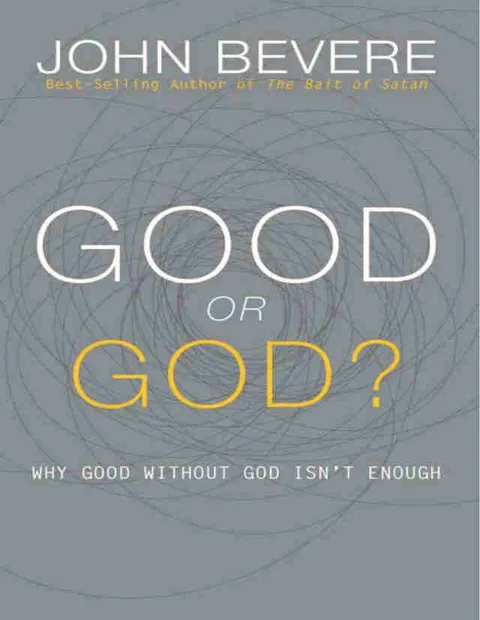

Good Or God: Why Good Without God Isn't Enough Order Printed Copy
- Author: John Bevere
- Size: 1.91MB | 234 pages
- |
Others like good or god: why good without god isn't enough Features >>
About the Book
"Good or God" by John Bevere explores the difference between living a good life based on human standards and pursuing a life aligned with God's will and purpose. The book challenges readers to examine their beliefs and actions to ensure they are truly seeking God's best for their lives. Bevere emphasizes the importance of living a life that is in alignment with God's plan in order to experience true fulfillment and purpose.
Hannah More
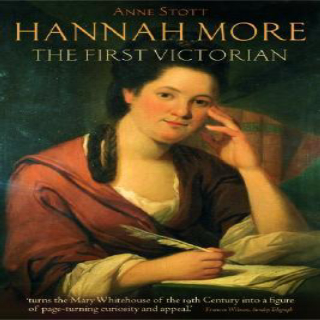 Beyond any doubt, Hannah More was the most influential female member of the Society for Effecting the Abolition of the African Slave Trade. She was educated at Bristol, an important slave-trading town, and began to publish her writing in the 1760s, while she was still a teenager. Her first play, The Inflexible Captive, was staged at Bath in 1775. Later in the 1770s, and for much of the 1780s, she spent time in London and made the acquaintance of many important political and society figures, including Samuel Johnson, Edmund Burke, and Elizabeth Montagu. Her play Percy was produced by David Garrick in 1777, and Fatal Falsehood was staged in 1779, but she came to regard the theatre as morally wrong, especially after the death of her mentors; Garrick and Johnson. She turned to religious writing, beginning with her Sacred Dramas in 1782. In 1784-5, she 'discovered' Ann Yearsley, the so-called 'poetical milkmaid of Bristol', whose poems More helped to publish, although the two later fell out.
In the 1780s, More widened her circle to include religious and philanthropic figures, including John Newton, Beilby Porteus and William Wilberforce. In the summer of 1786, she spent time with Sir Charles and Lady Margaret Middleton at the their home in Teston in Kent. Among their guests were the local vicar James Ramsay and a young Thomas Clarkson, both of whom were central to the early abolition campaign. More and Clarkson met again in Bristol in 1787, while he was on his fact-finding mission to the city, but they did not become close. However, in the same year More met Wilberforce, and their friendship was to become a deep and lasting one. More contributed much to the running of the newly-founded Abolition Society including, in February 1788, her publication of Slavery, a Poem which has been recognised as one of the more important slavery poems of the abolition period. Her relationship with members of the society, especially Wilberforce, was close. For example, she spent the summer of 1789 holidaying with Wilberforce in the Peak District - planning for the abolition campaign, at that time at its height, formed a great deal of their conversation.
By the mid-1790s, More had become closely involved with the 'Clapham Sect' of evangelical Christians, many of whom were involved in the abolition campaign. The group centred on Henry Thornton's home in Clapham and included Wilberforce, James Stephen, and Zachary Macaulay, among others. Throughout the 1790s, she wrote a number of religious tracts, known as the Cheap Repository Tracts, that eventually led to the formation of the Religious Tracts Society. Several of the Tracts oppose slavery and the slave trade, in particular, the poem The Sorrows of Yamba; or, The Negro Woman's Lamentation, which appeared in November 1795 and which was co-authored with Eaglesfield Smith. However, the tracts have also been noted for their encouragement of social quietism in an age of revolution. She continued to oppose slavery throughout her life, but at the time of the Abolition Bill of 1807, her health did not permit her to take as active a role in the movement as she had done in the late 1780s, although she maintained a correspondence with Wilberforce and others. In her later life, she dedicated much time to religious writing. Nevertheless, her most popular work was a novel, Coelebs in Search of a Wife, which appeared in two volumes in 1809 (and which ran to nine editions in 1809 alone). In the 1820s she grew gradually less well, and decreased - but did not entirely halt - the amount of writing she produced. On her death in 1833, she left more than £30,000 to charities and religious societies (equivalent to about £2,000,000 or $3,000,000 in 2004).
© Brycchan Carey 2004
Beyond any doubt, Hannah More was the most influential female member of the Society for Effecting the Abolition of the African Slave Trade. She was educated at Bristol, an important slave-trading town, and began to publish her writing in the 1760s, while she was still a teenager. Her first play, The Inflexible Captive, was staged at Bath in 1775. Later in the 1770s, and for much of the 1780s, she spent time in London and made the acquaintance of many important political and society figures, including Samuel Johnson, Edmund Burke, and Elizabeth Montagu. Her play Percy was produced by David Garrick in 1777, and Fatal Falsehood was staged in 1779, but she came to regard the theatre as morally wrong, especially after the death of her mentors; Garrick and Johnson. She turned to religious writing, beginning with her Sacred Dramas in 1782. In 1784-5, she 'discovered' Ann Yearsley, the so-called 'poetical milkmaid of Bristol', whose poems More helped to publish, although the two later fell out.
In the 1780s, More widened her circle to include religious and philanthropic figures, including John Newton, Beilby Porteus and William Wilberforce. In the summer of 1786, she spent time with Sir Charles and Lady Margaret Middleton at the their home in Teston in Kent. Among their guests were the local vicar James Ramsay and a young Thomas Clarkson, both of whom were central to the early abolition campaign. More and Clarkson met again in Bristol in 1787, while he was on his fact-finding mission to the city, but they did not become close. However, in the same year More met Wilberforce, and their friendship was to become a deep and lasting one. More contributed much to the running of the newly-founded Abolition Society including, in February 1788, her publication of Slavery, a Poem which has been recognised as one of the more important slavery poems of the abolition period. Her relationship with members of the society, especially Wilberforce, was close. For example, she spent the summer of 1789 holidaying with Wilberforce in the Peak District - planning for the abolition campaign, at that time at its height, formed a great deal of their conversation.
By the mid-1790s, More had become closely involved with the 'Clapham Sect' of evangelical Christians, many of whom were involved in the abolition campaign. The group centred on Henry Thornton's home in Clapham and included Wilberforce, James Stephen, and Zachary Macaulay, among others. Throughout the 1790s, she wrote a number of religious tracts, known as the Cheap Repository Tracts, that eventually led to the formation of the Religious Tracts Society. Several of the Tracts oppose slavery and the slave trade, in particular, the poem The Sorrows of Yamba; or, The Negro Woman's Lamentation, which appeared in November 1795 and which was co-authored with Eaglesfield Smith. However, the tracts have also been noted for their encouragement of social quietism in an age of revolution. She continued to oppose slavery throughout her life, but at the time of the Abolition Bill of 1807, her health did not permit her to take as active a role in the movement as she had done in the late 1780s, although she maintained a correspondence with Wilberforce and others. In her later life, she dedicated much time to religious writing. Nevertheless, her most popular work was a novel, Coelebs in Search of a Wife, which appeared in two volumes in 1809 (and which ran to nine editions in 1809 alone). In the 1820s she grew gradually less well, and decreased - but did not entirely halt - the amount of writing she produced. On her death in 1833, she left more than £30,000 to charities and religious societies (equivalent to about £2,000,000 or $3,000,000 in 2004).
© Brycchan Carey 2004
enjoy your possessions before they possess you
Take an inventory of your life. What do you own right now? Whatever possessions you have are no accident, and not a product of mere happenstance. At the micro level, Jesus promises to care for even the minutest everyday details, like pocket money and food and clothes. As we see in Scripture, in these small possessions, God calls us to live with moral standards because we are susceptible to sinning our way into big problems (like unreasonable consumer debt). God calls us to be wise with money and to work and live economically fruitful lives, and to be careful with our possessions. At the macro level, all wealth distribution and re-distribution is the work of our sovereign God (Ecclesiastes 5:18–6:2). All of our possessions are his, and he gives (and takes away) as he sees fit. God makes the poor and he makes the rich (1 Samuel 2:7). So how does God decide to distribute wealth in the lives of his creatures? This plays out in many different ways. God may give you many possessions, but not give you the power to enjoy those gifts — a great tragedy (Ecclesiastes 6:1–2). God may give you accumulated wealth, and give you the power to enjoy those gifts — a great blessing (Ecclesiastes 5:19, Proverbs 10:22). God may give you possessions, but through future persecution, he may take all those possessions away from you in the end (Hebrews 10:34). God may call you to a life of unalleviated poverty (2 Corinthians 6:10; 8:9). God may give you a life of wealth (2 Chronicles 32:29). God may give you a life in the middle — neither poverty nor wealth (Proverbs 30:8). God may bless you with great wealth, then take it all away and reduce your portfolio to ash, and then restore you with doubled wealth (Job). God may make you wealthy and then call you to voluntary poverty in order to show the world that he is your greatest treasure (Matthew 19:21; Mark 10:21; Luke 18:22). None of these situations is normative, if God sovereignly dispenses possessions to us as he sees fit (which he does). When it comes to possessions, our experiences will vary greatly. But no matter how much (or how little) we possess, there are four things that will help us rightly enjoy the gifts God has given us. 1. Money is temporary. Money existed before us, and it will exist after us, too. The streams of commerce have been flowing for millennia, and one day we will be gone and the currents of economic stimulus will flow to the next generation. We exist in time with money and possessions, but everything of value we own will be passed on to others. Which means in a very real sense, money is temporary. It carries the face of a Caesar or a president to remind us its value is as temporary as world rulers and the rise and fall of nations. So give back to Caesar what is Caesar’s. In other words, the Christian is called to possess all things as though we don’t possess anything (1 Corinthians 7:30). Hold the money, use the money, save the money, steward the money. But also recognize the cash in our wallets is the Monopoly money of this present age. The cash itself has no eternal face value. We entered this life with empty hands, we leave it with empty hands, and to live in the middle with a lust for cash is like holding a sharp dagger backwards and gutting our own souls (1 Timothy 6:6–10). This is true of cars and houses, too. C.S. Lewis said the secret to genuinely delighting in one’s own house is through sacrifice, through a certain crucifixion of the self’s relationship to it. We sacrifice our house, we release our grip on it, and then it becomes an object of joy. When it comes to possessions, true delight is found on the other side of disinterest (Letters 2.788). The takeaway: We don’t boast in our possessions; we boast that God possesses us (Jeremiah 9:23–24). Here our stewardship comes into focus. Material blessing is our temporary stewardship, but delighting in God and his gifts is our true and eternal vocation. 2. Enjoy your possessions now. As we have seen, we don’t always know what God is doing in our lives when it comes to our material possessions. He has different plans for us all. But he intends all of his children to enjoy the gifts he has given us. If you have pants, a shirt, and a sandwich you can be content in life, and if you can be content with a little, you can enjoy God’s goodness to you in every one of the millions of simple gifts he gives to you every day (1 Timothy 6:8). In fact, few things in this life are better than to enjoy your life and the good gifts from God in a spirit of fear and obedience and faith toward God (Ecclesiastes 8:15; 9:7–10; 10:19; 12:13). If you are prone to grumble more than express gratitude, pray and ask that God would give you the power to enjoy his gifts rightly — a gift in itself. As the book of Ecclesiastes makes clear: One of the rarest and most precious gifts is the gift of enjoying our daily gifts. 3. Enjoy your possessions by sharing them. The man who cannot enjoy God’s good gifts every day is often the man who wrongly thinks he must own gifts before enjoying them. We don’t have to own something to find joy in it. Beautiful art is intended to be shared in museums and galleries, not to be locked in the secluded basement of a billionaire. The delight of exclusivity is a delusion — a false delight. Christians get this. The delight of sharing is what drove the early church to share everything they owned (Acts 2:45; 4:32; 1 John 3:17). They gave money. They cared for the poor. They helped the missionaries. A group of wealthy women funded gospel work (Luke 8:2–3). There is a special delight in our possessions when we don’t think of them as “mine” but make use of them to increase the delight of others. 4. Enjoy what you do not own. Finally — and perhaps the whole reason why I wrote this article in the first place — God calls us to enjoy what we can never possess. I cannot own many of the greatest gifts God has given me. I do not own my wife; I do not own my kids; I don’t own my time, or the oceans, or the rain, or the sunshine, or the majestic mountain ranges — certainly not in any sense in which I own my minivan (my name is on the title). The man who loves the ocean so much that he sells all that he has and buys a beachfront property with his own private sand and closes it off from others so that he can exclusively use it is the man whose joy will die by exclusivity. He cannot enjoy possessions because the possessions possess him. On the other hand, the man who buys beachfront property in order to freely share that property with his friends and family will find his joy doubled. By his seaside generosity, this man will bless many others in great ways. But perhaps the most blessed of all is the man who doesn’t need to own beachfront property at all. He has learned to enjoy every beach in the world for its sheer beauty. He is freed from the desire to enjoy only what he possesses. This seems to be the way Romans 1 pushes us to contemplate. To be truly human is to express a Godward gratitude in the delights of creation. And if that is true, then we discover that what it means to delight in this world is a category that explodes all the categories of what the world promises us in possession. Old Tom Bombadil The beautiful literary example of a man who delights in what he doesn’t possess is found in the character Tom Bombadil, tucked into the early storyline of Tolkien’s The Lord of the Rings. In the epic unfolding storyline, Tom Bombadil is a mysterious figure who is quick to laughter and who seems to live in a blessed state of joy. But his life also bears no impact on the central drama that is unfolding around him. (Thus, Tom Bombadil never appears in the movies.) Tom’s role in the overall story is subtle and easy to miss. Early in the journey, Frodo and company wander into his lands, into a respite of joy in stark contrast to the darkness they would soon face. “Who is Tom Bombadil?” a curious Frodo later asks Tom’s wife, Goldberry. “He is the Master of wood, water, and hill.” “Then all this strange land belongs to him?” “No, indeed!” No, indeed! The woods, the water, and the hills that fill Tom Bombadil with delight are not his to possess — they are his to tend and to enjoy. To be sure, Tom is not an allegory against owning property, nor is he an allegory for passivism. As Tolkien also makes clear, it will take warfare against Sauron to stop the encroaching evil in order to preserve the lifestyle that Tom and Goldberry enjoy. As if we need the confirmation, Tolkien makes it clear in his letters that Tom is an intentional enigma. Tom incarnates a contrast. Tom represents a soul that has been freed from the greed of possession in order to delight in created beauty. He has renounced control and therefore finds the means of power to be valueless, too. As a result, Tom Bombadil can hold Frodo’s great ring of power with no danger to himself or anyone else. The ring wields no power over Tom because Tom has no interest in possessing the power of the ring. When the lust for possession is broken, when gratitude takes its place, and when one can simply delight in the glories of creation, then some of evil’s darkest schemes in the human heart are broken. Tom Bombadil is a model of delighting in what we do not possess, and then of sharing what we do possess — like dinner fellowship around the yellow cream, honeycomb, white bread and butter at his table. May we shine like such glad-hearted, grateful enigmas in our own world.