




GIP Library icon

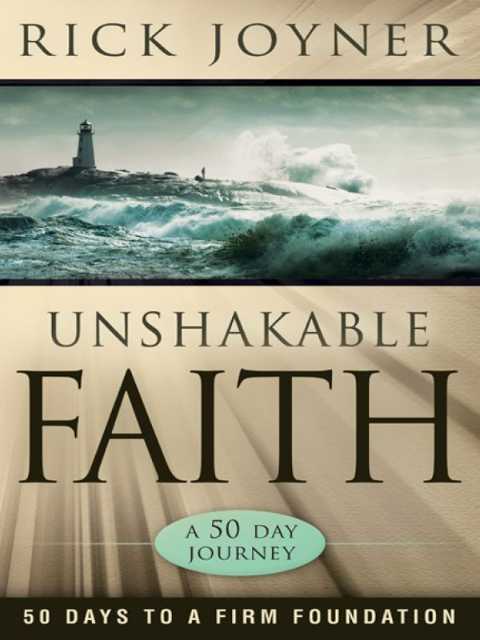
Unshakable Faith Unshakable Faith

Unshakable Faith Order Printed Copy

  • Author: Rick Joyner
  • Size: 261KB
  • |
Continue with
Google Twitter
LOG IN TO REVIEW
About the Book


"Unshakable Faith" by Rick Joyner is a practical guide to developing unwavering faith in God, even in the face of adversity and challenges. Joyner provides insightful teachings and personal stories to help readers strengthen their faith and trust in God's plans for their lives. The book emphasizes the importance of maintaining faith through difficult times and offers practical strategies for deepening one's relationship with God.

D.L. Moody

D.L. Moody Dwight Lyman Moody was born the sixth child of Edwin and Betsy Holton Moody in Northfield, Massachusetts on February 5, 1837. Dwight’s formal education ended after fifth grade, and he rapidly grew tired of life on the family farm. He left home at age 17 to seek employment in Boston. After failing to secure a desirable position, he asked his uncle, Samuel Holton, for a job. Reluctantly, Uncle Samuel hired Dwight to work in his own retail shoe store. However, to keep young Moody out of mischief, employment was conditional upon his attendance at the Mt. Vernon Congregational Church. SALVATION At Mt. Vernon Moody became part of the Sunday school class taught by Edward Kimball. On April 21, 1855, Kimball visited the Holton Shoe Store, found Moody in a stockroom, and there spoke to him of the love of Christ. Shortly thereafter, Moody accepted the love of God and devoted his life to serving Him. The following year brought Moody to Chicago with dreams of making his fortune in the shoe business. As he achieved success in selling shoes, Moody grew interested in providing a Sunday School class for Chicago's children and the local Young Men's Christian Association. YMCA During the revival of 1857 and 1858, Moody became more involved at the YMCA, performing janitorial jobs for the organization and serving wherever they needed him. In 1860 when he left the business world, he continued to increase his time spent serving the organization. In the YMCA’s 1861–1862 annual report, Moody was praised for all his efforts. Although they could not pay him, the YMCA recommended he stay "employed" as city missionary. MISSION SUNDAY SCHOOL Meanwhile, Moody's Mission Sunday School flourished, and it was different. Moody's desire was to reach the lost youth of the city: the children with little to no education, less than ideal family situations, and poor economic circumstances. Soon the Sunday School outgrew the converted saloon used as a meeting hall. As the classes grew, associates encouraged Moody to begin his own church. Eventually, on February 28, 1864, the Illinois Street Church (now The Moody Church) opened in its own building with Moody as pastor. CIVIL WAR As the political landscape of the United States changed in the 1860s, Moody's connection with the YMCA proved a useful tool in his ministry. With the Civil War approaching, the Union Army mobilized volunteer soldiers across the north. Camp Douglas was established outside of Chicago, which Moody saw as a great evangelistic opportunity. Along with a few others, Moody created the Committee on Devotional Meetings to minister to the troops stationed at Camp Douglas, the 72nd Illinois Volunteer Regiment. This was just the beginning of Moody's Civil War outreach. From 1861 to 1865, he ministered on battlefields and throughout the city, state and country to thousands of soldiers, both Union and Confederate. All the while, he maintained the Mission Sunday School. EMMA DRYER AND HER TRAINING SCHOOL FOR WOMEN While ministering in Chicago, Moody and his wife met a woman named Emma Dryer, a successful teacher and administrator. Moody was impressed with her zeal for ministry and her educational background. He knew that women had a unique ability to evangelize to mothers and children in a way that men never could, and saw Dryer as just the person to help him encourage this group. Moody asked Dryer to oversee a ministry specifically to train women for evangelistic outreach and missionary work. Under Dryer's leadership, the training program grew rapidly, and so did her desire for this ministry to reach men as well as women. She continued to pray that the Lord would place the idea for such a school on Moody's heart. THE CHICAGO FIRE On Sunday, October 8, 1871, as Moody came to the end of his sermon for the evening, the city fire bell began to ring. At first, no one thought much about it, as these city bells often rung. However, this night was different—it was the beginning of the Great Chicago Fire. Moody's first concern was for his family, locating them and making sure they were somewhere safe. After securing his family's safety, Moody and his wife stayed on the north side of the city to help other residents. The fire finally burned out Tuesday afternoon, after consuming much of what Moody had built. This was a poignant time in Moody's life and the fire forced him to reevaluate his ministry. It was during this time of evaluation he realized he needed to heed the Lord's call on his life. For years, he had been moving forward and then asking God to support his plans. He knew from this point on, his call was to preach the Word of God to the world. REVIVAL ABROAD In June 1872 Moody made his first trip to the United Kingdom. While he was there a few close contacts urged him to come back in a year. In June 1873, Moody and his family, and his good friend and musician Ira Sankey with his wife all traveled from New York to Liverpool, England. Moody and Sankey traveled throughout the UK and Ireland holding meetings, helping fuel the revival that was slowly sweeping the region. Moody's visit made a lasting impression, and inspired lay people across the region to begin children's ministries and ministry training schools for women. Moody was revolutionary in his evangelistic approach. Despite conflicting counsel from friends and trusted contacts, he and Sankey traveled to Ireland during a time when Catholics and Protestants were constantly at odds with each other. Moody was different: he did not care what denomination a person claimed, but just wanted the message of Christ to be heard. As a result, the revival swept into Ireland, and he won praises of both Catholics and Protestants. 1875 - 1878 After two years overseas, the Moody family finally returned to the United States. They settled in Northfield, where Moody was born and raised, and he began to plan his next round of evangelistic city campaigns. From October 1875 to May 1876, Moody and three other evangelists toured through the major cities of the Midwest and Atlantic coast, preaching the message of salvation. Moody would embark on yet another city campaign before the desire to train young Christian workers would grip him again. MOODY'S SCHOOLS Moody was on the cutting edge of ministry, and in 1879, Moody opened the Northfield Seminary for Young Women to provide young women the opportunity to gain an education. Not long after, Moody created the Mount Hermon School for Boys with the same goal as the girls' school: to educate the poor and minorities. Moody had an amazing ability to bridge the gap between denominations, which was apparent in the diverse religious backgrounds of the school's students. In 1886 Dryer's prayers were answered and the Chicago Evangelization Society (today, Moody Bible Institute) was founded. Moody had been focused on ministry near his home in Northfield but he came out to Chicago to help raise money for the Society, support Dryer, and see his dream become a reality. The Chicago Evangelization Society had been Moody's vision but really came to fruition because of Dryer's hard work. See History of Moody Bible Institute. That same year, Moody assembled a large group of college students at Mount Hermon for the first "College Students' Summer School." This conference would birth the Student Volunteer Movement for Foreign Missions. By 1911 it was estimated that 5,000 student volunteers from America alone had come out of the program. Moody's vision for the mission movement grew as it spread around the world to Europe and South Africa. LATER YEARS Moody continued to evangelize throughout America, often preaching in major cities and at various universities. His heart was for his schools, and he spent much of his time in Northfield. Moody was a visionary who always seemed a step ahead of the status quo. From training women, to reaching out to lost children, to bridging the gap between denominations, he was unlike any other. Moody was a man of great discernment. He had an innate ability to find capable, godly people to put into positions of leadership and bring his ideas to fruition. This enabled him to continue his evangelistic outreach while his ministries flourished. Throughout his life, Moody always found time to be with his family, making every effort to show his love and care for them. Moody died on December 22, 1899, surrounded by his family.

Parable of an Unhealthy Soul

How do works of obedience relate to the free, unmerited gift of God’s grace in the life of a Christian? This has been a recurring controversial and confusing issue since the earliest days of the church. If we are justified by God’s grace alone, through faith alone, in Christ’s sufficient substitutionary work alone, and not by any work of ours (Romans 3:8), then why are we warned and instructed to “strive . . . for the holiness without which no one will see the Lord” (Hebrews 12:14)? If our works don’t save us, then how can our not working (like not striving for holiness) prevent us from being saved? Before we turn to the apostle Peter for help, hear a parable of an unhealthy soul. Diligence Reveals Real Faith There was a man who was forty pounds overweight. Despite knowing it was dangerous to his health, for years he had indulged in too much of the wrong kinds of foods and neglected the right kinds of exercise. One day, his doctor told him he was in the early stages of developing type-2 diabetes. Not only that, but his vital signs also pointed to high risks of heart attack, stroke, and various cancers. If he didn’t make specific changes, his doctor warned, the man would surely die prematurely. So, the man heeded his doctor’s warnings. He made every effort to put new systems into place that encouraged healthy habits of eating and activity and discouraged his harmful old habits, preferences, and cravings. After twelve months, the man’s health was beginning to be transformed. He had lost most of his excess weight, felt better, had more energy, and no longer lived under the chronic, depressing cloud of knowing he was living in harmful self-indulgence. When his doctor next saw him, he was very pleased and said to the man, “Well done! You are no longer at heightened risk of premature death.” The man continued in his new ways and lived well into old age. Question: Was the man’s health restored through his faith in the gracious knowledge provided to him pertaining to life and healthiness, or was it restored through his diligent efforts to put this knowledge into practice? How Faith Works Do you see the problem with the question? It poses a false dichotomy. The man’s faith and his works were organically inseparable. If he didn’t have faith in what the doctor told him, he wouldn’t have heeded the doctor’s warning — there would have been no health-restoring works. If he didn’t obey the doctor’s instructions, whatever “faith” he may have claimed to have in his doctor would have been “dead faith” (James 2:26) — that faith would not have saved him from his health-destroying ways. This parable, imperfect as it is, is a picture of the biblical teaching on sanctification. In a nutshell, the New Testament teaches that the faith that justifies us is the same faith that sanctifies us. This faith is “the gift of God, not a result of works” (Ephesians 2:8–9). It’s just that this saving faith, by its nature, perseveres, and works to make us holy. We passively receive this gift of faith freely given to us by God. But faith, once received, does not leave a soul passive. It becomes the driving force behind our actions, the way we live. By its nature, faith believes the “precious and very great promises” of God (2 Peter 1:4), and the evidence that real faith is present in us manifests, over time, through the ways we act on those promises. The New Testament calls these actions “works of faith” (1 Thessalonians 1:3) or the “obedience of faith” (Romans 1:5). True works of faith don’t “nullify the grace of God” (Galatians 2:21); they are evidence that we have truly received the grace of God, and are themselves further expressions of grace. Now, let me show you one place where Scripture clearly teaches this. And as I do, imagine yourself as the unhealthy soul in my parable sitting in your doctor’s office — and your doctor is the apostle Peter. Dr. Peter has just examined your spiritual health and has some serious concerns. So, as a good physician, he gives you a firm exhortation. Escaping Through Promises [God’s] divine power has granted to us all things that pertain to life and godliness, through the knowledge of him who called us to his own glory and excellence, by which he has granted to us his precious and very great promises, so that through them you may become partakers of the divine nature, having escaped from the corruption that is in the world because of sinful desire. (2 Peter 1:3–4) Dr. Peter begins by telling you that God has granted to you all things. He agrees with his colleague, Dr. Paul, that God has granted you life, breath, and everything, including the day you were born, the places you’ll live, and how long (Acts 17:25–26). God has granted you regeneration (Ephesians 2:4–5), the measure of your faith (Romans 12:3), spiritual gifts (1 Corinthians 12:7–11), and capacity to work hard (1 Corinthians 15:10). And God has given you his “precious and very great promises so that through them” you may escape the power of sin and be transformed into his nature. Everything, from beginning to end, is God’s grace, since “a person cannot receive even one thing unless it is given him from heaven” (John 3:27). Make Every Effort For this very reason, make every effort to supplement your faith with virtue, and virtue with knowledge, and knowledge with self-control, and self-control with steadfastness, and steadfastness with godliness, and godliness with brotherly affection, and brotherly affection with love. (2 Peter 1:5–7) Notice Dr. Peter’s words: For this reason (because God has granted you everything), make every effort (act with faith in all God has promised you). In other words, prove the reality of your profession of faith, by doing whatever it takes to actively cultivate habits of grace, that nurture the character qualities necessary to live out the “obedience of faith” through doing tangible acts of good to bless others. What Negligence Reveals For if these qualities are yours and are increasing, they keep you from being ineffective or unfruitful in the knowledge of our Lord Jesus Christ. For whoever lacks these qualities is so nearsighted that he is blind, having forgotten that he was cleansed from his former sins. (2 Peter 1:8–9) “Diligence will reveal genuine faith because that is how faith works.” Dr. Peter’s prescription is clear and simple: if you cultivate these holy qualities, they will foster spiritual health and fruitfulness; if you don’t, you will experience spiritual decline and demise. Diligence will reveal genuine faith because that is how faith works: it leads to action. Negligence will reveal your lack of faith because “dead faith” doesn’t work. Now, this is a warning, not a condemnation. Peter knows well that all disciples have seasons of setbacks and failure. But he also knows, with Paul, that some disciples “profess to know God, but they deny him by their works” (Titus 1:16) — their profession of faith is not supported by the “obedience of faith.” Peter doesn’t want you to be one of those statistics, so he ends his firm exhortation to you on a hopeful note. Pursue Diligence by Faith Therefore, brothers, be all the more diligent to confirm your calling and election, for if you practice these qualities you will never fall. For in this way there will be richly provided for you an entrance into the eternal kingdom of our Lord and Savior Jesus Christ. (2 Peter 1:10–11) Just so you’re clear, Dr. Peter emphasizes the organic, inseparable relationship between God’s grace and your “works of faith.” He says, “Be diligent to confirm your calling and election.” You don’t call yourself to Christ; Christ calls you by his grace (John 15:16). You don’t elect yourself to salvation; God elects you by his grace (Ephesians 1:4–6). But you do have an essential contribution to make to your eternal spiritual health. You confirm the reality of God’s saving grace in your life through diligently obeying by faith all that Jesus commands you (Matthew 28:20) — or not. “You can confirm the reality of God’s saving grace in your life — or not.” This is Dr. Peter’s prescription for your assurance of salvation: your diligent obedience through faith, your making every effort to pursue holiness, is evidence that your faith is real and that the Holy Spirit is at work in you to make you a partaker in the divine nature. This is why Scripture commands us, “Strive for . . . the holiness without which no one will see the Lord” (Hebrews 12:14). It’s not that our striving, our “making every effort” to obey God, somehow merits us salvation. Rather, our striving is God’s gracious, ordained means — fed by his promises and supplied by his Spirit — to make us holy as he is holy (1 Peter 1:16) and to provide us “entrance into the eternal kingdom of our Lord and Savior Jesus Christ.” God’s grace is no less gracious because he chooses to grant it not only apart from our works (in justification) but also through our diligent “works of faith” (in sanctification) — especially since these works are evidence that our faith is real. Article by Jon Bloom

Feedback
Suggestionsuggestion box
x