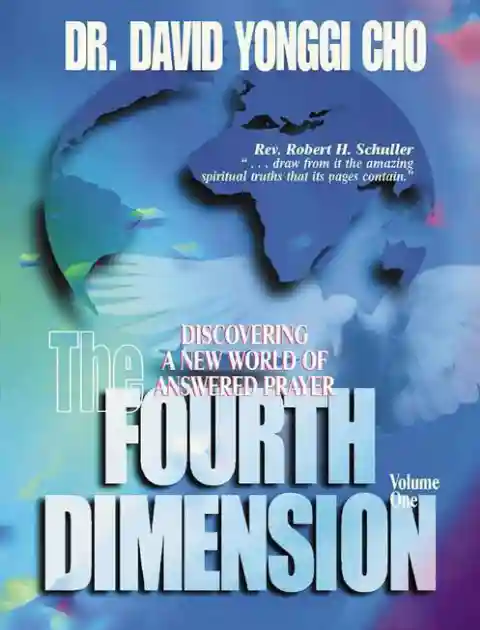

Others like the fourth dimension volume 1 Features >>

The Full Armor Of God
4th Dimensional Living In A 3d World

Jealousy: The Sin No One Talks About

In To His Likeness

The Price Of Greatness
Smith Wigglesworth On The Holy Spirit
Bitter Free (How To Forgive Anyone, Resolve Conflict And Overcome Anger)

How You Can Know The Will Of God
Regions Of Captivity

Gifts Of The Spirit
About the Book
"The Fourth Dimension Volume 1" by David Yonggi Cho explores the concept of faith and prayer as tools to unlock the power of the spiritual realm. Cho shares practical insights and personal anecdotes to help readers understand and apply these principles in their own lives. This book offers a fresh perspective on faith and prayer, encouraging readers to tap into the supernatural to see miraculous results.
Reinhard Bonnke
Reinhard Bonnke (19 April 1940 - 7 December 2019) was a German-American Pentecostal evangelist, principally known for his gospel missions throughout Africa. Bonnke had been an evangelist and missionary in Africa since 1967. In Nigeriaâs city, Lagos, in 2000, a single service is believed to have been attended by 1.6 million people. Christ for all Nations (CFAN), an organisation founded by Bonnke, claims he preached Christ to more than 79 million non believers.
Early life
Reinhard Bonnke was born on 19 April 1940, in the city of Königsberg, East Prussia, Germany, the fifth son of Hermann Bonnke, an army logistics officer in the Reichswehr who fought on the Eastern Front; his paternal grandfather was August Bonnke, the owner of a windmill in Trunz, East Prussia (now Milejewo, Poland), who was healed of an unknown ailment by the evangelist Luis Graf in 1922, but died during the evacuation of East Prussia in 1945. His mother was Metaa Bonnke (née Scheffler). Bonnke had six siblings: Martin, Gerhard, Jurgen, Peter and Felicitas, his only younger sibling and his only sister.
With his mother and siblings, he was taken to Denmark during the evacuation of East Prussia and spent some years in a displaced persons centre before settling in Gluckstadt, West Germany. After his own war service, his father became a pastor in the village of Krempe. He became a born-again Christian at the age of nine after his mother spoke with him about a sin that he had committed. He sensed a call from God to serve as a missionary in Africa from the age of 10 and said that he had the experience of baptism in the Holy Spirit.
Bonnke studied at the Bible College of Wales in Swansea, Wales, UK, where he was inspired by the director, Samuel Rees Howells. In one meeting Howells spoke of answered prayer; after this meeting, Bonnke prayed, "Lord, I also want to be a man of faith. I want to see your way of providing for needs." Passing through London, he had a chance meeting with the preacher George Jeffreys. As he walked, he came across a house with a nameplate on the front that said âGeorge Jeffreysâ. He wondered if it could be the great George Jeffreys who had founded the Elim Pentecostal churches in Ireland and England. He prayed for the young student and imparted grace to him.
After graduation, he pastored in Germany for seven years, including establishing a congregation in Flensburg which met in a former rum factory.
African mission
His work in Africa began in 1967. He arrived in South Africa and almost immediately encountered the apartheid system, which he developed an antipathy towards, which in turn caused friction between him and the minister who oversaw him in South Africa. Bonnke subsequently accepted a position to oversee three churches in Lesotho, but began again from scratch after he discovered that unbiblical practices had emerged in the congregations he was to oversee.
In the first few years of his work, Bonnke encountered poor results from his evangelistic efforts and felt frustrated at the pace of his ministry. Then he had a recurring dream featuring a picture of the map of Africa being splattered with blood and heard the voice of God crying "Africa Shall Be Saved". This ultimately led him to adopt large-scale evangelism, rather than the traditional small-scale missionary approach. He rented a stadium in Gaborone, Botswana, and preached with little cooperation from local churches. The first meetings saw about 100 people attending, but this number grew swiftly.
In 1974, Bonnke founded the mission organisation Christ for all Nations (CfaN). Originally based in Johannesburg, South Africa, the headquarters were relocated to Frankfurt, Germany, in 1986. This was done primarily to distance the organisation from South Africa's apartheid policy at the time.[9] Today CfaN has 9 offices across 5 continents.
Bonnke began his ministry holding tent meetings that accommodated large crowds. According to an account published by the Christian Broadcasting Network, in 1984 he commissioned the construction of what was claimed to be the world's largest mobile structure - a tent capable of seating 34,000; this was destroyed in a wind storm just before a major meeting and therefore the team decided to hold the event in the open air instead. According to this account, the event was subsequently attended by over 100,000 people which is far greater than the 34,000 seating capacity the tents could have contained. For various reasons, usually due to insufficient capacity, the 34,000-seat tent was only used once, in Harare, Zimbabwe, in 1986.
In addition to South Africa, Bonnke would also hold many campaigns in other African countries including Nigeria and Kenya and became known as "the Billy Graham of Africa." In the 5 February 2001 edition of Graham's Christianity Today, journalist Corrie Cutrer stated that Bonnke had set "record-breaking attendances" at recent events he held in Nigeria. Bonnke announced his "farewell gospel crusade" to be held in Lagos, Nigeria, in November 2017. Lagos is also the location of a gospel crusade held in 2000 which, according to CfaN, is the organization's largest to date, drawing an attendance of six million people in a 5-night crusade, and as much as 1.6 million attendance in one day. In 2009 Bonnke appointed his successor, Daniel Kolenda who continues to lead the ministry. In 2020, following Bonnke's death, Christ for all Nations launched the CfaN Evangelism Bootcamp. In 2022 Schools of Evangelism were started in South Africa, and Europe and Fire Camps were launched in dozens of nations on six continents. Today, more than 4,000 evangelists have been trained by Christ for all Nations and more than 91-million decisions for Christ have been counted. In 2024, in the 50th year of the ministry, CfaN is conducting 50 gospel crusades throughout the African continent.
Persecution
Kano riots, subsequent expulsion from Nigeria, and return to the country
In 1991, during Bonnke's visit to Kano in Nigeria, there were riots in the city as Muslims protested over remarks he had reportedly made about Islam in the city of Kaduna on his way to Kano. A rumour was spread that Bonnke was planning to "lead an invasion" into Kano. Muslim youths gathered at the Kofar Mata Eide-ground where they were addressed by several clerics who claimed that Bonnke was going to blaspheme Islam. About 8,000 youths gathered at the Emir's palace and after noon prayers the riots ensued, during which many Christians sustained various injuries and several churches were burned. Official reports state that at least eight people were killed, although other research and reports place the number as being as much as 500 as many of the Christians who were killed were thrown into wells and the attacks were spread between multiple locations.
Despite the state governor absolving Bonnke of any blame for the incident, Bonnke's subsequent attempts to return to Nigeria were denied, as the Nigerian Embassy refused his visa applications. In 2000, a new civilian government in Nigeria was elected to power, and President Olusegun Obasanjo, a Christian, invited Reinhard Bonnke to return to the country. Bonnke returned to Nigeria and held a crusades in Benin City in the south. He would deny reports that the Northern Region of Nigeria's Council of Ulamas banned him from entering northern Nigeria.
Bonnke held many crusades in Nigeria after 2000, and conversion rates were significantly higher than in many other African nations, with one campaign achieving a conversion of 1.1 million people. Nigeria would be where his final international crusade would be held, in Lagos in 2017.
Personal life
After graduating from the Bible College of Wales and returning to Germany, Bonnke led a series of meetings in Rendsburg. He began receiving speaking invitations from all around Germany and the rest of the world. Bonnke met Anni Suelze at a gospel music festival and admired the grace which she showed when a mistake led to her losing a music competition. He offered to preach at the church she attended and over time they fell in love. They married in 1964 and had three children: Kai-Uwe Friedrich, known as "Freddy", Gabrielle and Suzanne.
Death
Bonnke died on 7 December 2019. The month before, he had announced on his official Facebook page that he had undergone femur surgery and needed time to "learn how to walk again". Nigerian President Muhammadu Buhari, who is Muslim, praised Bonnke for his frequent visits to Nigeria and described his death as a "great loss to Nigeria".
His appointed successor is the evangelist Daniel Kolenda.
He would be buried in Gotha, Florida's Woodlawn Memorial Park, with his memorial stone being shaped to resemble Africa.
you donât have to get married to be happy
You donât have to get married to be happy. In fact, until we realize that we donât have to get married to be happy, weâre really not ready to marry. Disclaimer: I am now happily married. If youâre single, you may be ready to click away, and I can understand why. Too many married people have too much to say about singleness. To be sure, not every married person knows your particular pain and circumstances, but some do. And they may have a perspective on singleness, dating, and marriage that none of your single friends have. I was drunk in love more than once, infatuated in dating, mesmerized by marriage. I started dating in middle school, followed by one long serious relationship after another through high school and college. I thought I would be married by 22, and instead I got married almost a decade later. I said things I wish I could unsay, and crossed boundaries I wish I could go back and rebuild. Iâm not some married guy writing to single you. Iâm writing to single me. I know him better than I know my wife â his weaknesses, his blind spots, his impatience â and I have so much good news for him. And for you. When I say that you donât have to be married to be happy, I say that as someone who devoured romance looking desperately for lasting joy â and who knows what it feels like to end up further from it after each breakup. Does Marriage Mean Happiness? One of the greatest hurdles to getting married is our obsession with getting married. We too easily believe the lie that life will never be as good as it could have been if we never get married. The Bible actually says the opposite of that, even though it has many good things to say about marriage. âTo be truly happy in marriage, it cannot be the ultimate source of our happiness.â The apostle Paul celebrates singleness over  marriage: âI wish that all were as I myself am. . . . To the unmarried and the widows I say that it is good for them to remain single, as I amâ (1 Corinthians 7:7â8). According to him, we donât ever have to be married to be truly and deeply happy. In fact, marriage may actually threaten the only thing that will make us happy (1 Corinthians 7:32â35). Itâs not a command (1 Corinthians 7:6), he says, but counsel from someone who wrote half of the books in the New Testament. Elsewhere, he also celebrates love and marriage as much as anyone in Scripture (Ephesians 5:25â33). But what he wrote about singleness has everything to do with our desires to be married. You donât have to get married to be happy, but to be truly happy in marriage â and in life â marriage cannot be the ultimate source of your significance or happiness. To be truly happy with a husband or wife, you must be happier in Someone else first. You must be most satisfied in Him. Lonely Hunt for Happiness Romantic love is a heart terrorist unless it is anchored in a higher love. Jesus warns the not-yet-married, âWhoever loves father or mother more than me is not worthy of me, and whoever loves son or daughter more than me is not worthy of meâ (Matthew 10:37). Whoever loves future husband or wife more than me is not worthy of me.  Jesus, why would you pit my love for you against my love for my parents, or my spouse, or my children? Because even the best love here pales in comparison to that love, and any love that competes with our love for him jeopardizes our joy. Elisabeth Elliot writes, âThe cross, as it enters the love life, will reveal the heartâs truth. My heart, I knew, would be forever a lonely hunter unless settled âwhere true joys are to be foundââ ( Passion and Purity , 41). âThe happier you are in God before you are married, the happier youâll be with someone else when you get married.â Donât recklessly chase marriage for things you will only fully find in God. Fullness of joy is not found at that altar, and pleasures forevermore are not lying in the marriage bed. No, Scripture sings about a higher love and greater joy, âYou make known to me the path of life; in your presence there is fullness of joy; at your right hand are pleasures forevermoreâ (Psalms 16:11). A Lamp to My Heart Jesus tells a story about ten women waiting for the bridegroom, each carrying a lamp while they wait (Matthew 25:1). Five brought extra oil to keep their lamps lit, while the other five brought lamps, but no oil. Both sets of lamps burned brightly for a while, but as the bridegroom finally arrived â when the women needed the lamps most â five were left in the dark and out of the marriage feast (Matthew 25:10). The lamps illustrate, among other things, the difference between falling in love and staying in love. It doesnât take much at all to start a romantic flame, but it is much harder to sustain it through suffering, disappointment, and conflict. The happiest marriages have storehouses of spiritual oil other marriages have never known. Their love isnât fueled by physical attraction or relational chemistry, but by a mutual affection for and devotion to Christ. The happier you are with God before youâre married, the happier you will be with someone else if and when youâre married. The only people who will make you truly happy in marriage will love Jesus more than you. And the only people whom you will make truly happy in marriage are people you love less than you love Jesus. Thatâs true for every single person. You Need to Fall in Love You donât have to get married to be happy, but you do need to fall in love. When Jesus was asked about the most important command in the Bible, he answered, âYou shall love the Lord your God with all your heart and with all your soul and with all your strength and with all your mindâ (Luke 10:27). To find the love your soul longs for, you give your heart first to God, not to a husband or wife. The best way to pursue the marriage you want today is to pursue God  with all your heart, mind, soul, and strength. Again, Elliot writes, âWhen obedience to God contradicts what I think will give me pleasure, let me ask myself if I love Him. If I can say yes to that question, canât I say yes to pleasing Him? Canât I say yes even if it means a sacrifice? A little quiet reflection will remind me that yes to God always  leads in the end to joy. We can absolutely bank on thatâ ( Passion and Purity , 90). âThe best way to pursue the marriage you want today is to pursue God with all your heart, mind, soul, and strength.â Ten thousand years from now, your marriage may be just a sweet, but short sticky note in the massive filing cabinet of our happy marriage with Jesus. On our ten-thousandth anniversary with Christ, how will you think about your earthly marriage? How will you think about your current boyfriend or girlfriend (or crush)? After centuries without any confusion or fear or sadness, how will you reflect on your days of heartache and loneliness here? The painful desires and waiting will still have been very real, but now small and insignificant compared with the perfect, seamless love and happiness we will enjoy forever. Donât wait to figure out the source of your happiness until you find a husband or wife. Wait to find a spouse until youâve figured out the true source of happiness. If we knew just how happy Jesus would make us, we would stop looking so desperately for that happiness in a husband or wife. And then we just might be truly happy with that husband or wife one day.