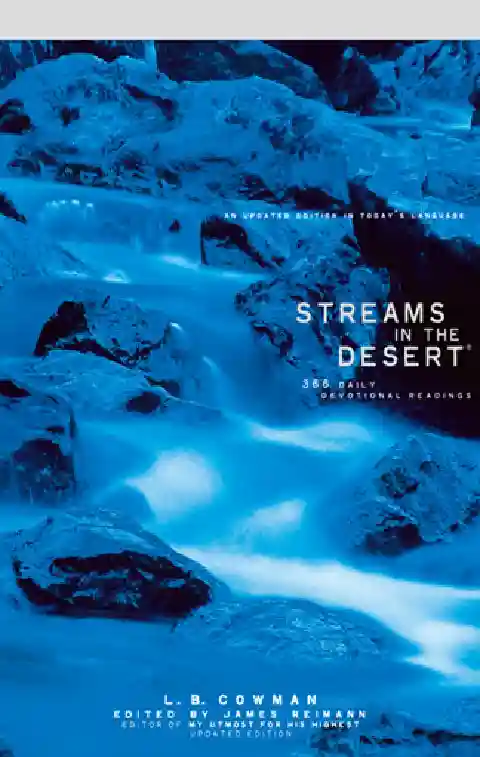

Streams In The Desert Order Printed Copy
- Author: L B Cowman, James Reimann
- Size: 1.62MB | 528 pages
- |
Others like streams in the desert Features >>

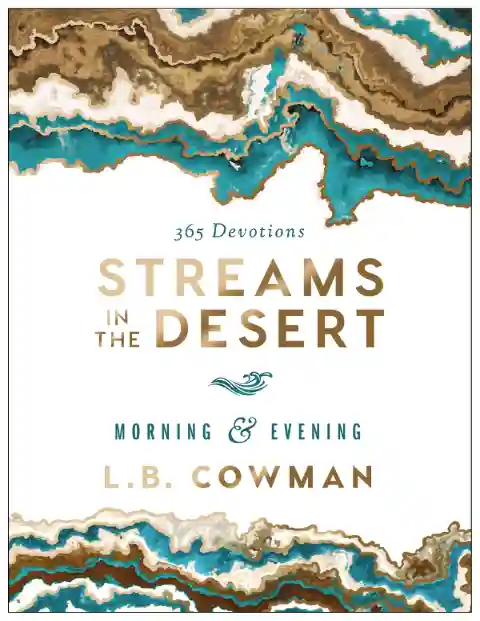
Streams In The Desert: Morning And Evening. 365 Devotions
Holiness Day By Day

Beatitudes - An Exposition Of Matthew 5:1-12
Exploring Worship: A Practical Guide To Praise And Worship

Daily Inspiration For The Purpose Driven Life
Letters Of Samuel Rutherford - With A Sketch Of His Life
Blessed In The Mess
Winged Life
1001 Bible Questions Answered

Take Time To Be Holy: 365 Daily Inspirations To Bring You Closer To God
About the Book
"Streams in the Desert" is a devotional classic that offers daily inspiration and encouragement for those going through difficult times. Filled with powerful quotes, stories, and biblical passages, this timeless book reminds readers to trust in God's provision and find strength in their faith, even in the midst of life's challenges.
William Still
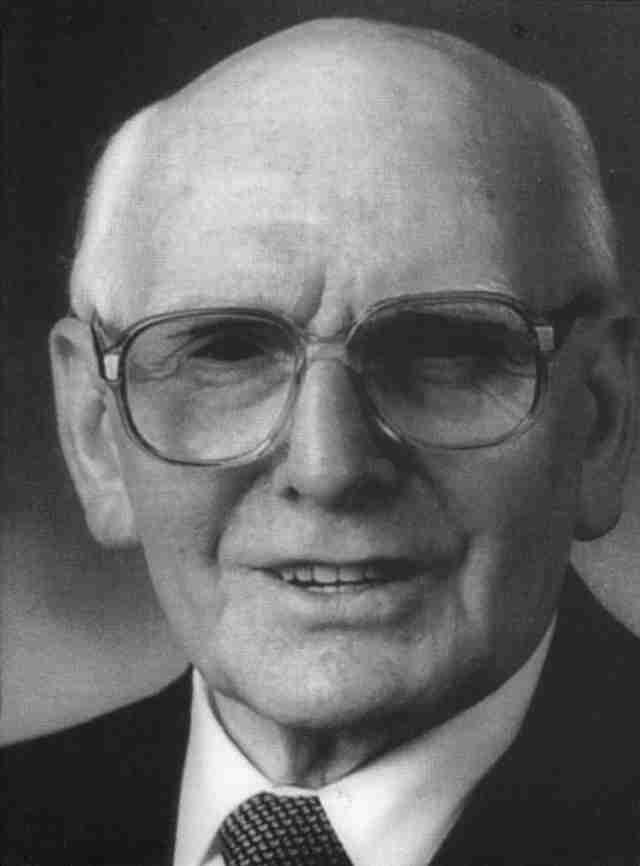 I recently read Dying to Live (Christian Focus, 1991), the autobiography of Scottish pastor William Still. I became interested in Still after reading his book The Work of the Pastor earlier this year.
The first half of Dying to Live tells about Still’s early years into young adulthood and his beginning in pastoral ministry. Still had an unsettled childhood. His parents were separated in his early years, and his father was an alcoholic. He was a sickly child who took refuge in music and became an accomplished pianist. He was part of the Salvation Army as a young man but then entered ministry in the Church of Scotland and served at the Gilcomston Church in his hometown of Aberdeen from 1945-1997.
The second half of the book deals with various aspects of Still’s pastoral ministry. Still was an evangelical. In his early ministry he worked with Billy Graham, Alan Redpath, and others in evangelistic events. With time, however, he moved away from what he came to call “evangelisticism” to develop a solid expositional ministry.
Still faced his fair share of hardships during the course of his ministry. When he moved away from pragmatic evangelistic methods, for example, more than two hundred people stopped attending his church almost overnight. In the preface, he references Martin Luther’s observation that there are three things which make a minister: study, prayer, and afflictions. He observes, “He who is not prepared to make enemies for Christ’s sake by the faithful preaching of the Word will never make lasting friends for Christ, either” (p. 93).
He describes one particularly difficult controversy early in his ministry when he confronted a group of disgruntled elders. At the end of one Sunday service, he read a statement confronting these men, which ended, “There you sit, with your heads down, guilty men. What would you say if I named you before the whole congregation? You stand condemned before God for your contempt of the Word and of his folk.” He adds, “The moment I had finished, I walked out of the pulpit. There was no last hymn—no benediction. I went right home. It was the hardest and most shocking thing I ever had to do in Gilcomston” (p. 124). That same week seven of his elders resigned and Still was called twice before his Presbytery to answer for the controversy. Yet, he endured.
Still maintains that in light of the unpleasantness one will face in the ministry that the minister of the Word must possess one quality in particular: “…I would say that this quality is courage: guts, sheer lion-hearted bravery, clarity of mind and purpose, grit. Weaklings are no use here. They have a place in the economy of God if they are not deliberate weaklings and stunted adults as Paul writes of both to the Romans and to the Corinthians. But weaklings are no use to go out and speak prophetically to men from God and declare with all compassion, as well as with faithfulness, the truth: the divine Word that cuts across all men’s worldly plans for their lives” (p. 140).
Still was a pioneer in several areas. First, he developed a pattern of preaching and teaching systematically through books of the Bible at a time when this was rarely done. He began a ministry of “consecutive Bible teaching” starting with the book of Galatians in 1947, calling this transition from “evangelisticism to systematic exposition … probably the most significant decision in my life” (p. 191).
He was also a pioneer in simplifying and integrating the ministry of the church. After noting how youth in the church were drifting away, even after extensive involvement in the church’s children’s ministry, Still writes, “I conceived the idea of ceasing all Sunday School after beginners and Primary age (seven years) and invited parents to have their children sit with them in the family pew from the age of eight” (p. 171). He laments “the disastrous dispersion of congregations by the common practice of segregating the church family into every conceivable category of division of ages, sexes, etc.” (p. 173).
Dying to Live is a helpful and encouraging work about the life and work of the minister and is to be commended to all engaged in the call of gospel ministry. As the title indicates, Still’s essential thesis is that in order to be effective in ministry the minister must suffer a series of deaths to himself (cf. John 12:24). On this he writes:
The deaths one dies before ministry can be of long duration—it can be hours and days before we minister, before the resurrection experience of anointed preaching. And then there is another death afterwards, sometimes worse than the death before. From the moment that you stand there dead in Christ and dead to everything you are and have and ever shall be and have, every breath you breathe thereafter, every thought you think, every word you say and deed you do, must be done over the top of your own corpse or reaching over it in your preaching to others. Then it can only be Jesus that comes over and no one else. And I believe that every preacher must bear the mark of that death. Your life must be signed by the Cross, not just Christ’s cross (and there is really no other) but your cross in his Cross, your particular and unique cross that no one ever died—the cross that no one ever could die but you and you alone: your death in Christ’s death (p. 136).
I recently read Dying to Live (Christian Focus, 1991), the autobiography of Scottish pastor William Still. I became interested in Still after reading his book The Work of the Pastor earlier this year.
The first half of Dying to Live tells about Still’s early years into young adulthood and his beginning in pastoral ministry. Still had an unsettled childhood. His parents were separated in his early years, and his father was an alcoholic. He was a sickly child who took refuge in music and became an accomplished pianist. He was part of the Salvation Army as a young man but then entered ministry in the Church of Scotland and served at the Gilcomston Church in his hometown of Aberdeen from 1945-1997.
The second half of the book deals with various aspects of Still’s pastoral ministry. Still was an evangelical. In his early ministry he worked with Billy Graham, Alan Redpath, and others in evangelistic events. With time, however, he moved away from what he came to call “evangelisticism” to develop a solid expositional ministry.
Still faced his fair share of hardships during the course of his ministry. When he moved away from pragmatic evangelistic methods, for example, more than two hundred people stopped attending his church almost overnight. In the preface, he references Martin Luther’s observation that there are three things which make a minister: study, prayer, and afflictions. He observes, “He who is not prepared to make enemies for Christ’s sake by the faithful preaching of the Word will never make lasting friends for Christ, either” (p. 93).
He describes one particularly difficult controversy early in his ministry when he confronted a group of disgruntled elders. At the end of one Sunday service, he read a statement confronting these men, which ended, “There you sit, with your heads down, guilty men. What would you say if I named you before the whole congregation? You stand condemned before God for your contempt of the Word and of his folk.” He adds, “The moment I had finished, I walked out of the pulpit. There was no last hymn—no benediction. I went right home. It was the hardest and most shocking thing I ever had to do in Gilcomston” (p. 124). That same week seven of his elders resigned and Still was called twice before his Presbytery to answer for the controversy. Yet, he endured.
Still maintains that in light of the unpleasantness one will face in the ministry that the minister of the Word must possess one quality in particular: “…I would say that this quality is courage: guts, sheer lion-hearted bravery, clarity of mind and purpose, grit. Weaklings are no use here. They have a place in the economy of God if they are not deliberate weaklings and stunted adults as Paul writes of both to the Romans and to the Corinthians. But weaklings are no use to go out and speak prophetically to men from God and declare with all compassion, as well as with faithfulness, the truth: the divine Word that cuts across all men’s worldly plans for their lives” (p. 140).
Still was a pioneer in several areas. First, he developed a pattern of preaching and teaching systematically through books of the Bible at a time when this was rarely done. He began a ministry of “consecutive Bible teaching” starting with the book of Galatians in 1947, calling this transition from “evangelisticism to systematic exposition … probably the most significant decision in my life” (p. 191).
He was also a pioneer in simplifying and integrating the ministry of the church. After noting how youth in the church were drifting away, even after extensive involvement in the church’s children’s ministry, Still writes, “I conceived the idea of ceasing all Sunday School after beginners and Primary age (seven years) and invited parents to have their children sit with them in the family pew from the age of eight” (p. 171). He laments “the disastrous dispersion of congregations by the common practice of segregating the church family into every conceivable category of division of ages, sexes, etc.” (p. 173).
Dying to Live is a helpful and encouraging work about the life and work of the minister and is to be commended to all engaged in the call of gospel ministry. As the title indicates, Still’s essential thesis is that in order to be effective in ministry the minister must suffer a series of deaths to himself (cf. John 12:24). On this he writes:
The deaths one dies before ministry can be of long duration—it can be hours and days before we minister, before the resurrection experience of anointed preaching. And then there is another death afterwards, sometimes worse than the death before. From the moment that you stand there dead in Christ and dead to everything you are and have and ever shall be and have, every breath you breathe thereafter, every thought you think, every word you say and deed you do, must be done over the top of your own corpse or reaching over it in your preaching to others. Then it can only be Jesus that comes over and no one else. And I believe that every preacher must bear the mark of that death. Your life must be signed by the Cross, not just Christ’s cross (and there is really no other) but your cross in his Cross, your particular and unique cross that no one ever died—the cross that no one ever could die but you and you alone: your death in Christ’s death (p. 136).
every day’s a bad day - how ecclesiastes taught me to enjoy life
After decades of ministry, what is one piece of advice I wish I had received as a young woman? Study the book of Ecclesiastes. Ecclesiastes has shown me the secret of enjoying life, even in the midst of trouble. It has rescued me from disillusionment when labors I thought were fruitful appeared to be for naught. When friends have turned their backs, Ecclesiastes has helped me guard against bitterness. It has cured me of setting my hope on a particular outcome, and protected me from becoming bewildered and disheartened by bad news. In short, Ecclesiastes made me a realist, and yet I’m happier than ever before. This collection of wisdom has become (as it is for J.I. Packer, whose writings introduced me to Ecclesiastes) my favorite book of the Bible, and one I regret not studying sooner. If you get the wisdom here while you are still young, it will prepare you for real life. It clears away false assumptions with which we sometimes read the rest of Scripture. Even if you find Ecclesiastes when you are older, it sure explains a lot. You learn that life didn’t go sideways; it was already crooked (Ecclesiastes 1:15). Ecclesiastes paints an unvarnished picture of real life, but its heavy shadows help you see the light of real joy. Bad Days Are Normal To begin with, Ecclesiastes tells us what life is really like. “It is an unhappy business that God has given to the children of man to be busy with” (Ecclesiastes 1:13). This is the way life really is, for all of us. Because of that first fatal sin, God cursed the ground and imposed hardship on Adam’s offspring (Genesis 3:16–19). The curse has affected all of us who live “under the sun” (Ecclesiastes 1:3). Christians are not exempt. The curse has also infected all of man’s work, “the toil at which he toils” (Ecclesiastes 1:3). Life is a burdensome task, a frustrating occupation, a grueling grind. It is an unhappy business. And God made it this way. Our problem is that we don’t really believe life is an unhappy business. We think if we work hard, we’ll eventually succeed. We imagine suffering is short-term, pain is the exception to the rule, and failure merely the prelude to victory. These illusions leave us blindsided by setbacks, devastated by failure and loss, bewildered by trials, confused by pain. This isn’t the way things were supposed to go! We talk about having “a bad day” as if it should be one in a thousand, but Ecclesiastes (and really the rest of Scripture, when you read it right side up) tells us that they are all bad. Daily work under the sun is an unhappy business. The sooner we face the fact that we live and work in a sin-cursed world, the more realistic and stable we will be. We will stop expecting things to always get better. We won’t be so surprised when they sometimes get worse. We no longer fear bad news: not because we hope it’s not coming, but because we know it is coming (Psalm 112:7; Ecclesiastes 12:1). Get Ecclesiastes, and we can learn to meet life’s unhappy business with pluck and humor. We won’t be so quick to doubt God, and we will finally have a settled peace in our heart. As my family reminds each other (with a smile) when faced with some new unhappy business, “That’s Ecclesiastes!” In other words, God can be trusted; he told us this was going to happen. Blessings You Cannot Count Ecclesiastes teaches us how to enjoy life , in the midst of our unhappy business. For while all humankind labors under the effects of the fall, to those God has called according to his purpose, he gives joy . “There is nothing better for a person than that he should eat and drink and find enjoyment in his toil. This also, I saw, is from the hand of God. . . . For to the one who pleases him God has given wisdom and knowledge and joy” (Ecclesiastes 2:24, 26). God’s gifts of enjoyment aren’t random; they are from his hand . As it says in James, “Every good gift and every perfect gift is from above, coming down from the Father of lights” (James 1:17). God blesses the Christian’s toil with enjoyment. Every feeling of satisfaction in a made bed, a mopped floor, and an organized closet is from the hand of God . Happiness in a deadline met, a budget balanced, or a report filed comes down from the Father of lights . Pleasure in a delicious meal, and in the dishes all cleaned and put away? You guessed it: from the hand of God . How about the relief of solving a problem, the delight of reading a book to your children, the blessing of easing your husband’s troubles? The fresh breeze through the open windows on carpool morning, the delightful lunch with friends, the sweet feeling of a comfortable bed at night — all of these moments of enjoyment in our work are gifts from the gracious hand of God . When you start to look for God’s gifts of joy, the ratio of troubles to joys becomes astonishingly unbalanced, leaning heavily in favor of joy. As my husband likes to say, good gifts are raining down upon us from the hand of God, every day, all day long. We can find enjoyment in our toil if only we would take the time to see, and give thanks to God. Consider: what is one way you can remind yourself to enjoy the gifts from God’s hand today? You will find that it is a happy unhappy business that God has given to those who please him. The Final Commendation Finally, Ecclesiastes helps us to see beyond our unhappy business . Even if your friends walk away, your business fails, or you are forced to move to a smaller home, you can persevere, because the final value of your work is not found in this life. “For God will bring every deed into judgment, with every secret thing, whether good or evil” (Ecclesiastes 12:14). In other words, it is not left to us, here and now, to determine the ultimate value of our work. As Jeremiah Burroughs says, we are simply called to “perform the duties of [our] present circumstances,” trusting God who will ultimately judge the fruitfulness of our work and give us our heavenly reward. This means that no matter how much heart you poured into a failed friendship, how much creativity you invested in a business you have to close, or how much effort you put into the home you have to leave, your work for the Lord is never a net loss. Which is why Paul can exhort us to “Be steadfast, immovable, always abounding in the work of the Lord, knowing that in the Lord your labor is not in vain” (1 Corinthians 15:58). Life under the sun is brutal, and it shows no signs of getting any easier. Our work is cursed and will often, more likely than not, fail on some human level. But the godly woman can face the future with peace and confidence; she even “laughs at the time to come” (Proverbs 31:25). For the same God who told us that life is hard has told us that he is near (Psalm 34:18). Through faith in Christ we can enjoy God’s fatherly gifts, abound in the work he has called us to, and look forward to the day when — oh, amazing grace! — we receive our commendation from God (1 Corinthians 4:5).