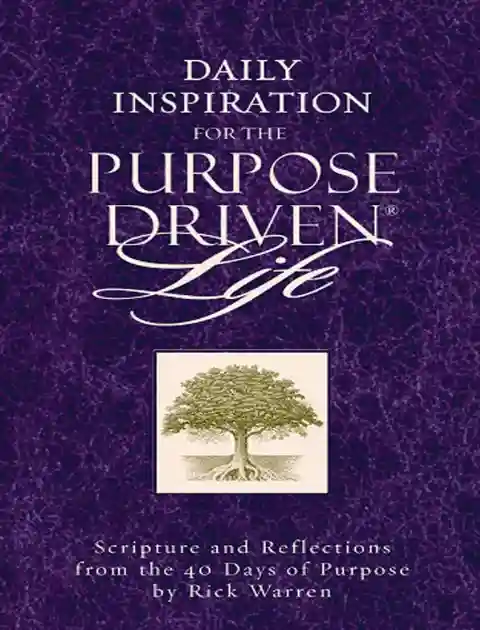

Daily Inspiration For The Purpose Driven Life Order Printed Copy
- Author: Rick Warren
- Size: 796KB | 238 pages
- |
Others like daily inspiration for the purpose driven life Features >>
About the Book
"Daily Inspiration For The Purpose Driven Life" by Rick Warren is a devotional book that provides daily reflections and scripture readings to help readers live a purpose-driven life. Each day offers encouragement, inspiration, and practical guidance for applying Biblical principles to everyday challenges. Warren's insightful and uplifting messages are designed to help readers grow spiritually and align their lives with God's purpose for them.
Jackie Hill Perry
Jackie Hill Perry has a way with words, and people canāt stop listening. A gifted poet, rapper, writer, and teacher, she has written books and Bible studies, released hip-hop albums, and taught at events, conferences, colleges, and coliseums all over the nation. Inspired by her powerful testimony of salvation and deliverance from a gay lifestyle and her teaching on the holiness of God, the word is out: God is good, He is Lord, and those who surrender to Him are made new.
The Power of God
Itās a message Jackie is passionate about because she knows firsthand the transformational power of Jesus Christ. She and her husband ā fellow spoken-word artist, Preston Perry ā met in 2009 while performing at an artistās showcase. Impressed with Jackieās poetry, Preston struck up a friendship that deepened over the years. Eventually, they began dating, which presented significant challenges but also great rewards. The Lord used Preston as a source of healing, and marriage forced Jackie to deal with hurts and fears sheād been reluctant to give to God. The couple, who reside in Atlanta, married in 2014. They are now the parents of three daughters: Eden, Autumn, and Sage; and are expecting a son.
A decade ago, Jackie could never have imagined marriage, motherhood, and ministry in her future. Violated and abandoned by men who should have loved and protected her, Jackie was hurting. Fear and distrust kept watch over her heart. Surrender wasnāt an option, even when a loving God promised her new life. Despite some exposure to church and to Scripture, Jackie was adamant that she would never submit to Jesus as Lord.
Her attraction to women started in early childhood and intensified during adolescence. Jackie finally gave in to same-sex desires, along with drugs and other habits that brought comfort, pleasure, and an emotional escape. Suppressing her femininity by wearing menās clothing and assuming the male role in dating relationships, Jackie says every area of her life was characterized by sin and rebellion against God.
Then one evening, 19-year-old Jackie felt the conviction of the Holy Spirit. Recalling the experience, she says, āIt was a God thing. No one can ever tell me that I saved myself. I had some understanding of Jesus and obedience and Christianity. But I sincerely wanted nothing to do with God on His terms.ā
Even as she resisted, Jackie clearly sensed the Lord speaking to her. āWhen He showed me that all of my sin would be the death of me ā that it was true that the wages of sin is death, but it was equally true that God offered eternal life if I would repent and believe ā I was compelled to trust Him. For the first time in my life, I knew that God was real and He was worth it. Just the day before, my heart was hard as a rock, and now I wanted Jesus. Only the Holy Spirit could have done that.ā
āFor the first time in my life, I knew that God was real and He was worth it. Just the day before, my heart was hard as a rock, and now I wanted Jesus. Only the Holy Spirit could have done that.ā
The Power of Words
Jackie dove into Godās Word and began discovering the woman He designed her to be ā mind, body, and spirit. Seeking to express herself in deeper, more artistic ways, she began writing poetry. Jackie didnāt shy away from revealing her past or the ongoing struggle with temptation and sin. Her poems unflinchingly spoke gospel truth and glorified God as the ultimate source of love and life. After connecting with the Passion for Christ Movement (P4CM), Jackie was asked to write a poem about being an ex-lesbian. Hesitant at first, she felt the Lord prompting her to move forward. Through its confessional lyrics and rock-solid theology, My Life as a Stud shined a spotlight on Jackieās conversion and marked the beginning of her public ministry.
āWhen My Life As a Stud came out in 2009, so many gay and lesbian people who didnāt go to church, didnāt trust Christians, and didnāt want to have anything to do with the Bible clicked on the poem and suddenly wanted Jesus. I realized God had given me this art form where Iām able to speak to peopleās hearts.ā
Since then, she has taken the message of Godās love to artist showcases, faith-based conferences, college campuses, and major media outlets. The foundation of her message is always the Word of God: In His goodness, God created male and female. As the perfect designer of gender and sexuality, God is worthy of trust and obedience. Although same-sex attraction is central to her testimony, Jackie emphasizes that the church should approach the LGBTQ community the same way it approaches other people. Everyone is created to be an image-bearer of the living God with a unique identity and great worth. Rather than labeling someone as āa gay friend,ā itās important to develop genuine, one-on-one relationships the same way Jesus did. By investing in authentic friendships, Christians will be able to share the gospel because theyāre actually modeling it.
The Power of Redemption
Jackie points out that being ādead in sinā goes far beyond someoneās sexual preference. Without Christ, people are lost in every way. But when Jesus gives new life, He forgives and redeems the whole person. She says, āGod saved me from sin, not just my sexuality. I was an all-around sinful person. In essence, sin was my lord. As much as I loved women in a lustful way, I also loved pornography and drugs, bitterness and unforgiveness.ā
Through discipleship, Jackie recognized the holistic nature of Godās redemption. āIāve learned that pride is one of my greatest struggles, even more so than same-sex attraction,ā she explains. āPride manifests itself in so many areas of my life, itās hard to keep up. God didnāt just rescue me from being gay. He saved me from believing Iām a better lord than He is.ā In response to the growing debate over same-sex attraction and the frequent questions she receives when people hear her testimony, Jackie wrote her first book, Gay Girl, Good God, to serve three core groups: people seeking to help and understand those within the LGBTQ community; people within the community who may disagree with some of her conclusions but are still intrigued; and people who are believers, yet have same-sex attraction and are trying to figure out how to love Jesus while dealing with those feelings.
When asked what she hopes the church learns from the book, she says, āI want people to see that how you reach the LGBTQ community is the same way you reach anybody ā with the gospel. The gospel is about God. The method shouldnāt be any different when youāre speaking to someone who is dealing with gluttony or lying or lust. Itās all the same. God is Lord, Heās Master, Heās King, Heās able to save. And the problem with sin is always a problem between us and God.ā
"God is Lord, Heās Master, Heās King, Heās able to save. And the problem with sin is always a problem between us and God."
The Power of Community
Jackie hopes the church will develop greater empathy for same-sex individuals and recognize how difficult it is to walk away from the gay lifestyle. She says, āItās not a random sin that is easily put off. The feelings are real, and it takes time and work and a long process of dying to self.ā Without a supportive church family to encourage and affirm her, the author might have fallen away. The first couple of years as a Christian were the hardest. Jackie had to learn to put off the old nature and put on Christ. The process required spiritual and physical discipline. She had to shop for womenās clothing, an experience that made her feel strange, vulnerable, and afraid.
Temptation was a constant source of condemnation, at times pushing Jackie into depression and doubt as she grieved over her sinful nature. After a decade of growing in Christ, Jackie still faces temptations but says theyāre more subtle and easier to flee. Instead of looking at women as objects of lust, she chooses to see them as image-bearers of God. In evaluating her walk with the Lord, she considers whether she is loving people well, growing in holiness, and bearing good fruit. And she looks to Jesus, who endured the horror of the cross because He loved God with all of His heart. Knowing Jesus didnāt want the cup of suffering, yet accepted it with humility, helps Jackie run the Christian race with endurance.
Endurance and spiritual growth became the inspiration for Jackieās second album, Crescendo, which was hailed as āstunning,ā āflawless,ā and arguably āthe best hip-hop album of the year.ā Although she began experimenting with rap simply for creative expression, Jackie soon saw it as another platform to share the gospel. When asked about the albumās title, the talented artist says, āIn music theory, ācrescendoā means the increase in sound. So I wanted to apply that to faith. When youāre in Christ, as your faith increases, your fruit should get louder. You love more, youāre more generous, more attentive to the needs of people. You listen well. Things begin to change as your faith becomes more evident.ā
She wrote the album to mimic that spiritual progression. The first track begins on a low note with āLamentations,ā a rap about the reality of sin and the tendency for Jackie to forget sheās been forgiven. Taking listeners through an honest exploration of spiritual growth, Crescendo ends on a high note, celebrating how the Lord saved Jackie through His gospel, initiated her Christian walk, and sustains her to this day.
The Power of Legacy
A gifted communicator and lyricist, Jackie isnāt just impacting culture with wordcraft. Sheās also building a spiritual legacy for her children. Because of her childhood trauma, the idea of raising daughters was terrifying. But sheās found so much joy in becoming a mom. Jackie says, āWhen I think of parenthood, I know Iām only called to steward these children and disciple them and hope they will love the Lord with all their hearts, souls, minds, and strength. When I was carrying Eden, Titus 2 really spoke to me about the older women teaching the younger women.
"Once I realized what a privilege it would be to raise up a woman in my home, I welcomed the challenge.ā As Jackie reflects on the last decade, she gives God all the glory and praise. Without Christ, she wouldnāt have her precious daughters, would have missed out on beautiful friendships, and would never have experienced being loved by a man for the first time in her life. āIf God hadnāt rescued me, none of this would be possible,ā Jackie says. āLife still has its challenges, for sure. But itās better. Itās so much better.ā
This article courtesy of HomeLife magazine.
weakness may be your greatest strength
How well are you investing the weaknesses youāve been given? Perhaps no one has ever asked you that question before. Perhaps it sounds nonsensical. After all, people investĀ assets Ā in order to increase their value. They donāt investĀ liabilities . They try to eliminate or minimize or even cover up liabilities. Itās easy for us to see our strengths as assets. But most of us naturally consider our weaknesses as liabilities ā deficiencies to minimize or cover up. But God, in his providence, gives us our weaknesses just as he gives us our strengths. In Godās economy, where the return on investment he most values is āfaith working through loveā (Galatians 5:6), weaknesses become assets ā we can even call themĀ talents Ā ā to be stewarded, to be invested. It may even be that the most valuable asset God has given you to steward is not a strength, but a weakness. But if weāre to value weaknesses as assets, we need to see clearly where Scripture teaches this. The apostle Paul provides us with the clearest theology of the priceless value of weakness. I have foundĀ 1 Corinthians 1:18ā2:16Ā and, frankly, the entire book of 2 Corinthians, to be immensely helpful in understanding the indispensable role weakness plays in strengthening the faith and witness of individual Christians and the church as a whole. Paradoxical Power of Weakness Paulās most famous statement on the paradoxical spiritual power of weakness appears in 2 Corinthians 12. He tells us of his ecstatic experience of being ācaught up into paradise,ā where he received overwhelming and ineffable revelations (2 Corinthians 12:1ā4). But as a result, a thorn was given me in the flesh, a messenger of Satan to harass me, to keep me from becoming conceited. Three times I pleaded with the Lord about this, that it should leave me. But he said to me, āMy grace is sufficient for you, for my power is made perfect in weakness.ā Therefore I will boast all the more gladly of my weaknesses, so that the power of Christ may rest upon me. For the sake of Christ, then, I am content with weaknesses, insults, hardships, persecutions, and calamities. For when I am weak, then I am strong. (2 Corinthians 12:7ā10) In these few sentences, Paul completely reframes the way Christians are to view weaknesses, even deeply painful ones that can appear to hinder our calling and that the powers of darkness seek to exploit. What at first seems to us like an expensive liability turns out to be a valuable, God-given asset. Weakness and Sin Before we go further, we need to be clear that Paul does not includeĀ sin Ā in his description of weakness here. The Greek word Paul uses isĀ astheneia , the most common word for āweaknessā in the New Testament. J.I. Packer, in his helpful study on 2 Corinthians,Ā Weakness Is the Way , explainsĀ astheneia Ā like this: The idea from first to last is of inadequacy. We talk about physical weakness [including sickness and disability] . . . intellectual weakness . . . personal weakness . . . a weak position when a person lacks needed resources and cannot move situations forward or influence events as desired . . . relational weakness when persons who should be leading and guiding fail to do so ā weak parents, weak pastors, and so on. (13ā14) But when Paul speaks of sin, he has more than inadequacy in mind. The Greek word for āsinā he typically uses isĀ hamartia , which refers to something that incurs guilt before God.Ā Hamartia Ā happens when we think, act, or feel in ways that transgress what God forbids. āWeaknesses manifest Godās power in us in ways our strengths donāt.ā Though Paul was aware thatĀ hamartia Ā could lead toĀ astheneia Ā (1 Corinthians 11:27ā30) andĀ astheneia Ā could lead toĀ hamartia Ā (Matthew 26:41), he clearly did not believe āweaknessā was synonymous with āsin.ā For he rebuked those who boasted that their sin displayed the power and immensity of Godās grace (Romans 6:1ā2). But he āgladlyā boasted of his weaknesses because they displayed the power and immensity of Godās grace (2 Corinthians 12:9). In sin, we turn from God to idols, which profanes God, destroys faith, and obscures God in the eyes of others. But weakness has the tendency to increase our conscious dependence on God, which glorifies him, strengthens our faith, and manifests his power in ways our strengths never do. And thatās the surprising value of our weaknesses: they manifest Godās power in us in ways our strengths donāt. Thatās what Jesus meant when he told Paul, āMy power is made perfect in weaknessā (2 Corinthians 12:9) ā āperfectā meaningĀ complete Ā orĀ entirely accomplished . Our weaknesses are indispensable because God manifests the fullness of his power through them. Asset Disguised as a Liability At this point, you may be thinking, āWhatever Paulās āthornā was, my weakness is not like that.ā Right. Thatās what we all think. I have a thorn-like weakness, known only to those closest to me. If I shared it with you, you might be surprised. It dogs me daily as I seek to carry out my family, vocational, and ministry responsibilities. It makes almost everything harder and regularly tempts me to exasperation. Itās not romantic, certainly not heroic. It humbles me in embarrassing, not noble, ways. And most painful to me, I can see how in certain ways it makes life harder for those I live and work with. Often it has seemed to me a liability. Iāve pleaded with the Lord, even in tears, to remove it or grant me more power to overcome it. But itās still here. Paul also initially saw his weakness as a grievous liability and pleaded repeatedly to be delivered from it. But as soon as he understood Christās purposes in it, he saw it in a whole new light: a priceless asset disguised as a liability. And he gloried in the depths of Godās knowledge, wisdom, and omnipotent grace. āGod, in his providence, gives us our weaknesses just as he gives us our strengths.ā I have been slower than Paul in learning to see my thorn as an asset (and honestly, Iām still learning). But I see at least some of the ways this weakness has strengthened me. It has forced me to live daily in dependent faith on Godās grace. It has heightened my gratitude for those God has placed around me who have strengths where Iām weak. Beset with my own weakness, I am more prone to deal gently and patiently with others who struggle with weaknesses different from mine (Hebrews 5:2). And I can see now how it has seasoned much of what Iāve written over the years with certain insights I doubt would have come otherwise. In other words, I see ways God has manifested his power more completely through my perplexing weakness. The fact that we donāt know what Paulās thorn was is evidence of Godās wisdom. If we did, we likely would compare our weaknesses to his and conclude that ours have no such spiritual value. And we would be wrong. Stewards of Surprising Talents Paul said that his weakness, his āthorn . . . in the flesh,ā was āgivenā to him (2 Corinthians 12:7). Given by whom? Whatever role Satan played, in Paulās mind he was secondary. Paul received this weakness, as well as āinsults, hardships, persecutions, and calamitiesā (2 Corinthians 12:10), as assets given to him by his Lord. And as a ā[steward] of the mysteries of Godā (1 Corinthians 4:1), he considered his weaknesses a crucial part of the portfolio his Master had entrusted to him. So, he determined to invest them well in order that his Master would see as much of a return as possible. If youāre familiar with Jesusās parable of the talents (Matthew 25:14ā30), you might recognize that Iām drawing from its imagery. Jesus has given each of us different ātalentsā to steward,Ā assets of immense kingdom value, āeach according to his abilityā (Matthew 25:15). And his expectation is that we will invest them well while we wait for his return. Some of these talents are strengths and abilities our Lord has given us. But some of them are our weaknesses, our inadequacies and limitations, which heās also given to us. And heās given us these weaknesses not only to increase in us the invaluable and shareable treasure of humility (2 Corinthians 12:7), but also to increase our strength in the most important aspects of our being: faith and love (2 Corinthians 12:10). But our weaknesses are not only given to us as individuals; they are also given to the church. Our limitations, as much as our abilities, are crucial to Christās design to equip his body so that it works properly and ābuilds itself up in loveā (Ephesians 4:16). Our weaknesses make us depend on one another in ways our strengths donāt (1 Corinthians 12:21ā26). Which means they are given to the church for the same reason they are given to us individually: so that the church may grow strong in faith (1 Corinthians 2:3ā5) and love (1 Corinthians 13) ā two qualities that uniquely manifest Jesusās reality and power to the world (John 13:35). Donāt Bury Your Weaknesses Someday, when our Master returns, he will ask us to give an account of the talents heās entrusted to us. Some of those talents will be our weaknesses. We donāt want to tell him we buried any of them. It may even be that the most valuable talent in our investment portfolio turns out to be a weakness. Since āit is required of stewards that they be found faithfulā (1 Corinthians 4:2), we would be wise to examine how faithfully we are stewarding the talents of our weaknesses. So, how well are you investing the weaknesses youāve been given?