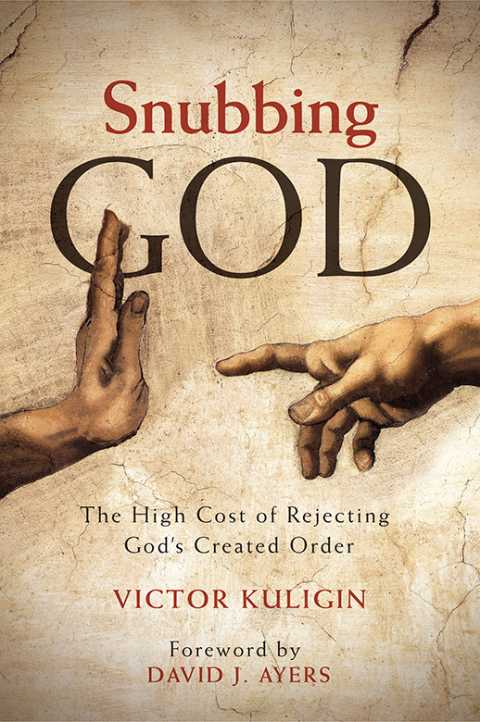

Snubbing God: The High Cost Of Rejecting God’s Created Order Order Printed Copy
- Author: Victor Kuligin
- Size: 1.18MB
- |
Others like snubbing god: the high cost of rejecting god’s created order Features >>
Living In The Grace Of God
Breaking The Curses Of Life
Walking In The Newness Of Life
Living In The Balance Of Grace And Faith
Living In The Kingdom Where Grace Rules
Grace Abounding To The Chief Of Sinners
Sinners In The Hands Of An Angry God
The New You & The Holy Spirit
What Does It Mean To Be Born Again
The Ministry Of Healing
About the Book
"Snubbing God: The High Cost Of Rejecting God’s Created Order" explores the consequences of society's rejection of God's design for humanity. Victor Kuligin argues that disregarding God's moral guidelines and principles ultimately leads to chaos and destruction. The book highlights the importance of following God's created order for a prosperous and fulfilling life.
John Murray
What Dead Abel Speaks to Us
The story of Cain and Abel in Genesis 4 tells much more about Cain than Abel. In fact, not one word is recorded from living Abel. But the author of Hebrews says that, “through [Abel’s] faith, though he died, he still speaks” (Hebrews 11:4). So what is dead Abel speaking to us? It was dusk. Cain was working late. Not wanting to face his parents, he was trying to disguise his guilt-infused fear with a preoccupation with his crops. Then suddenly the unmistakable voice of the Lᴏʀᴅ sent a shock through his core: “Where is Abel, your brother?” Cain had grown to loathe Abel. It had been building for years. No matter what, Abel always seemed to turn a situation to his advantage. Was there a conflict? Abel the Humble loved to be the first to reconcile. Did anyone need help? Abel the Servant loved to be the first to offer it. Was there an injury? Abel the Compassionate loved to be the first to comfort. Even when Cain showed greater endurance and ingenuity in his work, Abel could rob him of any satisfaction with a virtuoso performance of self-effacing virtue. What Cain found most maddening was Abel the Pious, flaunting his tender conscience and precious devotion to God for the admiration of all. Cain could barely stomach how father and mother gushed over that. With every perceived humiliation, Cain caressed the secret suspicion that Abel only used goodness to show himself superior to Cain. But that morning Cain had suffered a crushing blow. The Lᴏʀᴅ had required each brother to present an offering, the first fruits of their labors. Cain saw in this an opportunity. This time Abel would not upstage him. Cain would prove that he too could excel in devotion. So he made sure that his offering lavishly exceeded the required amount of his best produce. But when the Lᴏʀᴅ reviewed Cain’s extravagant offering, he rejected it. Cain was stunned. Then, injury to insult, the Lᴏʀᴅ accepted Abel’s comparatively simple lamb offering. Humiliated by Abel again! But this time before God! Cain was beside himself. Hatred metastasized into horror. Abel had outshined him for the last time. By late afternoon Abel’s lifeless body lay in a remote field, abandoned in the hope that a beast’s hunger would conceal the fratricide. But the Lᴏʀᴅ’s question left Cain naked and exposed (Hebrews 4:13). He lied with the anger of cornered guilt: “I do not know; am I my brother’s keeper?” What it was, in fact, that he did not know was that his silenced brother had not been quiet. The Lᴏʀᴅ replied, “What have you done? The voice of your brother’s blood is crying to me from the ground” (Genesis 4:9–10). Yes, the blood of dead Abel cried out to God for justice (Genesis 4:10; Hebrews 12:24). But the faith of dead Abel “still speaks” (Hebrews 11:4). So what is he saying to us through his faith? “Without faith it is impossible to please God” One thing we hear is that God only accepts faith-fueled offerings. It’s significant that God doesn’t provide details about either Cain’s or Abel’s offerings, the first ever recorded in the Bible. In the story, I imagined Cain trying to win God’s approval with an impressive looking offering. But it could just have easily been a stingy offering or an exactingly precise offering. The point is that right from the beginning God draws our attention away from what fallen humans think is important, namely how our works can make us look impressive, to what God thinks is important, namely how our works reveal who we trust. All of Scripture teaches us that “the righteous shall live by his faith” (Habakkuk 2:4) because “without faith it is impossible to please” God (Hebrews 11:6). Abel was “commended as righteous” by God because he presented his offering in faith (Hebrews 11:4). Cain’s offering was “evil” (1 John 3:12) because without humble trust in God, even our offerings (hear: any work we do for God) are evil to God — no matter if they appear to everyone else as obedient or impressive. “You will be hated by all for my name’s sake” A second thing we hear from Abel is that the world will hate you if you live by faith in Jesus (who the New Testament reveals is YHWH, the Lᴏʀᴅ in Philippians 2:11). The Apostle John makes this clear: “We should not be like Cain, who was of the evil one and murdered his brother. And why did he murder him? Because his own deeds were evil and his brother’s righteous. Do not be surprised, brothers, that the world hates you” (1 John 3:12–13). Abel was the first to discover that “all who desire to live a godly life in Christ Jesus will be persecuted” (2 Timothy 3:12). To “let [our] light shine before others, so that they may see [our] good works” (Matthew 5:16) will at times expose others’ wickedness and arouse their hatred (John 3:20). Jesus himself said, “you will be hated by all for my name's sake,” “some of you they will put to death” — some even at the hands of “parents and brothers and relatives and friends (Luke 21:16–17). Righteous faith arouses evil hatred. A better word than Abel’s blood In the story, though we’d rather see ourselves as Abel, we are all Cain. We were at one time cursed, “hostile to God” and alienated from him (Romans 8:7; Ephesians 4:18). Abel, the first martyr of faith, is a foreshadowing of our Lord Jesus, whose “blood… speaks a better word than the blood of Abel” (Hebrews 12:24). For though Abel’s innocent blood cried out for justice against sin, Jesus’s innocent blood cried out for mercy for sinners. Abel’s blood exposed Cain in his wretchedness. Jesus’s blood covers our wretchedness and cleanses us from all sin (Romans 7:24; 1 John 1:9). So now as we seek to present our bodies as living sacrifices to God, let us remember that the only thing that makes this acceptable to God, the only thing that makes it a spiritual service of worship, is our childlike faith in Jesus (Romans 12:1; 3:26). And let us soberly remember that the only reward this is likely to earn us from the world is its hatred. Article by Jon Bloom