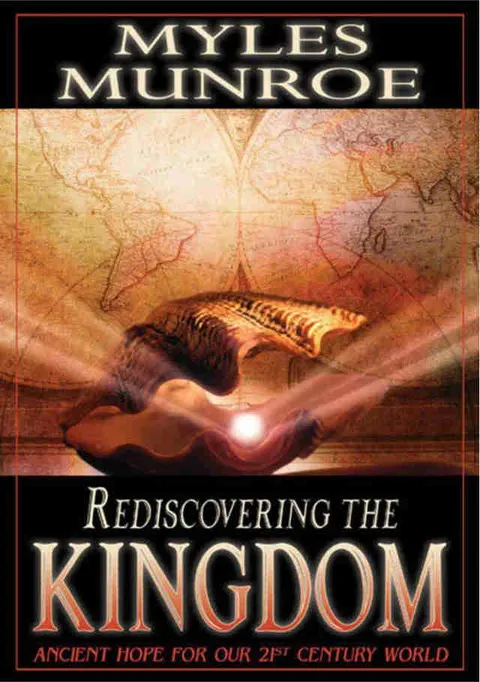

Others like rediscovering the kingdom Features >>

Applying The Kingdom

Jealousy: The Sin No One Talks About
Overcoming The Religious Spirit

The Kingdom Life
Wisdom From Myles Munroe
The Lamb In The Midst Of The Throne

Breaking Free: Discover The Victory Of Total Surrender
The Kingdom Of God In You

Exposing The Devil's Work
Overcoming The Storms Of Life
About the Book
"Rediscovering the Kingdom" by Myles Munroe explores the principles and values of the kingdom of God, emphasizing the importance of understanding and living according to these principles in order to experience true fulfillment, purpose, and success in life. Munroe highlights the significance of discovering one's true identity and purpose as a citizen of the kingdom, and offers practical insights on how to align one's life with the values and principles of the kingdom. The book encourages readers to reclaim their rightful place as heirs to God's kingdom and live a life of abundance, power, and influence.
Reinhard Bonnke
 Reinhard Bonnke (19 April 1940 - 7 December 2019) was a German-American Pentecostal evangelist, principally known for his gospel missions throughout Africa. Bonnke had been an evangelist and missionary in Africa since 1967. In Nigeria’s city, Lagos, in 2000, a single service is believed to have been attended by 1.6 million people. Christ for all Nations (CFAN), an organisation founded by Bonnke, claims he preached Christ to more than 79 million non believers.
Early life
Reinhard Bonnke was born on 19 April 1940, in the city of Königsberg, East Prussia, Germany, the fifth son of Hermann Bonnke, an army logistics officer in the Reichswehr who fought on the Eastern Front; his paternal grandfather was August Bonnke, the owner of a windmill in Trunz, East Prussia (now Milejewo, Poland), who was healed of an unknown ailment by the evangelist Luis Graf in 1922, but died during the evacuation of East Prussia in 1945. His mother was Metaa Bonnke (née Scheffler). Bonnke had six siblings: Martin, Gerhard, Jurgen, Peter and Felicitas, his only younger sibling and his only sister.
With his mother and siblings, he was taken to Denmark during the evacuation of East Prussia and spent some years in a displaced persons centre before settling in Gluckstadt, West Germany. After his own war service, his father became a pastor in the village of Krempe. He became a born-again Christian at the age of nine after his mother spoke with him about a sin that he had committed. He sensed a call from God to serve as a missionary in Africa from the age of 10 and said that he had the experience of baptism in the Holy Spirit.
Bonnke studied at the Bible College of Wales in Swansea, Wales, UK, where he was inspired by the director, Samuel Rees Howells. In one meeting Howells spoke of answered prayer; after this meeting, Bonnke prayed, "Lord, I also want to be a man of faith. I want to see your way of providing for needs." Passing through London, he had a chance meeting with the preacher George Jeffreys. As he walked, he came across a house with a nameplate on the front that said “George Jeffreys”. He wondered if it could be the great George Jeffreys who had founded the Elim Pentecostal churches in Ireland and England. He prayed for the young student and imparted grace to him.
After graduation, he pastored in Germany for seven years, including establishing a congregation in Flensburg which met in a former rum factory.
African mission
His work in Africa began in 1967. He arrived in South Africa and almost immediately encountered the apartheid system, which he developed an antipathy towards, which in turn caused friction between him and the minister who oversaw him in South Africa. Bonnke subsequently accepted a position to oversee three churches in Lesotho, but began again from scratch after he discovered that unbiblical practices had emerged in the congregations he was to oversee.
In the first few years of his work, Bonnke encountered poor results from his evangelistic efforts and felt frustrated at the pace of his ministry. Then he had a recurring dream featuring a picture of the map of Africa being splattered with blood and heard the voice of God crying "Africa Shall Be Saved". This ultimately led him to adopt large-scale evangelism, rather than the traditional small-scale missionary approach. He rented a stadium in Gaborone, Botswana, and preached with little cooperation from local churches. The first meetings saw about 100 people attending, but this number grew swiftly.
In 1974, Bonnke founded the mission organisation Christ for all Nations (CfaN). Originally based in Johannesburg, South Africa, the headquarters were relocated to Frankfurt, Germany, in 1986. This was done primarily to distance the organisation from South Africa's apartheid policy at the time.[9] Today CfaN has 9 offices across 5 continents.
Bonnke began his ministry holding tent meetings that accommodated large crowds. According to an account published by the Christian Broadcasting Network, in 1984 he commissioned the construction of what was claimed to be the world's largest mobile structure - a tent capable of seating 34,000; this was destroyed in a wind storm just before a major meeting and therefore the team decided to hold the event in the open air instead. According to this account, the event was subsequently attended by over 100,000 people which is far greater than the 34,000 seating capacity the tents could have contained. For various reasons, usually due to insufficient capacity, the 34,000-seat tent was only used once, in Harare, Zimbabwe, in 1986.
In addition to South Africa, Bonnke would also hold many campaigns in other African countries including Nigeria and Kenya and became known as "the Billy Graham of Africa." In the 5 February 2001 edition of Graham's Christianity Today, journalist Corrie Cutrer stated that Bonnke had set "record-breaking attendances" at recent events he held in Nigeria. Bonnke announced his "farewell gospel crusade" to be held in Lagos, Nigeria, in November 2017. Lagos is also the location of a gospel crusade held in 2000 which, according to CfaN, is the organization's largest to date, drawing an attendance of six million people in a 5-night crusade, and as much as 1.6 million attendance in one day. In 2009 Bonnke appointed his successor, Daniel Kolenda who continues to lead the ministry. In 2020, following Bonnke's death, Christ for all Nations launched the CfaN Evangelism Bootcamp. In 2022 Schools of Evangelism were started in South Africa, and Europe and Fire Camps were launched in dozens of nations on six continents. Today, more than 4,000 evangelists have been trained by Christ for all Nations and more than 91-million decisions for Christ have been counted. In 2024, in the 50th year of the ministry, CfaN is conducting 50 gospel crusades throughout the African continent.
Persecution
Kano riots, subsequent expulsion from Nigeria, and return to the country
In 1991, during Bonnke's visit to Kano in Nigeria, there were riots in the city as Muslims protested over remarks he had reportedly made about Islam in the city of Kaduna on his way to Kano. A rumour was spread that Bonnke was planning to "lead an invasion" into Kano. Muslim youths gathered at the Kofar Mata Eide-ground where they were addressed by several clerics who claimed that Bonnke was going to blaspheme Islam. About 8,000 youths gathered at the Emir's palace and after noon prayers the riots ensued, during which many Christians sustained various injuries and several churches were burned. Official reports state that at least eight people were killed, although other research and reports place the number as being as much as 500 as many of the Christians who were killed were thrown into wells and the attacks were spread between multiple locations.
Despite the state governor absolving Bonnke of any blame for the incident, Bonnke's subsequent attempts to return to Nigeria were denied, as the Nigerian Embassy refused his visa applications. In 2000, a new civilian government in Nigeria was elected to power, and President Olusegun Obasanjo, a Christian, invited Reinhard Bonnke to return to the country. Bonnke returned to Nigeria and held a crusades in Benin City in the south. He would deny reports that the Northern Region of Nigeria's Council of Ulamas banned him from entering northern Nigeria.
Bonnke held many crusades in Nigeria after 2000, and conversion rates were significantly higher than in many other African nations, with one campaign achieving a conversion of 1.1 million people. Nigeria would be where his final international crusade would be held, in Lagos in 2017.
Personal life
After graduating from the Bible College of Wales and returning to Germany, Bonnke led a series of meetings in Rendsburg. He began receiving speaking invitations from all around Germany and the rest of the world. Bonnke met Anni Suelze at a gospel music festival and admired the grace which she showed when a mistake led to her losing a music competition. He offered to preach at the church she attended and over time they fell in love. They married in 1964 and had three children: Kai-Uwe Friedrich, known as "Freddy", Gabrielle and Suzanne.
Death
Bonnke died on 7 December 2019. The month before, he had announced on his official Facebook page that he had undergone femur surgery and needed time to "learn how to walk again". Nigerian President Muhammadu Buhari, who is Muslim, praised Bonnke for his frequent visits to Nigeria and described his death as a "great loss to Nigeria".
His appointed successor is the evangelist Daniel Kolenda.
He would be buried in Gotha, Florida's Woodlawn Memorial Park, with his memorial stone being shaped to resemble Africa.
Reinhard Bonnke (19 April 1940 - 7 December 2019) was a German-American Pentecostal evangelist, principally known for his gospel missions throughout Africa. Bonnke had been an evangelist and missionary in Africa since 1967. In Nigeria’s city, Lagos, in 2000, a single service is believed to have been attended by 1.6 million people. Christ for all Nations (CFAN), an organisation founded by Bonnke, claims he preached Christ to more than 79 million non believers.
Early life
Reinhard Bonnke was born on 19 April 1940, in the city of Königsberg, East Prussia, Germany, the fifth son of Hermann Bonnke, an army logistics officer in the Reichswehr who fought on the Eastern Front; his paternal grandfather was August Bonnke, the owner of a windmill in Trunz, East Prussia (now Milejewo, Poland), who was healed of an unknown ailment by the evangelist Luis Graf in 1922, but died during the evacuation of East Prussia in 1945. His mother was Metaa Bonnke (née Scheffler). Bonnke had six siblings: Martin, Gerhard, Jurgen, Peter and Felicitas, his only younger sibling and his only sister.
With his mother and siblings, he was taken to Denmark during the evacuation of East Prussia and spent some years in a displaced persons centre before settling in Gluckstadt, West Germany. After his own war service, his father became a pastor in the village of Krempe. He became a born-again Christian at the age of nine after his mother spoke with him about a sin that he had committed. He sensed a call from God to serve as a missionary in Africa from the age of 10 and said that he had the experience of baptism in the Holy Spirit.
Bonnke studied at the Bible College of Wales in Swansea, Wales, UK, where he was inspired by the director, Samuel Rees Howells. In one meeting Howells spoke of answered prayer; after this meeting, Bonnke prayed, "Lord, I also want to be a man of faith. I want to see your way of providing for needs." Passing through London, he had a chance meeting with the preacher George Jeffreys. As he walked, he came across a house with a nameplate on the front that said “George Jeffreys”. He wondered if it could be the great George Jeffreys who had founded the Elim Pentecostal churches in Ireland and England. He prayed for the young student and imparted grace to him.
After graduation, he pastored in Germany for seven years, including establishing a congregation in Flensburg which met in a former rum factory.
African mission
His work in Africa began in 1967. He arrived in South Africa and almost immediately encountered the apartheid system, which he developed an antipathy towards, which in turn caused friction between him and the minister who oversaw him in South Africa. Bonnke subsequently accepted a position to oversee three churches in Lesotho, but began again from scratch after he discovered that unbiblical practices had emerged in the congregations he was to oversee.
In the first few years of his work, Bonnke encountered poor results from his evangelistic efforts and felt frustrated at the pace of his ministry. Then he had a recurring dream featuring a picture of the map of Africa being splattered with blood and heard the voice of God crying "Africa Shall Be Saved". This ultimately led him to adopt large-scale evangelism, rather than the traditional small-scale missionary approach. He rented a stadium in Gaborone, Botswana, and preached with little cooperation from local churches. The first meetings saw about 100 people attending, but this number grew swiftly.
In 1974, Bonnke founded the mission organisation Christ for all Nations (CfaN). Originally based in Johannesburg, South Africa, the headquarters were relocated to Frankfurt, Germany, in 1986. This was done primarily to distance the organisation from South Africa's apartheid policy at the time.[9] Today CfaN has 9 offices across 5 continents.
Bonnke began his ministry holding tent meetings that accommodated large crowds. According to an account published by the Christian Broadcasting Network, in 1984 he commissioned the construction of what was claimed to be the world's largest mobile structure - a tent capable of seating 34,000; this was destroyed in a wind storm just before a major meeting and therefore the team decided to hold the event in the open air instead. According to this account, the event was subsequently attended by over 100,000 people which is far greater than the 34,000 seating capacity the tents could have contained. For various reasons, usually due to insufficient capacity, the 34,000-seat tent was only used once, in Harare, Zimbabwe, in 1986.
In addition to South Africa, Bonnke would also hold many campaigns in other African countries including Nigeria and Kenya and became known as "the Billy Graham of Africa." In the 5 February 2001 edition of Graham's Christianity Today, journalist Corrie Cutrer stated that Bonnke had set "record-breaking attendances" at recent events he held in Nigeria. Bonnke announced his "farewell gospel crusade" to be held in Lagos, Nigeria, in November 2017. Lagos is also the location of a gospel crusade held in 2000 which, according to CfaN, is the organization's largest to date, drawing an attendance of six million people in a 5-night crusade, and as much as 1.6 million attendance in one day. In 2009 Bonnke appointed his successor, Daniel Kolenda who continues to lead the ministry. In 2020, following Bonnke's death, Christ for all Nations launched the CfaN Evangelism Bootcamp. In 2022 Schools of Evangelism were started in South Africa, and Europe and Fire Camps were launched in dozens of nations on six continents. Today, more than 4,000 evangelists have been trained by Christ for all Nations and more than 91-million decisions for Christ have been counted. In 2024, in the 50th year of the ministry, CfaN is conducting 50 gospel crusades throughout the African continent.
Persecution
Kano riots, subsequent expulsion from Nigeria, and return to the country
In 1991, during Bonnke's visit to Kano in Nigeria, there were riots in the city as Muslims protested over remarks he had reportedly made about Islam in the city of Kaduna on his way to Kano. A rumour was spread that Bonnke was planning to "lead an invasion" into Kano. Muslim youths gathered at the Kofar Mata Eide-ground where they were addressed by several clerics who claimed that Bonnke was going to blaspheme Islam. About 8,000 youths gathered at the Emir's palace and after noon prayers the riots ensued, during which many Christians sustained various injuries and several churches were burned. Official reports state that at least eight people were killed, although other research and reports place the number as being as much as 500 as many of the Christians who were killed were thrown into wells and the attacks were spread between multiple locations.
Despite the state governor absolving Bonnke of any blame for the incident, Bonnke's subsequent attempts to return to Nigeria were denied, as the Nigerian Embassy refused his visa applications. In 2000, a new civilian government in Nigeria was elected to power, and President Olusegun Obasanjo, a Christian, invited Reinhard Bonnke to return to the country. Bonnke returned to Nigeria and held a crusades in Benin City in the south. He would deny reports that the Northern Region of Nigeria's Council of Ulamas banned him from entering northern Nigeria.
Bonnke held many crusades in Nigeria after 2000, and conversion rates were significantly higher than in many other African nations, with one campaign achieving a conversion of 1.1 million people. Nigeria would be where his final international crusade would be held, in Lagos in 2017.
Personal life
After graduating from the Bible College of Wales and returning to Germany, Bonnke led a series of meetings in Rendsburg. He began receiving speaking invitations from all around Germany and the rest of the world. Bonnke met Anni Suelze at a gospel music festival and admired the grace which she showed when a mistake led to her losing a music competition. He offered to preach at the church she attended and over time they fell in love. They married in 1964 and had three children: Kai-Uwe Friedrich, known as "Freddy", Gabrielle and Suzanne.
Death
Bonnke died on 7 December 2019. The month before, he had announced on his official Facebook page that he had undergone femur surgery and needed time to "learn how to walk again". Nigerian President Muhammadu Buhari, who is Muslim, praised Bonnke for his frequent visits to Nigeria and described his death as a "great loss to Nigeria".
His appointed successor is the evangelist Daniel Kolenda.
He would be buried in Gotha, Florida's Woodlawn Memorial Park, with his memorial stone being shaped to resemble Africa.
Souls Are Our Reward
Run the race. Fight the good fight. Finish strong. Obtain the prize. Many of the familiar catchphrases for Christian faithfulness and perseverance come from a couple memorable verses: Do you not know that in a race all the runners run, but only one receives the prize? So run that you may obtain it. Every athlete exercises self-control in all things. They do it to receive a perishable wreath, but we an imperishable. (1 Corinthians 9:24–25) When our faith begins to falter, or our spiritual disciplines wane, or our joy fades to a dim flicker, or our love grows cold, we need to be reminded to run. Even when it hurts, even when we want to give up, even when we’d rather do anything else. Any race with Jesus will be hard (Luke 9:23). Faith, hope, love, and joy may come freely by grace, but that does not mean they are always easy. The apostle Paul, knowing the costs and rigors of following Christ, reaches for this kind of rugged and strenuous imagery again and again (Philippians 3:12–14; 2 Timothy 4:7–8). What might surprise us — even those of us who have been running with Christ for decades now — is what race Paul really had in mind, at least in 1 Corinthians 9:24. When he held out that wreath of all wreaths, he had more in mind than our clinging to faith and persisting in private prayer. Run to Win The verses above come immediately after another familiar passage, which ends, I have become all things to all people, that by all means I might save some. I do it all for the sake of the gospel, that I may share with them in its blessings. Do you not know that in a race all the runners run, but only one receives the prize? So run that you may obtain it. (1 Corinthians 9:22–24) The race Paul was running (and calling us to run) was not merely about guarding the faith in our own hearts, but about pursuing that faith and joy in others. The race may look (very) different for us than it did for an unmarried apostle, but the race is still our race. Paul was running to win the lost, despite how much effort it required and how much it cost him. He was talking about aggressive mission, not merely secret devotion. And that race — becoming all things to all people that we might save some — can be even more demanding, confusing, and discouraging than nurturing our own relationship with God. Many more give up trying to win the lost than give up going to church or reading the Bible. “Winning souls fills and waters the soul like nothing else.” Paul knew that winning the lost often feels like the back half of a marathon in the heat of August. So, he reminded the church to keep running — not to lose heart or slow down, but to press through to the end. Keep taking risks and making sacrifices to share, keep enduring the inevitable rejection and hostility, and, above all, keep praying for the lost. Keep running. Four Reasons to Run Well The apostle knew how much resistance we face in evangelism. Remember that he was hunted by murderers, stoned by crowds, beaten with rods, and almost flogged to death for trying to win people to Jesus. More than almost anyone, he knew how many incentives there were not to go and make disciples. But he also knew there were even more incentives to choose faithfulness and embrace suffering along the dangerous roads of soul-winning. He shares at least four of those incentives right here in 1 Corinthians 9. NEW JOY Perhaps nothing drove the soul-winning apostle more than the thought of one more sinner, even just one, being brought from the horrors of death and judgment to the heights of life and joy in Christ (2 Corinthians 1:24). “I have become all things to all people, that by all means I might save some” (1 Corinthians 9:22). Some. Notice how modest he (even he!) is about his goals in evangelism. And yet notice how driven he is: all things to all people by all means. The threefold all expresses the precious worth of the some, the unparalleled reward of seeing someone finally stumble upon their Treasure hidden in a field (Matthew 13:44). Winning souls fills and waters the soul like nothing else. Jesus himself says, “I tell you, there is joy before the angels of God over one sinner who repents” (Luke 15:10). If even one conversion sets heaven afire with joy, should it not thrill and motivate us? SHARED JOY The joy of seeing someone saved, however, is heightened further by the joy of enjoying Jesus with them (2 Timothy 1:4). “I do it all for the sake of the gospel,” Paul continues, “that I may share with them in its blessings” (1 Corinthians 9:23; Philippians 1:25). This incentive is wired into the heart of God himself — Father, Son, and Holy Spirit forever loving, sharing, enjoying, creating, saving together. It’s wired into the creation, which waits to share in “the freedom of the glory” waiting for us (Romans 8:21). And it’s wired into any real joy in us, because real joy is never content just to have, but must give and share. As Jesus says, “It is more blessed to give than to receive” (Acts 20:35). Has anyone modeled the ecstasy of shared joy more than the church in Macedonia? “In a severe test of affliction, their abundance of joy and their extreme poverty have overflowed in a wealth of generosity on their part” (2 Corinthians 8:2). What does abundant joy look like, even in extreme poverty? It looks like sharing. IMPERISHABLE JOY The clearest incentive to run well here, though, is the imperishable wreath waiting at the finish line. “Every athlete exercises self-control in all things. They do it to receive a perishable wreath, but we an imperishable” (1 Corinthians 9:25). So, what is this wreath? While Paul does not mention wreaths anywhere else in his letters, he does tell us more about the prize he covets. “What is our hope or joy or crown of boasting before our Lord Jesus at his coming?” he asks the Thessalonians. “Is it not you? For you are our glory and joy” (1 Thessalonians 2:19–20). And to the church at Philippi: “My brothers, whom I love and long for, my joy and crown, stand firm thus in the Lord, my beloved” (Philippians 4:1). His crown, his prize, his wreath on the last day will not be something he owns or wears; it will be the lives he saved, the joy he shared, the souls he won. And that wreath, unlike any wages or reward we might receive on earth, will live and grow and bloom long into eternity. How many of us spend our best time and effort, year after year, pursuing wreaths that perish, while failing to run for that which lasts forever? ASSURED JOY The last incentive, unlike the others, comes as a warning: “I do not run aimlessly; I do not box as one beating the air. But I discipline my body and keep it under control, lest after preaching to others I myself should be disqualified” (1 Corinthians 9:26–27). Along with the stunning rewards — new joy, shared joy, imperishable joy — fear also inspired Paul to love and pursue the lost. What will happen to me if I fail to prove faithful? He wanted the depth of assurance that comes through faithfully fulfilling his mission. The apostle knew he, even he, would be disqualified if he disobeyed what Jesus had called him to do — if he gave up running. And he knew men, even in ministry, who had been disqualified. He describes such men twice, with one sobering thread between them. He warns, People will be lovers of self, lovers of money, proud, arrogant, abusive, disobedient to their parents, ungrateful, unholy, heartless, unappeasable, slanderous, without self-control, brutal, not loving good, treacherous, reckless, swollen with conceit, lovers of pleasure rather than lovers of God, having the appearance of godliness, but denying its power. . . . These men also oppose the truth, men corrupted in mind and disqualified regarding the faith. (2 Timothy 3:2–5, 8) What’s startling (and frightening) about these men is that they were lovers of self, lovers of money, proud, arrogant, and abusive, yet they still had the appearance of godliness. They looked faithful while secretly indulging sin at the expense of others. They looked like they were running well when they were really only running from God. “Many more give up trying to win the lost than give up going to church or reading the Bible.” Paul mentions similar men elsewhere, who are “insubordinate, empty talkers, and deceivers” (Titus 1:10). “They profess to know God,” he says, “but they deny him by their works. They are detestable, disobedient, unfit” — “disqualified” — “for any good work” (Titus 1:16). The tragic thread between the two passages is that some profess to know Jesus, and even learn to act like Christians, and yet fail to ever truly run — to truly repent, believe, and treasure Jesus, and then make him known to others. And if we live like them, neglecting or ignoring what Christ demands of us, we too will be disqualified. “So,” Paul says, “I do not run aimlessly; I do not box as one beating the air. But I discipline my body and keep it under control” (1 Corinthians 9:26–27). He did everything he could to avoid their awful fate. Fear was not his sole motivation, or even his greatest motivation, but he feared the horrible cost of unfaithfulness — of skipping the race and abandoning the lost. So, he disciplined himself to run hard, and long, and well. And he called us to run with him. Article by Marshall Segal Staff writer, desiringGod.org