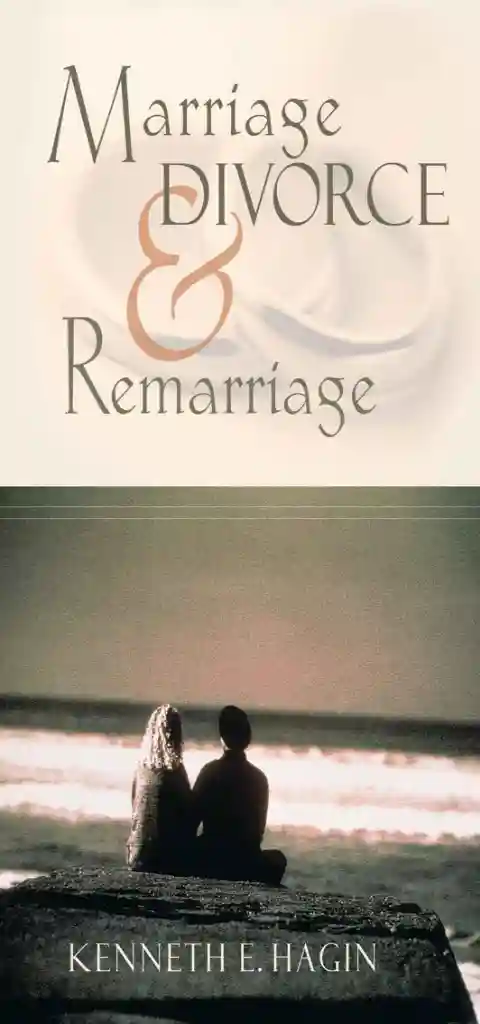

Marriage, Divorce, And Remarriage Order Printed Copy
- Author: Kenneth E. Hagin
- Size: 1.29MB | 154 pages
- |
Others like marriage, divorce, and remarriage Features >>
-160.webp)
Marriage Matters (Extraordinary Change Through Ordinary Moments)
Journey To The Altar - A Marriage Preparation Guidebook

Preparing For Marriage
A Marriage Without Regrets
Marriage On The Rock - God's Design For Your Dream Marriage
%20by%20Derek%20Prince-160.webp)
Marriage Covenant: The Biblical Secret For A Love That Lasts
Pathway To Christian Marriage

A Miracle For Your Marriage
The Story Of Marriage
This Momentary Marriage
About the Book
"Marriage, Divorce, And Remarriage" by Kenneth E. Hagin is a comprehensive guide that explores the biblical perspective on marriage, divorce, and remarriage. The book offers practical advice and insights on how to build a successful marriage, navigate through a divorce, and move forward with confidence in the event of a remarriage. Hagin provides clear and straightforward guidance based on scriptural principles, making this a valuable resource for individuals seeking to understand and strengthen their relationships.
Susannah Spurgeon
He Called Death Sweet Names
To me Erwin Rudolph will always be Dr. Rudolph. He was my professor and, when I was in college, I revered professors. But with all the reverence, he was a gentle rock of stability for this nervous, insecure sophomore, who that year — 1965 — declared an English major at Wheaton College. One of the reasons I was nervous and insecure was that I read so slowly. I knew I could not read a lot of long books in one semester, so I never took a lit class on “The Novel.” Instead I took poetry classes. That meant three classes with Dr. Rudolph: Pre-Renaissance, English Renaissance, and Eighteenth Century. In these classes, I did not have to read huge books. Instead I had to read poems really carefully — even memorize some. Dr. Rudolph required that we memorize and recite 42 lines of Chaucer in the original Middle English. This was terrifying to me. I was too nervous to speak in front of a whole class. Mercifully and patiently, Dr. Rudolph took the time to let me recite the lines to him alone in his office. He became my faculty adviser in the fall of 1965 and shepherded me through to graduation in the spring of 1968. I loved his classes. One reason is that he cared about substance, not just form. He cared about meaning and truth, great truth. To this day, the poets I love most (George Herbert, John Donne, Alexander Pope) are the ones who care about beauty and truth. Form and substance. Craft and content. I met these masters first in Dr. Rudolph’s classes. He awakened me to a world of truth and beauty in poetry which I did not know existed. I sought his counsel even after I left Wheaton. Although I sensed a vocational call to Scripture and went on to seminary after college, I was not sure if I could be a preacher, and I pondered for a year or two the serious possibility of following in Dr. Rudolph’s steps by getting a Ph.D. in English, and becoming a theologically serious English teacher. That didn’t happen. I think Dr. Rudolph was okay with that choice. His counsel was always balanced. He probably saw that my slow reading ability did not suit me well for an academic career in literature! My dominant memory of Dr. Rudolph is the one most relevant to his own death. Zeke, Dr. Rudolph’s son, was in my wife’s class at Wheaton, a year behind me. Zeke died of Multiple Sclerosis in August of 1969, three months after his graduation. I remember the very room I was in at my parents’ house when I read Dr. Rudolph’s tribute to Zeke. There was one immortal line that I have returned to again and again — as I return to it again now at Dr. Rudolph’s own death: “Near the end Zeke called death sweet names.” It has been almost 50 years, and I have not forgotten these words, nor the man who spoke them. I didn’t know Zeke. But I knew his father. And what an impact his farewell to his son had on me. It was full of sober sorrow in the face of the horrors of death, but also full of confidence that Zeke had not lived in vain, or died without hope. The same is true now for my professor, Dr. Rudolph. He did not live in vain. And he did not die without hope. Perhaps I should let him have the last word of triumph. In his book, Good-by, My Son , he wrote, We do not pretend to understand why God’s time-table differs so markedly from our own. But it was ours which was out of adjustment, not his. . . . I strongly affirm that belief in Divine Providence affords the Christian an undergirding he can ill afford to lose. I also discover that God may personally allow suffering to come upon us for reasons which please him. When he does, we ought not to demur, for God knows what is best for us. With deep love and appreciation, I say, Amen.