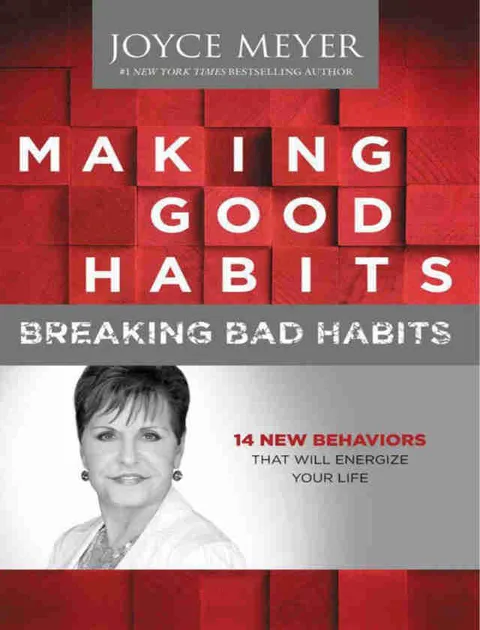

Making Good Habits, Breaking Bad Habits Order Printed Copy
- Author: Joyce Meyer
- Size: 844KB | 214 pages
- |
Others like making good habits, breaking bad habits Features >>

-160.webp)




About the Book
"Making Good Habits, Breaking Bad Habits" by Joyce Meyer explores the power of habits in shaping our lives and offers practical advice on how to develop positive habits and break negative ones. Meyer encourages readers to take responsibility for their choices and provides guidance on how to cultivate lasting change in their behavior. The book serves as a motivational guide for individuals seeking to improve their habits and create a more fulfilling life.
Reinhard Bonnke
 Reinhard Bonnke (19 April 1940 - 7 December 2019) was a German-American Pentecostal evangelist, principally known for his gospel missions throughout Africa. Bonnke had been an evangelist and missionary in Africa since 1967. In Nigeria’s city, Lagos, in 2000, a single service is believed to have been attended by 1.6 million people. Christ for all Nations (CFAN), an organisation founded by Bonnke, claims he preached Christ to more than 79 million non believers.
Early life
Reinhard Bonnke was born on 19 April 1940, in the city of Königsberg, East Prussia, Germany, the fifth son of Hermann Bonnke, an army logistics officer in the Reichswehr who fought on the Eastern Front; his paternal grandfather was August Bonnke, the owner of a windmill in Trunz, East Prussia (now Milejewo, Poland), who was healed of an unknown ailment by the evangelist Luis Graf in 1922, but died during the evacuation of East Prussia in 1945. His mother was Metaa Bonnke (née Scheffler). Bonnke had six siblings: Martin, Gerhard, Jurgen, Peter and Felicitas, his only younger sibling and his only sister.
With his mother and siblings, he was taken to Denmark during the evacuation of East Prussia and spent some years in a displaced persons centre before settling in Gluckstadt, West Germany. After his own war service, his father became a pastor in the village of Krempe. He became a born-again Christian at the age of nine after his mother spoke with him about a sin that he had committed. He sensed a call from God to serve as a missionary in Africa from the age of 10 and said that he had the experience of baptism in the Holy Spirit.
Bonnke studied at the Bible College of Wales in Swansea, Wales, UK, where he was inspired by the director, Samuel Rees Howells. In one meeting Howells spoke of answered prayer; after this meeting, Bonnke prayed, "Lord, I also want to be a man of faith. I want to see your way of providing for needs." Passing through London, he had a chance meeting with the preacher George Jeffreys. As he walked, he came across a house with a nameplate on the front that said “George Jeffreys”. He wondered if it could be the great George Jeffreys who had founded the Elim Pentecostal churches in Ireland and England. He prayed for the young student and imparted grace to him.
After graduation, he pastored in Germany for seven years, including establishing a congregation in Flensburg which met in a former rum factory.
African mission
His work in Africa began in 1967. He arrived in South Africa and almost immediately encountered the apartheid system, which he developed an antipathy towards, which in turn caused friction between him and the minister who oversaw him in South Africa. Bonnke subsequently accepted a position to oversee three churches in Lesotho, but began again from scratch after he discovered that unbiblical practices had emerged in the congregations he was to oversee.
In the first few years of his work, Bonnke encountered poor results from his evangelistic efforts and felt frustrated at the pace of his ministry. Then he had a recurring dream featuring a picture of the map of Africa being splattered with blood and heard the voice of God crying "Africa Shall Be Saved". This ultimately led him to adopt large-scale evangelism, rather than the traditional small-scale missionary approach. He rented a stadium in Gaborone, Botswana, and preached with little cooperation from local churches. The first meetings saw about 100 people attending, but this number grew swiftly.
In 1974, Bonnke founded the mission organisation Christ for all Nations (CfaN). Originally based in Johannesburg, South Africa, the headquarters were relocated to Frankfurt, Germany, in 1986. This was done primarily to distance the organisation from South Africa's apartheid policy at the time.[9] Today CfaN has 9 offices across 5 continents.
Bonnke began his ministry holding tent meetings that accommodated large crowds. According to an account published by the Christian Broadcasting Network, in 1984 he commissioned the construction of what was claimed to be the world's largest mobile structure - a tent capable of seating 34,000; this was destroyed in a wind storm just before a major meeting and therefore the team decided to hold the event in the open air instead. According to this account, the event was subsequently attended by over 100,000 people which is far greater than the 34,000 seating capacity the tents could have contained. For various reasons, usually due to insufficient capacity, the 34,000-seat tent was only used once, in Harare, Zimbabwe, in 1986.
In addition to South Africa, Bonnke would also hold many campaigns in other African countries including Nigeria and Kenya and became known as "the Billy Graham of Africa." In the 5 February 2001 edition of Graham's Christianity Today, journalist Corrie Cutrer stated that Bonnke had set "record-breaking attendances" at recent events he held in Nigeria. Bonnke announced his "farewell gospel crusade" to be held in Lagos, Nigeria, in November 2017. Lagos is also the location of a gospel crusade held in 2000 which, according to CfaN, is the organization's largest to date, drawing an attendance of six million people in a 5-night crusade, and as much as 1.6 million attendance in one day. In 2009 Bonnke appointed his successor, Daniel Kolenda who continues to lead the ministry. In 2020, following Bonnke's death, Christ for all Nations launched the CfaN Evangelism Bootcamp. In 2022 Schools of Evangelism were started in South Africa, and Europe and Fire Camps were launched in dozens of nations on six continents. Today, more than 4,000 evangelists have been trained by Christ for all Nations and more than 91-million decisions for Christ have been counted. In 2024, in the 50th year of the ministry, CfaN is conducting 50 gospel crusades throughout the African continent.
Persecution
Kano riots, subsequent expulsion from Nigeria, and return to the country
In 1991, during Bonnke's visit to Kano in Nigeria, there were riots in the city as Muslims protested over remarks he had reportedly made about Islam in the city of Kaduna on his way to Kano. A rumour was spread that Bonnke was planning to "lead an invasion" into Kano. Muslim youths gathered at the Kofar Mata Eide-ground where they were addressed by several clerics who claimed that Bonnke was going to blaspheme Islam. About 8,000 youths gathered at the Emir's palace and after noon prayers the riots ensued, during which many Christians sustained various injuries and several churches were burned. Official reports state that at least eight people were killed, although other research and reports place the number as being as much as 500 as many of the Christians who were killed were thrown into wells and the attacks were spread between multiple locations.
Despite the state governor absolving Bonnke of any blame for the incident, Bonnke's subsequent attempts to return to Nigeria were denied, as the Nigerian Embassy refused his visa applications. In 2000, a new civilian government in Nigeria was elected to power, and President Olusegun Obasanjo, a Christian, invited Reinhard Bonnke to return to the country. Bonnke returned to Nigeria and held a crusades in Benin City in the south. He would deny reports that the Northern Region of Nigeria's Council of Ulamas banned him from entering northern Nigeria.
Bonnke held many crusades in Nigeria after 2000, and conversion rates were significantly higher than in many other African nations, with one campaign achieving a conversion of 1.1 million people. Nigeria would be where his final international crusade would be held, in Lagos in 2017.
Personal life
After graduating from the Bible College of Wales and returning to Germany, Bonnke led a series of meetings in Rendsburg. He began receiving speaking invitations from all around Germany and the rest of the world. Bonnke met Anni Suelze at a gospel music festival and admired the grace which she showed when a mistake led to her losing a music competition. He offered to preach at the church she attended and over time they fell in love. They married in 1964 and had three children: Kai-Uwe Friedrich, known as "Freddy", Gabrielle and Suzanne.
Death
Bonnke died on 7 December 2019. The month before, he had announced on his official Facebook page that he had undergone femur surgery and needed time to "learn how to walk again". Nigerian President Muhammadu Buhari, who is Muslim, praised Bonnke for his frequent visits to Nigeria and described his death as a "great loss to Nigeria".
His appointed successor is the evangelist Daniel Kolenda.
He would be buried in Gotha, Florida's Woodlawn Memorial Park, with his memorial stone being shaped to resemble Africa.
Reinhard Bonnke (19 April 1940 - 7 December 2019) was a German-American Pentecostal evangelist, principally known for his gospel missions throughout Africa. Bonnke had been an evangelist and missionary in Africa since 1967. In Nigeria’s city, Lagos, in 2000, a single service is believed to have been attended by 1.6 million people. Christ for all Nations (CFAN), an organisation founded by Bonnke, claims he preached Christ to more than 79 million non believers.
Early life
Reinhard Bonnke was born on 19 April 1940, in the city of Königsberg, East Prussia, Germany, the fifth son of Hermann Bonnke, an army logistics officer in the Reichswehr who fought on the Eastern Front; his paternal grandfather was August Bonnke, the owner of a windmill in Trunz, East Prussia (now Milejewo, Poland), who was healed of an unknown ailment by the evangelist Luis Graf in 1922, but died during the evacuation of East Prussia in 1945. His mother was Metaa Bonnke (née Scheffler). Bonnke had six siblings: Martin, Gerhard, Jurgen, Peter and Felicitas, his only younger sibling and his only sister.
With his mother and siblings, he was taken to Denmark during the evacuation of East Prussia and spent some years in a displaced persons centre before settling in Gluckstadt, West Germany. After his own war service, his father became a pastor in the village of Krempe. He became a born-again Christian at the age of nine after his mother spoke with him about a sin that he had committed. He sensed a call from God to serve as a missionary in Africa from the age of 10 and said that he had the experience of baptism in the Holy Spirit.
Bonnke studied at the Bible College of Wales in Swansea, Wales, UK, where he was inspired by the director, Samuel Rees Howells. In one meeting Howells spoke of answered prayer; after this meeting, Bonnke prayed, "Lord, I also want to be a man of faith. I want to see your way of providing for needs." Passing through London, he had a chance meeting with the preacher George Jeffreys. As he walked, he came across a house with a nameplate on the front that said “George Jeffreys”. He wondered if it could be the great George Jeffreys who had founded the Elim Pentecostal churches in Ireland and England. He prayed for the young student and imparted grace to him.
After graduation, he pastored in Germany for seven years, including establishing a congregation in Flensburg which met in a former rum factory.
African mission
His work in Africa began in 1967. He arrived in South Africa and almost immediately encountered the apartheid system, which he developed an antipathy towards, which in turn caused friction between him and the minister who oversaw him in South Africa. Bonnke subsequently accepted a position to oversee three churches in Lesotho, but began again from scratch after he discovered that unbiblical practices had emerged in the congregations he was to oversee.
In the first few years of his work, Bonnke encountered poor results from his evangelistic efforts and felt frustrated at the pace of his ministry. Then he had a recurring dream featuring a picture of the map of Africa being splattered with blood and heard the voice of God crying "Africa Shall Be Saved". This ultimately led him to adopt large-scale evangelism, rather than the traditional small-scale missionary approach. He rented a stadium in Gaborone, Botswana, and preached with little cooperation from local churches. The first meetings saw about 100 people attending, but this number grew swiftly.
In 1974, Bonnke founded the mission organisation Christ for all Nations (CfaN). Originally based in Johannesburg, South Africa, the headquarters were relocated to Frankfurt, Germany, in 1986. This was done primarily to distance the organisation from South Africa's apartheid policy at the time.[9] Today CfaN has 9 offices across 5 continents.
Bonnke began his ministry holding tent meetings that accommodated large crowds. According to an account published by the Christian Broadcasting Network, in 1984 he commissioned the construction of what was claimed to be the world's largest mobile structure - a tent capable of seating 34,000; this was destroyed in a wind storm just before a major meeting and therefore the team decided to hold the event in the open air instead. According to this account, the event was subsequently attended by over 100,000 people which is far greater than the 34,000 seating capacity the tents could have contained. For various reasons, usually due to insufficient capacity, the 34,000-seat tent was only used once, in Harare, Zimbabwe, in 1986.
In addition to South Africa, Bonnke would also hold many campaigns in other African countries including Nigeria and Kenya and became known as "the Billy Graham of Africa." In the 5 February 2001 edition of Graham's Christianity Today, journalist Corrie Cutrer stated that Bonnke had set "record-breaking attendances" at recent events he held in Nigeria. Bonnke announced his "farewell gospel crusade" to be held in Lagos, Nigeria, in November 2017. Lagos is also the location of a gospel crusade held in 2000 which, according to CfaN, is the organization's largest to date, drawing an attendance of six million people in a 5-night crusade, and as much as 1.6 million attendance in one day. In 2009 Bonnke appointed his successor, Daniel Kolenda who continues to lead the ministry. In 2020, following Bonnke's death, Christ for all Nations launched the CfaN Evangelism Bootcamp. In 2022 Schools of Evangelism were started in South Africa, and Europe and Fire Camps were launched in dozens of nations on six continents. Today, more than 4,000 evangelists have been trained by Christ for all Nations and more than 91-million decisions for Christ have been counted. In 2024, in the 50th year of the ministry, CfaN is conducting 50 gospel crusades throughout the African continent.
Persecution
Kano riots, subsequent expulsion from Nigeria, and return to the country
In 1991, during Bonnke's visit to Kano in Nigeria, there were riots in the city as Muslims protested over remarks he had reportedly made about Islam in the city of Kaduna on his way to Kano. A rumour was spread that Bonnke was planning to "lead an invasion" into Kano. Muslim youths gathered at the Kofar Mata Eide-ground where they were addressed by several clerics who claimed that Bonnke was going to blaspheme Islam. About 8,000 youths gathered at the Emir's palace and after noon prayers the riots ensued, during which many Christians sustained various injuries and several churches were burned. Official reports state that at least eight people were killed, although other research and reports place the number as being as much as 500 as many of the Christians who were killed were thrown into wells and the attacks were spread between multiple locations.
Despite the state governor absolving Bonnke of any blame for the incident, Bonnke's subsequent attempts to return to Nigeria were denied, as the Nigerian Embassy refused his visa applications. In 2000, a new civilian government in Nigeria was elected to power, and President Olusegun Obasanjo, a Christian, invited Reinhard Bonnke to return to the country. Bonnke returned to Nigeria and held a crusades in Benin City in the south. He would deny reports that the Northern Region of Nigeria's Council of Ulamas banned him from entering northern Nigeria.
Bonnke held many crusades in Nigeria after 2000, and conversion rates were significantly higher than in many other African nations, with one campaign achieving a conversion of 1.1 million people. Nigeria would be where his final international crusade would be held, in Lagos in 2017.
Personal life
After graduating from the Bible College of Wales and returning to Germany, Bonnke led a series of meetings in Rendsburg. He began receiving speaking invitations from all around Germany and the rest of the world. Bonnke met Anni Suelze at a gospel music festival and admired the grace which she showed when a mistake led to her losing a music competition. He offered to preach at the church she attended and over time they fell in love. They married in 1964 and had three children: Kai-Uwe Friedrich, known as "Freddy", Gabrielle and Suzanne.
Death
Bonnke died on 7 December 2019. The month before, he had announced on his official Facebook page that he had undergone femur surgery and needed time to "learn how to walk again". Nigerian President Muhammadu Buhari, who is Muslim, praised Bonnke for his frequent visits to Nigeria and described his death as a "great loss to Nigeria".
His appointed successor is the evangelist Daniel Kolenda.
He would be buried in Gotha, Florida's Woodlawn Memorial Park, with his memorial stone being shaped to resemble Africa.
the spiritual gift of a closed door
Sometimes God makes us wait for doors to open in ministry because unwanted waiting is some of the best preparation for ministry. By the fall of 2008, I already knew I wanted to be a pastor. It was my senior year at Wake Forest University. I had wondered whether I might be a high school teacher, so I had tried a couple of education classes. Thinking I might go into ministry, though, I also signed up for one memorable course in the divinity school, on the apostle Paul and his letters. The course was taught by a universalist lesbian. On the last day of class, she handed back our final papers and told me she thought I should consider Christian ministry. It was almost enough to convince me not to. No, very much despite my experience in the divinity school, I still wanted to be pastor, largely because I had watched teenagers’ eyes light up, again and again, while we read about Jesus in the Gospel of John together. I came to faith through the ministry of Young Life, and then volunteered with the ministry throughout college. I spent much of my free time at East Forsyth High School, watching JV soccer games, playing ping pong, and telling 14- and 15-year-olds what God had done for me. I never felt more alive than when I was watching God use something in his word to set the filaments of their minds on fire. After that one class, I stayed plenty clear of the divinity school, and decided to major in business with a minor in ancient Greek (probably the only one in my class to do that). When I graduated in 2008, I knew I needed more training to learn how to handle the Bible faithfully, so I went straight to Bethlehem College & Seminary, where I graduated in 2012. Now ten years later, I’m still not a pastor. Humility in Ministry Now, to say I’m not yet a pastor is not to say that God hasn’t opened real doors for ministry. He clearly has. This article itself is but one sweet and unexpected evidence. But I’m not yet leading in the ways I thought I would be by now, which has given me a chance to reflect on why that might be. Why might God give me an ambition to lead, and bring solid confirmation of character and ability, and yet withhold certain opportunities to lead? Because sometimes unwanted waiting is some of the best preparation for ministry. “How many men have been given too much authority, too soon, and fallen headlong into the hands of hell?” When the apostle Paul laid out what kind of man a pastor must be, he wrote, “An overseer, as God’s steward, must be above reproach. He must not be arrogant . . .” (Titus 1:7). Does arrogance feel spiritually dangerous, even ruinous, to you? Paul said the same to young Timothy: “He must not be a recent convert, or he may become puffed up with conceit and fall into the condemnation of the devil” (1 Timothy 3:6). Is anything more dangerous to a ministry — or to a soul — than unchecked pride? How many men have been given too much authority, too soon, and fallen headlong into the hands of hell? The priceless gift of unwanted waiting in ministry is humility. A ministry without humility may seem to flourish for a time, but (as we’ve witnessed again and again) it ultimately harms those it claims to serve. Pride slowly erodes a ministry until it suddenly collapses on all involved. How kind of God, then, to save churches, families, and souls, by making some men wait until they can kneel low enough to lead well? Cheerful in the Shadows One of the best ways we can steward a season of waiting to shepherd is to learn to be a model sheep. Pastors worth following, after all, are always examples worth imitating. “Shepherd the flock of God that is among you,” the apostle Peter writes, “exercising oversight, not under compulsion, but willingly, as God would have you; not for shameful gain, but eagerly; not domineering over those in your charge, but being examples to the flock ” (1 Peter 5:2–3). So what kind of example are you becoming? Bobby Jamieson offers this counsel to aspiring leaders like me along these lines: What good deeds do you do that are seen by few or none? When did you last volunteer for a menial task? Which title means more to you, “brother,” which you are, or “pastor,” which you hope to be? Is being a servant your idea of greatness? One of the best things an aspiring pastor can do is serve outside the spotlight. Give elderly members rides to church. Serve in the nursery. Teach children Sunday school. Volunteer to serve food at, and clean up after, the wedding reception of a couple of church members you barely know. Everybody wants to be a servant until they get treated like one. Pastors not only are servants; they get treated like servants. Prepare yourself now for both the work and its reception by serving others. The best preparation for the spiritual trials of the spotlight is serving cheerfully in the shadows. ( The Path to Being a Pastor , 134) “One of the best ways we can steward a season of waiting to shepherd is to learn to be a model sheep.” How are you stewarding the shadows? If we could see how well these days were preparing us for the darker days of ministry ahead, we’d treasure the quiet, hidden work God is doing in and through us while we wait. Keep the Room Clean As I traveled with John Piper during the years I was his ministry assistant, I heard him tell some version of one particular story many times. Each time, the scene captivated and humbled me. A significant reason I chose to come to Bethlehem College & Seminary was to sit under and learn from him. His preaching class was all I hoped for, and more. As you might imagine, he came each day brimming with some fresh insight from his devotions, eager to wrestle with us over something God had said. He had (and has) a relentless appetite for uncovering reality in Scripture and pressing it into human hearts, especially his own. Those hours were intense and refreshing, serious and exciting. I came away wanting to see all he could see in God’s word. So, having had him as a teacher, and having admired him as a teacher, and having wanted to be a teacher like him, I leaned in all the more when he would tell this particular story. When I was in seminary, I said to John McClure, the head of the youth department at Lake Avenue Congregational Church, “I’m available, and I’ll do whatever you want me to do.” And he said, “Well, we need a seventh-grade boys Sunday school teacher this year.” I said, “Count me in.” I poured my life into those boys. There were about nine of them. . . . Four hours every Saturday afternoon I worked on my lesson. And at the end of that year, I said, “Now what do you want me to do, the same thing?” He said, “No, now we need a ninth-grade teacher.” So I said, “Okay,” and I jumped over a class and taught ninth grade. Midway through that year, the Galilean Sunday School Class of young married couples said, “We would like you to teach our class if they can do without you teaching the youth.” This is the way it’s gone my whole life. My dad said, “Keep the room clean where you are, son, and he’ll open the door when the next one’s ready.” I would pay to watch those nine 12-year-old boys under the waterfall of a young Piper’s love for Jesus. The story sticks with and sobers me because of how much someone as gifted as he is poured into just a few kids week after week. Hours of thinking, praying, and preparing for a tiny crowd of preteens (who could probably care less how much time he spent). I can picture what those lessons were like — John, with all he had, trying hard to creatively capture their wandering attention with the beauty and worth of God. Am I that faithful in the quiet, secret ministries God has given me? The story inspires me, though, because it reminds me that greater fruitfulness and responsibility in ministry often grow out of faithfulness in secret places. Are You Faithful in Little? While I traced the threads of humility, leadership, and waiting in Scripture, it dawned on me that, in one sense, our entire lives are one brief season of training for an eternity of ministry. Listen to how Jesus explains the parable of the talents: It will be like a man going on a journey, who called his servants and entrusted to them his property. To one he gave five talents, to another two, to another one, to each according to his ability. . . . Now after a long time the master of those servants came and settled accounts with them. And he who had received the five talents came forward, bringing five talents more, saying, “Master, you delivered to me five talents; here, I have made five talents more.” His master said to him, “Well done, good and faithful servant. You have been faithful over a little; I will set you over much. Enter into the joy of your master.” (Matthew 25:14–21) At the end of the age, he’ll say, “You have been faithful over a little; I will set you over much.” Not , “You have been faithful over a little, and I have nothing else for you to do,” but, “You have been faithful over a little in this life, and I have so much more for you to do in the next.” Even the largest, most well-known ministries are small and brief next to all Jesus will one day entrust to us — if we’re faithful with the talents we have. So, while you wait for some door to open, be as faithful as you can be with whatever work, however seemingly small, God has entrusted to you for now.