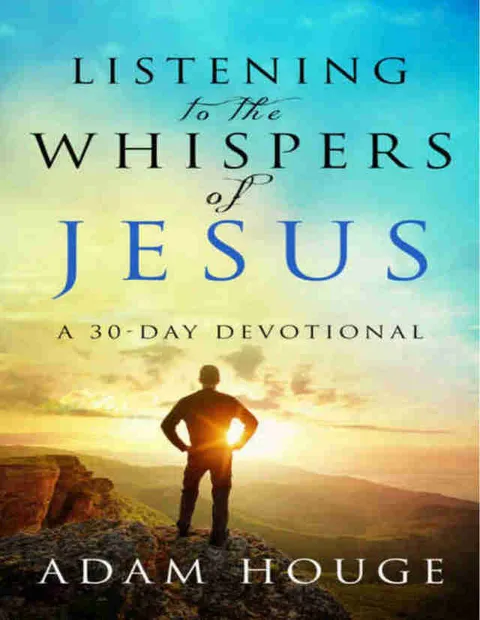

Others like listening to the whispers of jesus Features >>
Listening To God

Center Of The Universe Too
Experiencing The Words Of Jesus
Knowing The Heart Of God - A Year Of Daily Readings
Fixing My Eyes On Jesus Daily
Trusting God In Times Of Adversity
Hungry For More Of Jesus
Finding Intimacy With Jesus Made Simple
Gleanings In The Fields Of Boaz
Experiencing The Depths Of Jesus Christ
About the Book
"Listening to the Whispers of Jesus" by Adam Houge explores the importance of developing a closer relationship with Jesus through prayer and listening to His guidance. The book offers practical tips and insights on how to tune into God's voice and follow His will in our daily lives.
Jackie Hill Perry
Jackie Hill Perry has a way with words, and people can’t stop listening. A gifted poet, rapper, writer, and teacher, she has written books and Bible studies, released hip-hop albums, and taught at events, conferences, colleges, and coliseums all over the nation. Inspired by her powerful testimony of salvation and deliverance from a gay lifestyle and her teaching on the holiness of God, the word is out: God is good, He is Lord, and those who surrender to Him are made new.
The Power of God
It’s a message Jackie is passionate about because she knows firsthand the transformational power of Jesus Christ. She and her husband — fellow spoken-word artist, Preston Perry — met in 2009 while performing at an artist’s showcase. Impressed with Jackie’s poetry, Preston struck up a friendship that deepened over the years. Eventually, they began dating, which presented significant challenges but also great rewards. The Lord used Preston as a source of healing, and marriage forced Jackie to deal with hurts and fears she’d been reluctant to give to God. The couple, who reside in Atlanta, married in 2014. They are now the parents of three daughters: Eden, Autumn, and Sage; and are expecting a son.
A decade ago, Jackie could never have imagined marriage, motherhood, and ministry in her future. Violated and abandoned by men who should have loved and protected her, Jackie was hurting. Fear and distrust kept watch over her heart. Surrender wasn’t an option, even when a loving God promised her new life. Despite some exposure to church and to Scripture, Jackie was adamant that she would never submit to Jesus as Lord.
Her attraction to women started in early childhood and intensified during adolescence. Jackie finally gave in to same-sex desires, along with drugs and other habits that brought comfort, pleasure, and an emotional escape. Suppressing her femininity by wearing men’s clothing and assuming the male role in dating relationships, Jackie says every area of her life was characterized by sin and rebellion against God.
Then one evening, 19-year-old Jackie felt the conviction of the Holy Spirit. Recalling the experience, she says, “It was a God thing. No one can ever tell me that I saved myself. I had some understanding of Jesus and obedience and Christianity. But I sincerely wanted nothing to do with God on His terms.”
Even as she resisted, Jackie clearly sensed the Lord speaking to her. “When He showed me that all of my sin would be the death of me — that it was true that the wages of sin is death, but it was equally true that God offered eternal life if I would repent and believe — I was compelled to trust Him. For the first time in my life, I knew that God was real and He was worth it. Just the day before, my heart was hard as a rock, and now I wanted Jesus. Only the Holy Spirit could have done that.”
“For the first time in my life, I knew that God was real and He was worth it. Just the day before, my heart was hard as a rock, and now I wanted Jesus. Only the Holy Spirit could have done that.”
The Power of Words
Jackie dove into God’s Word and began discovering the woman He designed her to be — mind, body, and spirit. Seeking to express herself in deeper, more artistic ways, she began writing poetry. Jackie didn’t shy away from revealing her past or the ongoing struggle with temptation and sin. Her poems unflinchingly spoke gospel truth and glorified God as the ultimate source of love and life. After connecting with the Passion for Christ Movement (P4CM), Jackie was asked to write a poem about being an ex-lesbian. Hesitant at first, she felt the Lord prompting her to move forward. Through its confessional lyrics and rock-solid theology, My Life as a Stud shined a spotlight on Jackie’s conversion and marked the beginning of her public ministry.
“When My Life As a Stud came out in 2009, so many gay and lesbian people who didn’t go to church, didn’t trust Christians, and didn’t want to have anything to do with the Bible clicked on the poem and suddenly wanted Jesus. I realized God had given me this art form where I’m able to speak to people’s hearts.”
Since then, she has taken the message of God’s love to artist showcases, faith-based conferences, college campuses, and major media outlets. The foundation of her message is always the Word of God: In His goodness, God created male and female. As the perfect designer of gender and sexuality, God is worthy of trust and obedience. Although same-sex attraction is central to her testimony, Jackie emphasizes that the church should approach the LGBTQ community the same way it approaches other people. Everyone is created to be an image-bearer of the living God with a unique identity and great worth. Rather than labeling someone as “a gay friend,” it’s important to develop genuine, one-on-one relationships the same way Jesus did. By investing in authentic friendships, Christians will be able to share the gospel because they’re actually modeling it.
The Power of Redemption
Jackie points out that being “dead in sin” goes far beyond someone’s sexual preference. Without Christ, people are lost in every way. But when Jesus gives new life, He forgives and redeems the whole person. She says, “God saved me from sin, not just my sexuality. I was an all-around sinful person. In essence, sin was my lord. As much as I loved women in a lustful way, I also loved pornography and drugs, bitterness and unforgiveness.”
Through discipleship, Jackie recognized the holistic nature of God’s redemption. “I’ve learned that pride is one of my greatest struggles, even more so than same-sex attraction,” she explains. “Pride manifests itself in so many areas of my life, it’s hard to keep up. God didn’t just rescue me from being gay. He saved me from believing I’m a better lord than He is.” In response to the growing debate over same-sex attraction and the frequent questions she receives when people hear her testimony, Jackie wrote her first book, Gay Girl, Good God, to serve three core groups: people seeking to help and understand those within the LGBTQ community; people within the community who may disagree with some of her conclusions but are still intrigued; and people who are believers, yet have same-sex attraction and are trying to figure out how to love Jesus while dealing with those feelings.
When asked what she hopes the church learns from the book, she says, “I want people to see that how you reach the LGBTQ community is the same way you reach anybody — with the gospel. The gospel is about God. The method shouldn’t be any different when you’re speaking to someone who is dealing with gluttony or lying or lust. It’s all the same. God is Lord, He’s Master, He’s King, He’s able to save. And the problem with sin is always a problem between us and God.”
"God is Lord, He’s Master, He’s King, He’s able to save. And the problem with sin is always a problem between us and God."
The Power of Community
Jackie hopes the church will develop greater empathy for same-sex individuals and recognize how difficult it is to walk away from the gay lifestyle. She says, “It’s not a random sin that is easily put off. The feelings are real, and it takes time and work and a long process of dying to self.” Without a supportive church family to encourage and affirm her, the author might have fallen away. The first couple of years as a Christian were the hardest. Jackie had to learn to put off the old nature and put on Christ. The process required spiritual and physical discipline. She had to shop for women’s clothing, an experience that made her feel strange, vulnerable, and afraid.
Temptation was a constant source of condemnation, at times pushing Jackie into depression and doubt as she grieved over her sinful nature. After a decade of growing in Christ, Jackie still faces temptations but says they’re more subtle and easier to flee. Instead of looking at women as objects of lust, she chooses to see them as image-bearers of God. In evaluating her walk with the Lord, she considers whether she is loving people well, growing in holiness, and bearing good fruit. And she looks to Jesus, who endured the horror of the cross because He loved God with all of His heart. Knowing Jesus didn’t want the cup of suffering, yet accepted it with humility, helps Jackie run the Christian race with endurance.
Endurance and spiritual growth became the inspiration for Jackie’s second album, Crescendo, which was hailed as “stunning,” “flawless,” and arguably “the best hip-hop album of the year.” Although she began experimenting with rap simply for creative expression, Jackie soon saw it as another platform to share the gospel. When asked about the album’s title, the talented artist says, “In music theory, ‘crescendo’ means the increase in sound. So I wanted to apply that to faith. When you’re in Christ, as your faith increases, your fruit should get louder. You love more, you’re more generous, more attentive to the needs of people. You listen well. Things begin to change as your faith becomes more evident.”
She wrote the album to mimic that spiritual progression. The first track begins on a low note with “Lamentations,” a rap about the reality of sin and the tendency for Jackie to forget she’s been forgiven. Taking listeners through an honest exploration of spiritual growth, Crescendo ends on a high note, celebrating how the Lord saved Jackie through His gospel, initiated her Christian walk, and sustains her to this day.
The Power of Legacy
A gifted communicator and lyricist, Jackie isn’t just impacting culture with wordcraft. She’s also building a spiritual legacy for her children. Because of her childhood trauma, the idea of raising daughters was terrifying. But she’s found so much joy in becoming a mom. Jackie says, “When I think of parenthood, I know I’m only called to steward these children and disciple them and hope they will love the Lord with all their hearts, souls, minds, and strength. When I was carrying Eden, Titus 2 really spoke to me about the older women teaching the younger women.
"Once I realized what a privilege it would be to raise up a woman in my home, I welcomed the challenge.” As Jackie reflects on the last decade, she gives God all the glory and praise. Without Christ, she wouldn’t have her precious daughters, would have missed out on beautiful friendships, and would never have experienced being loved by a man for the first time in her life. “If God hadn’t rescued me, none of this would be possible,” Jackie says. “Life still has its challenges, for sure. But it’s better. It’s so much better.”
This article courtesy of HomeLife magazine.
Your First Years of Marriage
In many ways, we were a natural fit. My would-be husband and I both loved Jesus, studied his word, cherished worship through song, desired many children, longed to be hospitable, and valued the home and the wife’s joyful place in it. We both had Scandinavian heritage and understood the barbs that flew between Swedes and Norwegians. We both prized hard work — with an openness to risk-taking endeavors. As an engaged couple, with all we had going for us, it was hard for me to imagine what bumps we might face as we started down the road together. But that’s only because I underestimated how real and stubborn indwelling sin is. I thought external bumps in the road would be the obstacles — circumstances like finances or health issues or job difficulties — when really it was our own flesh that presented the biggest problems. Reflecting back on the first years of marriage and family, I commend three principles to ease the bumps and grease the wheels of joy in Christ in your marriage and family. 1. Let God Define ‘Normal’ We all come from unique backgrounds. Even two people who share a similar heritage, like my husband and I, have had vastly different childhoods. I grew up with 27 first cousins. I became an aunt at 14 and can’t really remember a time we didn’t have young children around our home (even though I was the youngest child in my family). My husband had four cousins and had rarely encountered an infant or toddler at close range prior to marrying into my family. This made for very different ideas of what “normal” felt and sounded like. I grew up on an acreage in a blue-collar town that bordered several rural communities. My mom grew up on a farm. My husband grew up in a first-ring suburb of a major metropolis. His dad grew up in the big city. We had very different conceptions of what the “outdoors” was for. For him, it was mainly for recreation and enjoyment — for hiking or biking or kayaking. For me, it was mainly for work — for mowing or burning the burn pile or doing animal chores. Our former “norms” can enrich our marriage, adding interest and laughter and providing opportunities to take something that’s been passed down and make it new. Or they can threaten the allegiance of our hearts. If what was normal to us in our childhood becomes the ultimate standard for our marriage, we have misplaced our loyalties. We need to be led by the only authoritative and inerrant guide to life and marriage that we have: All Scripture is breathed out by God and profitable for teaching, for reproof, for correction, and for training in righteousness, that the man of God may be complete, equipped for every good work. (2 Timothy 3:16–17) Including every good work in the sometimes thorny first years of marriage. In marriage, God is making something new: a new one-flesh union, that is, a new family. And when a husband and wife let God’s word define normal, the wife willingly comes under the leadership of her husband in submission, as Scripture directs her to reflect Christ’s church (Ephesians 5:22–25). Her family of origin may aid that process or hinder it, but in either case, a reprioritizing happens. For the husband, it means looking to Christ as the standard by which he loves and leads his wife, and adopting his previous family’s practices only inasmuch as they accord with Christ. “If God’s word is the norm, the authority, you will have solid common ground on which to stand, come what may.” When I was young, my mom gave me one primary piece of advice when it came to choosing a husband: “God’s word must be his authority.” It’s key advice for men and women, and I gladly pass it along to you. If God’s word is the norm, the authority — not the culture, not your friends’ opinions or your family’s traditions, not Netflix or social media — you will have solid common ground on which to stand, come what may. 2. Stay in Step with the Spirit Paul tells the Galatians, “If we live by the Spirit, let us also keep in step with the Spirit. Let us not become conceited, provoking one another, envying one another” (Galatians 5:25–26). It may seem unlikely for two people who love each other and have committed their lives to one another “for better or worse” to fall into conceit, envy, and provocation of one another — and yet it’s common enough in marriage. The lies of the world have primed us to believe that men and women are on two separate teams in life. Team Women must advocate for women, and Team Men (in a bit of irony) must also advocate for women (although many rebel against this). This means that, at least for those of us raised in the United States or the West, women are expected to compete with men. From a young age, girls are taught that how they rank is a function of whether or not they are beating the boys. This way of thinking infects both boys and girls. And while that attitude may lie dormant during dating or courtship, it will rear its head if not dealt with. In a husband, this can look like unrealistic expectations for his wife — treating her like another man who shouldn’t have any significant differences from him. For example, he may expect her to earn what he earns, or overlook the inherent vulnerability of pregnancy and caring for small children. In a wife, this can look like pulling out the measuring stick to keep track of all the ways she’s getting a raw deal compared to him. For example, she may envy the occasional out-to-eat work lunches while she eats with the kids at home, or she may resent that the care of small children falls mainly to her. These are deadly attitudes to maintain in a marriage. When we marry, the Spirit of God does something amazing: he makes us part of a new team. I was blessed to join Team Dodds — not Team Women, or Team Men, or Team Me. When something wonderful happens to the husband, the wife rejoices as though it has happened to her, because it has. When something difficult happens to the wife, the husband nurtures and defends her as though it has happened to him, because it has. How do we keep in step with the Spirit in marriage? By prayerfully and regularly confessing our sins, and by setting our minds on the things of the Spirit, with a special focus on Christ — his life, his words, and his ways (1 John 1:9; Romans 8:5). We walk in the Spirit of Christ when we conform to the way he’s designed the marriage: “‘a man shall leave his father and his mother and hold fast to his wife, and the two shall become one flesh.’ So they are no longer two but one flesh. What therefore God has joined together, let not man separate” (Matthew 19:5–6). 3. Share Your New Life with Others My husband and I were married in June 2002. By October, we were taking a class to join our local church. At the same time, we opened our home (the upstairs of a duplex) to host a small group of singles and couples. I was 21 and still finishing college. It may have seemed a bit premature for us to join a church we were so new to, or to host a small group made up of mostly strangers, but the church had a need and we were eager to help. We didn’t join the church or host a small group primarily as ways to establish a stronger marriage, but looking back, they were important in shaping the patterns and priorities of our life. “The hospitable people I know are hospitable with little and with much, in small spaces and in big.” Many young families think that hospitality will sprout when the timing is right — when they get a bigger place, or when the kids aren’t so little, or when the finances aren’t so tight, or when they get that one room cleaned out. I’ve never seen it happen that way. The hospitable people I know are hospitable with little and with much, in small spaces and in big, among babies and boomers, in a dirty kitchen and a clean one. Sharing your home with others — making food for them, stretching your grocery budget on their behalf, letting them into your bathroom, cleaning up after their messes, inviting them into your thoughts through conversation and listening to theirs — is shockingly intimate in a world where embodied presence is becoming rare. Paul tells the Thessalonian church that “being affectionately desirous of you, we were ready to share with you not only the gospel of God but also our own selves, because you had become very dear to us” (1 Thessalonians 2:8). When we invite others into our home, we give them a bit of “our own selves.” When a husband, wife, and their children offer their home and their “own selves” to others through hospitality, they are not robbing time or resources from each other; they are gaining by giving. Hospitality forms a family identity that is not navel-gazing, but focused on sharing the love of God in practical ways with others. I can think of little else that will form and establish a Christian family to be joyful and robust in the Lord for decades to come than to practice sharing your life with others. Don’t let your home or marriage or family be only private. “Welcome one another as Christ has welcomed you, for the glory of God” (Romans 15:7). A husband and wife who have made God’s word their norm and who are keeping in step with the Spirit will have much to share with others. Open your doors and welcome many to come taste of Christ’s goodness at your table. Article by Abigail Dodds