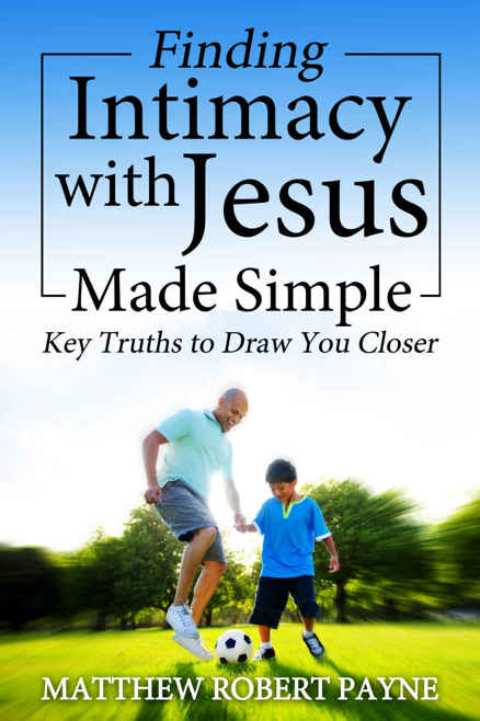

Finding Intimacy With Jesus Made Simple Order Printed Copy
- Author: Matthew Robert Payne
- Size: 218KB
- |
Others like finding intimacy with jesus made simple Features >>
Every Day With Jesus

Seeing And Savoring Jesus Christ
Fixing My Eyes On Jesus Daily
Finding Hope In The Last Words Of Jesus
Finding Favor With The King (Preparing For Your Moment In His Presence)
The Ministry Of The Psalmist (Music Ministry)

What Matters To Jesus
You'll Get Through This
The Pursuit Of His Presence
Something Good Is Going To Happen To You
About the Book
"Finding Intimacy With Jesus Made Simple" by Matthew Robert Payne is a guide for Christians seeking to deepen their connection with Jesus. The book offers practical advice and insights on how to develop a more intimate relationship with Jesus through prayer, worship, and personal reflection. It emphasizes the importance of cultivating a deep spiritual connection with Christ and provides tools for strengthening one's faith and experiencing the love of God in a deeper way.
R.C. Sproul
Robert Charles Sproul was an American theologian, author, or ordained pastor in the Presbyterian Church in America. He was also the chairman of Ligonier Ministries and also had a radio program which could be heard daily on the Renewing Your Mind radio broadcast in the United States and internationally.
His ministry Ligonier Ministries produced the Ligonier Statement on Biblical Inerrancy which would eventually grow into 1978 Chicago Statement on Biblical Inerrancy. Alongside Norman Geisler was one of the Chief Architects. Robert has been described as the greatest and most influential Proponent of the recovery of Reformed Theology in the last century.
Rc Sproul Age
He was born in Pittsburgh, Pennsylvania on February 13, 1939.
Rc Sproul Family
Sproul was the second child of Robert Cecil Sproul who was an accountant and a veteran of World War 2 and his wife Mayre Ann Sproul.
Rc Sproul Education
Sproul was a devoted supporter of the Pittsburgh Steelers and Pittsburgh Pirates as a youth. At the age of 15, he dropped out of school athletics in order to support his family. He obtained degrees from Westminister College, Pennsylvania in 1961, later Pittsburgh-Xenia Theological Seminary M.Div in 1964.
He then went to Free University of Amsterdam Drs., in 1969 and Whitefield Theological Seminary Ph.D., in 2001. Rc later taught at a number of colleges and seminaries including Reformed Theological Seminary in Orlando and in Jackson, Mississipi, and Knox Theological Seminary in Ft. Lauderdale.
Rc Sproul Wife
He married Vesta in 1960
Rc Sproul Children
They were blessed with two children namely Sherrie Darotiak and Robert Craig Sproul.
Rc Sproul Career
Ligonier Ministries hosts several theological conferences each year, including the main conference in Orlando, FL, at which Sproul was one of the primary speakers. Also served as co-pastor at Saint Andrew’s Chapel, a congregation in Sanford, Florida. He was ordained as an elder in the United Presbyterian Church in the USA in 1965, but left that denomination around 1975 and joined the Presbyterian Church in America. Sproul was also a Council member of the Alliance of Confessing Evangelicals.
Sproul was an ardent advocate of Calvinism in his many prints, audio, and video publications, and he was also known for his advocacy of the Thomistic (classical) approaches to Christian apologetics, less common among Reformed apologists, most of whom prefer presuppositionalism. A dominant theme in many of Sproul’s Renewing Your Mind lessons is the holiness and sovereignty of God.
Sproul, a staunch critic of the Roman Catholic Church and Catholic theology, denounced the 1994 ecumenical document Evangelicals and Catholics Together.
Rc Sproul Health and Death
On April 18, 2015, Sproul suffered a stroke and was admitted to a hospital. Five days later, on April 23, Dr. Sproul went home from the hospital, suffering no ill effects. He was, however, diagnosed with a diabetic condition “that be addressed through diet and regular medical attention.”
Sproul had long suffered from chronic obstructive pulmonary disease, and on December 2, 2017, he was hospitalized when his respiratory difficulties were exacerbated by flu. Despite medical efforts to restore respiratory function, he died on December 14, 2017, at the age of 78.
Some Wounds Never Heal
I didn’t realize how disorienting grief can be. In the aftermath of a dearly loved one’s death, I felt like I was living two worlds at once: one with him, and one without. My grandfather, more like a father, died on a Tuesday this past December. He “died on a Tuesday” summarizes the concussion. He died  — no longer will I see him poke his head up from his garden, or sit in the living room as he drinks in classical music. No longer will we go see movies together, study the Bible together, or go hiking up north. Death has hidden his face. And yet, it was a Tuesday . An hour after weeping with family at his side as he took his last breaths, I remember the profane intrusion: What would be for dinner?  Life, in one form or fashion, would continue without him. Tuesdays always hurry towards Wednesday. Time does not pay its respects for anyone. Our loved ones, when they die, die on Tuesdays. We Are Not the Same Their deaths, on their Tuesdays, affect our remaining Tuesdays after. Life has changed. We are changed. The death of a loved one is a blade that pierces beneath the armor, an arrow that lodges down in the soul. It brings a hurt we cannot defend, a pain we cannot forget, an injury which will never fully heal. “Alas! there are some wounds that cannot be wholly cured,” said Gandalf. “I fear it may be so with mine,” said Frodo. “There is no real going back. Though I may come to the Shire, it will not seem the same; for I shall not be the same. I am wounded with knife, sting, and tooth, and a long burden. Where shall I find rest?” Gandalf did not answer. “That old wound may never heal in this life, but Jesus will comfort us day by day and glorify our scars in the next.” Though life goes on without noticing our loss — daily broadcasts continue, people shop at grocery stores, buses come and go — we  are no longer the same. The ache will not finally leave, the groan not silence, the limp not amend until we remove the tattered garments of this life. They  are no longer with us. The loveliness of their memory is a beautiful, but long, burden cast over our remaining days. The streets we walked are haunted with laughter. We glance at their empty-chair out of habit. Though life for us has not ended, it has changed. There is no real going back. Death’s Prolonged Victims Death, I realize, often inflicts its greatest havoc upon its survivors; its primary victims do not yet lie in the grave. When my grandfather departed in the Lord, he went to a place where pain and suffering are forbidden, while our grief, on that same day, deepened. His tears finally wiped away as ours sprung forth. He is healed. Our bleeding goes on. We, not the departed, are left to wonder with the prophet, “Why is my pain unceasing, my wound incurable, refusing to be healed?” (Jeremiah 15:18). Our grief refuses to be healed, as C.S. Lewis describes, after the death of his wife, in A Grief Observed : Tonight all the hells of young grief have opened again. . . . In grief nothing “stays put.” One keeps on emerging from a phase, but it always recurs. Round and round. Everything repeats. . . . How often . . . will vast emptiness astonish me like a complete novelty and make me say, “I never realized my loss till this moment”? The same leg is cut off time after time. The first plunge of the knife into the flesh is felt again and again. Dying can be an ugly thing. But for many, the knife enters once and releases its victim. But for those left behind, the stab is repetitive. Death not only claims its victims but torments their loved ones. Where, if anywhere, shall we find rest? Pierced with Mary This heart-stabbing we feel is owned, not avoided, in the Scriptures. For one, this blade was foretold to pierce Mary decades before its advent. As Mary marveled at the prophesy given by Simeon concerning her newborn son — that he would be a light for the Gentiles and glory for Israel (Luke 2:29–32) — her wonder was interrupted by a prophesy concerning her as well: Behold, this child is appointed for the fall and rising of many in Israel, and for a sign that is opposed (and a sword will pierce through your own soul also), so that thoughts from many hearts may be revealed. (Luke 2:34–35) A sword will pierce through your own soul also. Jesus would be pierced, and Mary also . The blade entered later in the Gospels, “standing by the cross of Jesus were his mother and his mother’s sister, Mary the wife of Clopas, and Mary Magdalene” (John 19:25). She stood with her son and watched the horrible sight — she stood valiantly as the blade went in. Her beloved son, crucified upon a Roman tree in infamy and shame. The child to whom she spoke baby talk now groaned in unforgettable anguish. The child she swaddled, nursed, and held, now wrapped in death, nursed by anguish, and held up by nails which stapled his flesh to wood. “Death brings a hurt we cannot defend, a pain we cannot forget, an injury which will never fully heal.” How far through did it run when she heard him gasp through suffocation one last time on her behalf, “Woman, behold, your son!” Then he said to the disciple, “Behold, your mother!” (John 19:26–27). In his dying breath, under the wrath of men and the wrath of God, he considered her  well-being. Nails had pierced his hands and feet, and a spear now pierced his side, while a sword pierced her soul. Where Can We Find Rest? I do not mean to normalize the death of God’s own Son — it has no rival. His death is more horrific, more unthinkable, more grievous than the summation of every other death in history. But we know the soul-piercing effect of this blade when others have died as well. We see its sharpness pierce speech for seven days in the ash heap with Job and climb into the tears of Jesus at the tomb of Lazarus. And yet, while the death of our loved ones in the Lord constitute a heavy blow, it is precious  in the eyes of our Father. “Precious in the sight of the Lord is the death of his saints” (Psalm 116:15). And the reason for the preciousness is also foretold in the same verse as the piercing of soul. “Behold, this child is appointed for the fall and rising  of many in Israel” (Luke 2:34). The anastasis , the resurrection  of many. Death for God’s people is precious only because Mary’s son was appointed for their resurrection. He is the Resurrection and the Life. Death will not hide faces for long. Life After the Sword We may never return to life as it once was. That’s okay. But we must never let the old ache stop us from living. Wednesday must follow Tuesday. Here, John Piper’s counsel is timeless: “Occasionally, weep deeply over the life you hoped would be. Grieve the losses. Then wash your face. Trust God. And embrace the life you have.” Frodo asked what so many of us with missing loved ones do: Where can I find rest?  Gandalf did not answer. Jesus does: “Come to me, all who labor and are heavy laden, and I will give you rest.  Take my yoke upon you, and learn from me, for I am gentle and lowly in heart, and you will find rest for your souls ” (Matthew 11:28–29). We must go to him moment by moment, groan by groan, tear by tear. That old wound may never heal in this life, but Jesus will comfort us day by day and glorify our scars in the next.