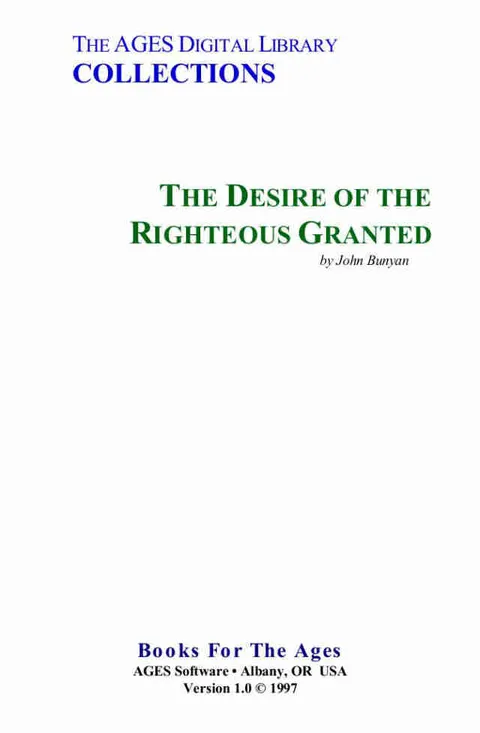

Justification By An Imputed Righteousness Order Printed Copy
- Author: J. Bunyan
- Size: 195KB | 87 pages
- |
Others like justification by an imputed righteousness Features >>
About the Book
"Justification By An Imputed Righteousness" by J. Bunyan discusses the concept of justification by faith and the imputation of Christ's righteousness to believers. Bunyan explains the biblical basis for this doctrine and its significance for salvation, emphasizing the importance of trusting in Christ alone for justification. The book serves as a theological guide for understanding the process of justification and the role of grace in God's plan of redemption.
A. A. Allen
Born in Sulphur Rock, Arkansas, in 1911, he grew up with an alcoholic father and an unfaithful mother who lived with a series of men. âBy the time I was twenty-one,â recalled Allen, âI was a nervous wreck. I couldnât get a cigarette to my lip with one hand. . . . I was a confirmed drunkard.â (Lexie Allen, Godâs Man of Faith and Power, p57, 1954). Two years later he served a jail sentence for stealing corn in the midst of the depression and thought of himself as âan ex-jailbird drifting aimlessly through life.â It was at this point that Allen was converted in a âtongues speakingâ Methodist church in 1934 He met his wife, Lexie in Colorado and she became a powerful influence in shaping him for his future ministry.
Licensed by the Assemblies of God as a minister in 1936 began an effective evangelistic ministry at a small church in Colorado. After a two year pastorate he spent four-and-a-half years during World War II, as a full-time revivalist. He was the worship leader, musician and preacher but low finances and mediocre results took their toll on this father of four children. He left the itinerant ministry in 1947 when he was offered the security of a pastorate in a stable Assemblies of God church in Corpus Christi, Texas.
Soon after moving to Texas he heard news of the revival and read a copy of âThe Voice of Healingâ magazine which he found incredulous and labelled the revivalists âfanatics.â However, in 1949, he attended an Oral Roberts campaign in Dallas where he was enthralled by Robertsâ power over the audience and left convinced that the revival was from God
Back in Texas, when his church board refused to sponsor a radio program, he resigned and began conducting revivals again with the hope that he too might develop a major healing ministry. In, He sent his first report to The Voice of Healing in May 1950, from Oakland, California, âMany say this is the greatest Revival in the history of Oaklandâ in what was to become typical AAA style.
He said, âAlthough I do not claim to possess the gift of healing, hundreds are being miraculously healed in this meeting of every known disease. I do not claim to possess a single gift of the Spirit nor to have the power to impart any gift to others, yet in this meeting, as well as in other recent meetings, all the gifts of the Spirit are being received and exercised night after night. (The Voice of Healing May 1950)
Observing the burgeoning ministry of others he noticed that the evangelists who were drawing the largest crowds were doing so under canvas. In the summer of 1951 joined the ranks of the tent ministries giving a down payment and commitment to pay off the remaining amount as the ministry grew â and it did. He established his headquarters in Dallas and in 1953 launched the Allen Revival Hour on radio. He conducted overseas campaigns in Cuba and Mexico regularly, and by1955 was broadcasting on seventeen Latin American radio stations as well as eighteen American ones.
Allenâs sanguine personality expressed itself in his enthusiastic reports, unparalleled showmanship and startling miraculous claims. He was a persuasive preacher, with a compelling presence and unusual empathy and rapport with the common people. He preached an old-time Pentecostal message with consummate skill. His message of holiness resonated in the hearts of those reared in austere Pentecostalism.
His stage presence and theatrical approach endeared him to the economically deprived working class and also to black communities. Ever the showman he made religion enjoyable and church-going fun.
But, above all, it was the power of God which attracted the huge audiences over the years. Thousands were converted in the midst of dramatic public healings and deliverances from evil spirits. Nothing was âdone in a cornerâ but all was employed to support the message that Jesus was alive and interested in the needs of ordinary people.
A. A. Allen considered himself the most persecuted preacher in the world. The Assemblies of God were not happy with his apparently questionable, or at least exaggerated, claims. His readiness to publicly counter-attack his accusers brought a continual stream of criticism and alienation from mainline Pentecostals.
But the accusation that he drank abusively was the straw that broke the camelâs back. In the fall 1955, he was arrested for drunken driving while conducting a revival in Knoxville, Tennessee. The local press took the opportunity to attack and expose Allen and the beleaguered minister forfeited his bail rather than stand trial on the charge.
Whatever the truth was Allen called the incident an âunprecedented persecutionâ aimed at ruining his ministry. As always he employed even the worst accusations to reinforce his claims that his commitment to Godâs work in Godâs way was truly from heaven, despite the fact that the Devil continually tried to destroy his ministry. His Miracle Magazine published his defense:
Allen declares that all this is but a trick of the devil to try to kill his ministry and his influence among his friends at a time when God has granted him greater miracles in his ministry than ever before. . . . If ministers pay the price of real MIRACLES today, they will meet with greater persecution than ever before. The only way to escape such persecution is to fold up and quit! But we are going on! Will you go on with us? (Miracle Magazine October, 1955)
Gordon Lindsay felt that the Voice of Healing had to take âa strong stand on ethics.â Allen resigned from the group, pre-empting their imminent dismissal. He immediately began publishing his own magazine, and, although he affected a cordial relationship with his former colleagues in the Voice of Healing, feelings remained strained.
In some ways independence suited Allen. His daughter recalled:
The Knoxville event also led to Allenâs separation from the Assemblies of God. It was suggested that he âwithdraw from the public ministry until the matter at Knoxville be settled.â Allenâs response was to surrender his credentials as âa withdrawal from public ministry at this time would ruin my ministry, for it would have the appearance of an admission of guilt.â
By the mid-1950âs many of the more moderate ministers tried to continue to work with the Pentecostal denominations â or at least to remain friendly â but Allen repeatedly attacked organized religion and urged Pentecostal ministers to establish independent churches which would be free to support the revival. He charged that the Sunday school had replaced the altar in the Pentecostal churches and that few church members were filled with the Holy Ghost:
âRevivals are almost a thing of the past. Many pastors, and even evangelists, declare they will never try another one. They say it doesnât work. They are holding âSunday School Conventions,â âTeacher Training Courses,â and social gatherings. With few exceptions the churches today are leaning more and more toward dependence upon organizational strength, and natural ability, and denominational âmethods.â They no longer expect to get their increase through the old fashioned revival altar bench, or through the miracle working power of God, but rather through the Sunday School.â
In fall 1956, Allen announced the formation of the Miracle Revival Fellowship, an alternative fellowship intended to license independent ministers and to support missions. Theologically, the fellowship welcomed all who accepted âthe concept that Christ is the only essential doctrine.â Allen urged laymen as well as ministers to join his fellowship, through his âEvery Member an Exhorter plan.â Although Allen announced that âMRF is not interested in dividing churches,â he also disclosed that âthe purpose of this corporation shall be to encourage the establishing and the maintenance of independent local, sovereign, indigenous, autonomous churches.â The fellowship listed more than 500 ministers in its âfirst ordination
Interestingly, as other ministries were struggling and the revival was waning, Allenâs charisma and ministry skills coupled with well-staged revivals and an amazingly gifted team, enabled him to re-establish his ministry and rebuild a substantial and effective work.
Miracle Magazine was resounding success. At the end of a yearâs publication in 1956, it had a paid subscription of about 200,000,and, according to Mrs. Allen, was âthe fastest growing subscription magazine in the world today.â In 1957, Allen began conducting the International Miracle Revival Training Camp, an embryonic ministerial training centre. In 1958, he was given land in Arizona where he began building a permanent headquarters and training centre. At the height of the 1958 crisis in the revival, Allen announced a five-pronged program for his ministry: tent revivals, the Allen Revival Hour radio broadcast, an overseas mission program, the Miracle Valley Training Centre, and a âgreat number of dynamic books and faith inspiring tractsâ published by the ministry. In 1958, Allen purchased Jack Coeâs old tent and proudly announced that he was moving into the âlargest tent in the world.â His old-time revivalism, up-beat gospel music and anointed entertainers continued to attract the masses.
Allan died at the Jack Tar Hotel in San Francisco, California on June 11, 1970 at the age of 59. Some claim that Allen died an alcoholic because the coronerâs report concluded Allen died from liver failure brought on by acute alcoholism. Others know that he had battled with excruciating pain from severe arthritis in his knees, for over a year. It is true that Allen had undergone surgery on one of his knees and in June of 1970, was considering surgery on the other knee. They believe that the Coronerâs Report of âfatty infiltration of the liverâ was a result of the few times he used alcohol in his last days to alleviate the excruciating pain of his arthritis.
Whatever is true of his death the life of A. A. Allen was one of extraordinary commitment to Jesus Christ which brought victory over the enemy of mankind. A. A. Allen was a true survivor. Even though the revival was declining in the late 1950âs and 1960âs his commitment to old-time faith-healing campaigns ensured the continuing testimony of signs and wonders to the next generation. He may have had his personal âquirks and foiblesâ but the testimony of thousands of the blessing they received, the enduring love for God that resulted and the demonstration of the power of the Gospel are good reasons to give God thanks for such an amazing life!
Uncommon Evangelical
It is often difficult to know how to navigate between religious factions on the right and the left. To the right may be those who emphasize good doctrine but seem to stand at armâs length from the world. To the left may be those who emphasize social engagement and activism but seem to have compromised theological fidelity. Yet we are not the first generation of evangelicals to grapple with this tension. The evangelicals of the early twentieth century also found themselves uncomfortably sandwiched between two increasing extremes. But, by Godâs providence, several evangelical theologians in the mid-twentieth century began championing a different way. The most influential of them was Carl F.H. Henry. Henry was a brilliant theologian, journalist, seminary professor, and evangelical luminary, best known as the intellectual giant who served as the first editor-in-chief of Christianity Today, the magazine founded by Billy Graham. One of the magazineâs later editors, David Neff, said, âIf we see Billy Graham as the great public face and generous spirit of the evangelical movement, Carl Henry was the brains.â More than anyone else, Henry set forth compelling intellectual arguments in favor of a new strand of evangelicalism â an evangelicalism that combined passion for right doctrine with passion for cultural engagement. Henry emphasized both evangelism and social activism. He insisted that evangelicals prioritize both theological scholarship and practical ministry training. And he modeled how to properly challenge those with whom you disagree, calling evangelicals to do so with kindness and humility. Henry gives us a blueprint for how we can be committed to both orthodoxy and orthopraxy. Fiery Bolt of Lightning Carl Ferdinand Howard Henry was born on January 2, 1913, to German immigrants and grew up in Long Island, New York. He was baptized in the Episcopal church and attended Sunday school, but religion was not important in the Henry household. After graduating high school in 1929, Henry began work as a freelance reporter. Within three years, he was the editor of a major newspaper in Long Island. He had become a âhard-nosed journalist given to pagan pleasures,â as Timothy George writes in Essential Evangelicalism (9). One day in 1933, however, Henry was sitting alone in his car during a violent storm, when a lightning strike frightened him. He described the experience like this: A fiery bolt of lightning, like a giant flaming arrow, seemed to pin me to the driverâs seat, and a mighty roll of thunder unnerved me. When the fire fell, I knew instinctively the Great Archer had nailed me to my own footsteps. Looking back, it was as if the transcendent Tetragrammaton wished me to know that I could not save myself and that heavenâs intervention was my only hope. (Confessions of a Theologian, 45â46) Soon after, Henry had a long conversation with a young evangelist named Gene Bedford. After that conversation, Henry embraced Jesus as Savior. Henry enrolled at Wheaton College in 1935, where he met Helga Bender, the daughter of Baptist missionaries. Carl and Helga married in 1940, beginning a 63-year marriage. He also developed a friendship with fellow classmate Billy Graham during his Wheaton years. Their friendship would last a lifetime and yield much fruit. After earning a BA and an MA from Wheaton as well as a BDiv and a ThD from Northern Baptist Theological Seminary, Henry pursued a PhD at Boston University. It was during his time in Boston that he strengthened his friendship with Harold John Ockenga, pastor of the historic Park Street Church. Together, Henry, Ockenga, and Graham became the three primary leaders of the resurgence of evangelicalism in the mid-twentieth century. New Kind of Evangelical Henry and Ockenga wanted to propagate a new brand of evangelicalism that avoided the social pull to both left and right extremes. The proponents of this new strand â often called neo-evangelicals â wanted to be more socially conscious than the fundamentalism of the previous decades, even as they stood for the same basic doctrines. They also were willing to work across denominational lines, hoping for a broader coalition of Christian leaders. Henry and Ockenga believed that Christianity had faltered culturally due to a lack of intellectual rigor among Christian leaders. The neo-evangelicals were convinced that if they were going to influence society, they needed to regain respect in academia. Evangelicalism would need to produce world-class scholars who could engage the elite intellectual centers, and thus âmeet theological liberals on their own ground and beat them at their own game,â as Albert Mohler puts it. With these goals in mind, Henry helped pioneer several key evangelical initiatives, including the National Association of Evangelicals (1942) and the Evangelical Theological Society (1949). In 1947, Ockenga and radio evangelist Charles Fuller launched Fuller Theological Seminary to be the flagship neo-evangelical institution, and they immediately recruited Henry to be the schoolâs founding dean. Henry remained on the faculty of Fuller until he became the first editor-in-chief of Christianity Today magazine in 1956. The magazine quickly became tremendously influential, largely due to Henryâs leadership. These initiatives led to an explosion in evangelical scholarship. Before the neo-evangelical movement, evangelicals heavily relied on nineteenth-century conservative scholarship. Evangelicals were mocked for ârelying on book reprints,â as Roger Nicole says (quoted in Awakening the Evangelical Mind, 168). However, in the second half of the twentieth century, evangelical scholars âproduced works on history, psychology, pastoral theology, homiletics, family relations, the devotional life, denominational distinctive, and scores of other subjects,â Nicole says. âThe problem in 1945 was that we had relatively few new conservative books; the problem now is that there are so many that few people can afford to purchase all those they would like to own.â As evangelical scholarship exploded, Henry led the way, earning his nickname âthe dean of the evangelicals.â Henry wrote more than forty books and countless articles, essays, and reviews throughout his career. His magnum opus was the three-thousand page, six-volume work God, Revelation, and Authority. This remarkable work thoroughly explores epistemology, divine self-revelation, hermeneutics, authority, and the nature of truth. Gregory Alan Thornbury sums up the project by saying that Henry wanted to present a theology that was âepistemologically viable, methodologically coherent, biblically accurate, socially responsible, evangelistically oriented, and universally applied.â What Can We Learn from Henry? If Henry were alive today, what might he say to modern evangelicals? An examination of Henryâs life and writings gives us insight into how he might address us. EVANGELISM Henryâs first exhortation might be toward evangelism. He writes, It would be a supreme act of lovelessness on the part of the Christian community to withhold from the body of humanity, lost in sin, the evangel that Christ died for sinners and that the new birth is available on the condition of personal repentance and faith. (Evangelicals at the Brink of Crisis, 36) Henry observed that far too many Christians had relegated evangelism to the professional evangelists â absolving themselves from any responsibility in the Great Commission by claiming that they werenât gifted for the task. During the early years of Fuller Seminary, Henryâs fervor for evangelism permeated the schoolâs culture. He fostered an âevangelistically alive missionary minded and warm collegial side of early Fuller community life,â as John Woodbridge puts it. Historian George Marsden has shared one studentâs memory of Dr. Henry often arriving to lecture at early Saturday morning seminars looking âbedraggled in an old baggy overcoat [because] he would periodically spend half the night out in Los Angeles witnessing to derelicts and helping them find shelterâ (Reforming Fundamentalism, 91). Henry was just as much an evangelist as he was a theologian or journalist. âHenry was just as much an evangelist as he was a theologian or journalist.â Henry balked at the idea that evangelism and theological studies were at odds. In his 1966 opening address to the World Congress on Evangelism in Berlin, he proclaimed the urgent need for biblically faithful theologian-evangelists. He knew that evangelistic efforts uninformed by good theology would lead to doctrinal confusion and weak discipleship. But he also knew that when theologians lack evangelistic fervor, they become too insular and persnickety. Henry challenged the delegates to âbecome theologian evangelists, rather than to remain content as just theologians or just evangelists,â John Woodbridge writes (Essential Evangelicalism, 82). JUSTICE In 1947, Henry published his most famous book, The Uneasy Conscience of Modern Fundamentalism, in response to the idea that there were only two options for Protestants: theological liberalism or a culturally detached fundamentalism. This book was a clarion call for evangelicals to reject this false dichotomy. Henry wanted evangelicals to lead the way in both theological integrity and social activism. He often said, âGod is both the God of justice and justification.â Henry believed that the most important task was âthe preaching of the gospel, in the interest of individual regeneration,â but he also believed that Christians ought to present the gospel âas the best solution of our problems, individual and socialâ (The Uneasy Conscience of Modern Fundamentalism, 89). God, in his self-revelation, gives us the best definition of justice. Therefore, Christians should be the greatest advocates for justice, on Godâs terms, in any society â presenting Godâs ways as the perfect picture of justice and righteousness. Henry writes, âEvangelicals know that injustice is reprehensible not simply because it is anti-human but because it is anti-Godâ (A Plea for Evangelical Demonstration, 14). Uneasy Conscience challenged evangelical leaders to address justice-related issues and to condemn social evils such as racism, exploitation of labor, and aggressive warfare. According to Henry, we should not be able to âlook with indifference upon miscarriages of justice in the law courts, usury, plundering the needy, failure to feed and clothe the poor, and over-charging for merchandiseâ (33). In true Kuyperian-fashion, he writes, âThe evangelical missionary message cannot be measured for success by the number of converts only. The Christian message has a salting effect upon the earth. It aims at a re-created societyâ (84). POLITICS Henry called upon more evangelicals to call out injustice in their writings, believing this would change hearts and minds. He also knew, however, that merely changing minds was not enough. To inspire societal change, he knew Christians needed to help change policies too. In his editorials, he often made arguments for specific pieces of legislation and policy changes. In Henryâs mind, it was not enough to simply get people to agree if such agreement did not lead to any practical effect. So, he was willing, as an editor, to publicly endorse specific ideas and frameworks in which the proper solutions to social ills could be found. âHenry would challenge us to cut against the harmful ideologies of both the left and the right.â The key for Henry, however, was to focus on ideas and frameworks rather than political parties. Henry would challenge us to cut against the harmful ideologies of both the left and the right. He would tell us to endorse good policies, regardless of which side of the aisle they come from, and he would warn evangelicals against becoming too loyal to one political party. Henry mostly agreed with conservative politics, but he insisted that evangelical leaders ought to avoid becoming mouthpieces for the conservative political movement in America. This put him at odds with the more conservative board members and financiers of Christianity Today, who wanted an outspoken politically conservative voice for the magazineâs editorials. This eventually cost Henry his job as editor-in-chief. Henry understood the power of politics, but he also understood the limitations too. He knew that policy changes could go only so far in the effort to reshape society. If Henry were alive today, he would exhort us to be careful to not put too much stock in political efforts. He knew that evangelicals needed to pour their greatest energies into gospel preaching and evangelism. RHETORIC Along with greater social engagement, the neo-evangelicals wanted to strike a more positive tone than the fundamentalists of the previous generation. Henry did not shy away from giving scathing warnings whenever necessary, but he often voiced striking notes of optimism and hope. In Uneasy Conscience, Henry asserts that evangelicals need to present their doctrine and ideas with a âdynamic to give it hopeâ (55). He wanted to engage with society, not just win an argument. After hearing the evangelical message, Henry wanted people to feel a sense of hope that there is indeed a better way. He also understood that our rhetoric matters. He knew that irenic and hopeful rhetoric would allow him to build rapport with people who otherwise might discredit or ignore him. For Henry, however, being irenic and hopeful was not merely a tactic in some quest to win more people to his side. Rather, such rhetoric was theologically informed. The ministry of Christ was personal and incarnational; therefore, Henry believed that the theologian must also be personal and incarnational. He wanted people to see the Savior through his life, so he sought to interact with others in the same manner as Christ. Timothy George, who spent significant time with Carl Henry, says, âThe thing that stands out was his extraordinary humility and kindness toward others. . . . I never heard him speak in a bitter or disparaging way about anybody, not even those with whom he disagreedâ (Essential Evangelicalism, 14). Modern evangelicals would be wise to follow Henryâs model. Humble Giant Marvin Olasky, former editor-in-chief of World magazine, shares an anecdote (recounted by Thornbury) from the life of Henry that gives us great insight into his humility. For several years toward the end of his life, Henry wrote op-ed columns for World. Olasky said that every few weeks he would get a letter in the mail from Henry â typically a three-page article. And in each letter, Henry always included a self-addressed stamped postcard with the handwritten words: Accept or Reject. He never presumed that what he had to say was worthy of being published. Henry was a remarkable leader and scholar. He was an impressive theologian. His evangelistic fervor was contagious. His kindness was sincere. His body of work is second to none in his generation. And his humility ran deep. Soon after Henryâs death on December 7, 2003, David S. Dockery wrote this tribute: âThose who met him for the first time often stood in awe of his giant intellect. But soon, almost without exception, they became more impressed with his humility and gracious spirit.â Article by Kenneth E. Ortiz