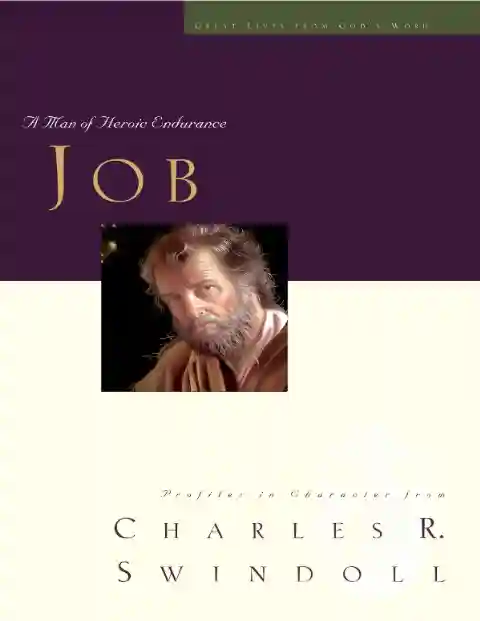

Job: A Man Of Heroic Endurance Order Printed Copy
- Author: Charles R. Swindoll
- Size: 1.97MB | 398 pages
- |
Others like job: a man of heroic endurance Features >>
Pathway To His Presence
-160.webp)
The Pursuit Of His Presence
Experiencing The Presence Of God
Seek And Find
Trusting God In Times Of Adversity
The Words Of Jesus: A Gospel Of The Sayings Of Our Lord With Reflections
Meditations On Jesus
Gleanings In The Fields Of Boaz

The Sermon On The Mount
Experiencing The Words Of Jesus
About the Book
"JOB: A MAN OF HEROIC ENDURANCE" by Charles R. Swindoll examines the story of Job from the Bible, highlighting his exemplary faith and perseverance in the face of immense suffering. Swindoll provides insights and lessons that can be applied to everyday life, showing how Job's story serves as a powerful example of trusting in God through trials and tribulations.
St. Patrick
Parable of an Unhealthy Soul
How do works of obedience relate to the free, unmerited gift of God’s grace in the life of a Christian? This has been a recurring controversial and confusing issue since the earliest days of the church. If we are justified by God’s grace alone, through faith alone, in Christ’s sufficient substitutionary work alone, and not by any work of ours (Romans 3:8), then why are we warned and instructed to “strive . . . for the holiness without which no one will see the Lord” (Hebrews 12:14)? If our works don’t save us, then how can our not working (like not striving for holiness) prevent us from being saved? Before we turn to the apostle Peter for help, hear a parable of an unhealthy soul. Diligence Reveals Real Faith There was a man who was forty pounds overweight. Despite knowing it was dangerous to his health, for years he had indulged in too much of the wrong kinds of foods and neglected the right kinds of exercise. One day, his doctor told him he was in the early stages of developing type-2 diabetes. Not only that, but his vital signs also pointed to high risks of heart attack, stroke, and various cancers. If he didn’t make specific changes, his doctor warned, the man would surely die prematurely. So, the man heeded his doctor’s warnings. He made every effort to put new systems into place that encouraged healthy habits of eating and activity and discouraged his harmful old habits, preferences, and cravings. After twelve months, the man’s health was beginning to be transformed. He had lost most of his excess weight, felt better, had more energy, and no longer lived under the chronic, depressing cloud of knowing he was living in harmful self-indulgence. When his doctor next saw him, he was very pleased and said to the man, “Well done! You are no longer at heightened risk of premature death.” The man continued in his new ways and lived well into old age. Question: Was the man’s health restored through his faith in the gracious knowledge provided to him pertaining to life and healthiness, or was it restored through his diligent efforts to put this knowledge into practice? How Faith Works Do you see the problem with the question? It poses a false dichotomy. The man’s faith and his works were organically inseparable. If he didn’t have faith in what the doctor told him, he wouldn’t have heeded the doctor’s warning — there would have been no health-restoring works. If he didn’t obey the doctor’s instructions, whatever “faith” he may have claimed to have in his doctor would have been “dead faith” (James 2:26) — that faith would not have saved him from his health-destroying ways. This parable, imperfect as it is, is a picture of the biblical teaching on sanctification. In a nutshell, the New Testament teaches that the faith that justifies us is the same faith that sanctifies us. This faith is “the gift of God, not a result of works” (Ephesians 2:8–9). It’s just that this saving faith, by its nature, perseveres, and works to make us holy. We passively receive this gift of faith freely given to us by God. But faith, once received, does not leave a soul passive. It becomes the driving force behind our actions, the way we live. By its nature, faith believes the “precious and very great promises” of God (2 Peter 1:4), and the evidence that real faith is present in us manifests, over time, through the ways we act on those promises. The New Testament calls these actions “works of faith” (1 Thessalonians 1:3) or the “obedience of faith” (Romans 1:5). True works of faith don’t “nullify the grace of God” (Galatians 2:21); they are evidence that we have truly received the grace of God, and are themselves further expressions of grace. Now, let me show you one place where Scripture clearly teaches this. And as I do, imagine yourself as the unhealthy soul in my parable sitting in your doctor’s office — and your doctor is the apostle Peter. Dr. Peter has just examined your spiritual health and has some serious concerns. So, as a good physician, he gives you a firm exhortation. Escaping Through Promises [God’s] divine power has granted to us all things that pertain to life and godliness, through the knowledge of him who called us to his own glory and excellence, by which he has granted to us his precious and very great promises, so that through them you may become partakers of the divine nature, having escaped from the corruption that is in the world because of sinful desire. (2 Peter 1:3–4) Dr. Peter begins by telling you that God has granted to you all things. He agrees with his colleague, Dr. Paul, that God has granted you life, breath, and everything, including the day you were born, the places you’ll live, and how long (Acts 17:25–26). God has granted you regeneration (Ephesians 2:4–5), the measure of your faith (Romans 12:3), spiritual gifts (1 Corinthians 12:7–11), and capacity to work hard (1 Corinthians 15:10). And God has given you his “precious and very great promises so that through them” you may escape the power of sin and be transformed into his nature. Everything, from beginning to end, is God’s grace, since “a person cannot receive even one thing unless it is given him from heaven” (John 3:27). Make Every Effort For this very reason, make every effort to supplement your faith with virtue, and virtue with knowledge, and knowledge with self-control, and self-control with steadfastness, and steadfastness with godliness, and godliness with brotherly affection, and brotherly affection with love. (2 Peter 1:5–7) Notice Dr. Peter’s words: For this reason (because God has granted you everything), make every effort (act with faith in all God has promised you). In other words, prove the reality of your profession of faith, by doing whatever it takes to actively cultivate habits of grace, that nurture the character qualities necessary to live out the “obedience of faith” through doing tangible acts of good to bless others. What Negligence Reveals For if these qualities are yours and are increasing, they keep you from being ineffective or unfruitful in the knowledge of our Lord Jesus Christ. For whoever lacks these qualities is so nearsighted that he is blind, having forgotten that he was cleansed from his former sins. (2 Peter 1:8–9) “Diligence will reveal genuine faith because that is how faith works.” Dr. Peter’s prescription is clear and simple: if you cultivate these holy qualities, they will foster spiritual health and fruitfulness; if you don’t, you will experience spiritual decline and demise. Diligence will reveal genuine faith because that is how faith works: it leads to action. Negligence will reveal your lack of faith because “dead faith” doesn’t work. Now, this is a warning, not a condemnation. Peter knows well that all disciples have seasons of setbacks and failure. But he also knows, with Paul, that some disciples “profess to know God, but they deny him by their works” (Titus 1:16) — their profession of faith is not supported by the “obedience of faith.” Peter doesn’t want you to be one of those statistics, so he ends his firm exhortation to you on a hopeful note. Pursue Diligence by Faith Therefore, brothers, be all the more diligent to confirm your calling and election, for if you practice these qualities you will never fall. For in this way there will be richly provided for you an entrance into the eternal kingdom of our Lord and Savior Jesus Christ. (2 Peter 1:10–11) Just so you’re clear, Dr. Peter emphasizes the organic, inseparable relationship between God’s grace and your “works of faith.” He says, “Be diligent to confirm your calling and election.” You don’t call yourself to Christ; Christ calls you by his grace (John 15:16). You don’t elect yourself to salvation; God elects you by his grace (Ephesians 1:4–6). But you do have an essential contribution to make to your eternal spiritual health. You confirm the reality of God’s saving grace in your life through diligently obeying by faith all that Jesus commands you (Matthew 28:20) — or not. “You can confirm the reality of God’s saving grace in your life — or not.” This is Dr. Peter’s prescription for your assurance of salvation: your diligent obedience through faith, your making every effort to pursue holiness, is evidence that your faith is real and that the Holy Spirit is at work in you to make you a partaker in the divine nature. This is why Scripture commands us, “Strive for . . . the holiness without which no one will see the Lord” (Hebrews 12:14). It’s not that our striving, our “making every effort” to obey God, somehow merits us salvation. Rather, our striving is God’s gracious, ordained means — fed by his promises and supplied by his Spirit — to make us holy as he is holy (1 Peter 1:16) and to provide us “entrance into the eternal kingdom of our Lord and Savior Jesus Christ.” God’s grace is no less gracious because he chooses to grant it not only apart from our works (in justification) but also through our diligent “works of faith” (in sanctification) — especially since these works are evidence that our faith is real. Article by Jon Bloom