










Kenneth E. Hagin
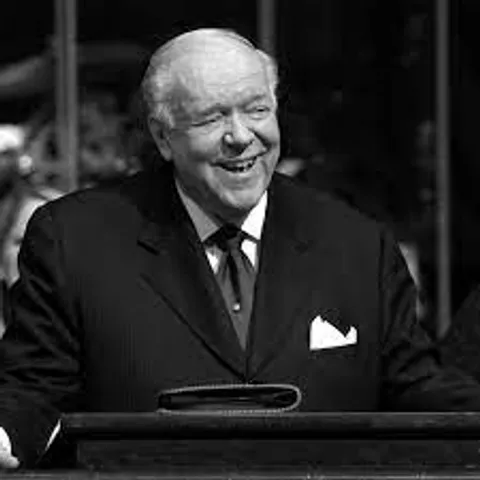 Rev. Kenneth Erwin Hagin was born on Aug. 20, 1917, in McKinney, Texas. Rev. Hagin was sickly as a child, suffering from a deformed heart and an incurable blood disease. He was not expected to live and became bedfast at age 15. In April 1933 during a dramatic conversion experience, he reported dying three times in 10 minutes, each time seeing the horrors of hell and then returning to life.
In August 1934, Rev. Hagin was miraculously healed, raised off a deathbed by the power of God and the revelation of faith in God’s Word. Jesus appeared to Rev. Hagin eight times over the next several years in visions that changed the course of his ministry. In 1967, he began a regular radio broadcast that continues today as Rhema for Today.
In 1968 Rev. Hagin published the first issues of The Word of Faith. That magazine, now produced nine times a year, has a circulation of over 200,000. The publishing outreach he founded, Faith Library Publications, has circulated worldwide more than 75 million copies of books by Rev. Hagin, Kenneth W. Hagin, Lynette Hagin, Craig W. Hagin, and several other authors. Faith Library Publications also has produced millions of audio and video teachings.
Other outreaches of Kenneth Hagin Ministries include Rhema Praise, a weekly television broadcast hosted by Revs. Kenneth and Lynette Hagin; Rhema Correspondence Bible School; Rhema Alumni Association; Rhema Ministerial Association International; the Rhema Prayer and Healing Center; and the Rhema prison ministry.
In 1974 Rev. Hagin founded what is now Rhema Bible Training College. The school has campuses all over the world and continues to expand.
Until shortly before his death, Rev. Hagin continued to travel and teach throughout the United States and into Canada conducting All Faiths’ Crusades and other special meetings.
Known as the “father of the modern faith movement,” Rev. Hagin was a dynamic preacher, teacher, and prophet. His teachings and books are filled with vivid stories that show God’s power and truth working in his life and the lives of others. He will be remembered not only as a great minister but as a great family man—for his family was his heart. He was there at every milestone ready to talk, to answer, to pray. He was a man whose belly laugh filled the room at the sight of one of his grandchildren or great-grandchildren.
Rev. Kenneth Erwin Hagin was born on Aug. 20, 1917, in McKinney, Texas. Rev. Hagin was sickly as a child, suffering from a deformed heart and an incurable blood disease. He was not expected to live and became bedfast at age 15. In April 1933 during a dramatic conversion experience, he reported dying three times in 10 minutes, each time seeing the horrors of hell and then returning to life.
In August 1934, Rev. Hagin was miraculously healed, raised off a deathbed by the power of God and the revelation of faith in God’s Word. Jesus appeared to Rev. Hagin eight times over the next several years in visions that changed the course of his ministry. In 1967, he began a regular radio broadcast that continues today as Rhema for Today.
In 1968 Rev. Hagin published the first issues of The Word of Faith. That magazine, now produced nine times a year, has a circulation of over 200,000. The publishing outreach he founded, Faith Library Publications, has circulated worldwide more than 75 million copies of books by Rev. Hagin, Kenneth W. Hagin, Lynette Hagin, Craig W. Hagin, and several other authors. Faith Library Publications also has produced millions of audio and video teachings.
Other outreaches of Kenneth Hagin Ministries include Rhema Praise, a weekly television broadcast hosted by Revs. Kenneth and Lynette Hagin; Rhema Correspondence Bible School; Rhema Alumni Association; Rhema Ministerial Association International; the Rhema Prayer and Healing Center; and the Rhema prison ministry.
In 1974 Rev. Hagin founded what is now Rhema Bible Training College. The school has campuses all over the world and continues to expand.
Until shortly before his death, Rev. Hagin continued to travel and teach throughout the United States and into Canada conducting All Faiths’ Crusades and other special meetings.
Known as the “father of the modern faith movement,” Rev. Hagin was a dynamic preacher, teacher, and prophet. His teachings and books are filled with vivid stories that show God’s power and truth working in his life and the lives of others. He will be remembered not only as a great minister but as a great family man—for his family was his heart. He was there at every milestone ready to talk, to answer, to pray. He was a man whose belly laugh filled the room at the sight of one of his grandchildren or great-grandchildren.
An Excellent New Book on Justification
If a thoughtful layman asked me what he should read to understand the doctrine of justification in relationship to the New Perspective on Paul, I would send him to Stephen Westerholm’s new book, Justification Reconsidered: Rethinking a Pauline Theme (Eerdmans, 2013). I enjoyed this book so much I found it difficult to put down. It is constructive. That is, it builds a clear and positive view of what justification is, rather than simply criticizing other views. For that reason, it provides a good introduction to the doctrine of justification itself for those who may not be clear on what Paul taught. According to the New Perspective But it is obviously written with a view to explaining and criticizing the so-called New Perspective (including Krister Stendahl, E.P. Sanders, J.D.G. Dunn, and N.T. Wright). The gist of that perspective is that the Judaism of Paul’s day was not a religion of legalism but of grace, and so, contrary to the historic view of Paul, legalism can hardly be what Paul found wrong with Judaism. His doctrine of justification must have had a different target. Therefore, the New Perspective says, justification “was not about how sinners could find a gracious God (by grace, not by works), but about the terms by which Gentles could be admitted to the people of God (without circumcision, Jewish food laws, and the like). A new Perspective was born” (26). The problem, Westerholm points out, is that the views of grace in contemporary Judaism did not exclude the merit of works alongside it. E.P. Sanders himself shows that the Rabbis “did not have a doctrine of original sin or of the essential sinfulness of each man in the Christian sense” (33). It follows, Westerholm argues, that “humanity’s predicament must be more desperate than Jews otherwise imagined” (33). Desperate for Grace This means that Paul’s “depiction of humanity’s condition required a much more rigorous dependence on divine grace than did Judaism’s” (34). Therefore, to show that Judaism had a doctrine of grace “is no reason to deny that Paul could have understood justification in terms of an exclusive reliance on grace in a way that was foreign to the thinking of contemporary Jews” (34). Therefore, Paul’s doctrine of justification did target not only a Jewish view, but any human view, that presumes to make good works any part of the ground of our being found righteous before God. “For Paul, God’s gift of salvation [i.e., justification] necessarily excludes any part to be played by God-pleasing ‘works’ since human beings are incapable of doing them” (32). “Paul sees the only righteousness available to sinful human beings to be that given as a gift of God’s grace, ‘apart from works’ (Romans 3:24; 4:2, 6; 5:17) — distinguishing grace from works in a way other Jews felt no need to do” (98). What the Doctrine Means In a statement that summarizes the whole book, Westerholm writes that this historic view of justification, shared by the Reformers and most Protestants, cannot be dismissed by the claim that the ancients were not concerned to find a gracious God (how could they not be, in the face of pending divine judgment?); or that it wrongly casts first-century Jews as legalists (its target is rather the sinfulness of all human beings); or that non-Christian Jews, too, depended on divine grace (of course they did, but without Paul’s need to distinguish grace from works); or that ‘righteousness’ means ‘membership in the covenant’ (never did, never will) and the expression ‘works of the law’ refers to the boundary markers of the Jewish people (it refers to all the ‘righteous’ deeds required by the law as its path to righteousness). (98) And, Westerholm observes, it is, of course, right to “emphasize the social implications of Paul’s doctrine of justification . . . in his own day and . . . draw out its social implications for our own” (98). But we should not identify the meaning of justification with its social implications (for example, table fellowship between Gentiles and Jews in Galatians 2; and multi-ethnic implications today). No. “The doctrine of justification means that God declares sinners righteous, apart from righteous deeds, when they believe in Jesus Christ” (99). Confusing the root with the fruit will, in the long run, kill the tree. Article by John Piper Founder & Teacher, desiringGod.org