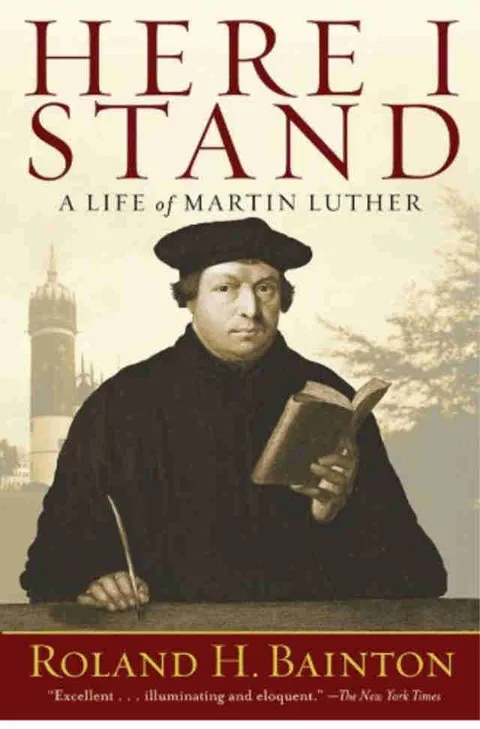

Others like here i stand Features >>

George Muller - The Guardian Of Bristols Orphans
John G. Lake, The Complete Collection Of His Life Teachings

Fire In The Bones - William Tyndale
Church History 101 - The Highlights Of Twenty Centuries
Elijah .. The Man Who Did Not Die
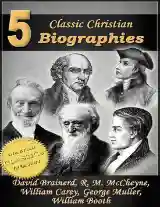
5 Classic Christian Biographies

Unprovoked Murder
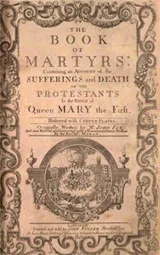
Foxes Books Of Martyrs
-160.webp)
I Stand At The Door And Knock
Testimonies To The Church, Vol 1
About the Book
"Here I Stand" is a biography of Martin Luther written by Roland Bainton. The book details Luther's journey from a humble monk to a leader of the Protestant Reformation, highlighting his challenges, beliefs, and struggles against the Catholic Church. Bainton explores Luther's theological ideas, his role in translating the Bible into German, and his stand against the corruption of the Church, resulting in his excommunication. The biography offers a comprehensive view of Luther's life, his courage, and his enduring impact on Christianity.
Maria Woodworth-Etter
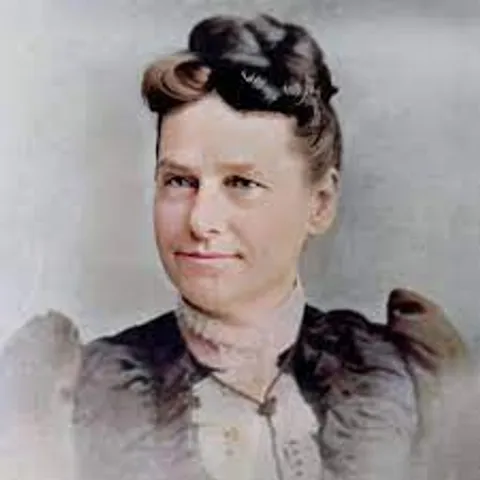 Maria Woodworth-Etter’s Early life
Maria’s early life was plagued with tragedies. Her father died of sunstroke when she was 11 years old leaving her mother with eight children to provide for. She married at 16 but fought a continual battle with ill-health, losing five of her six children. During her sickness she had visions of children in heaven and the lost suffering in hell.
She promised God, that if He would heal her, she would serve Him completely. She asked God for same apostolic power He gave the disciples and was gloriously baptized in the Holy Spirit. “It felt like liquid fire, and there were angels all around.”
The call to preach
Despite her personal struggles with ‘women in ministry’ and the prevailent hostile attitudes to female preachers, she felt compelled by God to accept the invitation to preach in the United Brethren in Christ (Friends) in 1876 and later associated with the Methodist Holiness church.
Evangelism with signs and wonders
Though simply evangelistic in the early days she was unusually successful and in 1885 supernatural signs began to accompany her ministry. Her ministry resurrected dead churches, brought salvation to thousands of unconverted and encouraged believers to seek a deeper walk with God.
She descibes one of her meetings
She described an 1883 meeting in Fairview, Ohio: “I felt impressed God was going to restore love and harmony in the church..… All present came to the altar, made a full consecration, and prayed for a baptism of the Holy Ghost and fire. That night it came. Fifteen same to the altar screaming for mercy.
Men and women fell and lay like dead. I felt it was the work of God, but did not know how to explain it or what to say. I was a little frightened . . . after lying for two hours all, one after another, sprang to their feet as quick as a flash with shining faces and shouted all over the house. I had never seen such bright conversions or such shouting….
The ministers and old saints wept and praised the Lord …..they said it was the Pentecost power, that the Lord was visiting them in great mercy and power …..(they) experienced visions of heaven and hell, collapsed on the floor as if they’d been shot or had died.” Subsequently, thousands were healed of a wide variety of sicknesses and diseases and many believers, even ministers, received mighty baptisms of the Holy Spirit. She soon became a national phenomenon.
1,000 seater tent
In 1889, she purchased a tent that could seat eight thousand people and set it up in Oakland, California. “The power of God was over all the congregation; and around in the city of Oakland. The Holy Ghost would fall on the people while we were preaching. The multitude would be held still, like as though death was in their midst.
Many of the most intelligent and best dressed men would fall back in their seats, with their hands held up to God. being held under the mighty power of God. Men and women fell, all over the tent, like trees in a storm; some would have visions of God. Most all of them came out shouting the praises of God.”
She declared that if 19th-century believers would meet God’s conditions, as the 120 did on the Day of Pentecost, they would have the same results. “A mighty revival would break out that would shake the world, and thousands of souls would be saved. The displays of God’s power on the Day of Pentecost were only a sample of what God designed should follow through the ages. Instead of looking back to Pentecost, let us always be expecting it to come, especially in these days.”
Her views of Pentecostalism
Initially she had grave concerns about the burgeoning Pentecostal movement, mainly because of some unbalanced teaching and reported extremism. Soon she came to believe it was an authentic move of the Holy Spirit and was enthusiastically welcomed within its ranks. She became both a model and a mentor for the fledgling movement. This association elicited another wave of revival between 1912 and her death in 1924 as she ministered throughout the country and her books were read across the world.
Etter Tabenacle
In 1918, she built Etter Tabernacle as her home church base and affiliated with the Assemblies of God. In her closing years she still ministered with a powerful anointing despite struggling with gastritis and dropsy. On occasion she would be carried to the podium, preach with extraordinary power, then be carried home again!
Her demise
Her health continued to decline and she died on September 16, 1924. She is buried in a grave in Indianapolis next to her daughter and son-in-law. Her inscription reads “Thou showest unto thousands lovingkindness.”
In conclusion
Without doubt Maria Woodworth-Etter was an amazing woman blessed with an astonishing ministry. Rev. Stanley Smith – one of the famous “Cambridge Seven” and for many years a worker with “The China Inland Mission” wrote this about her autobiography:
“I cannot let this opportunity go by without again bringing to the notice of my readers, ‘Acts of the Holy Ghost,’ or ‘Life and Experiences of Mrs. M. B. Woodworth-Etter.’ It is a book I value next to the Bible. In special seasons of waiting on God I have found it helpful to have the New Testament on one side of me and Mrs. Etter’s book on the other; this latter is a present-day record of ‘the Acts’ multiplied.
Mrs. Etter is a woman who has had a ministry of healing since 1885, her call as an evangelist being some years previous to this. I venture to think that this ministry is unparalleled in the history of the Church, for which I give all the glory to the Lord Jesus Christ, as Mrs. Etter would, I know, wish me to do. This ministry should be made known, for the glory of the Triune God and the good of believers.”
We agree and pray that such an anointing will rest upon God’s end-time people so that ‘this Gospel of the Kingdom will be preached in all the world before the end comes!’ Matthew 24:14
Tony Cauchi
Maria Woodworth-Etter’s Early life
Maria’s early life was plagued with tragedies. Her father died of sunstroke when she was 11 years old leaving her mother with eight children to provide for. She married at 16 but fought a continual battle with ill-health, losing five of her six children. During her sickness she had visions of children in heaven and the lost suffering in hell.
She promised God, that if He would heal her, she would serve Him completely. She asked God for same apostolic power He gave the disciples and was gloriously baptized in the Holy Spirit. “It felt like liquid fire, and there were angels all around.”
The call to preach
Despite her personal struggles with ‘women in ministry’ and the prevailent hostile attitudes to female preachers, she felt compelled by God to accept the invitation to preach in the United Brethren in Christ (Friends) in 1876 and later associated with the Methodist Holiness church.
Evangelism with signs and wonders
Though simply evangelistic in the early days she was unusually successful and in 1885 supernatural signs began to accompany her ministry. Her ministry resurrected dead churches, brought salvation to thousands of unconverted and encouraged believers to seek a deeper walk with God.
She descibes one of her meetings
She described an 1883 meeting in Fairview, Ohio: “I felt impressed God was going to restore love and harmony in the church..… All present came to the altar, made a full consecration, and prayed for a baptism of the Holy Ghost and fire. That night it came. Fifteen same to the altar screaming for mercy.
Men and women fell and lay like dead. I felt it was the work of God, but did not know how to explain it or what to say. I was a little frightened . . . after lying for two hours all, one after another, sprang to their feet as quick as a flash with shining faces and shouted all over the house. I had never seen such bright conversions or such shouting….
The ministers and old saints wept and praised the Lord …..they said it was the Pentecost power, that the Lord was visiting them in great mercy and power …..(they) experienced visions of heaven and hell, collapsed on the floor as if they’d been shot or had died.” Subsequently, thousands were healed of a wide variety of sicknesses and diseases and many believers, even ministers, received mighty baptisms of the Holy Spirit. She soon became a national phenomenon.
1,000 seater tent
In 1889, she purchased a tent that could seat eight thousand people and set it up in Oakland, California. “The power of God was over all the congregation; and around in the city of Oakland. The Holy Ghost would fall on the people while we were preaching. The multitude would be held still, like as though death was in their midst.
Many of the most intelligent and best dressed men would fall back in their seats, with their hands held up to God. being held under the mighty power of God. Men and women fell, all over the tent, like trees in a storm; some would have visions of God. Most all of them came out shouting the praises of God.”
She declared that if 19th-century believers would meet God’s conditions, as the 120 did on the Day of Pentecost, they would have the same results. “A mighty revival would break out that would shake the world, and thousands of souls would be saved. The displays of God’s power on the Day of Pentecost were only a sample of what God designed should follow through the ages. Instead of looking back to Pentecost, let us always be expecting it to come, especially in these days.”
Her views of Pentecostalism
Initially she had grave concerns about the burgeoning Pentecostal movement, mainly because of some unbalanced teaching and reported extremism. Soon she came to believe it was an authentic move of the Holy Spirit and was enthusiastically welcomed within its ranks. She became both a model and a mentor for the fledgling movement. This association elicited another wave of revival between 1912 and her death in 1924 as she ministered throughout the country and her books were read across the world.
Etter Tabenacle
In 1918, she built Etter Tabernacle as her home church base and affiliated with the Assemblies of God. In her closing years she still ministered with a powerful anointing despite struggling with gastritis and dropsy. On occasion she would be carried to the podium, preach with extraordinary power, then be carried home again!
Her demise
Her health continued to decline and she died on September 16, 1924. She is buried in a grave in Indianapolis next to her daughter and son-in-law. Her inscription reads “Thou showest unto thousands lovingkindness.”
In conclusion
Without doubt Maria Woodworth-Etter was an amazing woman blessed with an astonishing ministry. Rev. Stanley Smith – one of the famous “Cambridge Seven” and for many years a worker with “The China Inland Mission” wrote this about her autobiography:
“I cannot let this opportunity go by without again bringing to the notice of my readers, ‘Acts of the Holy Ghost,’ or ‘Life and Experiences of Mrs. M. B. Woodworth-Etter.’ It is a book I value next to the Bible. In special seasons of waiting on God I have found it helpful to have the New Testament on one side of me and Mrs. Etter’s book on the other; this latter is a present-day record of ‘the Acts’ multiplied.
Mrs. Etter is a woman who has had a ministry of healing since 1885, her call as an evangelist being some years previous to this. I venture to think that this ministry is unparalleled in the history of the Church, for which I give all the glory to the Lord Jesus Christ, as Mrs. Etter would, I know, wish me to do. This ministry should be made known, for the glory of the Triune God and the good of believers.”
We agree and pray that such an anointing will rest upon God’s end-time people so that ‘this Gospel of the Kingdom will be preached in all the world before the end comes!’ Matthew 24:14
Tony Cauchi
Faithfulness in Forgotten Places
When the Holy Spirit cultivates his fruit in our lives, he often works in ways we would never pray for (Galatians 5:22–23). To grow the fruit of love in us, he may give us an enemy; to grow the fruit of peace, he may allow conflict to come near. And to grow the fruit of faithfulness, he may send us to forgotten places. Forgotten places are those corners of the world where no one seems to be watching, where our efforts go unseen, unthanked. Perhaps we labor among diapers and dishes, cubicles and emails. Or maybe, more painfully, among unfruitful mission fields, rebellious children, or spouses whose love has cooled. All of us live in forgotten places sometimes; some live there all the time. Drudgery as a Disciple We should beware of underestimating the spiritual strain of such monotonous and seemingly unrewarded toil. The daily duties in forgotten places may be small, but pile them up over months, years, or decades, and you may start to sympathize with Oswald Chambers when he writes, We do not need the grace of God to stand crises, human nature and pride are sufficient, we can face the strain magnificently; but it does require the supernatural grace of God to live twenty-four hours in every day as a saint, to go through drudgery as a disciple, to live an ordinary, unobserved, ignored existence as a disciple of Jesus. “To grow the fruit of faithfulness, God may send us to forgotten places.” Chambers may overstate his case — but not by much. In truth, the forgotten places can feel like a wilderness, and many days come when we find ourselves searching for something to keep us going, some water from the rock to sustain us in this desert (Psalm 105:41). We will find it, not in the forgotten places themselves, but in the God who sent us here, who is with us here, and who promises to reward us here. God’s Providence At times, we may stare at the responsibilities in front of us and wonder how we landed here. How did we wander into this wilderness of drab days and hidden obedience? We have become familiar with the backward glance, wondering if we missed a turn somewhere. How clarifying, then, to remember that our life situation is not ultimately a matter of chance, nor of any mistakes we have made, nor even of the string of events leading up to the present, but of God’s providence. The tasks in front of us are, at least for today, God’s assignment to us. To be sure, God’s providence does not nullify the decisions — and perhaps the mistakes or sins — that led us to this station in life, nor does it discourage us from striving after better circumstances: we are more than twigs in the stream of God’s purposes. But God’s providence does teach us to see, as the Heidelberg Catechism puts it, that “leaf and blade, rain and drought, fruitful and barren years, food and drink, health and sickness, riches and poverty, indeed, all things, come to us not by chance but by his fatherly hand.” No matter how we got here, the forgotten places are ultimately from our Father’s hand. Over and again, God describes our own plans and efforts as significant, but his as decisive — even over the most personal matters of life. He determines when and where we live (Acts 17:26). He assigns to us a measure of faith (Romans 12:3). He apportions spiritual gifts as he wills (1 Corinthians 12:11). He entrusts to us a number of talents — whether five, two, or just one (Matthew 25:15). He gives us a specific ministry (Colossians 4:17). He even calls us to a particular life (1 Corinthians 7:17). In time, this forgotten place may give way to somewhere different — and depending on the circumstances, we may be wise to seek that change. But for now, we can look at the responsibilities in front of us and say with relief, “My Father’s hand has led me here.” God’s Pleasure God not only sends us to the forgotten places, however; he also meets us there. When we labor in obscurity, he is near (Psalm 139:5). When our work escapes the notice of every human eye, it does not escape his (Luke 12:7). He catches every whispered prayer, every Godward groan. He stands ready at every moment to mark the smallest tasks we perform in faith. The wise man tells us why: “Lying lips are an abomination to the Lord, but those who act faithfully are his delight” (Proverbs 12:22). God delights not mainly in the greatness of the work, but in the faithfulness of the worker. What else could explain the New Testament’s insistence that even the lowest, most invisible members of society are “serving the Lord Christ” when they walk faithfully in their callings (Colossians 3:24)? The smallest duties done in faith become duties done for Christ. “God delights not mainly in the greatness of the work, but in the faithfulness of the worker.” The missionary Hudson Taylor was fond of saying, “A little thing is a little thing, but faithfulness in little things is a great thing.” Cooking a meal, filling a spreadsheet, buying groceries, wiping a child’s nose — these are little things. But if done faithfully for Christ’s sake, they become greater than all the triumphs and trophies of an unbelieving world. They become the delight of our watching Lord. God’s Promise Once we have traced God’s providence in the past and felt his pleasure in the present, he would have us consider the future, when all our obedience will be rewarded. When many Christians imagine judgment day, we assume the spotlight will fall on the grand acts of sin and righteousness. And surely it will — but not only. Remarkably, when Jesus and the apostles speak of that day, they often focus on life’s ordinary moments. “On the day of judgment people will give account for every careless word they speak,” Jesus tells us (Matthew 12:36). On the other hand, God will reward his people for the smallest good works they do by his grace: for giving to the needy (Matthew 6:4), for praying in the closet (Matthew 6:6), for fasting in secret (Matthew 6:18), even for giving a cup of cold water to one of Christ’s disciples (Matthew 10:42). The apostle Paul similarly writes that “we must all appear before the judgment seat of Christ, so that each one may receive what is due for what he has done in the body, whether good or evil” (2 Corinthians 5:10). But then in Ephesians he clarifies the kind of good he has in mind: not just extravagant good, impressive good, or above-average good, but “whatever good” (Ephesians 6:8). Come judgment day, every scrap of unseen obedience will find its fitting reward. Living and dying in forgotten places, then, is no infallible index of our labor in God’s eyes. Many saints, in fact, will not know the true worth of what they’ve done for Christ until Christ himself tells them (Matthew 25:37–40). Exceptional in the Ordinary Chambers, after remarking on the grace required to endure drudgery as a disciple, goes on to write, “It is inbred in us that we have to do exceptional things for God; but we have not. We have to be exceptional in the ordinary things, to be holy in mean streets, among mean people, and this is not learned in five minutes.” Again, Chambers may slightly overstate his case. God sometimes does call us to do exceptional things for him: to adopt children, to launch ministries, to plant churches, to move overseas. But the point still holds, because none of us will do anything exceptional unless we have first learned, through ten thousand steps of faithfulness, to be exceptional in the ordinary. We are not on our own here. Faithfulness, remember, is a fruit of the Spirit. And to bear that fruit in us, he would have us treasure up the providence, the pleasure, and the promises of God that hem us in behind and before, and follow us into every forgotten place. Article by Scott Hubbard