
GIP Library icon

LOG IN TO REVIEW

Inspiring, I was much impacted.

- ugochukwu diala (4 months ago)

About the Book


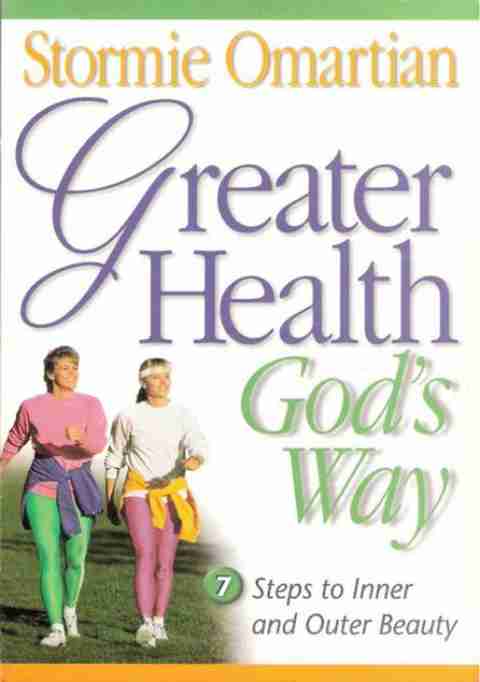
"Greater Health God's Way" by Stormie Omartian is a guide to achieving physical, emotional, and spiritual health through faith and prayer. The book offers practical advice for improving overall well-being, including tips on eating healthy, exercising, managing stress, and developing a deeper connection with God. Omartian emphasizes the importance of trusting in God's plan for our health and seeking His guidance in all aspects of our lives.

Fanny Crosby

Fanny Crosby "Oh, what a happy soul I am, / although I cannot see! / I am resolved that in this world / Contented I will be." Francis Jane Crosby wrote more than 9,000 hymns, some of which are among the most popular in every Christian denomination. She wrote so many that she was forced to use pen names lest the hymnals be filled with her name above all others. And, for most people, the most remarkable thing about her was that she had done so in spite of her blindness. "I think it is a great pity that the Master did not give you sight when he showered so many other gifts upon you," remarked one well-meaning preacher. Fanny Crosby responded at once, as she had heard such comments before. "Do you know that if at birth I had been able to make one petition, it would have been that I was born blind?" said the poet, who had been able to see only for her first six weeks of life. "Because when I get to heaven, the first face that shall ever gladden my sight will be that of my Savior." Blinded by a quack Born in Putnam County, New York, Crosby became ill within two months. Unfortunately, the family doctor was away, and another man—pretending to be a certified doctor—treated her by prescribing hot mustard poultices to be applied to her eyes. Her illness eventually relented, but the treatment left her blind. When the doctor was revealed to be a quack, he disappeared. A few months later, Crosby's father died. Her mother was forced to find work as a maid to support the family, and Fanny was mostly raised by her Christian grandmother. Her love of poetry began early—her first verse, written at age 8, echoed her lifelong refusal to feel sorry for herself: Oh, what a happy soul I am, although I cannot see! I am resolved that in this world Contented I will be. How many blessings I enjoy That other people don't, To weep and sigh because I'm blind I cannot, and I won't! While she enjoyed her poetry, she zealously memorized the Bible. Memorizing five chapters a week, even as a child she could recite the Pentateuch, the Gospels, Proverbs, the Song of Solomon, and many psalms chapter and verse. Her mother's hard work paid off. Shortly before her fifteenth birthday, Crosby was sent to the recently founded New York Institute for the Blind, which would be her home for 23 years: 12 as a student, 11 as a teacher. She initially indulged in her own poetry and was called upon to pen verses for various occasions. In time the principal asked her to avoid such "distractions" in favor of her general instruction. "We have no right to be vain in the presence of the Owner and Creator of all things," he said. It was the work of a traveling phrenologist (one who studies the shape and irregularities of the skull for insights into character and mental capacity) that changed the school's mind and again ignited her passion. Though his study is now the ridicule of science, the phrenologist's words were to prove prophetic: "Here is a poetess. Give her every possible encouragement. Read the best books to her and teach her the finest that is in poetry. You will hear from this young lady some day." Poetry for presidents It didn't take long. By age 23 Crosby was addressing Congress and making friendships with presidents. In fact, she knew all the chief executives of her lifetime, especially Grover Cleveland, who served as secretary for the Institute for the Blind before his election. Another member of the institute, former pupil Alexander van Alstine, married Crosby in 1858. Considered one of New York's best organists, he wrote the music to many of Crosby's hymns. Crosby herself put music to only a few of hers, though she played harp, piano, guitar, and other instruments. More often, musicians came to her for lyrics. For example, one day musician William Doane dropped by her home for a surprise visit, begging her to put some words to a tune he had recently written and which he was to perform at an upcoming Sunday School convention. The only problem was that his train to the convention was leaving in 35 minutes. He sat at the piano and played the tune. "Your music says, 'Safe in the Arms of Jesus,'" Crosby said, scribbling out the hymn's words immediately. "Read it on the train and hurry. You don't want to be late!" The hymn became one of Crosby's most famous. Though she was under contract to submit three hymns a week to her publisher and often wrote six or seven a day (for a dollar or two each), many became incredibly popular. When Dwight Moody and Ira Sankey began to use them in their crusades, they received even more attention. Among them are "Blessed Assurance," "All the Way My Savior Leads Me," "To God Be the Glory," "Pass Me Not, O Gentle Savior," "Safe in the Arms of Jesus," "Rescue the Perishing," and "Jesus Keep Me Near the Cross." She could write very complex hymns and compose music with a more classical structure (she could even improvise it), but she preferred to write simple, sentimental verses that could be used for evangelism. She continued to write her poetry up to her death, a month shy of her ninety-fifth birthday. "You will reach the river brink, some sweet day, bye and bye," was her last stanza.

If You Could See What You Will Be

Some of the sweetest and deepest promises of God are also some of the most neglected, often because they either feel too great to grasp or because they don’t seem to immediately intersect with life today. For instance, is any promise more staggering and yet forgotten than what God says about our glory? The one worthy of all glory not only commands us to glorify him in whatever we do, but he also vows, almost unthinkably, to one day glorify us. Can you imagine it? You probably can’t, and that’s likely why you gravitate to other, more concrete promises: the canceling of sin, the hearing of prayers, the drying of tears, the helping in weakness. And yet all of these precious and very great promises lead to a promise so surprising it sounds scandalous: His divine power has granted to us all things that pertain to life and godliness, through the knowledge of him who called us to his own glory and excellence, by which he has granted to us his precious and very great promises, so that through them you may become partakers of the divine nature, having escaped from the corruption that is in the world because of sinful desire. (2 Peter 1:3–4) Those who believe in God will not only be set free from sinning, healed from sickness, and delivered from death, but will “partake of the divine nature.” We will not only spend eternity with God, but we will genuinely become like God. What Will We Be Like? Now, we must say that, though we will be like him, we will not be him. We will partake of the divine nature; we will never own a divine nature. “I am the Lord,” God says. “That is my name; my glory I give to no other” (Isaiah 42:8). The qualification is vital — the difference between worship and blasphemy — but don’t let what God has not promised silence what he has: if you are in Christ, then you, yes you, will be glorified. “The body we have can and will perish, but the body we will have can never die.” When we are finally and fully glorified, the risen and glorified Lord Jesus “will transform our lowly body to be like his glorious body, by the power that enables him even to subject all things to himself” (Philippians 3:21). Or, as the apostle John says, “Beloved, we are God’s children now, and what we will be has not yet appeared; but we know that when he appears we shall be like him, because we shall see him as he is” (1 John 3:2). What will we be like? What do we know about glorified humans? What can we expect in the bodies to come? The apostle Paul anticipates that very question, knowing we would struggle to imagine our current bodies made glorious: “But someone will ask, ‘How are the dead raised? With what kind of body do they come?’” (1 Corinthians 15:35). As part of his answer, he compares the bodies we have to the glory we will be, and in at least four ways. Life Without Death The first distinction may be the most obvious: “There are heavenly bodies and earthly bodies, but the glory of the heavenly is of one kind, and the glory of the earthly is of another. . . . What is sown is perishable; what is raised is imperishable” (1 Corinthians 15:40, 42). The body we have can and will perish, but the body we will have can never die. Paul goes on: The dead will be raised imperishable, and we shall be changed. For this perishable body must put on the imperishable, and this mortal body must put on immortality. When the perishable puts on the imperishable, and the mortal puts on immortality, then shall come to pass the saying that is written: “Death is swallowed up in victory.” (1 Corinthians 15:52–54) The dead — those who have already perished — will be raised imperishable. The dead will not only live, but be unable to die. How different will life be when death is an impossibility? Because of sin, every minute of life on earth has been laced with brevity, fragility, and futility. The whole creation, including our bodies, have been enslaved to corruption (Romans 8:21). Even after we know we will live forever, we still know we may die tomorrow. Cars may collide, hearts may fail, cancer may emerge, surgeries may backfire, influenza may overpower. Death mercilessly cuts, robs, cheats, and grieves — for now. But God will give us a body that death cannot harm or threaten. One day, after centuries of immortality, we may wake up and forget what it felt like to be perishable — to wonder if we or someone we love might die soon. We’ll lie in bed and wonder, instead, that death has been swallowed whole in victory. Life Without Sin Our new bodies will be imperishable, set free from even the possibility of death, and they will be cleansed of every hint of sin. “It is sown in dishonor,” Paul says; “it is raised in glory” (1 Corinthians 15:43). What does it mean that our bodies are sown in dishonor? It means we all like sheep have gone (and go) astray (Isaiah 53:6). It means none of us — no, not one — is without sin (1 John 1:8). It means we all, without exception, have fallen short of the glory of God (Romans 3:23). But one day, if you belong to Christ, you will be without sin. One day you will not fall short of the glory of God anymore. One day you will never go astray again. “We long for the glorified body to come, and we glorify God with the one we have.” “When Christ who is your life appears, then you also will appear with him in glory” (Colossians 3:4). We will not only be ourselves without the turmoil and consequences of sin, but we will be ourselves soaked in glory (Romans 9:23). Beholding glory, face to face, we will become glorious (2 Corinthians 3:18). We will radiantly reflect the power and loveliness of God like never before, and yet more and more into eternity. Reflecting on this glory, C.S. Lewis writes, It is a serious thing to live in a society of possible gods and goddesses, to remember that the dullest, most uninteresting person you can talk to may one day be a creature which, if you saw it now, you would be strongly tempted to worship. (The Weight of Glory, 45) Our glory, of course, will not ultimately be ours. But we will more than see the glory of God. We will experience his glory, becoming glorious with his glory. Life Without Weakness The next comparison may be the most immediately personal for many of us: “It is sown in weakness; it is raised in power” (1 Corinthians 15:43). The longer we live in the bodies we have, the more acquainted we are with our weakness. That won’t be true forever. Weakness has a beautiful, God-designed, God-honoring, and temporary purpose. In a broken and weak world longing for healing, strength, and freedom, our weaknesses highlight the power of God to save and sustain. For now, “we have this treasure in jars of clay, to show that the surpassing power belongs to God and not to us” (2 Corinthians 4:7). In glory, though, our power, not our weakness, will magnify his surpassing power. His power will always be greater than ours, but he will trade our frailty for real stability, ability, and strength. We won’t have to be content any longer “with weaknesses, insults, hardships, persecutions, and calamities” (2 Corinthians 12:10). We won’t have any to be content with. When we look back on our lives with the eyes and strength of redeemed bodies, weakness will likely be a faint and pleasant memory, like sleepless newborn nights. Pleasant, because we will be able to see just how much the pain and inconvenience of our weaknesses exalted his comfort, power, and love. For now, we experience his power through weakness, but then we will experience his power without weakness. Life Without Limits Lastly, Paul says, “It is sown a natural body; it is raised a spiritual body” (1 Corinthians 15:44). This one may be the most difficult to grasp, at least immediately. Thankfully, Paul explains this one more than the others. “Thus it is written, ‘The first man Adam became a living being’; the last Adam became a life-giving spirit” (1 Corinthians 15:45). Adam received the breath of life (Genesis 2:7); Jesus gives life — abundant life, eternal life, glorious life. “We will more than see the glory of God. We will experience his glory, becoming glorious with his glory.” If we are born again, we are sons of both Adams. “The first man was from the earth, a man of dust; the second man is from heaven. As was the man of dust” — sinful, weak, and subject to death — “so also are those who are of the dust, and as is the man of heaven” — sinless, powerful, and victorious over death — “so also are those who are of heaven. Just as we have borne the image of the man of dust, we shall also bear the image of the man of heaven” (1 Corinthians 15:47–49). As broken, sinful, fragile, and vulnerable as we have been in Adam, we will be just as pure, strong, and invincible in Christ. Do not mistake, as many often do, a “spiritual” body to mean a spirit without a body. That would be the opposite of what God, through Paul, is promising. Perhaps the simplest, and most overlooked, blessing of our new bodies will be that they are bodies. We’re not destined to float through clouds and stars forever. We’re destined to live on a real earth like ours, with real bodies like ours, surrounded by blessings and experiences like ours, but all without the weakness, mortality, and sin that plague all we know and enjoy now. If You Could See What You Are As difficult as it may be to grasp or believe that God will glorify us, it is all the more startling to learn that, in some real sense, he already has. Paul writes, “We all, with unveiled face, beholding the glory of the Lord, are being transformed into the same image from one degree of glory to another. For this comes from the Lord who is the Spirit” (2 Corinthians 3:18). We may have to wait for glory in full, but in Christ we already have glory in degrees. Paul says as much in 1 Corinthians 15: “There are heavenly bodies and earthly bodies, but the glory of the heavenly is of one kind, and the glory of the earthly is of another. There is one glory of the sun, and another glory of the moon, and another glory of the stars; for star differs from star in glory” (1 Corinthians 15:40–41). To be sure, this earthly body pales next to the glory of the heavenly body, but God has given our earthly bodies a glory of their own, a glory to be marveled at and stewarded well. Again Paul writes, Do you not know that your body is a temple of the Holy Spirit within you, whom you have from God? You are not your own, for you were bought with a price. So glorify God in your body. (1 Corinthians 6:19–20) Those who will be glorified know that they have glory living in them now, that their bodies have been bought with precious, sinless, glorious blood, that their jars of clay have been made holy and serve a spectacular purpose. So, we long for the glorified body to come, and we glorify God with the one we have. Article by Marshall Segal

Feedback
Suggestionsuggestion box
x