
Others like digging the wells of revival Features >>

Reaching The Lost: Evangelism
The End Of Reason

God Can Do It Again
Holy Spirit: Are We Flammable Or Fireproof
Is God Real

Jeshua Hamashiah

The Name
-160.webp)
Caring For Creation (The Evangelicals Guide To Climate Change And A Healthy Environment)
-160.webp)
Evidence For The Resurrection (What It Means For Your Relationship With God)

Are You Ready
About the Book
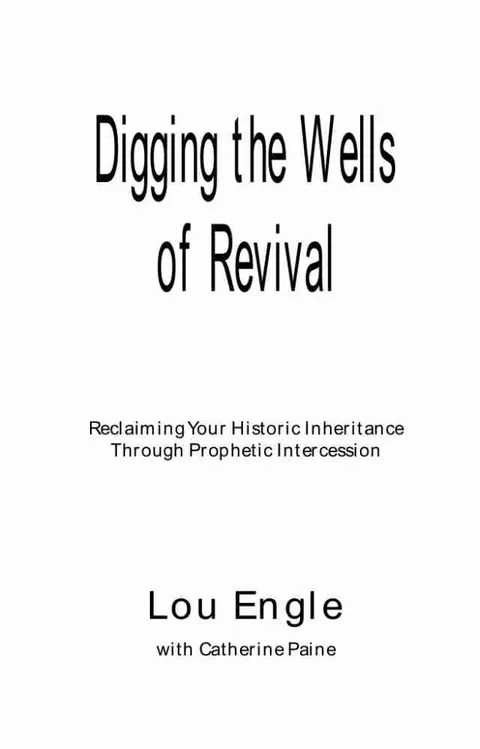
"Digging the Wells of Revival" by Lou Engle is a guide to understanding and participating in revival movements. Engle draws on biblical examples and personal experiences to discuss the importance of prayer, fasting, and unity in preparing for and sustaining times of spiritual renewal. The book encourages readers to embrace a lifestyle of seeking God's presence and to actively participate in bringing about revival in their communities.
George Eldon Ladd

your letter to your future spouse
I vividly remember the first time I saw the movie Titanic . The passionate love between Jack and Rose awakened something fierce in my little preteen heart. I thought little of marriage before that movie. Now it consumed my thoughts and dreams. For my friends and me, riding off into the sunset with our respective Jack Dawsons became the ultimate goal in life. We quickly believed the lie that a committed, romantic relationship was all we needed to be okay. Marriage became a savior. As Rose said at the end of the movie, “There was a man named Jack Dawson, and he saved me — in every way a person can be saved.” Though Titanic is now twenty years old, the same romance-as-savior theme is still present in our culture. But surprisingly, many churches don’t reject this lie. They Christianize it. Marriage Idolatry Youth leaders, aware of their teens’ lust for romance and sexual intimacy, are eager to steer students away from poor decisions, and rightly so. But instead of pointing to a present Christ as the promised prize in the fight against lust, far too many point to a future spouse. This strategy may succeed in preserving the virginity of young Christian teens, but the “think about your future spouse” approach misses the heart of the Bible’s message that Jesus alone can satisfy. One specific manifestation of this is the practice of writing notes to a future spouse. There are dozens of Christian articles on how and why to write to a future husband or wife. Though many people believe in this practice and encourage it, it keeps our focus in the wrong place. It subtly (or overtly) puts our hope for happiness in someone other than Christ. Undoubtedly, marriage is a treasured gift many Christians will receive. Instituted by God before the fall, and intended to showcase the beauty of the gospel, marriage ought to be highly regarded by God’s people. But marriage is no savior. It cannot rescue, redeem, or ultimately fulfill us. It has no final power to save us from our loneliness, emptiness, or purposelessness. Believing marriage can do the work of God himself is to serve an idol. So, in the interests of putting marriage in its proper place, here are four reasons to set your hope in a present Christ rather than a future husband or wife. 1. God doesn’t promise marriage. God gives many promises for those in Christ, but none of them includes a spouse. Yes, marriage is a wonderful gift and one worth praying for, but God doesn’t guarantee we will marry. Even for those who are given this gift, it is not promised for a lifetime, as many young widows can attest. This is a shocking reality to many, likely due to a misapplication of Psalm 37:4, “Delight yourself in the Lord, and he will give you the desires of your heart.” “If I desire marriage,” we reason, “God said I need only delight myself in him, and he will grant it!” But God does not specify how and when he will grant those desires. For example, other desires often sit underneath the desire for marriage — desires for intimacy, belonging, wholeness, and companionship. But these are all desires God promises to meet in himself, whether we get married or not. He does not need marriage to satisfy the ache in our hearts; he only needs himself. God will give us the desires of our hearts — but in such a way that we’re singing praises to Jesus, not to a spouse. Don’t hope in a promise that God has not given. Instead, put your hope somewhere secure: on the rock of Christ. 2. Marriage can’t handle the pressure. Channeling all of our longings into marriage will crush it. No one person can handle the weight of our desires. The idea of a perfect mate can haunt us when we’re living side by side with another sinner. When we write romantic and idealistic letters to a future husband or wife, we set our hearts in the wrong place and build unrealistic expectations. The more we pour into the letters, the further our future husband or wife will fall short of our standards. Despairing disillusionment is common in Christian marriages likely because the partners have put too much hope in the marriage itself. Marriage is a terrible savior. But if we keep Jesus as our source of hope and joy, he will sustain us through every change in our relational status, and all the ups and downs of married life. 3. Singleness is not a subpar alternative. Eagerly hoping in a future spouse can be a way to avoid the sting of prolonged, unwanted singleness. But God doesn’t see singleness as a curse — he sees it as a gift! The Bible calls singleness the greater alternative, one that promotes undistracted devotion to Jesus (1 Corinthians 7:32–35). Although it’s true that most people will marry, that doesn’t prove that marriage satisfies. There are just as many unhappy married people as there are unhappy single people. Both groups face the same daily battle: Will I fight to find my joy in Jesus today? The longing for marriage does expose one truth: eternal life is found in intimacy, in knowing and being known. But the intimacy we were made for is not intimacy with a fellow sinner, but intimacy with God through Jesus: “This is eternal life, that they know you, the only true God, and Jesus Christ whom you have sent” (John 17:3). 4. God is supremely valuable. Banking our joy on a future spouse assumes we cannot be satisfied and whole without marriage. But marriage is not the grand prize of life — God is. He is the treasure in the field worth selling all we have to own. In Christ, our access to intimacy with God is certain. To know God through Christ is to find abundant life. Though it may be hard to believe on the days our prayers seem to bounce off the ceiling, the Psalms witness to this reality all over: “Whom have I in heaven but you? And there is nothing on earth that I desire besides you” (Psalm 73:25). “A day in your courts is better than a thousand elsewhere” (Psalm 84:10). “In your presence there is fullness of joy; at your right hand are pleasures forevermore” (Psalm 16:11). Though we cannot see, touch, and hear God like we can a fellow human, he is more real and more enjoyable than human intimacy ever can be. Draw near to him and he will draw near to you (James 4:8)! Take the energy you might put toward meditating on a future spouse and instead meditate on God, who has revealed himself to us in the pages of the Bible. The Marriage We Are Promised The end of Titanic pictures a heavenly reunion of all those who died in the 1912 tragedy. A youthful Rose walks through the crowd and approaches her one true love, the one who saved her. Finally, she is united with Jack. Forever and ever, amen. Christian, do you recognize this narrative? It is a shadow of the happy ending awaiting us. One day, we will be reunited with believing friends and family members, and we will finally see our One True Love face-to-face, the One who saved us in every way a person can be saved. But it will not be our spouse, but Jesus. His love saves us, satisfies us, and sustains us. Married or single, he alone should be the central figure in our lives. Don’t lay the weight of your desires, hopes, and dreams on an earthly marriage, but on Christ. Only his love is strong enough to sustain you.