
GIP Library icon

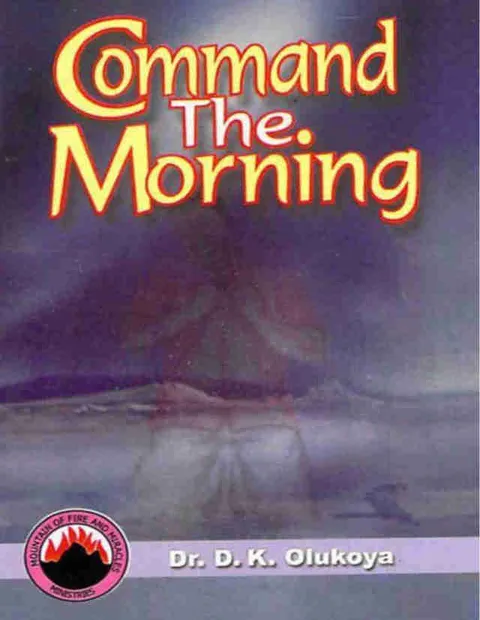
Command The Morning Command The Morning

Command The Morning Order Printed Copy

  • Author: D. K. Olukoya
  • Size: 389KB | 56 pages
  • |
Continue with
Google Twitter
LOG IN TO REVIEW
About the Book


"Command the Morning" by D. K. Olukoya is a spiritual guide that offers practical strategies and prayers for taking control of your day and shaping your future through the power of positive declarations and prayer. The book emphasizes the importance of starting your day with purposeful prayer and faith to overcome obstacles and achieve success. It provides insights on spiritual warfare, breaking negative cycles, and cultivating an attitude of victory and faith.

Johnny Cash

Johnny Cash Johnny Cash, the Man in Black, was a singer, guitarist and songwriter whose music innovatively mixed country, rock, blues and gospel influences. Who Was Johnny Cash? Johnny Cash grew up in a poor farming community and joined the Air Force in 1950. He co-founded a band following his discharge, and within a few years Johnny Cash and the Tennessee Two had scored hits with songs like "Walk the Line." Cash's career was nearly derailed in the 1960s by a serious substance-abuse problem, but his marriage to June Carter and acclaimed album Johnny Cash at Folsom Prison (1968) put him back on track. In later years, Cash joined the country supergroup the Highwaymen and released a series of recordings with producer Rick Rubin. Early Life Cash was born on February 26, 1932, in Kingsland, Arkansas. The son of poor Southern Baptist sharecroppers, Cash, one of seven children born to Ray and Carrie Rivers Cash, moved with his family at the age of 3 to Dyess, Arkansas, so that his father could take advantage of the New Deal farming programs instituted by President Franklin Roosevelt. There, the Cash clan lived in a five-room house and farmed 20 acres of cotton and other seasonal crops. Cash spent much of the next 15 years out in the fields, working alongside his parents and siblings to help pay off their debts. It wasn't an easy life, and music was one of the ways the Cash family found escape from some of the hardships. Songs surrounded the young Cash, be it his mother's folk and hymn ballads, or the working music people sang out in the fields. From an early age Cash, who began writing songs at age 12, showed a love for the music that enveloped his life. Sensing her boy's gift for song, Carrie scraped together enough money so that he could take singing lessons. However, after just three lessons his teacher, enthralled with Cash's already unique singing style, told him to stop taking lessons and to never deviate from his natural voice. Religion, too, had a strong impact on Cash's childhood. His mother was a devout member of the Pentecostal Church of God, and his older brother Jack seemed committed to joining the priesthood until his tragic death in 1944 in an electric-saw accident. The experiences of his early farming life and religion became recurring themes in Cash's career. Military Service and Musical Aspirations In 1950, Cash graduated high school and left Dyess to seek employment, venturing to Pontiac, Michigan, for a brief stint at an auto body plant. That summer he enlisted in the U.S. Air Force as "John R. Cash"—military regulations required a full first name—and he was sent for training at Lackland Air Force Base in San Antonio, Texas, where he met future wife Vivian Liberto. For the bulk of his four years in the Air Force, Cash was stationed in Landsberg, West Germany, where he worked as a radio intercept officer, eavesdropping on Soviet radio traffic. It was also in Germany that Cash began to turn more of his attention toward music. With a few of his Air Force buddies, he formed the Landsberg Barbarians, giving Cash a chance to play live shows, teach himself more of the guitar and take a shot at songwriting. "We were terrible," he said later, "but that Lowenbrau beer will make you feel like you're great. We'd take our instruments to these honky-tonks and play until they threw us out or a fight started." After his discharge in July 1954, Cash married Vivian and settled with her in Memphis, Tennessee, where he worked, as best he could, as an appliance salesman. Pursuing music on the side, Cash teamed up with a couple of mechanics, Marshall Grant and Luther Perkins, who worked with Cash's older brother Roy. The young musicians soon formed a tight bond, with the crew and their wives often heading over to one of their houses to play music, much of it gospel. Cash, who banged away on an old $5 guitar he'd purchased in Germany, became the frontman for the group, and they honed their unique synthesis of blues and country-and-western music through live performances. "He was a decent singer, not a great one," wrote Marshall Grant, in his 2006 autobiography, I Was There When it Happened: My Life with Johnny Cash. "But there was power and presence in his voice." Johnny Cash and the Tennessee Two In July 1954, another Memphis musician, Elvis Presley, cut his first record, sparking a wave of Elvis-mania as well as an interest in the local producer, Sun Records owner Sam Phillips, who had issued the record. Later that year Cash, Grant and Perkins made an unannounced visit to Sun to ask Phillips for an audition. The Sun Records owner gave in and Cash and the boys soon returned to show off their skills. Phillips liked their sound but not their gospel-driven song choices, which he felt would have a limited market, and asked them to return with an original song. The trio did just that, beginning work on the Cash-written "Hey Porter," shortly that first Sun session. Phillips liked that song, as well as the group's follow-up effort, "Cry, Cry, Cry," and signed the newly branded Johnny Cash and the Tennessee Two. "Hey Porter" was released in May 1955 and later that year "Cry, Cry, Cry" peaked at No. 14 on the Billboard charts. Other hits followed, including the Top 10 tracks "So Doggone Lonesome" and "Folsom Prison Blues." But true fame arrived in 1956 when Cash wrote and released "I Walk The Line," which catapulted to No. 1 on the country music charts and sold 2 million copies. He released his debut album, Johnny Cash with His Hot & Blue Guitar in 1957, and cemented his fame with chart-toppers like "Ballad of a Teenage Queen" and "Don't Take Your Guns to Town." Drugs and Divorce By the early 1960s, Cash, who had relocated his family to California and left Sun for Columbia Records, was a musical superstar. On the road for 300 nights a year with the group now known as the Tennessee Three, he was often accompanied by June Carter, who co-wrote what became one of the Man in Black's signature songs, "Ring of Fire" (1963). Cash also sought to establish himself as an actor, starring in the movie Five Minutes to Live (1961) and a few Western-themed TV programs. But the schedule and the pressures that faced him took a toll on his personal life. Drugs and alcohol were frequent tour companions while Vivian, left home to take care of their family, which now included daughters Rosanne (b. 1955), Kathy (b. 1956), Cindy (b. 1959) and Tara (b. 1961) grew increasingly frustrated with her husband's absence. In 1966, she finally filed for divorce. Cash's personal life continued to spiral out of control. The following year, after a serious drug binge, Cash was discovered in a near-death state by a policeman in a small village in Georgia. There were other incidents, too, including an arrest for smuggling amphetamines into the United States across the Mexican border, and for starting a forest fire in a California park. "I took all the drugs there are to take, and I drank," Cash recalled. "Everybody said that Johnny Cash was through 'cause I was walkin' around town 150 pounds. I looked like walking death." Remarriage and Revival Cash got the lifeline he needed from his old touring companion, June Carter, who helped him refocus on his Christian faith and get the drug addiction treatment he needed. The two were married on March 1, 1968. With his new wife, Cash embarked on a remarkable turnaround. In 1969, he began hosting The Johnny Cash Show, a TV variety series that showcased contemporary musicians ranging from Bob Dylan to Louis Armstrong. It also provided a forum for Cash to explore a number of social issues, tackling discussions that ranged from the war in Vietnam to prison reform to the rights of Native Americans. The same year his show debuted, Cash also took home two Grammy Awards for the live album Johnny Cash at Folsom Prison (1968). A critical and commercial success, the album was credited with helping to revive the artist's popularity. In early 1970, Cash and Carter experienced more joy with the birth of their first and only child, John Carter Cash. The ensuing decade offered up more success for the artist, as Cash's music career flourished with the release of hit singles like "A Thing Called Love" (1972) and "One Piece at a Time" (1976). He also co-starred with Kirk Douglas in A Gunfight (1970), wrote music for the feature Little Fauss and Big Halsy (1970) and published a best-selling autobiography, Man in Black (1975). In 1980, he became the youngest living person to be elected to the Country Music Hall of Fame. Cash continued to maintain a busy schedule, and he increasingly teamed up with other musicians. In 1986, he banded with old Sun Records colleagues Carl Perkins, Jerry Lee Lewis and Roy Orbison to record the widely popular compilation The Class Of '55. Meanwhile, he joined forces with fellow country stalwarts Kris Kristofferson, Willie Nelson and Waylon Jennings to form the Highwaymen, which released three studio albums between 1985 and 1995. In the early 1990s, Cash stepped into the studio with U2 to record The Wanderer, a track that would appear on the group's 1993 release, Zooropa. Throughout this time, though, Cash's health problems and his continued battles with addiction were nearby. After undergoing abdominal surgery in 1983, he checked himself into the Betty Ford Clinic. In 1988, Cash again went under the knife, this time for double-bypass heart surgery. But, like always, Cash pushed on. He was inducted into the Rock and Roll Hall of Fame in 1992, and in 1994 he teamed with music producer Rick Rubin to release American Recordings. A 13-track acoustic album that mixed traditional ballads with modern compositions, American Recordings earned Cash a new audience and a 1995 Grammy Award for Best Contemporary Folk Album. He followed with another Rubin-produced album, Unchained (1996), and in 1997 he published his second memoir, Cash: The Autobiography. Final Years, Death and Legacy Cash's physical health became more of an issue in the late 1990s. He was diagnosed with the neurodegenerative disease Shy-Drager syndrome—a misdiagnosis that was later corrected to autonomic neuropathy—and was hospitalized for pneumonia in 1998. Still, the artist continued making music. In 2002, he released American IV: The Man Comes Around, a mix of originals and covers, including songs from the Beatles to Trent Reznor of Nine Inch Nails. The album, recorded at the Cash Cabin Studio in Hendersonville, Tennessee, was the fourth Cash-Rubin compilation. Over the next year, Cash's health continued to decline. He was devastated when his longtime love, June Carter, died in May 2003, but he continued to work. With Rubin at his side, the singer recorded what would become American V: A Hundred Highways. Just a week before his death on September 12, 2003, from complications associated with diabetes, Cash wrapped up his final track. "Once June passed, he had the will to live long enough to record, but that was pretty much all," Rubin later recalled. "A day after June passed, he said, 'I need to have something to do every day. Otherwise, there's no reason for me to be here.'" That November, Cash was posthumously honored at the CMA annual awards, winning best album for American IV, best single and best video. In 2005, the story of his life and career through the late 1960s was made into a feature film, Walk the Line, starring Joaquin Phoenix as Cash and Reese Witherspoon as Carter. In 2006, fans were treated to new music from the late artist. May brought Personal File, a two-CD set of unreleased material recorded decades earlier. In July, American V: A Hundred Highways was unveiled. Starkly arranged and sometimes mournful, the songs highlighted Cash's older and rougher sounding voice, which seared with a raw honesty. Not surprisingly, Cash's influence continued to resonate. In 2007, the community of Starkville, Mississippi, paid honor to the performer and his arrest there in 1965 for public intoxication with the Johnny Cash Flower Pickin' Festival. The following year, the late artist won another Grammy, for Best Short Form Music Video for God's Gonna Cut You Down. "I think he'll be remembered for the way he grew as a person and an artist," wrote Kris Kristofferson in 2010, upon Cash's selection by Rolling Stone magazine as the 31st greatest artist of all time. "He went from being this guy who was as wild as Hank Williams to being almost as respected as one of the fathers of our country. He was friends with presidents and with Billy Graham. You felt like he should've had his face on Mount Rushmore." In 2010, additional material from recording sessions with Rubin were released as American VI: Ain't No Grave. In December 2013, it was revealed that another album from Cash had been unearthed. Out Among the Stars, which had been recorded in the early 1980s but never released by Columbia Records, was discovered by John Carter Cash in his father's archives. Underscoring the singer's sustained popularity, the album became a chart-topper following its release in March 2014.

He Dared to Defy the Pope

One of the great rediscoveries of the Reformation — especially of Martin Luther — was that the word of God comes to us in the form of a book, the Bible. Luther grasped this powerful fact: God preserves the experience of salvation and holiness from generation to generation by means of a book of revelation, not a bishop in Rome. The life-giving and life-threatening risk of the Reformation was the rejection of the pope and councils as the infallible, final authority of the church. One of Luther’s arch-opponents in the Roman Church, Sylvester Prierias, wrote in response to Luther’s 95 theses, “He who does not accept the doctrine of the Church of Rome and pontiff of Rome as an infallible rule of faith, from which the Holy Scriptures, too, draw their strength and authority, is a heretic” (Luther: Man Between God and the Devil, 193). In other words, the church and the pope are the authoritative deposit of salvation and the word of God — and the book, the Bible, is derivative and secondary. “What is new in Luther,” biographer Heiko Oberman writes, “is the notion of absolute obedience to the Scriptures against any authorities, be they popes or councils” (Luther, 204). This rediscovery of the word of God above all earthly powers shaped Luther and the entire Reformation. But Luther’s path to that rediscovery was a tortuous one, beginning with a lightning storm at age 21. Fearful Monk In the summer of 1505, the providential Damascus-like experience happened. On the way home from law school on July 2, Luther was caught in a thunderstorm and was hurled to the ground by lightning. He cried out, “Help me, St. Anne! I will become a monk” (Luther, 92). He feared for his soul and did not know how to find safety in the gospel. So he took the next best thing: the monastery. Fifteen days later, to his father’s dismay, Luther left his legal studies and kept his vow. He knocked at the gate of the Augustinian hermits in Erfurt and asked the prior to accept him into the order. Later he said this choice was a flagrant sin — “not worth a farthing” because it was made against his father and out of fear. Then he added, “But how much good the merciful Lord has allowed to come of it!” (Luther, 125). “The Bible had come to mean more to Luther than all the fathers and commentators.” Fear and trembling pervaded Luther’s years in the monastery. At his first mass two years later, for example, he was so overwhelmed at the thought of God’s majesty that he almost ran away. The prior persuaded him to continue. But this incident would not be an isolated one in Luther’s life. Luther would later remember of these years, “Though I lived as a monk without reproach, I felt that I was a sinner before God with an extremely disturbed conscience. I could not believe that he was placated by my satisfaction” (Martin Luther: Selections from His Writings, 12). Luther would not be married for another twenty years — to Katharina von Bora on June 13, 1525 — which means he lived with sexual temptations as a single man until he was 42. But “in the monastery,” he said, “I did not think about women, money, or possessions; instead my heart trembled and fidgeted about whether God would bestow his grace on me” (Luther, 128). His all-consuming longing was to know the happiness of God’s favor. “If I could believe that God was not angry with me,” he said, “I would stand on my head for joy” (Luther, 315). Good News: God’s Righteousness In 1509, Luther’s beloved superior and counselor and friend, Johannes von Staupitz, allowed Luther to begin teaching the Bible. Three years later, on October 19, 1512, at the age of 28, Luther received his doctor’s degree in theology, and von Staupitz turned over to him the chair in biblical theology at the University of Wittenberg, which Luther held the rest of his life. As Luther set to work reading, studying, and teaching Scripture from the original languages, his troubled conscience seethed beneath the surface — especially as he confronted the phrase “the righteousness of God” in Romans 1:16–17. He wrote, “I hated that word ‘righteousness of God,’ which according to the use and custom of all the teachers, I had been taught to understand philosophically regarding the formal or active righteousness, as they called it, with which God is righteous and punishes the unrighteous sinner” (Selections, 11). But suddenly, as he labored over the text of Romans, all Luther’s hatred for the righteousness of God turned to love. He remembers, At last, by the mercy of God, meditating day and night, I gave heed to the context of the words, namely, “In it the righteousness of God is revealed, as it is written, ‘He who through faith is righteous shall live.’” There I began to understand [that] the righteousness of God is that by which the righteous lives by a gift of God, namely by faith. And this is the meaning: the righteousness of God is revealed by the gospel, namely, the passive righteousness with which [the] merciful God justifies us by faith, as it is written, “He who through faith is righteous shall live.” Here I felt that I was altogether born again and had entered paradise itself through open gates. . . . And I extolled my sweetest word with a love as great as the hatred with which I had before hated the word “righteousness of God.” Thus that place in Paul was for me truly the gate to paradise. (Selections, 12). Standing on the Book For Luther, the importance of study was so interwoven with his discovery of the true gospel that he could never treat study as anything other than utterly crucial and life-giving and history-shaping. Study had been his gateway to the gospel and to the Reformation and to God. We take so much for granted today about the truth and about the word that we can hardly imagine what it cost Luther to break through to the truth, and to sustain access to the word. Study mattered. His life and the life of the church hung on it. And so, Luther studied, and preached, and wrote more than most of us can imagine. “An indispensable key to understanding the Scriptures is suffering in the path of righteousness.” Luther was not the pastor of the town church in Wittenberg, but he did share the preaching with his pastor friend, Johannes Bugenhagen. The record bears witness to how utterly devoted he was to the preaching of Scripture. For example, in 1522 he preached 117 sermons, the next year 137 sermons. In 1528, he preached almost 200 times, and from 1529 we have 121 sermons. So the average in those four years was one sermon every two and a half days. And all of it arose from rigorous, disciplined study. He told his students that the exegete should treat a difficult passage no differently than Moses did the rock in the desert, which he smote with his rod until water gushed out for his thirsty people (Luther, 224). In other words, strike the text. In relating his breakthrough with Romans 1:16–17, he wrote, “I beat importunately upon Paul” (Selections, 12). There is a great incentive in this beating on the text: “The Bible is a remarkable fountain: the more one draws and drinks of it, the more it stimulates thirst” (What Luther Says: An Anthology, vol. 1, 67). That is what study was to Luther — taking a text the way Jacob took the angel of the Lord, and saying, “It must yield. I will hear and know the word of God in this text for my soul and for the church!” (see Genesis 32:26). That’s how he broke through to the meaning of “the righteousness of God” in justification. And that is how he broke through tradition and philosophy again and again. Luther had one weapon with which he recovered the gospel from being sold in the markets of Wittenberg: Scripture. He drove out the moneychangers — the indulgence sellers — with the whip of the word of God. Slandered and Struck Down Study was not the only factor that opened God’s word to Luther. Suffering did as well. Trials were woven into life for Luther. Keep in mind that from 1521 on, Luther lived under the ban of the empire. Emperor Charles V said, “I have decided to mobilize everything against Luther: my kingdoms and dominions, my friends, my body, my blood and my soul” (Luther, 29). He could be legally killed, except where he was protected by his prince, Frederick of Saxony. He endured relentless slander of the cruelest kind. He once observed, “If the Devil can do nothing against the teachings, he attacks the person, lying, slandering, cursing, and ranting at him. Just as the papists’ Beelzebub did to me when he could not subdue my Gospel, he wrote that I was possessed by the Devil, was a changeling, my beloved mother a whore and bath attendant” (Luther, 88). Physically, he suffered from excruciating kidney stones and headaches, with buzzing in his ears and ear infections and incapacitating constipation and hemorrhoids. “I nearly gave up the ghost — and now, bathed in blood, can find no peace. What took four days to heal immediately tears open again” (Luther, 328). Oratio, Meditatio, Tentatio In God’s providence, however, these multiplied sufferings did not destroy Luther, but instead turned him into a theologian. Luther noticed in Psalm 119 that the psalmist not only prayed and meditated over the word of God in order to understand it; he also suffered in order to understand it. Psalm 119:67, 71 says, “Before I was afflicted I went astray, but now I keep your word. . . . It is good for me that I was afflicted, that I might learn your statutes.” An indispensable key to understanding the Scriptures is suffering in the path of righteousness. “The rediscovery of the word of God above all earthly powers shaped Luther and the entire Reformation.” Thus, Luther said, “I want you to know how to study theology in the right way. I have practiced this method myself. . . . Here you will find three rules. They are frequently proposed throughout Psalm [119] and run thus: Oratio, meditatio, tentatio (prayer, meditation, tribulation).” And tribulation he called the “touchstone.” “[These rules] teach you not only to know and understand, but also to experience how right, how true, how sweet, how lovely, how mighty, how comforting God’s word is: it is wisdom supreme” (What Luther Says, vol. 3, 1359–60). He proved the value of trials over and over again in his own experience. “For as soon as God’s Word becomes known through you,” he says, “the devil will afflict you, will make a real [theological] doctor of you, and will teach you by his temptations to seek and to love God’s Word. For I myself . . . owe my papists many thanks for so beating, pressing, and frightening me through the devil’s raging that they have turned me into a fairly good theologian, driving me to a goal I should never have reached” (What Luther Says, vol. 3, 1360). Above All Earthly Powers Luther said with resounding forcefulness in 1545, the year before he died, “Let the man who would hear God speak, read Holy Scripture” (What Luther Says, vol. 2, 62). He lived what he urged. He wrote in 1533, “For a number of years I have now annually read through the Bible twice. If the Bible were a large, mighty tree and all its words were little branches, I have tapped at all the branches, eager to know what was there and what it had to offer” (What Luther Says, vol. 1, 83). Oberman says Luther kept to that practice for at least ten years (Luther, 173). The Bible had come to mean more to Luther than all the fathers and commentators. Here Luther stood, and here we stand. Not on the pronouncements of popes, or the decisions of councils, or the winds of popular opinion, but on “that word above all earthly powers” — the living and abiding word of God. Article by John Piper

Feedback
Suggestionsuggestion box
x