
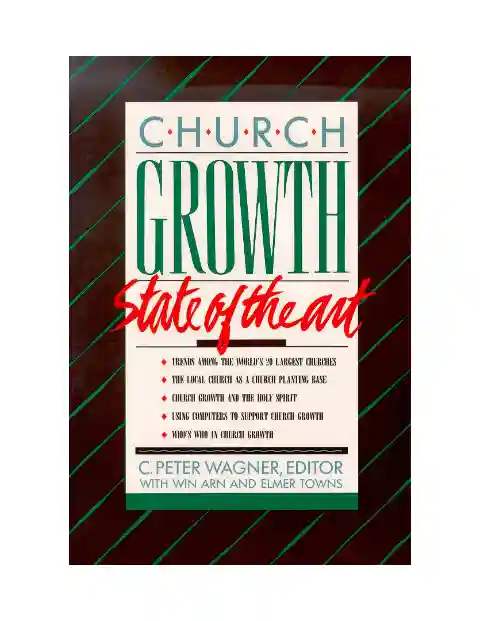

Church Growth: State Of The Art Order Printed Copy
- Author: C. Peter Wagner
- Size: 1.22MB | 204 pages
- |
Others like church growth: state of the art Features >>

He Came To Set The Captives Free
Seeking Allah, Finding Jesus
The Case For The Resurrection Of Jesus

Join This Chariot

Taking Action
Beyond Opinion: Living The Faith We Defend
What Jesus Started: Joining The Movement
The New Proof Producers
Live Before You Die
-160.webp)
Out Of Commission (Getting Every Christian Back To The Great Commission)
About the Book
"Church Growth: State of the Art" by C. Peter Wagner provides a comprehensive overview of current strategies and trends in church growth. The book covers various aspects of church growth, such as leadership development, evangelism, and the role of technology in expanding congregations. Wagner offers practical insights and suggestions for pastors and church leaders looking to increase the size and impact of their church.
Lecrae Moore

If You Could See What You Will Be
Some of the sweetest and deepest promises of God are also some of the most neglected, often because they either feel too great to grasp or because they don’t seem to immediately intersect with life today. For instance, is any promise more staggering and yet forgotten than what God says about our glory? The one worthy of all glory not only commands us to glorify him in whatever we do, but he also vows, almost unthinkably, to one day glorify us. Can you imagine it? You probably can’t, and that’s likely why you gravitate to other, more concrete promises: the canceling of sin, the hearing of prayers, the drying of tears, the helping in weakness. And yet all of these precious and very great promises lead to a promise so surprising it sounds scandalous: His divine power has granted to us all things that pertain to life and godliness, through the knowledge of him who called us to his own glory and excellence, by which he has granted to us his precious and very great promises, so that through them you may become partakers of the divine nature, having escaped from the corruption that is in the world because of sinful desire. (2 Peter 1:3–4) Those who believe in God will not only be set free from sinning, healed from sickness, and delivered from death, but will “partake of the divine nature.” We will not only spend eternity with God, but we will genuinely become like God. What Will We Be Like? Now, we must say that, though we will be like him, we will not be him. We will partake of the divine nature; we will never own a divine nature. “I am the Lord,” God says. “That is my name; my glory I give to no other” (Isaiah 42:8). The qualification is vital — the difference between worship and blasphemy — but don’t let what God has not promised silence what he has: if you are in Christ, then you, yes you, will be glorified. “The body we have can and will perish, but the body we will have can never die.” When we are finally and fully glorified, the risen and glorified Lord Jesus “will transform our lowly body to be like his glorious body, by the power that enables him even to subject all things to himself” (Philippians 3:21). Or, as the apostle John says, “Beloved, we are God’s children now, and what we will be has not yet appeared; but we know that when he appears we shall be like him, because we shall see him as he is” (1 John 3:2). What will we be like? What do we know about glorified humans? What can we expect in the bodies to come? The apostle Paul anticipates that very question, knowing we would struggle to imagine our current bodies made glorious: “But someone will ask, ‘How are the dead raised? With what kind of body do they come?’” (1 Corinthians 15:35). As part of his answer, he compares the bodies we have to the glory we will be, and in at least four ways. Life Without Death The first distinction may be the most obvious: “There are heavenly bodies and earthly bodies, but the glory of the heavenly is of one kind, and the glory of the earthly is of another. . . . What is sown is perishable; what is raised is imperishable” (1 Corinthians 15:40, 42). The body we have can and will perish, but the body we will have can never die. Paul goes on: The dead will be raised imperishable, and we shall be changed. For this perishable body must put on the imperishable, and this mortal body must put on immortality. When the perishable puts on the imperishable, and the mortal puts on immortality, then shall come to pass the saying that is written: “Death is swallowed up in victory.” (1 Corinthians 15:52–54) The dead — those who have already perished — will be raised imperishable. The dead will not only live, but be unable to die. How different will life be when death is an impossibility? Because of sin, every minute of life on earth has been laced with brevity, fragility, and futility. The whole creation, including our bodies, have been enslaved to corruption (Romans 8:21). Even after we know we will live forever, we still know we may die tomorrow. Cars may collide, hearts may fail, cancer may emerge, surgeries may backfire, influenza may overpower. Death mercilessly cuts, robs, cheats, and grieves — for now. But God will give us a body that death cannot harm or threaten. One day, after centuries of immortality, we may wake up and forget what it felt like to be perishable — to wonder if we or someone we love might die soon. We’ll lie in bed and wonder, instead, that death has been swallowed whole in victory. Life Without Sin Our new bodies will be imperishable, set free from even the possibility of death, and they will be cleansed of every hint of sin. “It is sown in dishonor,” Paul says; “it is raised in glory” (1 Corinthians 15:43). What does it mean that our bodies are sown in dishonor? It means we all like sheep have gone (and go) astray (Isaiah 53:6). It means none of us — no, not one — is without sin (1 John 1:8). It means we all, without exception, have fallen short of the glory of God (Romans 3:23). But one day, if you belong to Christ, you will be without sin. One day you will not fall short of the glory of God anymore. One day you will never go astray again. “We long for the glorified body to come, and we glorify God with the one we have.” “When Christ who is your life appears, then you also will appear with him in glory” (Colossians 3:4). We will not only be ourselves without the turmoil and consequences of sin, but we will be ourselves soaked in glory (Romans 9:23). Beholding glory, face to face, we will become glorious (2 Corinthians 3:18). We will radiantly reflect the power and loveliness of God like never before, and yet more and more into eternity. Reflecting on this glory, C.S. Lewis writes, It is a serious thing to live in a society of possible gods and goddesses, to remember that the dullest, most uninteresting person you can talk to may one day be a creature which, if you saw it now, you would be strongly tempted to worship. (The Weight of Glory, 45) Our glory, of course, will not ultimately be ours. But we will more than see the glory of God. We will experience his glory, becoming glorious with his glory. Life Without Weakness The next comparison may be the most immediately personal for many of us: “It is sown in weakness; it is raised in power” (1 Corinthians 15:43). The longer we live in the bodies we have, the more acquainted we are with our weakness. That won’t be true forever. Weakness has a beautiful, God-designed, God-honoring, and temporary purpose. In a broken and weak world longing for healing, strength, and freedom, our weaknesses highlight the power of God to save and sustain. For now, “we have this treasure in jars of clay, to show that the surpassing power belongs to God and not to us” (2 Corinthians 4:7). In glory, though, our power, not our weakness, will magnify his surpassing power. His power will always be greater than ours, but he will trade our frailty for real stability, ability, and strength. We won’t have to be content any longer “with weaknesses, insults, hardships, persecutions, and calamities” (2 Corinthians 12:10). We won’t have any to be content with. When we look back on our lives with the eyes and strength of redeemed bodies, weakness will likely be a faint and pleasant memory, like sleepless newborn nights. Pleasant, because we will be able to see just how much the pain and inconvenience of our weaknesses exalted his comfort, power, and love. For now, we experience his power through weakness, but then we will experience his power without weakness. Life Without Limits Lastly, Paul says, “It is sown a natural body; it is raised a spiritual body” (1 Corinthians 15:44). This one may be the most difficult to grasp, at least immediately. Thankfully, Paul explains this one more than the others. “Thus it is written, ‘The first man Adam became a living being’; the last Adam became a life-giving spirit” (1 Corinthians 15:45). Adam received the breath of life (Genesis 2:7); Jesus gives life — abundant life, eternal life, glorious life. “We will more than see the glory of God. We will experience his glory, becoming glorious with his glory.” If we are born again, we are sons of both Adams. “The first man was from the earth, a man of dust; the second man is from heaven. As was the man of dust” — sinful, weak, and subject to death — “so also are those who are of the dust, and as is the man of heaven” — sinless, powerful, and victorious over death — “so also are those who are of heaven. Just as we have borne the image of the man of dust, we shall also bear the image of the man of heaven” (1 Corinthians 15:47–49). As broken, sinful, fragile, and vulnerable as we have been in Adam, we will be just as pure, strong, and invincible in Christ. Do not mistake, as many often do, a “spiritual” body to mean a spirit without a body. That would be the opposite of what God, through Paul, is promising. Perhaps the simplest, and most overlooked, blessing of our new bodies will be that they are bodies. We’re not destined to float through clouds and stars forever. We’re destined to live on a real earth like ours, with real bodies like ours, surrounded by blessings and experiences like ours, but all without the weakness, mortality, and sin that plague all we know and enjoy now. If You Could See What You Are As difficult as it may be to grasp or believe that God will glorify us, it is all the more startling to learn that, in some real sense, he already has. Paul writes, “We all, with unveiled face, beholding the glory of the Lord, are being transformed into the same image from one degree of glory to another. For this comes from the Lord who is the Spirit” (2 Corinthians 3:18). We may have to wait for glory in full, but in Christ we already have glory in degrees. Paul says as much in 1 Corinthians 15: “There are heavenly bodies and earthly bodies, but the glory of the heavenly is of one kind, and the glory of the earthly is of another. There is one glory of the sun, and another glory of the moon, and another glory of the stars; for star differs from star in glory” (1 Corinthians 15:40–41). To be sure, this earthly body pales next to the glory of the heavenly body, but God has given our earthly bodies a glory of their own, a glory to be marveled at and stewarded well. Again Paul writes, Do you not know that your body is a temple of the Holy Spirit within you, whom you have from God? You are not your own, for you were bought with a price. So glorify God in your body. (1 Corinthians 6:19–20) Those who will be glorified know that they have glory living in them now, that their bodies have been bought with precious, sinless, glorious blood, that their jars of clay have been made holy and serve a spectacular purpose. So, we long for the glorified body to come, and we glorify God with the one we have. Article by Marshall Segal

.webp)