
Others like christ the lord out of egypt Features >>

About the Book
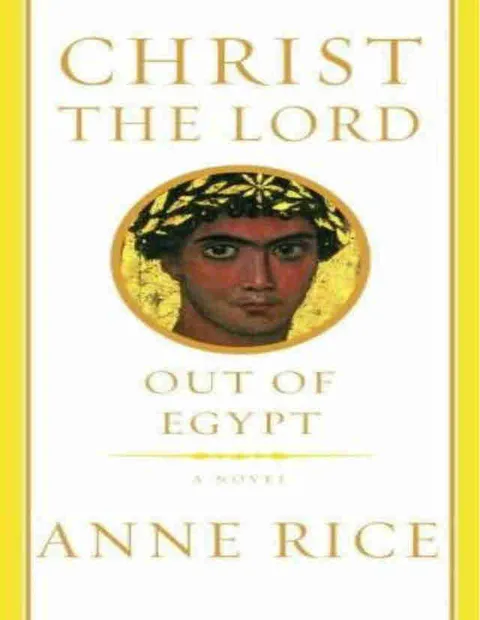
"Christ the Lord Out of Egypt" by Anne Rice follows the story of a young Jesus as he grapples with his identity and powers after discovering the truth about his divine heritage. Set in Egypt during the time of King Herod's reign, the novel explores Jesus' journey of self-discovery and his realization of his destiny as the Son of God. Through vivid storytelling and historical accuracy, Rice delves into the religious and supernatural elements surrounding Jesus' early life.
A.W. Pink
Arthur Walkington Pink (1 April 1886 – 15 July 1952) was an English Bible teacher who sparked a renewed interest in the exposition of Calvinism or Reformed Theology. Little known in his own lifetime, Pink became "one of the most influential evangelical authors in the second half of the twentieth century."[1]
Biography Arthur Walkington Pink was born in Nottingham, England, to a corn merchant, a devout non-conformist of uncertain denomination, though probably a Congregationalist.[2] Otherwise, almost nothing is known of Pink's childhood or education except that he had some ability and training in music.[3] As a young man, Pink joined the Theosophical Society, an occult gnostic group in contemporary England, and he apparently rose to enough prominence within its ranks that Annie Besant, its head, offered to admit him to its leadership circle.[4] In 1908 he renounced Theosophy for evangelical Christianity.[5]
Desiring to become a minister but unwilling to attend a liberal theological college in England, Pink very briefly studied at Moody Bible Institute in Chicago in 1910 before taking the pastorate of the Congregational church in Silverton, Colorado. In 1912 Pink left Silverton, probably for California, and then took a joint pastorate of churches in rural Burkesville and Albany, Kentucky.[6] In 1916, he married Vera E. Russell (1893–1962), who had been reared in Bowling Green, Kentucky, and Pink's next pastorate was at Scottsville Baptist Church, Scottsville, Kentucky.[7] Then the newlyweds moved in 1917 to Spartanburg, South Carolina, where Pink became pastor of Northside Baptist Church.[8]
By this time Pink had become acquainted with prominent dispensationalist Fundamentalists, such as Harry Ironside and Arno C. Gaebelein, and his first two books, published in 1917 and 1918, were in agreement with that theological position.[9] Yet Pink's views were changing, and during these years he also wrote the first edition of The Sovereignty of God (1918), which argued that God did not love sinners who had not been predestined unto salvation, and that He had deliberately created "unto damnation" those who would not accept Christ.[10] Whether because of his Calvinistic views, his nearly incredible studiousness, his weakened health, or his lack of sociability, Pink left Spartanburg in 1919 believing that God would "have me give myself to writing."[11] But Pink then seems next to have taught the Bible—with some success—in California for a tent evangelist named Thompson while continuing his intense study of Puritan writings.
In January 1922, Pink published the first issue of Studies in the Scriptures, which by the end of the following year had about a thousand subscribers and which was to occupy most of his time for the remainder of his life and become the source for dozens of books, some arranged from Studies articles after his death.[12] In 1923 Pink suffered a nervous breakdown, and he and his wife lived with friends in Philadelphia until he regained his health. In 1925, the Pinks sailed to Sydney, Australia, where he served as both an evangelist and Bible teacher at the Ashfield Tabernacle. But his impolitic preaching of Calvinist doctrine resulted in a unanimous resolve of the Baptist Fraternal of New South Wales not to endorse him. From 1926 to 1928, Pink served as pastor of two groups of Strict and Particular Baptists.[13]
Returning to England, Pink was invited to preach at a pastorless church in Seaton, Devon; but though he was welcomed by some members, the overseers thought his installation as pastor would split the church.[14] In the spring of 1929, Pink and wife returned to her home state of Kentucky where he intended to become pastor of the Baptist church in Morton's Gap. Once again his hopes were unrealized. To a friend he wrote, "I am more firmly convinced today than I was 14 months ago that our place is on the 'outside of the camp.' That is the place of 'reproach,' of loneliness, and of testing."[15] In 1930 Pink was able to start a Bible class in Glendale, California, while also turning down opportunities to speak in some Fundamentalist churches.[16] The following year, the Pinks rented an unpainted wooden house in Union County, Pennsylvania, where a small group met; then in 1933 they moved to York, Pennsylvania.
Pink decided that if his ministry was to be totally one of writing, he could do that just as well in England. In September 1934 he and his wife moved to Cheltenham, Gloucestershire, near honorary agents of Studies in the Scriptures. Pink seems to have finally given way to despair. To a friend he wrote "that those of my friends who would dearly like to help me are powerless to do so; while those who could, will not. And in a very few years at most it will be too late. What I have gone through the last seven years is so reacting on my physical and mental constitution, that ere long I shall be incapacitated even if doors should be opened unto me. However, I can see nothing else than to attempt to seek grace to bow to the Lord's sovereign pleasure, and say, 'Not my will, but thine be done.'"[17]
In 1936, the Pinks moved to Hove, on the south coast near Brighton. After the death of his father in 1933, Pink received enough of the estate to allow him and his wife to live very simply without financial concerns; and between 1936 until his death in 1952, Pink devoted himself completely to Studies in the Scriptures. Vera believed her husband's almost unrelenting work schedule unhealthy, and she remarkably succeeded in having him take up stamp collecting as a hobby.[18] In 1940, Hove became a regular target of German air raids, and the Pinks moved to Stornoway, Isle of Lewis, Outer Hebrides, Scotland, where they remained for the rest of his life. The island was a bastion of Calvinism, but church services were held mostly in Scots Gaelic, and visitors were not especially welcomed in any case.[19] Pink governed his time in study and writing with "military precision." To a friend he wrote that he went out to shop and get exercise for an hour, six days a week, but that otherwise he never left his study except when working in a small garden. While in Hove, he even published a note in Studies advising subscribers that "it is not convenient for us to receive any visitors, and respectfully ask readers who may visit these parts to kindly refrain from calling upon us, but please note that we are always glad to hear from Christian friends."[20] Rather than attend church, on Sunday mornings, Pink spent time ministering to readers by letter.[21]
In 1951 Vera became aware that Pink was failing. He lost weight and was in pain but refused to take any medicine that might dull his mind and hinder him from completing his work. He died on 15 July 1952. His last words were "The Scriptures explain themselves." Pink left enough written material to allow publication of Studies until December 1953.[22] Vera Pink survived her husband by ten years and after his death made new friends and mingled more freely with others.[23]
Influence
It is alleged that Pink's personality made it difficult for him to have a successful pastoral ministry. He has been criticized for being too individualistic and of too critical a temperament, lacking the benefit of thorough theological discussions with other men of similar gifts. One young pastor, Rev. Robert Harbach who corresponded with Pink for years remembered a very different Pink, who possessed a "pastor's heart." Pink's correspondence with Harbach (until Pink's failing health ended their correspondence in 1949) was warm, heartfelt and fatherly. Early in their correspondence, Pink wrote "I want you to feel perfectly free to call on me for any help I may be able to render you. I am in touch with a number of young pastors, and I deem it part of my work, and a privilege, to offer what advice I can."[24]
Pink's acclaimed contemporary D. Martyn Lloyd-Jones received spiritual benefit from reading Pink and recommended him to others. To one young minister, he said, "Don't waste your time reading Barth and Brunner. You will get nothing from them to aid you with preaching. Read Pink."[25] But Lloyd-Jones also said, "If I had behaved as Pink did, I would have achieved nothing. Nothing at all... I had to be very patient and take a very long-term look at things. Otherwise I would have been dismissed and whole thing would have been finished."[26] Furthermore, without the assistance and companionship of his wife, who dedicated herself completely to him and his work, Pink would have (as he freely admitted) "been overwhelmed" and probably would have achieved little even in writing.[27]
Theologically Pink was rejected during his lifetime because of his opposition to Arminianism; but after his death, there was a major shift of evangelical opinion towards Calvinistic theology. By 1982, Baker Book House had published 22 of Pink's books and sold 350,000 total copies. Nevertheless, it was Pink's Sovereignty of God that did "more than any other in redirecting the thinking of a younger generation." After Banner of Truth Trust republished it in 1961—modifying it to remove Pink's alleged hyper-Calvinism—the book sold 177,000 copies by 2004.[28]
References
7. "NEW LIGHT ON THE EARLY MINISTRY OF A. W. PINK (PART 2)". The Arthur W. Pink Archive. Retrieved 27 June 2020.
13. Murray argues that Pink left the first of these two groups because he was not Calvinistic enough for them because he asserted belief in the "free offer of the gospel and in human responsibility to receive the gospel.", 77-123; R. P. Belcher, "Pink, Arthur Walkington," Timothy Larson, ed., Biographical Dictionary of Evangelicals (Downers Grove, IL: IVP, 2003), 529. Ronald Hanko argues that "Pink never taught that God loves everyone or desires to save everyone, or promises salvation to everyone in the gospel, as the Banner does." Ronald Hanko, "The Forgotten Pink," British Reformed Journal No. 17 (Jan-March 1997), 4.
23. Murray, 283. She was remembered by one of these friends as "an elegant and gracious lady with a radiant expression and a loving and lively interest in people."
28. Murray, 314–15. The Banner of Truth Trust edition has been criticized for omitting nearly half the original work, including three entire chapters. Hanko, "The Forgotten Pink."
my wedding was supposed to be today
I made a life plan when I was ten years old (yeah, I know, crazy). It included all the normal things: graduate high school, go to college, travel the world. With regard to romance, though, I always assumed I would get married at 23, because “Why not?” and “Surely I’ll have met somebody by then.” So, in my late teens, I arbitrarily picked a date (today, April 22, 2017) as my likely wedding day because (a) it’s a few months before my 24th birthday and (b) I’ve always wanted a spring wedding. I added details about kids and jobs and travel along the way, but my plan has remained mostly unchanged. Pretty straightforward, right? Except the God I serve isn’t always a straightforward God. He is straightforward in what he wants from me: to act justly, love kindness, and to walk humbly with him (Micah 6:8), and to set nothing above him in my heart, mind, or soul (Deuteronomy 6:5). But what about beyond that? What about my wedding day? “I have had to learn to battle the temptations that creep into unwanted waiting and unwanted singleness.” Much to the woe of my control-desiring heart, he leaves much of it a surprise and mystery. To those who do not know him or trust him, the way he makes us wait may seem like stinginess or even evil. But in truth, he wants something better for us: for our trust and joy in him to flourish. As a planner, I must learn to live day-by-day by faith, not by sight, knowing that whatever he gives me is truly, deeply good for me (Romans 8:28). No matter how much his plans diverge from mine, no matter how much heartbreak those plans bring, no matter how far out of my comfort zone he pushes or pulls me, he is not only ultimately good, but his plans for me are also always better. Three Ways to Wait So, here on my “wedding day,” I’ve been single for several years now, including all of my five years as a Christian. I wasn’t asked out on a single date during college (and haven’t been since), so I have had to learn to battle the temptations that creep into unwanted waiting and unwanted singleness. Here are three lessons I have picked up in the fight. 1. Trust God to give you every good gift at the perfect time. While we wait, we will be tempted to doubt God’s love and ability. We are talking about the Lord who has built and leveled the nations throughout generations. He is the Lord who flooded the whole earth and held back the Red Sea long enough for his people to walk through on dry ground. Surely this great Lord of history can handle a small thing like the date of my wedding. And that’s what a wedding is: one day of millions of days. Not to say it isn’t important, but it also isn’t anywhere near ultimate. “My purity is not for me. My wedding is not for me. Marriage will not be for me. It is all for God.” Marriage is a gift. A gift isn’t earned or bargained for, and neither is a spouse. Pursuing maturity in Christ should be a consistent theme in any believer’s life, but never as currency to spend on something else. We pursue Christ not to “earn” a spouse, but in order to know Christ (Philippians 3:10). The gift isn’t given because the gift-receiver is fit enough, or tall enough, or smart enough. It is freely given because the gift-Giver is good. You cannot “earn” your way or “behave” your way to a spouse. God must give him or her to you in his own way, and at his time. 2. Make God the treasure and anchor of your life. While we wait, we will be tempted to envy others. There are many people getting married today that are not following the Lord and have (sometimes flagrantly) disobeyed him in the process. Regardless, if Jesus is our greatest treasure, we do not obey in order to gain a husband or a wife, and we do not groan under the perceived unfairness of unrepentant people getting married. My purity is not for me. My wedding is not for me. Marriage (if it happens for me) will not be for me. All these things are for the Lord and for his glory, not for me so that my life turns out “fairly.” Instead of praying for fairness in this life, we pray with Jesus, “Not my will, but yours, be done” (Luke 22:42). I pray that all couples getting married today would know my Lord and Savior, but many won’t. They will not have my anchor and firm foundation when life and marriage are hard (and they will be). What is there to envy? If single people lived so assured of God’s love that we were secure and satisfied in the absence of a spouse, perhaps the Lord would use us to witness to married men and women whose marriages have disappointed them or fallen apart. 3. Refuse to settle for someone who does not love Jesus. While we wait, we will be tempted to settle. We should not draw comfort from the assurance that God has someone for each of us to marry. He may not. Even if he doesn’t, or even if that person comes into our lives ten years late (by our schedule), that does not give us the right to rebel, disobey, or run away. None of us is entitled to marriage. I am not entitled to marriage. “Our romantic lives should look strange to the world, and so should our joy in singleness.” Our only constraint in seeking a spouse is to marry someone within the body of believers (2 Corinthians 6:14). It’s a simple guideline, and yet so easy to compromise. But if we’re to have marriages that glorify the eternal God at all, we cannot fall into the trap of setting aside faith, and basing our crushes and choices on temporal qualities like physical appearance or material wealth. I say “trap” because that’s what a spouse not centered on Christ will undoubtedly become. Recall what happened to Solomon, touted the wisest man in history: For when Solomon was old his wives turned away his heart after other gods, and his heart was not wholly true to the Lord his God, as was the heart of David his father. For Solomon went after Ashtoreth the goddess of the Sidonians, and after Milcom the abomination of the Ammonites. So Solomon did what was evil in the sight of the Lord and did not wholly follow the Lord, as David his father had done. (1 Kings 11:4–6) Heartbreakingly, this lust-following idol-worshiper is the same man who, in his youth, “loved the Lord, walking in the statutes of David his father” (1 Kings 3:3). The difference a few decades and poor choices in romance can make, right? A man to whom God gave wisdom, and whose future in loving and serving the Lord started out as promising as his father David’s, ends up unabashedly worshiping abominations — gods that cannot see or hear, let alone give wisdom or deserve worship. Many of those wives were probably pretty physically attractive (he was a king, after all), but they helped turn his heart into something ugly and steer his path away from the Lord. Rather than chafe at our only restriction in romance, followers of Christ should rejoice in the blessing of not being enslaved in the search for financial security or good looks or athletic ability. Our romantic lives should look strange to the world, and so should our joy in singleness. The Spirit empowers us to be countercultural lights pointing forward to our one true Bridegroom and our one true wedding day (Revelation 19:7).