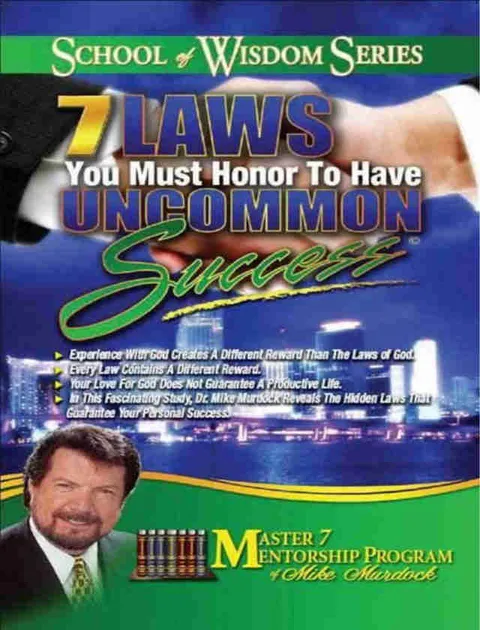

7 Laws You Must Honor To Have Uncommon Success Order Printed Copy
- Author: Mike Murdock
- Size: 1.3MB | 89 pages
- |
Others like 7 laws you must honor to have uncommon success Features >>










About the Book
In "7 Laws You Must Honor to Have Uncommon Success," author Mike Murdock outlines seven essential principles that individuals must follow in order to achieve extraordinary success in their lives. These laws include the Law of Recognition, the Law of Assignment, and the Law of Mentorship, among others. By adhering to these laws, readers can gain insights and actionable steps to reach their full potential and experience uncommon success in all areas of their lives.
Jackie Hill Perry

Love Is the Overflow of Joy in God
More clearly than any other writer in the Bible, the apostle Paul opened up the truth to me that God is most glorified in me when I am most satisfied in him. It was thrilling to discover that glorifying God and satisfying my soul are not at odds. I have told the story of that discovery elsewhere. But there is a second chapter to the story that makes my thankfulness to Paul all the sweeter. I owe to him, more than to anyone else, another crucial, life-changing discovery. If the first discovery was how to resolve the tension between the desire to glorify God and the desire to be happy, the second discovery was how to resolve the tension between the desire to be happy in God and the desire to love other people. Another Unresolved Tension Can you really love people if, in the very act of doing them good, you are seeking the fullness of your own joy? After all, it was Paul himself who said, “Love . . . does not seek its own” (1 Corinthians 13:4–5 NASB). And in another place, “Let no one seek his own good, but the good of his neighbor” (1 Corinthians 10:24). And again, “We . . . have an obligation to bear with the failings of the weak, and not to please ourselves” (Romans 15:1). So how can you claim to love people if, in the very act of loving them, you are seeking your own joy? “On the other side of self-denial — even death — is everlasting joy in the presence of God.” This question felt just as urgent as the first one about how to glorify God while seeking my own joy. Jesus had said that “the great and first” commandment is to love God (Matthew 22:38). But he also said that the commandment to love our neighbor “is like it” (Matthew 22:39). So the question of how to love people out of a heart that could not stop wanting to be happy — indeed, a heart that dare not stop wanting to be happy, lest God be dishonored by my failing to be happy in him — that question was just as urgent as any. So how does the pursuit of joy in God relate to love for other people? Paul showed me that genuine, Spirit-awakened joy in God does not hinder love for people but in fact overflows with love for people. It has a built-in impulse to expand. Joy in God grows as it’s extended into the lives of other people so they can share in it. Paul Points the Way Paul gives us the most explicit illustration of this in the New Testament. It’s found in 2 Corinthians 8:1–2, where Paul is seeking to motivate love in the Corinthians by pointing to the Macedonian Christians and the amazing way they had shown love. We want you to know, brothers, about the grace of God that has been given among the churches of Macedonia, for in a severe test of affliction, their abundance of joy and their extreme poverty have overflowed in a wealth of generosity on their part. . . . I say this not as a command, but to prove by the earnestness of others that your love also is genuine. (2 Corinthians 8:1–2, 8) Note carefully that the “abundance of joy” in the hearts of the Macedonians was not owing to comfortable circumstances. They were in “extreme poverty” and “a severe test of affliction.” “Their abundance of joy” was owing to “the grace of God” that had been “given” (2 Corinthians 8:1). Their sins were forgiven. The wrath of God had been replaced with the divine smile of everlasting favor. Guilt was gone. Hell was closed. Heaven was open. The Spirit was indwelling. Hope had exploded in their hearts. All of this because of Christ, when they deserved none of it. The grace of God had been given (2 Corinthians 8:1). This “abundance of joy” became a fountain of love for people. It could not be clearer: “Their abundance of joy . . . overflowed in a wealth of generosity” (2 Corinthians 8:2). This was love. He called it that in verse 8: “. . . that your love also is genuine.” So Paul’s definition of genuine, God-exalting love would be this: Love is the overflow of joy in God that meets the needs of others. Joy for the Sake of Love This is more profound than what first meets the eye. Paul is not saying, “True happiness requires love for people.” That’s true. An unloving person will not be happy in the long run. But this is an oversimplification that misses the crucial point. The point is not that in order to have the truest pleasure we must love people. Rather, the point is that when joy in God overflows into the lives of others in the form of generosity, that overflow of joy is love. Or to say it another way: we do not merely seek to love in order to be happy, but we seek to be happy in God in order to love. It was “their abundance of joy” that overflowed in love (2 Corinthians 8:2). This thought seemed so radical to me that I wanted to check myself by testing it with the rest of Scripture. Is it true that my joy is that closely connected with my love for people? What I found was a stream of biblical commands to: love kindness, not just do it (Micah 6:8); do acts of mercy with cheerfulness (Romans 12:8); joyfully suffer loss in the service of prisoners (Hebrews 10:34); be a cheerful giver (2 Corinthians 9:7); make our joy the joy of others (2 Corinthians 2:3); tend the flock of God willingly and eagerly (1 Peter 5:2); and keep watch over souls with joy (Hebrews 13:17). To me this was amazing. We are not dealing here with something marginal or clever. This really is soul piercing and radically life changing: the pursuit of authentic love for people includes the pursuit of joy, because joy in God is an essential component of authentic love. This is vastly different from saying, “Let’s all be loving because it will make us happy.” This is saying, “Let’s all seek to be so full of joy in God that it overflows in sacrificial love to other people.” Love That Survives All Sorrow That word sacrificial might sound paradoxical. If we are overflowing in joy to others, and our joy is expanding by drawing others into it, then why talk of sacrifice? The reason is that the path of greatest joy in this life is often the path of great suffering. In the age to come, after Jesus returns, all pain will be gone. But not yet. In this life, love will often demand suffering. It may, in fact, demand that we lay down our lives. But Paul sets the pace for us when he says, “I rejoice in my sufferings for your sake” (Colossians 1:24). “In all our affliction, I am overflowing with joy” (2 Corinthians 7:4). “We rejoice in our sufferings” (Romans 5:3). There are reasons for this strange and wonderful kind of joy that survives and even thrives in affliction. One reason is that Jesus taught us, “It is more blessed to give than to receive” (Acts 20:35). The overflow to others is enriching to us. Another reason is that even though “some of you they will put to death,” in the end “not a hair of your head will perish” (Luke 21:16, 18). Jesus had said, “Everyone who lives and believes in me shall never die” (John 11:26). The world thinks we die. But Jesus takes us so immediately into his care that there is no break in life. A third reason is the promise, “your reward is great in heaven” (Matthew 5:12). Finally, the greatest act of love that was ever performed was sustained by joy in God: “[Look] to Jesus, . . . who for the joy that was set before him endured the cross” (Hebrews 12:2). “We do not merely seek to love in order to be happy, but we seek to be happy in God in order to love.” This is why, during my 33 years as a pastor, the signature text we came back to again and again was 2 Corinthians 6:10: “as sorrowful, yet always rejoicing.” Always. Rejoicing at the same time as sorrowing. Not just sequentially. Simultaneously. Loving others does not have to wait till sorrow passes, because joy does not wait. And during those 33 years, the signature song that the pastoral staff would sing again and again was “It Is Well with My Soul”: When peace like a river attendeth my way, When sorrows like sea billows roll, Whatever my lot, thou hast taught me to say, “It is well, it is well with my soul.” Genuine love makes many sacrifices for the beloved. There is much pain and many sorrows. But in Christ there is no ultimate sacrifice. To be sure, Jesus calls for self-denial. But his argument for self-denial is “whoever loses his life for my sake and the gospel’s will save it” (Mark 8:35). On the other side of self-denial — even death — is everlasting joy in the presence of God. Love Is Not Begrudging I have never met people who are offended because the sacrifices we make for their good bring us joy. In fact, merely dutiful “love” — or worse, begrudging “love” — does not make people feel loved. It makes them feel like a burden. I am sure, therefore, that Paul would agree with the writer to the Hebrews when he tells his hearers to let the leaders keep watch over them “with joy and not with groaning, for that would be of no advantage to you” (Hebrews 13:17). Begrudging ministry is of no advantage to the people. Or to put it positively, finding joy in caring for people is a great advantage to them. It is love. This is surely why Paul said to the Corinthians, “I felt sure of all of you, that my joy would be the joy of you all” (2 Corinthians 2:3). Yes! If you come to me and want me to experience joy — that is, if you want to love me — come with joy. And the best joy of all is joy in God. Bring me that. Overflow on me with that. I will feel loved. And you will be glad. So Paul has done it again. He not only showed me how my pursuit of God’s glory and my pursuit of happiness fit together, but he also showed me how that unquenchable desire for happiness fits together with loving people. Genuine, Christ-exalting, Spirit-empowered, sacrificial love for people is the overflow of joy in God that expands by meeting the needs of others. How can I not love the man who, after the Lord Jesus, showed me, more clearly than anyone else, the beauty of such a way of life? Article by John Piper