
Others like the tipping point Features >>
Outliers - The Story Of Success
The Spirit Of Leadership

The Little Big Small Business Book
The 17 Indisputable Laws Of Teamwork
Better Decisions, Fewer Regrets (5 Questions To Help You Determine Your Next Move)
Reinvent Yourself

Insight For Impact
No Limits
From Failure To Success
Everyone Communicates, Few Connect
About the Book
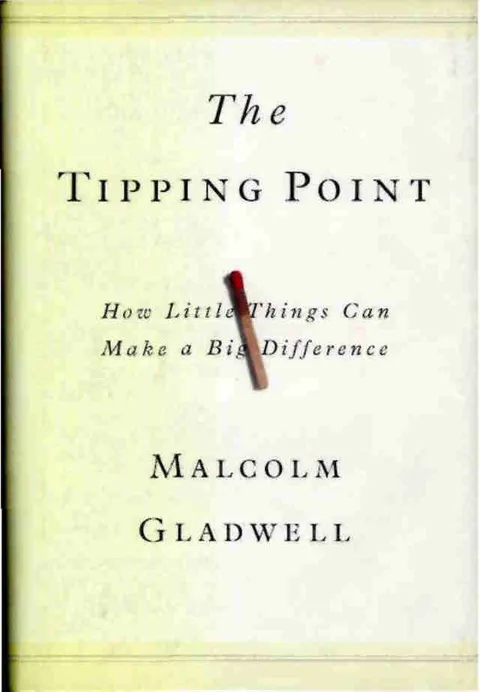
"The Tipping Point" by Malcolm Gladwell explores the concept of how small changes can lead to significant shifts in society, business, and culture. Gladwell identifies key factors that contribute to tipping points, including the roles of connectors, mavens, and salesmen in spreading ideas and trends. Through compelling case studies and examples, he demonstrates how understanding these tipping points can help individuals and organizations create and leverage opportunities for change and success.
Joni Eareckson Tada
Joni Eareckson Tada is a remarkable woman. Injured in a diving accident at the age of 17, Joni has had to endure more physical suffering than most of us ever will. Though she suffered a deep depression and lost the will to live in the aftermath of her accident, she gradually came back to a deeper relationship with God. Because of her early struggles, she has become strong in her faith and is a testimony to the world of how when we are weak, God is strong. Her story is not one of bitterness and despair, as we might imagine it to be, but one of love and victory.
Joni Eareckson Tada was born in Baltimore, Maryland in 1950 to John and Lindy Eareckson. She was the youngest of four sisters, Linda, Jay, and Kathy. Her name is pronounced “Johnny”, being he named after her father. Joni inherited her father’s athletic and creative abilities, giving father and daughter a special bond. Her childhood was an extremely happy one. She grew into a young adult surrounded by love, happiness, and security in her parent’s home. The Eareckson family shared a great love for the outdoors, which promoted family togetherness. They shared in various outdoor activities such as camping trips, horseback riding, hiking, tennis, and swimming.
In 1967, after graduating from high school, Joni had her fateful accident. It was a hot July day and she was to meet her sister Kathy and some friends at the beach on Chesapeake Bay to swim. When she arrived, she dove in quickly, and immediately knew something was wrong. Though she felt no real pain, a tightness seemed to encompass her. Her first thought was that she was caught in a fishing net and she tried to break free and get to the surface. Panic seized her as she realized she couldn’t move and she was lying face down on the bottom of the bay. She realized she was running out of air and resigned herself to the fact that she was going to drown.
Her sister, Kathy, called for her. She ran to Joni and pulled her up. To Kathy’s surprise, Joni could not support herself and tumbled back into the water. Kathy pulled her out and Joni gasped for air. Joni was puzzled as to why her arms were still tied to her chest. Then to her dismay, Joni realized they were not tied, but were draped lifelessly across her sister’s back. Kathy yelled for someone to call an ambulance and Joni was rushed to the hospital.
Joni’s life was changed forever that July day in 1967. She had broken her neck – a fracture between the fourth and fifth cervical levels. She was now a quadriplegic, paralyzed from the shoulders down. While her friends were busy sending out graduation announcements and preparing to go to college in the fall, Joni was fighting for her very life and having to accept the fact that she would have to live out the rest of her life in a wheelchair.
Joni’s rehabilitation was not easy. As you might imagine she was angry and she raged against her fate. She struggled with depression and often times she wanted to end her life. She could not understand how God could let this happen to her. Before the accident she had felt that she wasn’t living the life she should be so she had prayed that God would change her life – that he’d turn it around. After months of staring at the ceiling and wallowing in her depression, Joni began to wonder if this was God’s answer to her prayer.
This realization that God was working in her life was the beginning of Joni’s journey to wholeness as a disabled person. She participated in various rehabilitation programs that taught her how to live with her disabilities and she immersed herself in God’s Word to become spiritually strong.
Joni’s life has been a full one. She has learned early on to compensate for her handicaps. Being naturally creative, she learned to draw and paint holding her utensils with her teeth. She began selling her artwork and the endeavor was a great success. There was a real demand for her work. She kept herself very busy with her artwork and gained for herself a degree of independence. She was also able to share Christ’s love in her drawings. She always signed her paintings “PTL” which stood for “Praise the Lord”.
Joni has also become a sought after conference speaker, author, and actress, portraying herself in the World Wide Pictures production of “Joni”, the life story of Joni Eareckson in 1978. She has written several books including “Holiness in Hidden Places”, “Joni”, which was her autobiography, and many children’s titles. But her most satisfying and far-reaching work is her advocacy on behalf of the disabled.
In 1979, Joni moved to California to begin a ministry to the disabled community around the globe. She called it Joni and Friends Ministries (JAF Ministries), fulfilling the mandate of Jesus in Luke 14:13,23 to meet the needs of the poor, crippled, and lame. Joni understood first-hand the loneliness and alienation many handicapped people faced and their need for friendship and salvation. The ministry was soon immersed with calls for both physical and spiritual help for the disabled.
JAF Ministries thus uncovered the vast hidden needs of the disabled community and began to train the local church for effective outreach to the disabled, an often overlooked mission field. JAF Ministries today includes local offices in such major cities as Charlotte, Chicago, Dallas/Fort Worth, Phoenix, and SanFrancisco. The goal of the ministry is to have ten such offices in metropolitan areas by the year 2001.
Through JAF Ministries, Joni tapes a five-minute radio program called “Joni and Friends”, heard daily all over the world. She has heart for people who, like herself, must live with disabilities. Her role as an advocate for the disabled has led to a presidential appointment to the National Council on Disability for over three years. Joni also serves on the board of the Lausanne Committee for World Evangelization as a senior associate for evangelism among disabled persons. Joni has also begun Wheels for the World, a ministry which involves restoring wheelchairs and distributing them in developing nations.
Joni has won many awards and commendations throughout her life. In 1993 she was named Churchwoman of the Year by the Religious Heritage Foundation and the National Association of Evangelicals named her “Layperson of the Year”, making her the first woman ever to receive that honor. Also among the numerous awards she has received are the American Academy of Achievement’s Golden Plate Award, The Courage Award of the Courage Rehabilitation Center, the Award of Excellence from the Patricia Neal Rehabilitation Center, the Victory Award from the National Rehabilitation Hospital, and the Golden Word Award from the International Bible Society.
In 1982, Joni married Ken Tada. Today, eighteen years later, the marriage is strong and committed and they are still growing together in Christ. Ken and Joni travel together with JAF Ministries speaking at family retreats about the day to day experiences of living with disabilities. At the helm of JAF Ministries, Ken and Joni strive to demonstrate in tangible ways that God has not abandoned those with disabilities. And they speak from experience.
my wedding was supposed to be today
I made a life plan when I was ten years old (yeah, I know, crazy). It included all the normal things: graduate high school, go to college, travel the world. With regard to romance, though, I always assumed I would get married at 23, because “Why not?” and “Surely I’ll have met somebody by then.” So, in my late teens, I arbitrarily picked a date (today, April 22, 2017) as my likely wedding day because (a) it’s a few months before my 24th birthday and (b) I’ve always wanted a spring wedding. I added details about kids and jobs and travel along the way, but my plan has remained mostly unchanged. Pretty straightforward, right? Except the God I serve isn’t always a straightforward God. He is straightforward in what he wants from me: to act justly, love kindness, and to walk humbly with him (Micah 6:8), and to set nothing above him in my heart, mind, or soul (Deuteronomy 6:5). But what about beyond that? What about my wedding day? “I have had to learn to battle the temptations that creep into unwanted waiting and unwanted singleness.” Much to the woe of my control-desiring heart, he leaves much of it a surprise and mystery. To those who do not know him or trust him, the way he makes us wait may seem like stinginess or even evil. But in truth, he wants something better for us: for our trust and joy in him to flourish. As a planner, I must learn to live day-by-day by faith, not by sight, knowing that whatever he gives me is truly, deeply good for me (Romans 8:28). No matter how much his plans diverge from mine, no matter how much heartbreak those plans bring, no matter how far out of my comfort zone he pushes or pulls me, he is not only ultimately good, but his plans for me are also always better. Three Ways to Wait So, here on my “wedding day,” I’ve been single for several years now, including all of my five years as a Christian. I wasn’t asked out on a single date during college (and haven’t been since), so I have had to learn to battle the temptations that creep into unwanted waiting and unwanted singleness. Here are three lessons I have picked up in the fight. 1. Trust God to give you every good gift at the perfect time. While we wait, we will be tempted to doubt God’s love and ability. We are talking about the Lord who has built and leveled the nations throughout generations. He is the Lord who flooded the whole earth and held back the Red Sea long enough for his people to walk through on dry ground. Surely this great Lord of history can handle a small thing like the date of my wedding. And that’s what a wedding is: one day of millions of days. Not to say it isn’t important, but it also isn’t anywhere near ultimate. “My purity is not for me. My wedding is not for me. Marriage will not be for me. It is all for God.” Marriage is a gift. A gift isn’t earned or bargained for, and neither is a spouse. Pursuing maturity in Christ should be a consistent theme in any believer’s life, but never as currency to spend on something else. We pursue Christ not to “earn” a spouse, but in order to know Christ (Philippians 3:10). The gift isn’t given because the gift-receiver is fit enough, or tall enough, or smart enough. It is freely given because the gift-Giver is good. You cannot “earn” your way or “behave” your way to a spouse. God must give him or her to you in his own way, and at his time. 2. Make God the treasure and anchor of your life. While we wait, we will be tempted to envy others. There are many people getting married today that are not following the Lord and have (sometimes flagrantly) disobeyed him in the process. Regardless, if Jesus is our greatest treasure, we do not obey in order to gain a husband or a wife, and we do not groan under the perceived unfairness of unrepentant people getting married. My purity is not for me. My wedding is not for me. Marriage (if it happens for me) will not be for me. All these things are for the Lord and for his glory, not for me so that my life turns out “fairly.” Instead of praying for fairness in this life, we pray with Jesus, “Not my will, but yours, be done” (Luke 22:42). I pray that all couples getting married today would know my Lord and Savior, but many won’t. They will not have my anchor and firm foundation when life and marriage are hard (and they will be). What is there to envy? If single people lived so assured of God’s love that we were secure and satisfied in the absence of a spouse, perhaps the Lord would use us to witness to married men and women whose marriages have disappointed them or fallen apart. 3. Refuse to settle for someone who does not love Jesus. While we wait, we will be tempted to settle. We should not draw comfort from the assurance that God has someone for each of us to marry. He may not. Even if he doesn’t, or even if that person comes into our lives ten years late (by our schedule), that does not give us the right to rebel, disobey, or run away. None of us is entitled to marriage. I am not entitled to marriage. “Our romantic lives should look strange to the world, and so should our joy in singleness.” Our only constraint in seeking a spouse is to marry someone within the body of believers (2 Corinthians 6:14). It’s a simple guideline, and yet so easy to compromise. But if we’re to have marriages that glorify the eternal God at all, we cannot fall into the trap of setting aside faith, and basing our crushes and choices on temporal qualities like physical appearance or material wealth. I say “trap” because that’s what a spouse not centered on Christ will undoubtedly become. Recall what happened to Solomon, touted the wisest man in history: For when Solomon was old his wives turned away his heart after other gods, and his heart was not wholly true to the Lord his God, as was the heart of David his father. For Solomon went after Ashtoreth the goddess of the Sidonians, and after Milcom the abomination of the Ammonites. So Solomon did what was evil in the sight of the Lord and did not wholly follow the Lord, as David his father had done. (1 Kings 11:4–6) Heartbreakingly, this lust-following idol-worshiper is the same man who, in his youth, “loved the Lord, walking in the statutes of David his father” (1 Kings 3:3). The difference a few decades and poor choices in romance can make, right? A man to whom God gave wisdom, and whose future in loving and serving the Lord started out as promising as his father David’s, ends up unabashedly worshiping abominations — gods that cannot see or hear, let alone give wisdom or deserve worship. Many of those wives were probably pretty physically attractive (he was a king, after all), but they helped turn his heart into something ugly and steer his path away from the Lord. Rather than chafe at our only restriction in romance, followers of Christ should rejoice in the blessing of not being enslaved in the search for financial security or good looks or athletic ability. Our romantic lives should look strange to the world, and so should our joy in singleness. The Spirit empowers us to be countercultural lights pointing forward to our one true Bridegroom and our one true wedding day (Revelation 19:7).