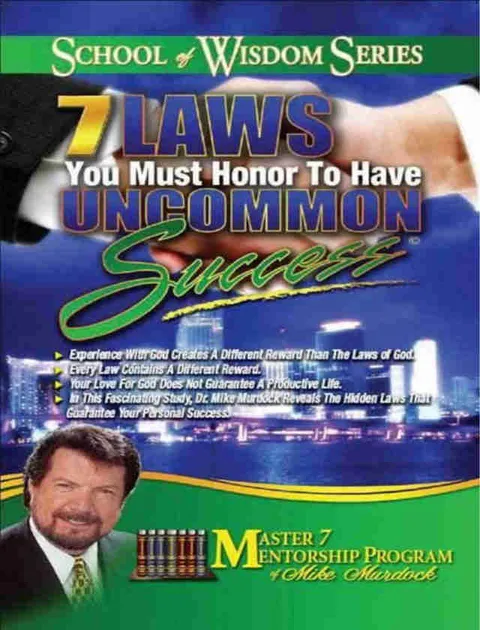

7 Laws You Must Honor To Have Uncommon Success Order Printed Copy
- Author: Mike Murdock
- Size: 1.3MB | 89 pages
- |
Others like 7 laws you must honor to have uncommon success Features >>

About the Book
In "7 Laws You Must Honor to Have Uncommon Success," author Mike Murdock outlines seven essential principles that individuals must follow in order to achieve extraordinary success in their lives. These laws include the Law of Recognition, the Law of Assignment, and the Law of Mentorship, among others. By adhering to these laws, readers can gain insights and actionable steps to reach their full potential and experience uncommon success in all areas of their lives.
Johnny Cash
Johnny Cash, the Man in Black, was a singer, guitarist and songwriter whose music innovatively mixed country, rock, blues and gospel influences.
Who Was Johnny Cash?
Johnny Cash grew up in a poor farming community and joined the Air Force in 1950. He co-founded a band following his discharge, and within a few years Johnny Cash and the Tennessee Two had scored hits with songs like "Walk the Line." Cash's career was nearly derailed in the 1960s by a serious substance-abuse problem, but his marriage to June Carter and acclaimed album Johnny Cash at Folsom Prison (1968) put him back on track. In later years, Cash joined the country supergroup the Highwaymen and released a series of recordings with producer Rick Rubin.
Early Life
Cash was born on February 26, 1932, in Kingsland, Arkansas. The son of poor Southern Baptist sharecroppers, Cash, one of seven children born to Ray and Carrie Rivers Cash, moved with his family at the age of 3 to Dyess, Arkansas, so that his father could take advantage of the New Deal farming programs instituted by President Franklin Roosevelt. There, the Cash clan lived in a five-room house and farmed 20 acres of cotton and other seasonal crops.
Cash spent much of the next 15 years out in the fields, working alongside his parents and siblings to help pay off their debts. It wasn't an easy life, and music was one of the ways the Cash family found escape from some of the hardships. Songs surrounded the young Cash, be it his mother's folk and hymn ballads, or the working music people sang out in the fields.
From an early age Cash, who began writing songs at age 12, showed a love for the music that enveloped his life. Sensing her boy's gift for song, Carrie scraped together enough money so that he could take singing lessons. However, after just three lessons his teacher, enthralled with Cash's already unique singing style, told him to stop taking lessons and to never deviate from his natural voice.
Religion, too, had a strong impact on Cash's childhood. His mother was a devout member of the Pentecostal Church of God, and his older brother Jack seemed committed to joining the priesthood until his tragic death in 1944 in an electric-saw accident. The experiences of his early farming life and religion became recurring themes in Cash's career.
Military Service and Musical Aspirations
In 1950, Cash graduated high school and left Dyess to seek employment, venturing to Pontiac, Michigan, for a brief stint at an auto body plant. That summer he enlisted in the U.S. Air Force as "John R. Cash"—military regulations required a full first name—and he was sent for training at Lackland Air Force Base in San Antonio, Texas, where he met future wife Vivian Liberto. For the bulk of his four years in the Air Force, Cash was stationed in Landsberg, West Germany, where he worked as a radio intercept officer, eavesdropping on Soviet radio traffic.
It was also in Germany that Cash began to turn more of his attention toward music. With a few of his Air Force buddies, he formed the Landsberg Barbarians, giving Cash a chance to play live shows, teach himself more of the guitar and take a shot at songwriting. "We were terrible," he said later, "but that Lowenbrau beer will make you feel like you're great. We'd take our instruments to these honky-tonks and play until they threw us out or a fight started."
After his discharge in July 1954, Cash married Vivian and settled with her in Memphis, Tennessee, where he worked, as best he could, as an appliance salesman. Pursuing music on the side, Cash teamed up with a couple of mechanics, Marshall Grant and Luther Perkins, who worked with Cash's older brother Roy. The young musicians soon formed a tight bond, with the crew and their wives often heading over to one of their houses to play music, much of it gospel.
Cash, who banged away on an old $5 guitar he'd purchased in Germany, became the frontman for the group, and they honed their unique synthesis of blues and country-and-western music through live performances. "He was a decent singer, not a great one," wrote Marshall Grant, in his 2006 autobiography, I Was There When it Happened: My Life with Johnny Cash. "But there was power and presence in his voice."
Johnny Cash and the Tennessee Two
In July 1954, another Memphis musician, Elvis Presley, cut his first record, sparking a wave of Elvis-mania as well as an interest in the local producer, Sun Records owner Sam Phillips, who had issued the record. Later that year Cash, Grant and Perkins made an unannounced visit to Sun to ask Phillips for an audition. The Sun Records owner gave in and Cash and the boys soon returned to show off their skills. Phillips liked their sound but not their gospel-driven song choices, which he felt would have a limited market, and asked them to return with an original song.
The trio did just that, beginning work on the Cash-written "Hey Porter," shortly that first Sun session. Phillips liked that song, as well as the group's follow-up effort, "Cry, Cry, Cry," and signed the newly branded Johnny Cash and the Tennessee Two. "Hey Porter" was released in May 1955 and later that year "Cry, Cry, Cry" peaked at No. 14 on the Billboard charts.
Other hits followed, including the Top 10 tracks "So Doggone Lonesome" and "Folsom Prison Blues." But true fame arrived in 1956 when Cash wrote and released "I Walk The Line," which catapulted to No. 1 on the country music charts and sold 2 million copies. He released his debut album, Johnny Cash with His Hot & Blue Guitar in 1957, and cemented his fame with chart-toppers like "Ballad of a Teenage Queen" and "Don't Take Your Guns to Town."
Drugs and Divorce
By the early 1960s, Cash, who had relocated his family to California and left Sun for Columbia Records, was a musical superstar. On the road for 300 nights a year with the group now known as the Tennessee Three, he was often accompanied by June Carter, who co-wrote what became one of the Man in Black's signature songs, "Ring of Fire" (1963). Cash also sought to establish himself as an actor, starring in the movie Five Minutes to Live (1961) and a few Western-themed TV programs.
But the schedule and the pressures that faced him took a toll on his personal life. Drugs and alcohol were frequent tour companions while Vivian, left home to take care of their family, which now included daughters Rosanne (b. 1955), Kathy (b. 1956), Cindy (b. 1959) and Tara (b. 1961) grew increasingly frustrated with her husband's absence. In 1966, she finally filed for divorce.
Cash's personal life continued to spiral out of control. The following year, after a serious drug binge, Cash was discovered in a near-death state by a policeman in a small village in Georgia. There were other incidents, too, including an arrest for smuggling amphetamines into the United States across the Mexican border, and for starting a forest fire in a California park. "I took all the drugs there are to take, and I drank," Cash recalled. "Everybody said that Johnny Cash was through 'cause I was walkin' around town 150 pounds. I looked like walking death."
Remarriage and Revival
Cash got the lifeline he needed from his old touring companion, June Carter, who helped him refocus on his Christian faith and get the drug addiction treatment he needed. The two were married on March 1, 1968.
With his new wife, Cash embarked on a remarkable turnaround. In 1969, he began hosting The Johnny Cash Show, a TV variety series that showcased contemporary musicians ranging from Bob Dylan to Louis Armstrong. It also provided a forum for Cash to explore a number of social issues, tackling discussions that ranged from the war in Vietnam to prison reform to the rights of Native Americans.
The same year his show debuted, Cash also took home two Grammy Awards for the live album Johnny Cash at Folsom Prison (1968). A critical and commercial success, the album was credited with helping to revive the artist's popularity. In early 1970, Cash and Carter experienced more joy with the birth of their first and only child, John Carter Cash.
The ensuing decade offered up more success for the artist, as Cash's music career flourished with the release of hit singles like "A Thing Called Love" (1972) and "One Piece at a Time" (1976). He also co-starred with Kirk Douglas in A Gunfight (1970), wrote music for the feature Little Fauss and Big Halsy (1970) and published a best-selling autobiography, Man in Black (1975). In 1980, he became the youngest living person to be elected to the Country Music Hall of Fame.
Cash continued to maintain a busy schedule, and he increasingly teamed up with other musicians. In 1986, he banded with old Sun Records colleagues Carl Perkins, Jerry Lee Lewis and Roy Orbison to record the widely popular compilation The Class Of '55. Meanwhile, he joined forces with fellow country stalwarts Kris Kristofferson, Willie Nelson and Waylon Jennings to form the Highwaymen, which released three studio albums between 1985 and 1995. In the early 1990s, Cash stepped into the studio with U2 to record The Wanderer, a track that would appear on the group's 1993 release, Zooropa.
Throughout this time, though, Cash's health problems and his continued battles with addiction were nearby. After undergoing abdominal surgery in 1983, he checked himself into the Betty Ford Clinic. In 1988, Cash again went under the knife, this time for double-bypass heart surgery.
But, like always, Cash pushed on. He was inducted into the Rock and Roll Hall of Fame in 1992, and in 1994 he teamed with music producer Rick Rubin to release American Recordings. A 13-track acoustic album that mixed traditional ballads with modern compositions, American Recordings earned Cash a new audience and a 1995 Grammy Award for Best Contemporary Folk Album. He followed with another Rubin-produced album, Unchained (1996), and in 1997 he published his second memoir, Cash: The Autobiography.
Final Years, Death and Legacy
Cash's physical health became more of an issue in the late 1990s. He was diagnosed with the neurodegenerative disease Shy-Drager syndrome—a misdiagnosis that was later corrected to autonomic neuropathy—and was hospitalized for pneumonia in 1998.
Still, the artist continued making music. In 2002, he released American IV: The Man Comes Around, a mix of originals and covers, including songs from the Beatles to Trent Reznor of Nine Inch Nails. The album, recorded at the Cash Cabin Studio in Hendersonville, Tennessee, was the fourth Cash-Rubin compilation.
Over the next year, Cash's health continued to decline. He was devastated when his longtime love, June Carter, died in May 2003, but he continued to work. With Rubin at his side, the singer recorded what would become American V: A Hundred Highways. Just a week before his death on September 12, 2003, from complications associated with diabetes, Cash wrapped up his final track.
"Once June passed, he had the will to live long enough to record, but that was pretty much all," Rubin later recalled. "A day after June passed, he said, 'I need to have something to do every day. Otherwise, there's no reason for me to be here.'"
That November, Cash was posthumously honored at the CMA annual awards, winning best album for American IV, best single and best video. In 2005, the story of his life and career through the late 1960s was made into a feature film, Walk the Line, starring Joaquin Phoenix as Cash and Reese Witherspoon as Carter.
In 2006, fans were treated to new music from the late artist. May brought Personal File, a two-CD set of unreleased material recorded decades earlier. In July, American V: A Hundred Highways was unveiled. Starkly arranged and sometimes mournful, the songs highlighted Cash's older and rougher sounding voice, which seared with a raw honesty.
Not surprisingly, Cash's influence continued to resonate. In 2007, the community of Starkville, Mississippi, paid honor to the performer and his arrest there in 1965 for public intoxication with the Johnny Cash Flower Pickin' Festival. The following year, the late artist won another Grammy, for Best Short Form Music Video for God's Gonna Cut You Down.
"I think he'll be remembered for the way he grew as a person and an artist," wrote Kris Kristofferson in 2010, upon Cash's selection by Rolling Stone magazine as the 31st greatest artist of all time. "He went from being this guy who was as wild as Hank Williams to being almost as respected as one of the fathers of our country. He was friends with presidents and with Billy Graham. You felt like he should've had his face on Mount Rushmore."
In 2010, additional material from recording sessions with Rubin were released as American VI: Ain't No Grave. In December 2013, it was revealed that another album from Cash had been unearthed. Out Among the Stars, which had been recorded in the early 1980s but never released by Columbia Records, was discovered by John Carter Cash in his father's archives. Underscoring the singer's sustained popularity, the album became a chart-topper following its release in March 2014.
Your First Years of Marriage
In many ways, we were a natural fit. My would-be husband and I both loved Jesus, studied his word, cherished worship through song, desired many children, longed to be hospitable, and valued the home and the wife’s joyful place in it. We both had Scandinavian heritage and understood the barbs that flew between Swedes and Norwegians. We both prized hard work — with an openness to risk-taking endeavors. As an engaged couple, with all we had going for us, it was hard for me to imagine what bumps we might face as we started down the road together. But that’s only because I underestimated how real and stubborn indwelling sin is. I thought external bumps in the road would be the obstacles — circumstances like finances or health issues or job difficulties — when really it was our own flesh that presented the biggest problems. Reflecting back on the first years of marriage and family, I commend three principles to ease the bumps and grease the wheels of joy in Christ in your marriage and family. 1. Let God Define ‘Normal’ We all come from unique backgrounds. Even two people who share a similar heritage, like my husband and I, have had vastly different childhoods. I grew up with 27 first cousins. I became an aunt at 14 and can’t really remember a time we didn’t have young children around our home (even though I was the youngest child in my family). My husband had four cousins and had rarely encountered an infant or toddler at close range prior to marrying into my family. This made for very different ideas of what “normal” felt and sounded like. I grew up on an acreage in a blue-collar town that bordered several rural communities. My mom grew up on a farm. My husband grew up in a first-ring suburb of a major metropolis. His dad grew up in the big city. We had very different conceptions of what the “outdoors” was for. For him, it was mainly for recreation and enjoyment — for hiking or biking or kayaking. For me, it was mainly for work — for mowing or burning the burn pile or doing animal chores. Our former “norms” can enrich our marriage, adding interest and laughter and providing opportunities to take something that’s been passed down and make it new. Or they can threaten the allegiance of our hearts. If what was normal to us in our childhood becomes the ultimate standard for our marriage, we have misplaced our loyalties. We need to be led by the only authoritative and inerrant guide to life and marriage that we have: All Scripture is breathed out by God and profitable for teaching, for reproof, for correction, and for training in righteousness, that the man of God may be complete, equipped for every good work. (2 Timothy 3:16–17) Including every good work in the sometimes thorny first years of marriage. In marriage, God is making something new: a new one-flesh union, that is, a new family. And when a husband and wife let God’s word define normal, the wife willingly comes under the leadership of her husband in submission, as Scripture directs her to reflect Christ’s church (Ephesians 5:22–25). Her family of origin may aid that process or hinder it, but in either case, a reprioritizing happens. For the husband, it means looking to Christ as the standard by which he loves and leads his wife, and adopting his previous family’s practices only inasmuch as they accord with Christ. “If God’s word is the norm, the authority, you will have solid common ground on which to stand, come what may.” When I was young, my mom gave me one primary piece of advice when it came to choosing a husband: “God’s word must be his authority.” It’s key advice for men and women, and I gladly pass it along to you. If God’s word is the norm, the authority — not the culture, not your friends’ opinions or your family’s traditions, not Netflix or social media — you will have solid common ground on which to stand, come what may. 2. Stay in Step with the Spirit Paul tells the Galatians, “If we live by the Spirit, let us also keep in step with the Spirit. Let us not become conceited, provoking one another, envying one another” (Galatians 5:25–26). It may seem unlikely for two people who love each other and have committed their lives to one another “for better or worse” to fall into conceit, envy, and provocation of one another — and yet it’s common enough in marriage. The lies of the world have primed us to believe that men and women are on two separate teams in life. Team Women must advocate for women, and Team Men (in a bit of irony) must also advocate for women (although many rebel against this). This means that, at least for those of us raised in the United States or the West, women are expected to compete with men. From a young age, girls are taught that how they rank is a function of whether or not they are beating the boys. This way of thinking infects both boys and girls. And while that attitude may lie dormant during dating or courtship, it will rear its head if not dealt with. In a husband, this can look like unrealistic expectations for his wife — treating her like another man who shouldn’t have any significant differences from him. For example, he may expect her to earn what he earns, or overlook the inherent vulnerability of pregnancy and caring for small children. In a wife, this can look like pulling out the measuring stick to keep track of all the ways she’s getting a raw deal compared to him. For example, she may envy the occasional out-to-eat work lunches while she eats with the kids at home, or she may resent that the care of small children falls mainly to her. These are deadly attitudes to maintain in a marriage. When we marry, the Spirit of God does something amazing: he makes us part of a new team. I was blessed to join Team Dodds — not Team Women, or Team Men, or Team Me. When something wonderful happens to the husband, the wife rejoices as though it has happened to her, because it has. When something difficult happens to the wife, the husband nurtures and defends her as though it has happened to him, because it has. How do we keep in step with the Spirit in marriage? By prayerfully and regularly confessing our sins, and by setting our minds on the things of the Spirit, with a special focus on Christ — his life, his words, and his ways (1 John 1:9; Romans 8:5). We walk in the Spirit of Christ when we conform to the way he’s designed the marriage: “‘a man shall leave his father and his mother and hold fast to his wife, and the two shall become one flesh.’ So they are no longer two but one flesh. What therefore God has joined together, let not man separate” (Matthew 19:5–6). 3. Share Your New Life with Others My husband and I were married in June 2002. By October, we were taking a class to join our local church. At the same time, we opened our home (the upstairs of a duplex) to host a small group of singles and couples. I was 21 and still finishing college. It may have seemed a bit premature for us to join a church we were so new to, or to host a small group made up of mostly strangers, but the church had a need and we were eager to help. We didn’t join the church or host a small group primarily as ways to establish a stronger marriage, but looking back, they were important in shaping the patterns and priorities of our life. “The hospitable people I know are hospitable with little and with much, in small spaces and in big.” Many young families think that hospitality will sprout when the timing is right — when they get a bigger place, or when the kids aren’t so little, or when the finances aren’t so tight, or when they get that one room cleaned out. I’ve never seen it happen that way. The hospitable people I know are hospitable with little and with much, in small spaces and in big, among babies and boomers, in a dirty kitchen and a clean one. Sharing your home with others — making food for them, stretching your grocery budget on their behalf, letting them into your bathroom, cleaning up after their messes, inviting them into your thoughts through conversation and listening to theirs — is shockingly intimate in a world where embodied presence is becoming rare. Paul tells the Thessalonian church that “being affectionately desirous of you, we were ready to share with you not only the gospel of God but also our own selves, because you had become very dear to us” (1 Thessalonians 2:8). When we invite others into our home, we give them a bit of “our own selves.” When a husband, wife, and their children offer their home and their “own selves” to others through hospitality, they are not robbing time or resources from each other; they are gaining by giving. Hospitality forms a family identity that is not navel-gazing, but focused on sharing the love of God in practical ways with others. I can think of little else that will form and establish a Christian family to be joyful and robust in the Lord for decades to come than to practice sharing your life with others. Don’t let your home or marriage or family be only private. “Welcome one another as Christ has welcomed you, for the glory of God” (Romans 15:7). A husband and wife who have made God’s word their norm and who are keeping in step with the Spirit will have much to share with others. Open your doors and welcome many to come taste of Christ’s goodness at your table. Article by Abigail Dodds