

Others like the hidden man Features >>

The God I Never Knew

When The Many Are One

The Oil And The Mantle

The Enemy Has Done This

The Tree And Your Ministry

The Wisdom Of Making Right Choices

The Bible Way To Receive The Holy Spirit

The Person And Work Of The Holy Spirit

Invading Babylon - The 7 Mountain Mandate

How To Become A Water Walker
About the Book
"The Hidden Man" by E.W. Kenyon explores the concept of the hidden man of the heart, a spiritual reality that affects every aspect of a person's life. Kenyon delves into the power of positive confession, the importance of faith and the role of the Holy Spirit in transforming the hidden man. The book emphasizes the need for believers to align their thoughts and words with God's truth to experience victory in life.
Gladys Aylward
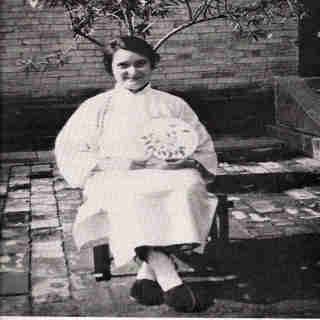 Gladys Aylward was born in London in 1904 (or a few years earlier). She worked for several years as a parlormaid, and then attended a revival meeting at which the preacher spoke of dedicating one's life to the service of God. Gladys responded to the message, and soon after became convinced that she was called to preach the Gospel in China. At the age of 26, she became a probationer at the China Inland Mission Center in London, but was failed to pass the examinations. She worked at other jobs and saved her money. Then she heard of a 73-year-old missionary, Mrs. Jeannie Lawson, who was looking for a younger woman to carry on her work. Gladys wrote to Mrs. Lawson and was accepted if she could get to China. She did not have enough money for the ship fare, but did have enough for the train fare, and so in October of 1930 she set out from London with her passport, her Bible, her tickets, and two pounds ninepence, to travel to China by the Trans-Siberian Railway, despite the fact that China and the Soviet Union were engaged in an undeclared war. She arrived in Vladivostok and sailed from there to Japan and from Japan to Tientsin, and thence by train, then bus, then mule, to the inland city of Yangchen, in the mountainous province of Shansi, a little south of Peking (Beijing). Most of the residents had seen no Europeans other than Mrs. Lawson and now Miss Aylward. They distrusted them as foreigners, and were not disposed to listen to them.
Yangchen was an overnight stop for mule caravans that carried coal, raw cotton, pots, and iron goods on six-week or three-month journeys. It occurred to the two women that their most effective way of preaching would be to set up an inn. The building in which they lived had once been an inn, and with a bit of repair work could be used as one again. They laid in a supply of food for mules and men, and when next a caravan came past, Gladys dashed out, grabbed the rein of the lead mule, and turned it into their courtyard. It went willingly, knowing by experience that turning into a courtyard meant food and water and rest for the night. The other mules followed, and the muleteers had no choice. They were given good food and warm beds at the standard price, and their mules were well cared for, and there was free entertainment in the evening--the inkeepers told stories about a man named Jesus. After the first few weeks, Gladys did not need to kidnap customers -- they turned in at the inn by preference. Some became Christians, and many of them (both Christians and non-Christians) remembered the stories, and retold them more or less accurately to other muleteers at other stops along the caravan trails. Gladys practiced her Chinese for hours each day, and was becoming fluent and comfortable with it. Then Mrs. Lawson suffered a severe fall, and died a few days later. Gladys Aylward was left to run the mission alone, with the aid of one Chinese Christian, Yang, the cook.
A few weeks after the death of Mrs. Lawson, Miss Aylward met the Mandarin of Yangchen. He arrived in a sedan chair, with an impressive escort, and told her that the government had decreed an end to the practice of footbinding. (Note: Among the upper and middle classes, it had for centuries been the custom that a woman's foot should be wrapped tightly in bandages from infancy, to prevent it from growing. Thus grown women had extremely tiny feet, on which they could walk only with slow, tottering steps, which were thought to be extremely graceful.) The government needed a foot-inspector, a woman (so that she could invade the women's quarters without scandal), with her own feet unbound (so that she could travel), who would patrol the district enforcing the decree. It was soon clear to them both that Gladys was the only possible candidate for the job, and she accepted, realizing that it would give her undreamed-of opportunities to spread the Gospel.
During her second year in Yangchen, Gladys was summoned by the Mandarin. A riot had broken out in the men's prison. She arrived and found that the convicts were rampaging in the prison courtyard, and several of them had been killed. The soldiers were afraid to intervene. The warden of the prison said to Gladys, "Go into the yard and stop the rioting." She said, "How can I do that?" The warden said, "You have been preaching that those who trust in Christ have nothing to fear." She walked into the courtyard and shouted: "Quiet! I cannot hear when everyone is shouting at once. Choose one or two spokesmen, and let me talk with them." The men quieted down and chose a spokesman. Gladys talked with him, and then came out and told the warden: "You have these men cooped up in crowded conditions with absolutely nothing to do. No wonder they are so edgy that a small dispute sets off a riot. You must give them work. Also, I am told that you do not supply food for them, so that they have only what their relatives send them. No wonder they fight over food. We will set up looms so that they can weave cloth and earn enough money to buy their own food." This was done. There was no money for sweeping reforms, but a few friends of the warden donated old looms, and a grindstone so that the men could work grinding grain. The people began to call Gladys Aylward "Ai-weh-deh," which means "Virtuous One." It was her name from then on.
Soon after, she saw a woman begging by the road, accompanied by a child covered with sores and obviously suffering severe malnutrition. She satisfied herself that the woman was not the child's mother, but had kidnapped the child and was using it as an aid to her begging. She bought the child for ninepence--a girl about five years old. A year later, "Ninepence" came in with an abandoned boy in tow, saying, "I will eat less, so that he can have something." Thus Ai-weh-deh acquired a second orphan, "Less." And so her family began to grow.... She was a regular and welcome visitor at the palace of the Mandarin, who found her religion ridiculous, but her conversation stimulating. In 1936, she officially became a Chinese citizen. She lived frugally and dressed like the people around her (as did the missionaries who arrived a few years after in in the neighboring town of Tsechow, David and Jean Davis and their young son Murray, of Wales), and this was a major factor in making her preaching effective.
Then the war came. In the spring of 1938, Japanese planes bombed the city of Yangcheng, killing many and causing the survivors to flee into the mountains. Five days later, the Japanese Army occupied Yangcheng, then left, then came again, then left. The Mandarin gathered the survivors and told them to retreat into the mountains for the duration. He also announced that he was impressed by the life of Ai-weh-deh and wished to make her faith his own. There remained the question of the convicts at the jail. The traditional policy favored beheading them all lest they escape. The Mandarin asked Ai-weh-deh for advice, and a plan was made for relatives and friends of the convicts to post a bond guaranteeing their good behavior. Every man was eventually released on bond. As the war continued Gladys often found herself behind Japanese lines, and often passed on information, when she had it, to the armies of China, her adopted country. She met and became friends with "General Ley," a Roman Catholic priest from Europe who had teken up arms when the Japanese invaded, and now headed a guerilla force. Finally he sent her a message. The Japanese are coming in full force. We are retreating. Come with us." Angry, she scrawled a Chinese note, Chi Tao Tu Pu Twai, "Christians never retreat!" He sent back a copy of a Japanese handbill offering $100 each for the capture, dead or alive, of (1) the Mandarin, (2) a prominent merchant, and (3) Ai-weh-deh. She determined to flee to the government orphanage at Sian, bringing with her the children she had accumulated, about 100 in number. (An additional 100 had gone ahead earlier with a colleague.) With the children in tow, she walked for twelve days. Some nights they found shelter with friendly hosts. Some nights they spent unprotected on the mountainsides. On the twelfth day, they arrived at the Yellow River, with no way to cross it. All boat traffic had stopped, and all civilian boats had been seized to keep them out of the hands of the Japanese. The children wanted to know, "Why don't we cross?" She said, "There are no boats." They said, "God can do anything. Ask Him to get us across." They all knelt and prayed. Then they sang. A Chinese officer with a patrol heard the singing and rode up. He heard their story and said, "I think I can get you a boat." They crossed, and after a few more difficulties Ai-weh-deh delivered her charges into competent hands at Sian, and then promptly collapsed with typhus fever and sank into delirium for several days.
As her health gradually improved, she started a Christian church in Sian, and worked elsewhere, including a settlement for lepers in Szechuan, near the borders of Tibet. Her health was permanently impaired by injuries received during the war, and in 1947 she returned to England for a badly needed operation. She remained in England, preaching there.
In 1957, Alan Burgess wrote a book about her, The Small Woman. It was condensed in The Reader's Digest, and made into a movie called The Inn of the Sixth Happiness, starring Ingrid Bergman. When Newsweek magazine reviewed the movie, and summarized the plot, a reader, supposing the story to be fiction, wrote in to say, "In order for a movie to be good, the story should be believable!" Miss Gladys Aylward, the Small Woman, Ai-weh-deh, died 3 January 1970.
Gladys Aylward was born in London in 1904 (or a few years earlier). She worked for several years as a parlormaid, and then attended a revival meeting at which the preacher spoke of dedicating one's life to the service of God. Gladys responded to the message, and soon after became convinced that she was called to preach the Gospel in China. At the age of 26, she became a probationer at the China Inland Mission Center in London, but was failed to pass the examinations. She worked at other jobs and saved her money. Then she heard of a 73-year-old missionary, Mrs. Jeannie Lawson, who was looking for a younger woman to carry on her work. Gladys wrote to Mrs. Lawson and was accepted if she could get to China. She did not have enough money for the ship fare, but did have enough for the train fare, and so in October of 1930 she set out from London with her passport, her Bible, her tickets, and two pounds ninepence, to travel to China by the Trans-Siberian Railway, despite the fact that China and the Soviet Union were engaged in an undeclared war. She arrived in Vladivostok and sailed from there to Japan and from Japan to Tientsin, and thence by train, then bus, then mule, to the inland city of Yangchen, in the mountainous province of Shansi, a little south of Peking (Beijing). Most of the residents had seen no Europeans other than Mrs. Lawson and now Miss Aylward. They distrusted them as foreigners, and were not disposed to listen to them.
Yangchen was an overnight stop for mule caravans that carried coal, raw cotton, pots, and iron goods on six-week or three-month journeys. It occurred to the two women that their most effective way of preaching would be to set up an inn. The building in which they lived had once been an inn, and with a bit of repair work could be used as one again. They laid in a supply of food for mules and men, and when next a caravan came past, Gladys dashed out, grabbed the rein of the lead mule, and turned it into their courtyard. It went willingly, knowing by experience that turning into a courtyard meant food and water and rest for the night. The other mules followed, and the muleteers had no choice. They were given good food and warm beds at the standard price, and their mules were well cared for, and there was free entertainment in the evening--the inkeepers told stories about a man named Jesus. After the first few weeks, Gladys did not need to kidnap customers -- they turned in at the inn by preference. Some became Christians, and many of them (both Christians and non-Christians) remembered the stories, and retold them more or less accurately to other muleteers at other stops along the caravan trails. Gladys practiced her Chinese for hours each day, and was becoming fluent and comfortable with it. Then Mrs. Lawson suffered a severe fall, and died a few days later. Gladys Aylward was left to run the mission alone, with the aid of one Chinese Christian, Yang, the cook.
A few weeks after the death of Mrs. Lawson, Miss Aylward met the Mandarin of Yangchen. He arrived in a sedan chair, with an impressive escort, and told her that the government had decreed an end to the practice of footbinding. (Note: Among the upper and middle classes, it had for centuries been the custom that a woman's foot should be wrapped tightly in bandages from infancy, to prevent it from growing. Thus grown women had extremely tiny feet, on which they could walk only with slow, tottering steps, which were thought to be extremely graceful.) The government needed a foot-inspector, a woman (so that she could invade the women's quarters without scandal), with her own feet unbound (so that she could travel), who would patrol the district enforcing the decree. It was soon clear to them both that Gladys was the only possible candidate for the job, and she accepted, realizing that it would give her undreamed-of opportunities to spread the Gospel.
During her second year in Yangchen, Gladys was summoned by the Mandarin. A riot had broken out in the men's prison. She arrived and found that the convicts were rampaging in the prison courtyard, and several of them had been killed. The soldiers were afraid to intervene. The warden of the prison said to Gladys, "Go into the yard and stop the rioting." She said, "How can I do that?" The warden said, "You have been preaching that those who trust in Christ have nothing to fear." She walked into the courtyard and shouted: "Quiet! I cannot hear when everyone is shouting at once. Choose one or two spokesmen, and let me talk with them." The men quieted down and chose a spokesman. Gladys talked with him, and then came out and told the warden: "You have these men cooped up in crowded conditions with absolutely nothing to do. No wonder they are so edgy that a small dispute sets off a riot. You must give them work. Also, I am told that you do not supply food for them, so that they have only what their relatives send them. No wonder they fight over food. We will set up looms so that they can weave cloth and earn enough money to buy their own food." This was done. There was no money for sweeping reforms, but a few friends of the warden donated old looms, and a grindstone so that the men could work grinding grain. The people began to call Gladys Aylward "Ai-weh-deh," which means "Virtuous One." It was her name from then on.
Soon after, she saw a woman begging by the road, accompanied by a child covered with sores and obviously suffering severe malnutrition. She satisfied herself that the woman was not the child's mother, but had kidnapped the child and was using it as an aid to her begging. She bought the child for ninepence--a girl about five years old. A year later, "Ninepence" came in with an abandoned boy in tow, saying, "I will eat less, so that he can have something." Thus Ai-weh-deh acquired a second orphan, "Less." And so her family began to grow.... She was a regular and welcome visitor at the palace of the Mandarin, who found her religion ridiculous, but her conversation stimulating. In 1936, she officially became a Chinese citizen. She lived frugally and dressed like the people around her (as did the missionaries who arrived a few years after in in the neighboring town of Tsechow, David and Jean Davis and their young son Murray, of Wales), and this was a major factor in making her preaching effective.
Then the war came. In the spring of 1938, Japanese planes bombed the city of Yangcheng, killing many and causing the survivors to flee into the mountains. Five days later, the Japanese Army occupied Yangcheng, then left, then came again, then left. The Mandarin gathered the survivors and told them to retreat into the mountains for the duration. He also announced that he was impressed by the life of Ai-weh-deh and wished to make her faith his own. There remained the question of the convicts at the jail. The traditional policy favored beheading them all lest they escape. The Mandarin asked Ai-weh-deh for advice, and a plan was made for relatives and friends of the convicts to post a bond guaranteeing their good behavior. Every man was eventually released on bond. As the war continued Gladys often found herself behind Japanese lines, and often passed on information, when she had it, to the armies of China, her adopted country. She met and became friends with "General Ley," a Roman Catholic priest from Europe who had teken up arms when the Japanese invaded, and now headed a guerilla force. Finally he sent her a message. The Japanese are coming in full force. We are retreating. Come with us." Angry, she scrawled a Chinese note, Chi Tao Tu Pu Twai, "Christians never retreat!" He sent back a copy of a Japanese handbill offering $100 each for the capture, dead or alive, of (1) the Mandarin, (2) a prominent merchant, and (3) Ai-weh-deh. She determined to flee to the government orphanage at Sian, bringing with her the children she had accumulated, about 100 in number. (An additional 100 had gone ahead earlier with a colleague.) With the children in tow, she walked for twelve days. Some nights they found shelter with friendly hosts. Some nights they spent unprotected on the mountainsides. On the twelfth day, they arrived at the Yellow River, with no way to cross it. All boat traffic had stopped, and all civilian boats had been seized to keep them out of the hands of the Japanese. The children wanted to know, "Why don't we cross?" She said, "There are no boats." They said, "God can do anything. Ask Him to get us across." They all knelt and prayed. Then they sang. A Chinese officer with a patrol heard the singing and rode up. He heard their story and said, "I think I can get you a boat." They crossed, and after a few more difficulties Ai-weh-deh delivered her charges into competent hands at Sian, and then promptly collapsed with typhus fever and sank into delirium for several days.
As her health gradually improved, she started a Christian church in Sian, and worked elsewhere, including a settlement for lepers in Szechuan, near the borders of Tibet. Her health was permanently impaired by injuries received during the war, and in 1947 she returned to England for a badly needed operation. She remained in England, preaching there.
In 1957, Alan Burgess wrote a book about her, The Small Woman. It was condensed in The Reader's Digest, and made into a movie called The Inn of the Sixth Happiness, starring Ingrid Bergman. When Newsweek magazine reviewed the movie, and summarized the plot, a reader, supposing the story to be fiction, wrote in to say, "In order for a movie to be good, the story should be believable!" Miss Gladys Aylward, the Small Woman, Ai-weh-deh, died 3 January 1970.
We Need More Holy Fools
A man is trapped in a car, rushing down a hill toward a cliff. The doors are locked. The brakes are out. The steering barely works. Far ahead, he can see other cars hurtling into the abyss. How far they fall, he does not know. What they find at the bottom, he cannot imagine. But he does not seek to know; he does not try to imagine. Instead, he paints the windshield, climbs into the back seat, and puts in his headphones. This image, adapted from Peter Kreeft, captures my life in January 2008, as I walked down a college sidewalk in Colorado. The car was my body; the hill, time; the cliff, death. I was, as we all are, rushing toward the moment when my pulse would stop. And though unsure of what would come afterward, I found a thousand ways to look away. “The Lord looks down from heaven on the children of man, to see if there are any who understand, who seek after God” (Psalm 14:2). Like so many other children of men, I neither understood nor sought, I neither asked nor knocked, but let myself tumble through time without a thought of eternity. I was a “fool,” to put it bluntly (Psalm 14:1). And I desperately needed another kind of fool to wake me up. Puncturing the Daydream Few people, perhaps, would look at a normal Western life like mine — busy, successful, spiritually indifferent — and say, “folly.” But could it be because the folly is socially acceptable? Might we modern Western men and women have made a silent pact to ignore eternity? “Might we modern Western men and women have made a silent pact to ignore eternity?” Blaise Pascal, seventeenth-century Christian polymath, thought so. When Pascal looked round at his modern country, neighbors, and self, he saw a collective pathology, a shared insanity: “Man’s sensitivity to little things and insensitivity to the greatest things are marks of a strange disorder,” he said ( Christianity for Modern Pagans , 203). We cultivate hobbies, and follow celebrities, and read the news without knowing why we exist. We stumble through an unthinkably vast cosmos, circled round by unthinkably intricate wonders, too distracted to ask, “Who made this?” We develop firm opinions about politics, and care not whether souls live forever, and where. We look often into our mirrors and seldom into our deep and fallen hearts. A strange disorder indeed. And so, Pascal walked around with needles in hand, seeking to puncture the daydream of secular or religiously nominal apathy to eternity. His unfinished book Pensées (abridged and explained in Kreeft’s masterful Christianity for Modern Pagans ) may have been his sharpest needle. What Is a Life ‘Well-Lived’? Our lives here are hemmed in by mystery and uncertainty. We live on a small rock in an immense universe. We know little about where we came from or where we’re going. We struggle even to understand ourselves. But a few matters remain clear and unmistakable, including the great fact that, one day, we will die. Our car hurtles down the hill, lower today than yesterday. The abyss awaits. And what then? For secular or nominally religious countrymen like Pascal’s, and ours, the options are two: “the inescapable and appalling alternative of being annihilated or wretched throughout eternity” (191). Either Christianity is false, and our flickering candle goes out forever — or Christianity is true, and, awakening to life’s meaning too late, we fall “into the hands of a wrathful God” (193). A society like ours would lead us to believe that eighty years “well lived” (whatever that means) filled with “personal meaning” (whatever that means) makes for a good life; we need seek no more. To Pascal, those were the words of one who had painted the windshield black. Death, rightly reckoned with, functions like the final scene of a tragic play: it reaches its fingers back into all of life, disfiguring every moment, darkly witnessing that all is not well. “The last act is bloody, however fine the rest of the play,” Pascal writes. “They throw earth over your head and it is finished forever” (144). Stand above the hole in the ground, the dust from which we came and to which we’ll return (Genesis 3:19), and consider: “That is the end of the world’s most illustrious life” (191). “We ourselves are an enigma, wrapped in a world of mystery, headed inevitably for the grave.” We ourselves are an enigma, wrapped in a world of mystery, headed inevitably for the grave. Such a dire plight might send us searching for wisdom, if it weren’t for our insane “solution.” Insanity of Our ‘Solutions’ How do we — mortal men and women, nearing the cliff’s edge — typically respond to our plight? “We run heedlessly into the abyss after putting something in front of us to stop us seeing it” (145). We deny. We divert. We distract. Until one day we die. Of course, no one ever says, “I will distract myself because I don’t want to consider my death and what may come afterward.” We suppress the truth more subconsciously than that (Romans 1:18). Instinctively, we avoid the “house of mourning,” or else dress it with euphemisms, for fear of facing, terribly and unmistakably, that “this is the end of all mankind” — that this is our end (Ecclesiastes 7:2). Summarizing Pascal, Kreeft writes, If you are typically modern, your life is like a rich mansion with a terrifying hole right in the middle of the living-room floor. So you paper over the hole with a very busy wallpaper pattern to distract yourself. You find a rhinoceros in the middle of your house. The rhinoceros is wretchedness and death. How in the world can you hide a rhinoceros? Easy: cover it with a million mice. Multiply diversions. (169) Eighty years may seem like a long time to distract yourself from the most fundamental questions of life and death. But with hearts like ours, in a world like ours, it is not too long. Make a career. Raise a family. Build wealth. Plan vacations. Get promoted. Watch movies. Collect sports cards. Read the news. Play golf. Resist uncomfortable questions. We hang a curtain over the cliff’s edge that keeps us from seeing the abyss. But not from rushing into it. Sanest People in the World Our chosen “solution,” then, only aggravates our dire plight. Our distractions sedate us on the way to death rather than sending us searching for some escape. Which means the world has a desperate need for people like Pascal, men and women whom we might call (to use a phrase from church history) holy fools . The term holy fools drips with the same irony Paul used when he spoke of “the foolishness of God” (1 Corinthians 1:25) and said, “We are fools for Christ” (1 Corinthians 4:10). In truth, holy fools are the world’s sanest people. They have felt the sting of sin and death. They have found deliverance in Jesus Christ. And now they are trying to tell the world. With Pascal, they see that “there are only two classes of people who can be called reasonable: those who serve God with all their heart because they know him and those who seek him with all their heart because they do not know him” (195). And so, holy fools call people into the “folly” that is our only sanity. They come to those caught in distraction, lost in diversion, and they serve, love, persuade, and prod. They risk reputation and comfort, willing to look foolish in the eyes of a wayward world. They bring eternity into everyday conversations with cashiers, neighbors, and other parents at the park. Boldly and patiently, courageously and graciously, they say, “See your death. See your sin. And seek him with all your heart.” To those bent on diversion, holy fools may seem imbalanced, extreme, awkward, pushy. But not to everyone. Some, as they hear of the Christ these fools preach, will catch a glimmer of “the power of God and the wisdom of God” (1 Corinthians 1:24). And they will become another fool for him. Give Us More Fools for Christ Pascal (and the apostle Paul) make me feel that I am not yet the fool I ought to be. Too often, I prefer social decorum to holy discomfort, this-worldly niceness to next-worldly boldness. But they also make me feel a keen gratitude for the holy fools among us, and a longing to be more like them. For I owe my life to one. In January 2008, as my little car rushed down the hill, and as I did what I could to cover my eyes, someone stopped me on the sidewalk. I would later learn that he belonged to a campus ministry widely known for sharing Jesus with students — widely known, but not widely loved. Their message was, to most, foolishness — and their way of stopping others on the sidewalk, a stumbling block. But to me that day, by grace, it looked like the wisdom of God. In time, I would realize that my various diversions could not deliver me from death. Nor could a life “well lived” forgive my sins or undig my grave. Only Jesus could. It took a holy fool to make me sane, and oh how the world needs more.