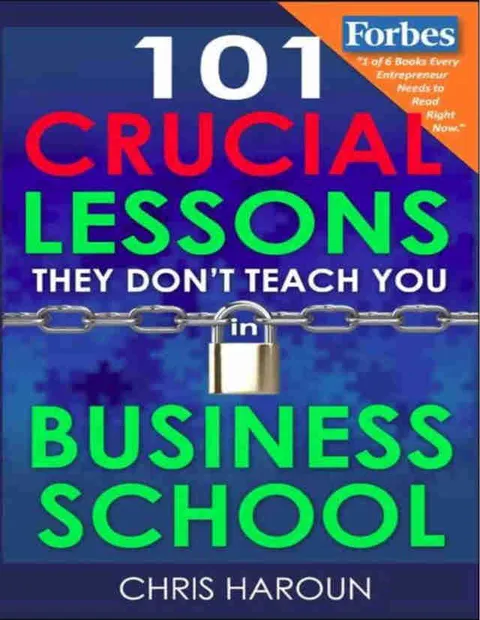

101 Crucial Lessons They Don't Teach You In Business School Order Printed Copy
- Author: Chris Haroun
- Size: 516KB | 134 pages
- |
Others like 101 crucial lessons they don't teach you in business school Features >>
The 100 Absolutely Unbreakable Laws Of Business Success
The Rules Of Work
101 Activities For Teaching Creativity And Problem Solving

None Of These Diseases

Goal Setting
Ethics 101 - What Every Leader Needs To Succeed
Leadership

The Four Agreements

Anger: Taming A Powerful Emotion
Give And Take - A Revolutionary Approach To Success
About the Book
"101 Crucial Lessons They Don't Teach You In Business School" by Chris Haroun provides practical advice and insights for success in the business world that are often overlooked in traditional business education. The book covers a wide range of topics, from networking and leadership to negotiation and decision-making, offering valuable lessons for aspiring entrepreneurs and professionals alike. Haroun's straightforward approach and real-world examples make this book a valuable resource for anyone looking to succeed in the business world.
Warren Wiersbe
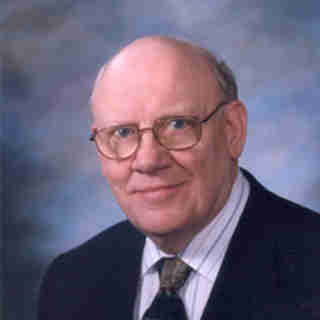 Dr. Warren Wiersbe once described Heaven as “not only a destination, but also a motivation. When you and I are truly motivated by the promise of eternity with God in heaven, it makes a difference in our lives.”
For Wiersbe, the promise of eternity became the motivation for his long ministry as a pastor, author, and radio speaker. Beloved for his biblical insight and practical teaching, he was called “one of the greatest Bible expositors of our generation” by the late Billy Graham.
Warren W. Wiersbe died on May 2, 2019, in Lincoln, Nebraska, just a few weeks shy of his 90th birthday.
“He was a longtime, cherished friend of Moody Bible Institute, a faithful servant of the Word, and a pastor to younger pastors like me,” said Dr. Mark Jobe, president of Moody Bible Institute. “We are lifting up pastor Wiersbe’s family in prayer at this time and rejoicing in the blessed hope that believers share together.”
Wiersbe grew up in East Chicago, Indiana, a town known for its steel mills and hard-working blue-collar families. In his autobiography, he connected some of his earliest childhood memories to Moody Bible Institute; his home church pastor was a 1937 graduate, Dr. William H. Taylor. After volunteering to usher at a 1945 Youth for Christ rally, Wiersbe found himself listening with rapt attention to Billy Graham’s sermon, and responded with a personal prayer of dedication.
In a precocious turn of events, the young Wiersbe was already a published author, having written a book of card tricks for the L. L. Ireland Magic Co. of Chicago. He quickly learned to liven up Sunday school lessons with magic tricks as object lessons (“not the cards!” he would say). After his high school graduation in 1947 (he was valedictorian), he spent a year at Indiana University before transferring to Northern Baptist Seminary in Chicago, where he earned a bachelor of theology degree. His future wife, Betty, worked in the school library, and Wiersbe was a frequent visitor.
While in seminary he became pastor of Central Baptist Church in East Chicago, serving until 1957. During those years he became a popular YFC speaker, which led to a full-time position with Youth for Christ International in Wheaton. He published his first article for Moody Monthly magazine in 1956, about Bible study methods, and seemed to outline his ongoing writing philosophy. “This is more of a personal testimony,” he said, “because I want to share these blessings with you, rather than write some scholarly essay, which I am sure I could not do anyway.”
At a 1957 YFC convention in Winona Lake, Indiana, Wiersbe preached a sermon that was broadcast live over WMBI, his first connection to Moody Radio. “I wish every preacher could have at least six months’ experience as a radio preacher,” he said later (because they would preach shorter).
While working with Youth for Christ, Wiersbe got a call from Pete Gunther at Moody Publishers, asking about possible book projects. First came Byways of Blessing (1961), an adult devotional; then two more books in 1962, A Guidebook for Teens and Teens Triumphant. He would eventually publish 14 titles with Moody, including William Culbertson: A Man of God (1974), Live Like a King (1976), The Annotated Pilgrim’s Progress (1980), and Ministering to the Mourning (2006), written with his son, David Wiersbe.
In 1961, D. B. Eastep invited Wiersbe to join the staff of Calvary Baptist Church in Covington, Kentucky. forming a succession plan that was hastened by Eastep’s sudden death in 1962. Warren and Betty Wiersbe remained at the church for 10 years, until they were surprised by a phone call from The Moody Church. The pastor, Dr. George Sweeting, had just resigned to become president of Moody Bible Institute. Would Wiersbe fill the pulpit, and pray about becoming a candidate?
He was already well known to the Chicago church—and to the MBI community. He continued to write for Moody Monthly and had just started a new column, “Insights for the Pastor.” The monthly feature continued to run during the years Wiersbe served at The Moody Church. Wiersbe would become one of the magazine’s most prolific writers—200 articles during a 40-year span. Meanwhile he also started work on the BE series of exegetical commentaries, books that soon found a place on the shelf of every evangelical pastor.
His ministry to pastors continued as he spoke at Moody Founder’s Week, Pastors’ Conference, and numerous campus events. He also inherited George Sweeting’s role as host of the popular Songs in the Night radio broadcast, produced by Moody Radio’s Bob Neff and distributed on Moody’s growing network of radio stations.
Later in life he would move to Lincoln, Nebraska, where he served as host of the Back to the Bible radio broadcast. He also taught courses on preaching at Trinity Evangelical Divinity School and Grand Rapids Baptist Seminary. He kept writing, eventually publishing more than 150 books and losing track of how many (“I can’t remember them all, and I didn’t save copies of everything,” he said.)
Throughout his ministry, Warren Wiersbe described himself as a bridge builder, a reference to his homiletical method of moving “from the world of the Bible to the world of today so that we could get to the other side of glory in Jesus.” As explained by his grandson, Dan Jacobson, “His preferred tools were words, his blueprints were the Scriptures, and his workspace was a self-assembled library.”
Several of Wiersbe’s extended family are Moody alums, including a son, David Wiersbe ’76; grandson Dan Jacobsen ’09 and his wife, Kristin (Shirk) Jacobsen ’09; and great-nephew Ryan Smith, a current student.
During his long ministry and writing career, Warren Wiersbe covered pretty much every topic, including the inevitability of death. These words from Ministering to the Mourning offer a fitting tribute to his own ministry:
We who are in Christ know that if He returns before our time comes to die, we shall be privileged to follow Him home. God’s people are always encouraged by that blessed hope. Yet we must still live each day soberly, realizing that we are mortal and that death may come to us at any time. We pray, “Teach us to number our days aright, that we may gain a heart of wisdom” (Psalm 90:12).
Dr. Warren Wiersbe once described Heaven as “not only a destination, but also a motivation. When you and I are truly motivated by the promise of eternity with God in heaven, it makes a difference in our lives.”
For Wiersbe, the promise of eternity became the motivation for his long ministry as a pastor, author, and radio speaker. Beloved for his biblical insight and practical teaching, he was called “one of the greatest Bible expositors of our generation” by the late Billy Graham.
Warren W. Wiersbe died on May 2, 2019, in Lincoln, Nebraska, just a few weeks shy of his 90th birthday.
“He was a longtime, cherished friend of Moody Bible Institute, a faithful servant of the Word, and a pastor to younger pastors like me,” said Dr. Mark Jobe, president of Moody Bible Institute. “We are lifting up pastor Wiersbe’s family in prayer at this time and rejoicing in the blessed hope that believers share together.”
Wiersbe grew up in East Chicago, Indiana, a town known for its steel mills and hard-working blue-collar families. In his autobiography, he connected some of his earliest childhood memories to Moody Bible Institute; his home church pastor was a 1937 graduate, Dr. William H. Taylor. After volunteering to usher at a 1945 Youth for Christ rally, Wiersbe found himself listening with rapt attention to Billy Graham’s sermon, and responded with a personal prayer of dedication.
In a precocious turn of events, the young Wiersbe was already a published author, having written a book of card tricks for the L. L. Ireland Magic Co. of Chicago. He quickly learned to liven up Sunday school lessons with magic tricks as object lessons (“not the cards!” he would say). After his high school graduation in 1947 (he was valedictorian), he spent a year at Indiana University before transferring to Northern Baptist Seminary in Chicago, where he earned a bachelor of theology degree. His future wife, Betty, worked in the school library, and Wiersbe was a frequent visitor.
While in seminary he became pastor of Central Baptist Church in East Chicago, serving until 1957. During those years he became a popular YFC speaker, which led to a full-time position with Youth for Christ International in Wheaton. He published his first article for Moody Monthly magazine in 1956, about Bible study methods, and seemed to outline his ongoing writing philosophy. “This is more of a personal testimony,” he said, “because I want to share these blessings with you, rather than write some scholarly essay, which I am sure I could not do anyway.”
At a 1957 YFC convention in Winona Lake, Indiana, Wiersbe preached a sermon that was broadcast live over WMBI, his first connection to Moody Radio. “I wish every preacher could have at least six months’ experience as a radio preacher,” he said later (because they would preach shorter).
While working with Youth for Christ, Wiersbe got a call from Pete Gunther at Moody Publishers, asking about possible book projects. First came Byways of Blessing (1961), an adult devotional; then two more books in 1962, A Guidebook for Teens and Teens Triumphant. He would eventually publish 14 titles with Moody, including William Culbertson: A Man of God (1974), Live Like a King (1976), The Annotated Pilgrim’s Progress (1980), and Ministering to the Mourning (2006), written with his son, David Wiersbe.
In 1961, D. B. Eastep invited Wiersbe to join the staff of Calvary Baptist Church in Covington, Kentucky. forming a succession plan that was hastened by Eastep’s sudden death in 1962. Warren and Betty Wiersbe remained at the church for 10 years, until they were surprised by a phone call from The Moody Church. The pastor, Dr. George Sweeting, had just resigned to become president of Moody Bible Institute. Would Wiersbe fill the pulpit, and pray about becoming a candidate?
He was already well known to the Chicago church—and to the MBI community. He continued to write for Moody Monthly and had just started a new column, “Insights for the Pastor.” The monthly feature continued to run during the years Wiersbe served at The Moody Church. Wiersbe would become one of the magazine’s most prolific writers—200 articles during a 40-year span. Meanwhile he also started work on the BE series of exegetical commentaries, books that soon found a place on the shelf of every evangelical pastor.
His ministry to pastors continued as he spoke at Moody Founder’s Week, Pastors’ Conference, and numerous campus events. He also inherited George Sweeting’s role as host of the popular Songs in the Night radio broadcast, produced by Moody Radio’s Bob Neff and distributed on Moody’s growing network of radio stations.
Later in life he would move to Lincoln, Nebraska, where he served as host of the Back to the Bible radio broadcast. He also taught courses on preaching at Trinity Evangelical Divinity School and Grand Rapids Baptist Seminary. He kept writing, eventually publishing more than 150 books and losing track of how many (“I can’t remember them all, and I didn’t save copies of everything,” he said.)
Throughout his ministry, Warren Wiersbe described himself as a bridge builder, a reference to his homiletical method of moving “from the world of the Bible to the world of today so that we could get to the other side of glory in Jesus.” As explained by his grandson, Dan Jacobson, “His preferred tools were words, his blueprints were the Scriptures, and his workspace was a self-assembled library.”
Several of Wiersbe’s extended family are Moody alums, including a son, David Wiersbe ’76; grandson Dan Jacobsen ’09 and his wife, Kristin (Shirk) Jacobsen ’09; and great-nephew Ryan Smith, a current student.
During his long ministry and writing career, Warren Wiersbe covered pretty much every topic, including the inevitability of death. These words from Ministering to the Mourning offer a fitting tribute to his own ministry:
We who are in Christ know that if He returns before our time comes to die, we shall be privileged to follow Him home. God’s people are always encouraged by that blessed hope. Yet we must still live each day soberly, realizing that we are mortal and that death may come to us at any time. We pray, “Teach us to number our days aright, that we may gain a heart of wisdom” (Psalm 90:12).
you can’t fake what you love
The soul is measured by its flights, Some low and others high, The heart is known by its delights, And pleasures never lie. I was 25 years old when John Piper’s book The Pleasures of God was first released in 1991. My wife and I had been attending Bethlehem Baptist for two years and had read John’s book Desiring God , which unpacked what he called Christian Hedonism. His fresh emphasis on the truth that God is most glorified in us when we are most satisfied in him was working its way into our spiritual bones. But as I read the introduction to The Pleasures of God , the one-sentence poem above crystalized the truth of Christian Hedonism for me, opening my mind to the role delight plays in the Christian life. One Sentence Begets Another John wrote that life-changing sentence as a kind of exposition of another life-changing sentence he had read four years earlier. In fact, the whole sermon series that birthed the book was born of his meditation on that sentence written in the seventeenth century by a young Professor of Divinity in Scotland named Henry Scougal. Scougal had actually penned the sentence in a personal letter of spiritual counsel to a friend, but it was so profound that others copied and passed it around. Eventually Scougal gave permission for it to be published in 1677 as The Life of God in the Soul of Man . A year later, Scougal died of tuberculosis before he had reached his twenty-eighth birthday. John Piper describes what gripped him so powerfully: One sentence riveted my attention. It took hold of my thought life in early 1987 and became the center of my meditation for about three months. What Scougal said in this sentence was the key that opened for me the treasure house of the pleasures of God. He said, “ The worth and excellency of a soul is to be measured by the object of its love .” (18) John realized that this statement is as true of God as it was of man. The worth and excellency of God’s soul is measured by the object of its love. This object must, then, be God himself, since nothing of greater value exists than God. John previously devoted a whole chapter in Desiring God to God’s happiness in himself — the God-centeredness of God. Scougal’s sentence, however, opened glorious new dimensions of this truth for John as he contemplated how the excellency of God’s soul is measured. And John’s sentence opened glorious new dimensions for me as I began to contemplate that a heart, whether human or divine, is known by its delights. Pleasures Never Lie It was the last line of John’s poem that hit me hardest: The heart is known by its delights, And pleasures never lie. Pleasures never lie. This phrase cut through a lot of my confusion and self-deceit to the very heart of the matter: what really matters to my heart. “Our lips can lie about what we love, but our pleasures never lie.” “Pleasures never lie” doesn’t mean things we find pleasurable are never deceitful. We all know, from personal experience as well as the testimony of Scripture, that many worldly pleasures lie to us (Hebrews 11:25). Rather, it means that pleasure is the whistle-blower of the heart. Pleasure is our heart’s way of telling us what we treasure (Matthew 6:21). When we take pleasure in something evil, we don’t have a pleasure problem ; we have a treasure problem . Our heart’s pleasure gauge is working just like it’s supposed to. What’s wrong is what our heart loves. Our lips can lie about what we love, but our pleasures never lie . And we can’t keep our pleasure-giving treasures hidden, whether good or evil, at least not for long. What we truly love always ends up working its way out of the unseen heart into the plain view of what we say and don’t say, and what we do and don’t do. My heart, like God’s heart, is known by its delights. I found this wonderfully clarifying. It resonated deeply; all my experience bore out its truth. And I saw it woven throughout the Bible. The more I contemplated it, however, the more devastating this truth became. Devastated by Delight It’s devastating because if the worth and excellency of my soul is measured by the heights of its flights of delights in God, I find myself “naked and exposed” before God, without embellishment or disguise (Hebrews 4:13). No professed theology, however robust and historically orthodox, no amount of giftedness I possess, no “reputation of being alive” (Revelation 3:1) can compensate if I have a deficit of delight in God. And to make sure I understand what is and isn’t allowed on the affectional scale, John says, You don’t judge the glory of a soul by what it wills to do with lukewarm interest, or with mere teeth-gritting determination. To know a soul’s proportions you need to know its passions. The true dimensions of a soul are seen in its delights. Not what we dutifully will but what we passionately want reveals our excellence or evil. (18) As I place my passions on God’s soul-scale, my deficits become clear. I’m a mixed bag when it comes to my passion for God. I can savor God like Psalm 63 and yet still sin against him like Psalm 51. I have treasured God like Psalm 73:25–26, and questioned him like Psalm 73:2–3. Sometimes I sweetly sing Psalm 23:1–3, and sometimes I bitterly cry Psalm 10:1. At times I keenly feel the wretchedness of Romans 7:24, and at times the wonder of Romans 8:1. I have known the light of Psalm 119:105 and the darkness of Psalm 88:1–3. I’ve known the fervency of Romans 12:11 and the lukewarmness of Revelation 3:15. Many times I need Jesus’s exhortation in Matthew 26:41. “We must know our spiritual poverty before we will earnestly seek true spiritual wealth.” It is devastating to stand before God with only what we passionately want revealing the state of our hearts, measuring the worth of our souls. But it is a merciful devastation we desperately need. For we must know our spiritual poverty before we will earnestly seek true spiritual wealth. We must see our miserable idolatries before we will repent and forsake them. We must feel our spiritual deadness before we will cry out, “Will you not revive us again, that your people may rejoice in you?” (Psalm 85:6) That’s all true. However, the longer I contemplated John’s sentence over time, the more I realized the devastating exposure of my spiritual poverty is meant to be a door into an eternal world of delight-filled love. Pleasures Forevermore I made this discovery in the story of the rich young man (Mark 10:17–22). When Jesus helped this man see his heart’s true passions (when he exposed his spiritual poverty), the exposure wasn’t Jesus’s primary purpose. Jesus wanted the man to have “treasure in heaven,” to give this man eternal joy (Mark 10:21). And Jesus knew the man would never joyfully sell everything he had to obtain the treasure that is God unless he saw God as his supreme treasure (Matthew 13:44). So he tried to show him by calling the man to the devastating door of exposure and knocking on it. And he grieved when the man wouldn’t open it, because the door led to a far greater treasure than the one he would leave behind. God created pleasure because he is a happy God and wants his joy to be in us and our joy to be full (John 15:11). When he designed pleasure as the measure of our treasure, his ultimate purpose was that we would experience maximal joy in the Treasure. And that the Treasure would receive maximal glory from the joy we experience in him. It is a marvelous, merciful, absolutely genius design: God is most glorified in us when we are most satisfied in him . If God has to expose our poverty to pursue our eternal joy, he will. But what he really wants for us is to experience “fullness of joy” in his presence and “pleasures forevermore” at his right hand (Psalm 16:11). And so it is a great mercy, even if at times devastating, that our pleasures never lie.