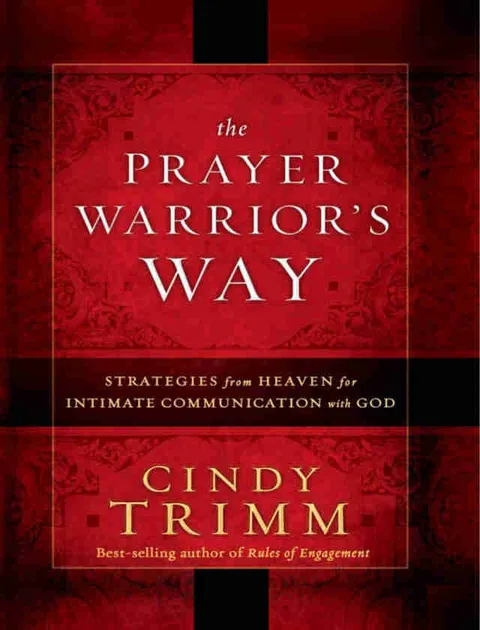

Others like the prayer warrior's way Features >>
Prayer Warrior
The Prayer Of Jabez
The Power Of A Praying Woman
The Power Of A Praying Life
The Power Of A Praying Nation
The Power Of Praise And Worship

Prayer For Patient Waiting - II Thessalonians 3:5

Prayer Altars - A Strategy That Is Changing Nations
Operating In The Courts Of Heaven
How To Pray With Passion And Power
About the Book
"The Prayer Warrior's Way" by Cindy Trimm is a guide to developing a powerful and effective prayer life. Trimm provides practical strategies and insights for engaging in spiritual warfare, interceding for others, and deepening your relationship with God through prayer. She emphasizes the importance of aligning your prayers with God's will and standing firm in faith. Through engaging stories and practical advice, Trimm shows readers how to become strong and effective prayer warriors in their own lives.
Isaac Watts

seven prayers for christian dating
If we refuse to pray in dating, we refuse to receive the precious resources we need most in dating. Too many of us struggle in dating — to discern our hearts, to communicate with one another, to balance priorities and responsibilities, to reject sexual temptation — without ever asking God for his wisdom, strength, and help. We wonder why we make the same mistakes and fall into sin over and over again, while we leave the King sitting on the bench. We may talk about praying, but we rarely actually talk to God. We read articles, text friends, listen to podcasts, even ask for advice, but put off kneeling at the feet of our Father in heaven. If we want to date well, we will need to pray more. The invitation to pray in dating is not another burden heaped onto the back of single men and women. It is the path into having our feelings and desires tested, confirmed, and fulfilled. It’s not another gen. ed. course we have to pass before God gives us a husband or a wife. It is the 747 big enough, strong enough, and safe enough to carry us through these single years, and if God wills, into the new country of marriage. Don’t start dating without praying, and don’t stop praying while you’re waiting. If you don’t know what to pray, here are seven prayers for any not-yet-married relationship. 1. Free us to date differently. “Whether you eat or drink” — or date or marry — “or whatever you do, do all to the glory of God.” (1 Corinthians 10:31) Our Father in heaven, so much in the dating scene today seems so broken — unnecessary ambiguity, unhealthy communication, fear of commitment, boundaries crossed, messy breakups. Because we are yours, we desperately want our dating to be different. Set our relationship apart from every fallen example around us. Allow our love and respect for one another to say something profound and beautiful about your Son, even when we make mistakes or sin against each other. 2. Give us a passion for each other’s faith and joy in you. I know that I will remain and continue with you all, for your progress and joy in the faith, so that in me you may have ample cause to glory in Christ Jesus. (Philippians 1:25–26) It will be too easy to focus our attention and energy on each other — the status of our relationship, the nature of our conflict, the trajectory of our feelings — but the most important dynamic in our relationship will be its influence on our relationship with you. I am naturally more concerned with what my girlfriend (or boyfriend) thinks and feels about me, when I should be far more concerned with what she (or he) thinks and feels about you. God, inspire in us a passion for each other’s faith and joy in you. 3. Keep our affection for each other from blinding us to sin. I feel a divine jealousy for you, since I betrothed you to one husband, to present you as a pure virgin to Christ. But I am afraid that as the serpent deceived Eve by his cunning, your thoughts will be led astray from a sincere and pure devotion to Christ. (2 Corinthians 11:2–3) The line between affection and infatuation can blur quickly in a relationship, blinding us to you and to ourselves. Having “fallen in love,” we lose touch with our fallenness. Satan steps into the euphoria and deceives us into ignoring, overlooking, or excusing sin. We compromise in relationships in ways we never would otherwise. God, blow away the fog of any infatuation, and fill our eyes with your truth and beauty. When every fiber of every muscle in our bodies wants to give into temptation, ignite our hearts to reject sin’s filthy promises and to prefer you and your righteousness. 4. Remind us our bodies were bought with a precious and infinite price. Flee from sexual immorality. Every other sin a person commits is outside the body, but the sexually immoral person sins against his own body. Or do you not know that your body is a temple of the Holy Spirit within you, whom you have from God? You are not your own, for you were bought with a price. So glorify God in your body. (1 Corinthians 6:18–20) Sadly and tragically, sexual immorality seems to be the norm — even, in some cases, among relationships claiming to be Christian. But when everyone else is giving in, we refuse to give up. Whenever we are tempted to cross boundaries you have lovingly set for us, carry our minds to the cross, where Jesus died to liberate us from every ounce of sexual sin. It will be one of the most radical, countercultural, Spirit-enabled feats of our lives: choosing to deny the impulse to experiment or express ourselves sexually in dating because we trust you and treasure Jesus. 5. Weave our dating relationship into other meaningful relationships. Take care, brothers, lest there be in any of you an evil, unbelieving heart, leading you to fall away from the living God. But exhort one another every day, as long as it is called “today,” that none of you may be hardened by the deceitfulness of sin. (Hebrews 3:12–13) Father, guard us from isolating ourselves and our relationship from other believers. The more time we spend one-on-one with each other, the less time we spend with other important people in our lives. That distance is one of the greatest dangers in dating. Draw the men and women we need into our feelings, our communication, and our decision-making. Bring us other Christians who love us enough to ask hard questions. When the temptation will be to date off in a corner, weave our relationship into real, consistent, and engaged community. 6. In your perfect timing, give us clarity about whether we should marry. Commit your way to the Lord; trust in him, and he will act. . . . Be still before the Lord and wait patiently for him. (Psalms 37:5, 7) If any of you lacks wisdom, let him ask God, who gives generously to all without reproach, and it will be given him. (James 1:5) We feel how vulnerable we are in dating — the uncertainty, the fragility, the volatility. It is not a safe love yet, because it is not yet sealed with our promises. If we are to truly, deeply, exclusively, freely, and passionately love each other, it must be as husband and wife. It must be inside the beautiful and mysterious oneness of marriage. So, give us clarity, God. We are waiting for you to make clear whether we should marry. We don’t want to date one day longer than you would have us. We’re pleading for wisdom in dating because we know how much you love to give it to those who ask. 7. At every step, remain our first and greatest love. “You shall love the Lord your God with all your heart and with all your soul and with all your strength and with all your mind.” (Luke 10:27) “I have this against you, that you have abandoned the love you had at first.” (Revelation 2:4) Above all, forbid that any love would begin to overshadow or replace our love for you. If either of us consistently draws us away from you, give us enough faith and love to walk away. Guard us from anyone who wants your place in our heart, and lead us to a husband or wife who has already given all of their heart, soul, mind, and strength to you. Whether we ever marry or not, we pledge our love first and forever to you — from this day forward, for better, for worse, for richer, for poorer, in sickness and health — until death once and for all marries us to you.
-480.webp)