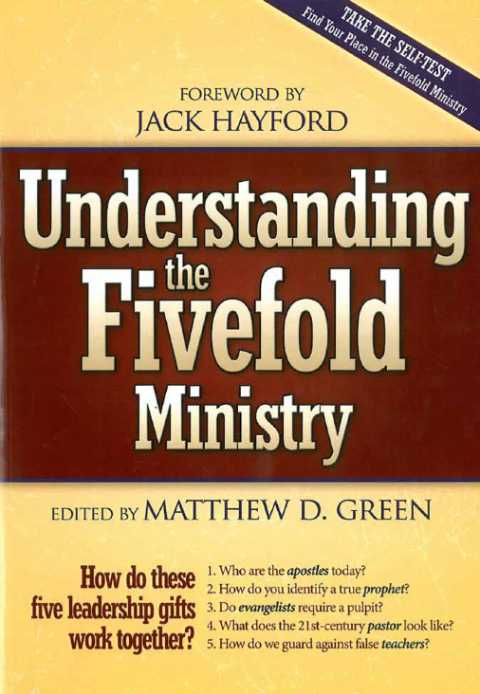

Others like understanding the fivefold ministry Features >>
Reading The Word Of God In The Presence Of God: A Handbook For Biblical Interpretation

Mere Christianity
Father, Son, And Holy Spirit (Relationships, Roles, And Relevance)

Babylon, Mystery, Religion

Ten Commandments
The Lion And The Lamb

God In The Dock
The Ministry Gifts
Supremacy Of Christ In A Post Modern World
The Holiness Of God
About the Book
"Understanding The Fivefold Ministry" by Matthew Green explores the keys to understanding and operating in the five ministry offices of apostle, prophet, evangelist, pastor, and teacher within the Christian church. The book provides insight into the roles and responsibilities of each office, and how they can work together in harmony to fulfill God's purpose for the church. Through practical examples and biblical teachings, Green offers guidance on how to effectively serve in each ministry role and bring about spiritual growth and transformation within the church community.
A.W. Pink
Arthur Walkington Pink (1 April 1886 – 15 July 1952) was an English Bible teacher who sparked a renewed interest in the exposition of Calvinism or Reformed Theology. Little known in his own lifetime, Pink became "one of the most influential evangelical authors in the second half of the twentieth century."[1]
Biography Arthur Walkington Pink was born in Nottingham, England, to a corn merchant, a devout non-conformist of uncertain denomination, though probably a Congregationalist.[2] Otherwise, almost nothing is known of Pink's childhood or education except that he had some ability and training in music.[3] As a young man, Pink joined the Theosophical Society, an occult gnostic group in contemporary England, and he apparently rose to enough prominence within its ranks that Annie Besant, its head, offered to admit him to its leadership circle.[4] In 1908 he renounced Theosophy for evangelical Christianity.[5]
Desiring to become a minister but unwilling to attend a liberal theological college in England, Pink very briefly studied at Moody Bible Institute in Chicago in 1910 before taking the pastorate of the Congregational church in Silverton, Colorado. In 1912 Pink left Silverton, probably for California, and then took a joint pastorate of churches in rural Burkesville and Albany, Kentucky.[6] In 1916, he married Vera E. Russell (1893–1962), who had been reared in Bowling Green, Kentucky, and Pink's next pastorate was at Scottsville Baptist Church, Scottsville, Kentucky.[7] Then the newlyweds moved in 1917 to Spartanburg, South Carolina, where Pink became pastor of Northside Baptist Church.[8]
By this time Pink had become acquainted with prominent dispensationalist Fundamentalists, such as Harry Ironside and Arno C. Gaebelein, and his first two books, published in 1917 and 1918, were in agreement with that theological position.[9] Yet Pink's views were changing, and during these years he also wrote the first edition of The Sovereignty of God (1918), which argued that God did not love sinners who had not been predestined unto salvation, and that He had deliberately created "unto damnation" those who would not accept Christ.[10] Whether because of his Calvinistic views, his nearly incredible studiousness, his weakened health, or his lack of sociability, Pink left Spartanburg in 1919 believing that God would "have me give myself to writing."[11] But Pink then seems next to have taught the Bible—with some success—in California for a tent evangelist named Thompson while continuing his intense study of Puritan writings.
In January 1922, Pink published the first issue of Studies in the Scriptures, which by the end of the following year had about a thousand subscribers and which was to occupy most of his time for the remainder of his life and become the source for dozens of books, some arranged from Studies articles after his death.[12] In 1923 Pink suffered a nervous breakdown, and he and his wife lived with friends in Philadelphia until he regained his health. In 1925, the Pinks sailed to Sydney, Australia, where he served as both an evangelist and Bible teacher at the Ashfield Tabernacle. But his impolitic preaching of Calvinist doctrine resulted in a unanimous resolve of the Baptist Fraternal of New South Wales not to endorse him. From 1926 to 1928, Pink served as pastor of two groups of Strict and Particular Baptists.[13]
Returning to England, Pink was invited to preach at a pastorless church in Seaton, Devon; but though he was welcomed by some members, the overseers thought his installation as pastor would split the church.[14] In the spring of 1929, Pink and wife returned to her home state of Kentucky where he intended to become pastor of the Baptist church in Morton's Gap. Once again his hopes were unrealized. To a friend he wrote, "I am more firmly convinced today than I was 14 months ago that our place is on the 'outside of the camp.' That is the place of 'reproach,' of loneliness, and of testing."[15] In 1930 Pink was able to start a Bible class in Glendale, California, while also turning down opportunities to speak in some Fundamentalist churches.[16] The following year, the Pinks rented an unpainted wooden house in Union County, Pennsylvania, where a small group met; then in 1933 they moved to York, Pennsylvania.
Pink decided that if his ministry was to be totally one of writing, he could do that just as well in England. In September 1934 he and his wife moved to Cheltenham, Gloucestershire, near honorary agents of Studies in the Scriptures. Pink seems to have finally given way to despair. To a friend he wrote "that those of my friends who would dearly like to help me are powerless to do so; while those who could, will not. And in a very few years at most it will be too late. What I have gone through the last seven years is so reacting on my physical and mental constitution, that ere long I shall be incapacitated even if doors should be opened unto me. However, I can see nothing else than to attempt to seek grace to bow to the Lord's sovereign pleasure, and say, 'Not my will, but thine be done.'"[17]
In 1936, the Pinks moved to Hove, on the south coast near Brighton. After the death of his father in 1933, Pink received enough of the estate to allow him and his wife to live very simply without financial concerns; and between 1936 until his death in 1952, Pink devoted himself completely to Studies in the Scriptures. Vera believed her husband's almost unrelenting work schedule unhealthy, and she remarkably succeeded in having him take up stamp collecting as a hobby.[18] In 1940, Hove became a regular target of German air raids, and the Pinks moved to Stornoway, Isle of Lewis, Outer Hebrides, Scotland, where they remained for the rest of his life. The island was a bastion of Calvinism, but church services were held mostly in Scots Gaelic, and visitors were not especially welcomed in any case.[19] Pink governed his time in study and writing with "military precision." To a friend he wrote that he went out to shop and get exercise for an hour, six days a week, but that otherwise he never left his study except when working in a small garden. While in Hove, he even published a note in Studies advising subscribers that "it is not convenient for us to receive any visitors, and respectfully ask readers who may visit these parts to kindly refrain from calling upon us, but please note that we are always glad to hear from Christian friends."[20] Rather than attend church, on Sunday mornings, Pink spent time ministering to readers by letter.[21]
In 1951 Vera became aware that Pink was failing. He lost weight and was in pain but refused to take any medicine that might dull his mind and hinder him from completing his work. He died on 15 July 1952. His last words were "The Scriptures explain themselves." Pink left enough written material to allow publication of Studies until December 1953.[22] Vera Pink survived her husband by ten years and after his death made new friends and mingled more freely with others.[23]
Influence
It is alleged that Pink's personality made it difficult for him to have a successful pastoral ministry. He has been criticized for being too individualistic and of too critical a temperament, lacking the benefit of thorough theological discussions with other men of similar gifts. One young pastor, Rev. Robert Harbach who corresponded with Pink for years remembered a very different Pink, who possessed a "pastor's heart." Pink's correspondence with Harbach (until Pink's failing health ended their correspondence in 1949) was warm, heartfelt and fatherly. Early in their correspondence, Pink wrote "I want you to feel perfectly free to call on me for any help I may be able to render you. I am in touch with a number of young pastors, and I deem it part of my work, and a privilege, to offer what advice I can."[24]
Pink's acclaimed contemporary D. Martyn Lloyd-Jones received spiritual benefit from reading Pink and recommended him to others. To one young minister, he said, "Don't waste your time reading Barth and Brunner. You will get nothing from them to aid you with preaching. Read Pink."[25] But Lloyd-Jones also said, "If I had behaved as Pink did, I would have achieved nothing. Nothing at all... I had to be very patient and take a very long-term look at things. Otherwise I would have been dismissed and whole thing would have been finished."[26] Furthermore, without the assistance and companionship of his wife, who dedicated herself completely to him and his work, Pink would have (as he freely admitted) "been overwhelmed" and probably would have achieved little even in writing.[27]
Theologically Pink was rejected during his lifetime because of his opposition to Arminianism; but after his death, there was a major shift of evangelical opinion towards Calvinistic theology. By 1982, Baker Book House had published 22 of Pink's books and sold 350,000 total copies. Nevertheless, it was Pink's Sovereignty of God that did "more than any other in redirecting the thinking of a younger generation." After Banner of Truth Trust republished it in 1961—modifying it to remove Pink's alleged hyper-Calvinism—the book sold 177,000 copies by 2004.[28]
References
7. "NEW LIGHT ON THE EARLY MINISTRY OF A. W. PINK (PART 2)". The Arthur W. Pink Archive. Retrieved 27 June 2020.
13. Murray argues that Pink left the first of these two groups because he was not Calvinistic enough for them because he asserted belief in the "free offer of the gospel and in human responsibility to receive the gospel.", 77-123; R. P. Belcher, "Pink, Arthur Walkington," Timothy Larson, ed., Biographical Dictionary of Evangelicals (Downers Grove, IL: IVP, 2003), 529. Ronald Hanko argues that "Pink never taught that God loves everyone or desires to save everyone, or promises salvation to everyone in the gospel, as the Banner does." Ronald Hanko, "The Forgotten Pink," British Reformed Journal No. 17 (Jan-March 1997), 4.
23. Murray, 283. She was remembered by one of these friends as "an elegant and gracious lady with a radiant expression and a loving and lively interest in people."
28. Murray, 314–15. The Banner of Truth Trust edition has been criticized for omitting nearly half the original work, including three entire chapters. Hanko, "The Forgotten Pink."
the other spurgeon: how susannah loved charles through suffering
On January 31, 1892, Charles Haddon Spurgeon (1834–1892) died in Menton, France, with his wife, Susie, at his bedside. His death was the deepest valley of Susie’s many years of suffering. While Charles’s body was transported back to London for a week of memorial services, Susie retreated to the estate of Thomas Hanbury, just across the Italian border and only a few miles from Menton, her grief and her physical affliction barring her from returning home immediately. There, as the blue waters of the Mediterranean kissed the Italian shoreline, Susie contemplated her future without Charles: When the storms come, and our trees of delight are bare and leafless, when He strips us of the comforts to which His love has accustomed us — or more painful still, — when He leaves us alone in the world, to mourn the absence of the chief desire of our heart; — to sing to Him then , to bless and praise and laud His dear name then , this is the work of His free grace only. ( The Sword and the Trowel , December 1903, 606) For decades, Susie had borne the anxiety of Charles’s trials as well as the weight of her own poor health. Though youthful curls still donned her face, wrinkles betrayed the challenges of her life. Staring at the sea from the portico of the majestic Hanbury mansion a thousand miles from home, Susie determined to continue Charles’s gospel-centered ministry. But how? Hardworking Widow Susie reflected back to 1875. The first volume of Charles’s book Lectures to My Students  was about to be published, and Susie expressed a great desire for every pastor in England to receive a copy. Far from dismissing her idea, Charles encouraged her to act on her godly desire. And so began “Mrs. Spurgeon’s Book Fund.” Now, seventeen years later, overlooking the Italian coast, Susie decided that the Book Fund would remain her first priority of ministry. This was no small commitment, for she would oversee every aspect of the Fund, and by the time she died in 1903, Susie had given over 200,000 books to 25,000 pastors — gifts that encouraged them, strengthened their churches, and promoted the gospel across the land. While being the largest of Susie’s ministry endeavors, the Book Fund was only one among many ministries for the widow. In the mid-1890s, she helped plant Beulah Baptist Church at Bexhill-on-Sea. She also authored several books herself and even served as coeditor and major contributor to the four-volume C.H. Spurgeon’s Autobiography . All of this work grew from Susie’s commitment to labor for the glory of God, the good of many, and the promotion of her husband’s legacy. During their engagement, she had vowed never to hinder the preacher in his ministry, and though she was now aging, afflicted, and alone, she wouldn’t abandon the task. Susie Meets Charles Susannah (Susie) Thompson was born January 15, 1832, in London, the only daughter of Robert and Susannah Thompson. A London girl with big city ways, she made several trips to Paris during her youth in order to learn French. Her family attended New Park Street Chapel, where James Smith pastored (1842–1850), his evangelistic ministry provoking a desire in Susie for salvation and baptism. The desire was realized in 1852, when the 20-year-old Susie was converted. Due in part to her personality and in part to various cultural factors, however, she concealed her faith for a time. In April of 1854, after the youthful Charles had arrived to serve as pastor of New Park Street Chapel, he learned of Susie’s spiritual struggles and gifted her his favorite book, John Bunyan’s The Pilgrim’s Progress , in order to assist her spiritual growth. This outreach by Charles pried open Susie’s shy heart. Charles counseled her to engage her faith in diligent Christian service, and his message stuck. At the same time, love blossomed between the two, and they were engaged in August of 1854. Susie was baptized by Charles in early 1855, and they were married on January 8, 1856. Twin sons followed, but shortly after their birth, the first major trial of the young couple’s marriage confronted them. The Spurgeons’ Suffering Charles and Susie honeymooned in Paris and enjoyed a full cultural experience, from art galleries to cathedrals. Susie spoke French fluently, but Charles not at all. He delighted in his new bride serving as his interpreter. After returning to London, they moved into their first residence together, a place that Susie called “Love Land” ( Autobiography , 2:180). Her description of their first home is apt, for Charles and Susie enjoyed a delightful marriage of 36 years: affectionate and happily romantic. But woven into the fabric of their marriage were also seasons of dark suffering, separation, and sadness. MUSIC HALL DISASTER Charles was extremely busy the first year of their marriage: caring for a growing congregation, leading auxiliary ministries connected to the church, answering mounds of correspondence, and preaching across the British Isles, along with editing and writing. The Surrey Gardens Music Hall disaster on October 19, 1856, illustrates both the heights of Charles’s fame and the depths of his sorrows. Charles was but 22 years old when upwards of ten thousand people crowded the hall to hear him preach, with thousands more gathered outside. Early in the service, a contingency of mischief-makers yelled “Fire!” though there was no fire. Panic ensued, and in the rush to exit the building, seven people were trampled to death, and thirty more were badly injured. Spurgeon was inconsolable, and the future of his ministry seemed in doubt. When Susie received the news at home, she hit her knees in prayer for the many sufferers and for her despondent husband. Though Spurgeon resumed his ministry a couple of weeks later, he was permanently scarred emotionally. Susie was an anchor in this storm as they looked to Christ together. PHYSICAL AFFLICTIONS Charles’s physical nemesis was gout. Later, kidney disease was added, and both were coupled with seasons of depression aggravated by memories of the disaster at the Music Hall. For Susie’s part, in mid-1868 her church attendance began to wane, and from then until 1892, she rarely attended worship services due to physical ailments. In early 1869, she was operated on by the acclaimed gynecologist James Simpson, and though she was helped somewhat by the surgery, she nevertheless continued to suffer for the rest of her days. THEOLOGICAL CONTROVERSIES Several controversies erupted throughout Charles’s ministry, but the one that most troubled him was known as the Down-Grade Controversy of 1887. At the heart of this controversy was what Charles saw as the undermining of fundamental biblical doctrines by some men in the Baptist Union. The disagreement led Charles to resign from the Union. Though not engaged directly in the controversy, Susie contended for the truth by increasing her Book Fund efforts, encouraging pastors to read doctrinally sound books. In her own way, she pushed back against the tide of theological liberalism alongside her husband. Susie believed that this controversy, with its corresponding loss of friendships, tragically accelerated Spurgeon’s death. Humble, Steadfast Faith Charles’s death in 1892 grieved but did not paralyze Susie. Throughout her life, Susie was motivated by Charles’s early words to her when she was facing doubts. “Active service brings with it warmth, and this tends to remove doubting, for our works thus become evidence of our calling and election” ( Letters of Charles Haddon Spurgeon , 54). Charles’s words motivated Susie then and for all of her days. Yet it wasn’t only personal resolve that kept her going. Proclaiming the true power behind her labor, Susie writes, “I look unto the Lord with humble, steadfast gaze, and receive courage and strength to press onward and upward in the path he has marked out for me!” ( Free Grace and Dying Love , 101–2). This statement didn’t come cheaply, either, as if it were merely the product of an emotional moment. For Susie, Bible reading year after year and cover to cover, along with prayer and regular reading of the best soul-nourishing devotional writings of the day, cultivated a deep and abiding Christ-centeredness. Susie’s story contains bountiful evidence of her faith in Christ and sacrificial service for his kingdom. Her son Charles wrote of her “labor for the Lord” even when “the mind was weary, and the body exceedingly weak” ( The Sword and the Trowel , December 1903, 607). At her death, Susie’s other son, Thomas, wrote of how his mother’s life might speak to future generations: Methinks she would press upon us, even more earnestly and sweetly than before, the preciousness of the Word, and our duty to hide it in our hearts. She would bid us prize and plead the promises. She would charge us to cling to the Cross and to cleave to that which is good. She would implore the unsaved at once to trust the finished work of Jesus. ( The Sword and the Trowel , December 1903, 608) Susie’s great-great-granddaughter, Susie Spurgeon Cochrane, writes, “When there were good times, she gave Him the praise, and when there were trials, she fell on her knees before Him, Again and again she went to the Fountain of Living Water and drank deeply from it. Then, and only then, was she able to do all that she did in her life” ( Susie: The Life and Legacy of Susannah Spurgeon , 256). The Bitter Is Sweet Susie was the wife of the world’s most famous pastor, an author of books, a lover of the poor, a church-plant helper, and a devoted mother and grandmother. Though pressed in the vice of affliction and grief, Susie was determined to live with Christ as her life and the joy of others as her mission (Philippians 1:21–26). On the tomb where Susie is buried beside Charles are inscribed the words of a hymn — words descriptive of her devotion to Jesus and hope for the future. Since all that I meet shall work for my good, The bitter is sweet, the medicine is food. Though painful at present, wilt cease before long, And then, O! how pleasant, the conqueror’s song.