

Others like the ministry gifts Features >>

The Ministers' Handbook Of Ceremonies
Understanding The Fivefold Ministry
Spirit Hermeneutics

Hebrews For Everyone
-160.webp)
Father, Son, And Holy Spirit (Relationships, Roles, And Relevance)

A Preface To Paradise Lost

God's Plan For Man

Deep Exegesis - The Mystery Of Reading Scripture

The Seven Church Ages
Hermeneutics
About the Book
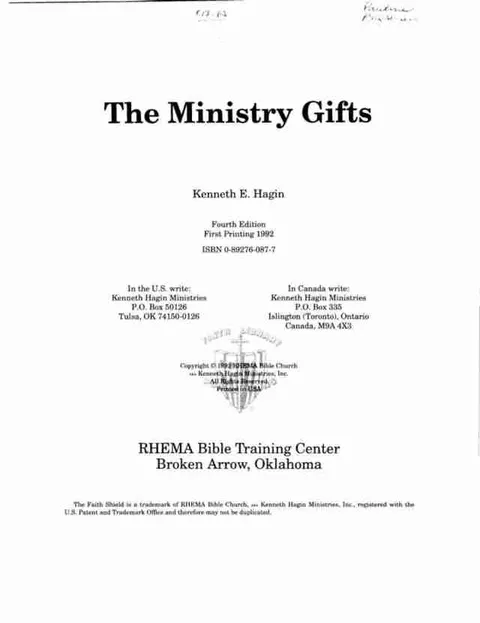
"The Ministry Gifts" by Kenneth Hagin provides a comprehensive examination of the fivefold ministry gifts outlined in Ephesians 4:11-12, including apostles, prophets, evangelists, pastors, and teachers. Hagin offers insights into the roles and functions of each gift, as well as guidance on how to recognize and develop these gifts in individuals within the church. Through biblical teachings and personal anecdotes, he emphasizes the importance of equipping and empowering believers for effective ministry.
Rich Mullins
 Born Richard Wayne Mullins on October 21, 1955, in Richmond, IN; died on September 19, 1997, in La Salle County, IL; son of John and Neva Mullins. Education: Attended Friends University, Wichita, KS, late 1980s.
The talents of Contemporary Christian singer/songwriter Rich Mullins and his work with the group Zion were first noticed by Christian music superstar Amy Grant. The inclusion of his song "Sing Your Praise to the Lord" on Grant's Age to Age album in 1982 soon lead to deals with Reunion Records and the start of a successful career as a songwriter and singer. With nearly ten albums and numerous Contemporary Christian hit songs to his credit, Mullins's career was cut short by an automobile accident that took his life on September 19, 1997, in Illinois.
Raised near Richmond, Indiana, Mullins began writing songs in his head as he drove a tractor over the fields of his family's farm. He taught himself to play the piano at age four and soon mastered a number of other instruments as well, including the guitar and hammered dulcimer. Long before his birth, however, factors over which he had no control were beginning to shape the world in which he would grow up. In Rich Mullins: An Arrow Pointing to Heaven by James Bryan Smith, the singer tells of some family history and how it came to affect his life: "My dad grew up back and forth between Kentucky and Virginia because his father was a coal miner. And when my dad was 14 my grandpa came home and told my grandma to load up the truck 'cause they were gonna move.... And my grandpa said, 'Well, Rose, we're going to Detroit.' And she said, 'Why in the world are we going to Detroit?' And he said, 'Because I don't want my boys to grow up to be coal miners.' And so they got as far as Indiana and ran out of gas--and that's how I got here."
As a boy, Mullins was known as Wayne, his middle name. Although he went by Richard when he went off to college and shortened that to Rich when he launched his music career, he preferred to be known as Wayne by his family. Mullins was particularly close to his mother, Neva, who was raised a Quaker. He admits, however, to having been somewhat embarrassed by his father, who was raised in the heart of Appalachia, "which is a very polite way to say that he was a hillbilly," Mullins told Smith. Mullins said that it was not until he was nearing the end of high school that he began to understand the true meaning of the biblical injunction to "honor thy father and mother." In Smith's book Mullins is quoted: "[I]f you cannot honor your father and mother, then you can't honor anybody. Until you come to terms with your heritage, you'll never be at peace with yourself. That was a real breakthrough moment for me. So, what I needed to do was come to understand the Appalachian life, so that I could know more about my father, who had been a stranger to me all my life."
In 1974, after finishing high school, Mullins attended Cincinnati Bible College in Ohio, working as a youth minister in a local church. A couple of years into college, he formed a band of his own. The band only stayed together for about a year, and during that time it performed Christian music at schools and colleges throughout the Cincinnati area. In the late 1970s Mullins left college to work with Zion Ministries and perform with their band, aptly named Zion. In the summer of 1981 a copy of an album recorded by Zion--made up mostly of songs written by Mullins--found its way to Christian singer Amy Grant. The up-and-coming Grant and her managers were impressed by Mullins's "Sing Your Praise to the Lord" and decided to include it on Grant's next album, Age to Age, released in 1982. Mike Blanton, an adviser to Grant and founder of Reunion Records, signed Mullins to his first publishing deal as well as his first artist deal.
Mullins's first album for Reunion, self-titled, was released in 1986 and includes such songs as "Place to Stand," "Elijah," and "Few Good Men." He followed that in 1987 with Pictures in the Sky, which includes "When You Love," "Be with You," and "Verge of a Miracle." Winds of Heaven, Stuff of Earth, Mullins's third album for Reunion, was released in 1989 and features "Awesome God," "Other Side of the World," and "If I Stand." Also hitting music stores in 1989 was Never Picture Perfect, which includes the singles "I Will Sing," "While the Nations Rage," and "First Family."
In 1988 Mullins moved to Wichita, Kansas, to study music education at Friends University, a nondenominational Christian institution. While studying at Friends, he continued to record and perform whenever he could. In 1991 and 1992, he released two volumes of a compilation entitled World As Best As I Remember It. After completing his studies at Friends, Mullins joined a Compassion International mission to the vast Navajo Reservation in Arizona to teach music to the local children and spread the Christian gospel to whomever he could reach. As part of his work in the Navajo Nation, he formed a music club for some of the younger residents. In May of 1995, he moved to the Navajo Nation, settling into a trailer adjacent to the reservation. He lived there with fellow musician Mitch McVicker, and the two were involved in a project to collect musical instruments for the children of the reservation.
Throughout his career, Mullins has been nominated a total of 12 times for Dove Awards, presented each year to the best in Contemporary Christian music. He never received the award, but close friend Doris Howard told Release magazine that he probably didn't mind. "Nashville didn't own Rich, but then, he cared nothing for the things of this world."
On September 19, 1997, the Jeep in which Mullins and McVicker were traveling from Chicago to Wichita overturned on Interstate 39 in La Salle County, Illinois. Both men were thrown onto the road from their vehicle. A tractor trailer following close behind swerved to miss the Jeep but instead hit Rich, killing him instantly. McVicker, though injured critically, recovered.
Rich Mullins's Career
Joined Christian group Zion, late 1970s; released self-titled album for Reunion Records, 1986; recorded total of nine albums of Christian music for Reunion, 1986-96; wrote several Contemporary Christian hits, including "Awesome God" and "Sing Your Praise to the Lord"; studied music education, devoted time to relief efforts among Navajo Indians of the Southwest, mid-1990s.
Born Richard Wayne Mullins on October 21, 1955, in Richmond, IN; died on September 19, 1997, in La Salle County, IL; son of John and Neva Mullins. Education: Attended Friends University, Wichita, KS, late 1980s.
The talents of Contemporary Christian singer/songwriter Rich Mullins and his work with the group Zion were first noticed by Christian music superstar Amy Grant. The inclusion of his song "Sing Your Praise to the Lord" on Grant's Age to Age album in 1982 soon lead to deals with Reunion Records and the start of a successful career as a songwriter and singer. With nearly ten albums and numerous Contemporary Christian hit songs to his credit, Mullins's career was cut short by an automobile accident that took his life on September 19, 1997, in Illinois.
Raised near Richmond, Indiana, Mullins began writing songs in his head as he drove a tractor over the fields of his family's farm. He taught himself to play the piano at age four and soon mastered a number of other instruments as well, including the guitar and hammered dulcimer. Long before his birth, however, factors over which he had no control were beginning to shape the world in which he would grow up. In Rich Mullins: An Arrow Pointing to Heaven by James Bryan Smith, the singer tells of some family history and how it came to affect his life: "My dad grew up back and forth between Kentucky and Virginia because his father was a coal miner. And when my dad was 14 my grandpa came home and told my grandma to load up the truck 'cause they were gonna move.... And my grandpa said, 'Well, Rose, we're going to Detroit.' And she said, 'Why in the world are we going to Detroit?' And he said, 'Because I don't want my boys to grow up to be coal miners.' And so they got as far as Indiana and ran out of gas--and that's how I got here."
As a boy, Mullins was known as Wayne, his middle name. Although he went by Richard when he went off to college and shortened that to Rich when he launched his music career, he preferred to be known as Wayne by his family. Mullins was particularly close to his mother, Neva, who was raised a Quaker. He admits, however, to having been somewhat embarrassed by his father, who was raised in the heart of Appalachia, "which is a very polite way to say that he was a hillbilly," Mullins told Smith. Mullins said that it was not until he was nearing the end of high school that he began to understand the true meaning of the biblical injunction to "honor thy father and mother." In Smith's book Mullins is quoted: "[I]f you cannot honor your father and mother, then you can't honor anybody. Until you come to terms with your heritage, you'll never be at peace with yourself. That was a real breakthrough moment for me. So, what I needed to do was come to understand the Appalachian life, so that I could know more about my father, who had been a stranger to me all my life."
In 1974, after finishing high school, Mullins attended Cincinnati Bible College in Ohio, working as a youth minister in a local church. A couple of years into college, he formed a band of his own. The band only stayed together for about a year, and during that time it performed Christian music at schools and colleges throughout the Cincinnati area. In the late 1970s Mullins left college to work with Zion Ministries and perform with their band, aptly named Zion. In the summer of 1981 a copy of an album recorded by Zion--made up mostly of songs written by Mullins--found its way to Christian singer Amy Grant. The up-and-coming Grant and her managers were impressed by Mullins's "Sing Your Praise to the Lord" and decided to include it on Grant's next album, Age to Age, released in 1982. Mike Blanton, an adviser to Grant and founder of Reunion Records, signed Mullins to his first publishing deal as well as his first artist deal.
Mullins's first album for Reunion, self-titled, was released in 1986 and includes such songs as "Place to Stand," "Elijah," and "Few Good Men." He followed that in 1987 with Pictures in the Sky, which includes "When You Love," "Be with You," and "Verge of a Miracle." Winds of Heaven, Stuff of Earth, Mullins's third album for Reunion, was released in 1989 and features "Awesome God," "Other Side of the World," and "If I Stand." Also hitting music stores in 1989 was Never Picture Perfect, which includes the singles "I Will Sing," "While the Nations Rage," and "First Family."
In 1988 Mullins moved to Wichita, Kansas, to study music education at Friends University, a nondenominational Christian institution. While studying at Friends, he continued to record and perform whenever he could. In 1991 and 1992, he released two volumes of a compilation entitled World As Best As I Remember It. After completing his studies at Friends, Mullins joined a Compassion International mission to the vast Navajo Reservation in Arizona to teach music to the local children and spread the Christian gospel to whomever he could reach. As part of his work in the Navajo Nation, he formed a music club for some of the younger residents. In May of 1995, he moved to the Navajo Nation, settling into a trailer adjacent to the reservation. He lived there with fellow musician Mitch McVicker, and the two were involved in a project to collect musical instruments for the children of the reservation.
Throughout his career, Mullins has been nominated a total of 12 times for Dove Awards, presented each year to the best in Contemporary Christian music. He never received the award, but close friend Doris Howard told Release magazine that he probably didn't mind. "Nashville didn't own Rich, but then, he cared nothing for the things of this world."
On September 19, 1997, the Jeep in which Mullins and McVicker were traveling from Chicago to Wichita overturned on Interstate 39 in La Salle County, Illinois. Both men were thrown onto the road from their vehicle. A tractor trailer following close behind swerved to miss the Jeep but instead hit Rich, killing him instantly. McVicker, though injured critically, recovered.
Rich Mullins's Career
Joined Christian group Zion, late 1970s; released self-titled album for Reunion Records, 1986; recorded total of nine albums of Christian music for Reunion, 1986-96; wrote several Contemporary Christian hits, including "Awesome God" and "Sing Your Praise to the Lord"; studied music education, devoted time to relief efforts among Navajo Indians of the Southwest, mid-1990s.
Live Like You’ll Live Forever
The world makes its quiet but furious war against death, groping to live forever. Plastic surgery, obsessive fitness, compulsive dieting, pouring billions into scientific research searching for the holy grail of immortality. The author of Hebrews describes the condition as a lifelong slavery to the fear of death (Hebrews 2:15). Try as we may, Adam’s and Eve’s children cannot shake the ancient nightmare. [God] drove out the man, and at the east of the garden of Eden he placed the cherubim and a flaming sword that turned every way to guard the way to the tree of life. (Genesis 3:24) Humanity, east of Eden, still reaches out in vain for that Tree of Life. Curing Death How would the world change overnight if all people everywhere heard that a man had cured death? How many ages would pass celebrating the discovery? But as it stands, these same people bypass the knowledge of a true eternity because it is not the eternity they invented. “How would the world change overnight if all people everywhere heard that man had cured death?” God has placed in us a sense that life continues after death: “[God] has put eternity into man’s heart” (Ecclesiastes 3:11). Yet most suppress this knowledge of their own immortality. But why? Because they “did not see fit to acknowledge God” (Romans 1:28) — the God “who inhabits eternity” (Isaiah 57:15). They disavow the truth their hearts would thrill to believe because they do not approve of any eternity with God. Better to steal happy moments from a broken and fleeting mortality, their dead hearts reason, than submerge in an endless existence with the God they disapprove. Immortal Beings All men, we know, shall live forever. We trust and love the eternal God, we believe in the resurrection from the dead, we believe Jesus’s promise of eternal life with him. And we know the everlasting fate of the wicked: “These will go away into eternal punishment, but the righteous into eternal life” (Matthew 25:46). Eternity exists, we believe, and all men are immortal. The souls we come in contact with at the ballgame, in the restaurant, walking the dog — shall be a million years from now. The mailman, the bus driver, the nosy neighbor — immortal beings. The most decrepit among us shall outlive the galaxy. “The most decrepit among us shall outlive the galaxy.” Even considering those who have gone before us — the deceased grandfather, the fallen child, the departed spouse — though hidden momentarily from our eyes, we know they are and shall be again. Death, we profess, is the Great Interruption, not the Great End. Falling Leaf While we say we believe in undying souls (a truth that the world would go delirious to acknowledge), do we give that momentous reality much thought? Does that eternal weight of glory hold much weight with us? Has it changed your week at all? How many of us have believed upon eternity, as John Foster lamented, in vain? The very consciousness that your minds have been capable of admitting and dismissing this subject [eternity] without a prolonged and serious emotion, ought to produce at last that seriousness, by means of wonder and alarm, which may well be awakened by the consideration how many years you have believed this truth in vain. (An Essay on the Improvement of Time, 150–151) How many years have I believed in eternity without much effect? And not just any eternity, but eternity with the Blessed God? Eternity with Jesus Christ? How many of my waking moments of these short and numbered days have orbited around the ceaseless “day of eternity” (2 Peter 3:18)? If in Christ I have hope in this life only, do I really feel myself of all people most to be pitied (1 Corinthians 15:19)? How this world deceives me. The sturdy tree and its branches I call “this life”; the falling leaf I call, “eternity.” Forgotten Forever With one glance of the mind, I realize my madness. Who at sea would give all his affection and thought to a day’s trip onboard, completely disregarding the inescapable land ahead? I forget that “Surely a man goes about as a shadow!” (Psalm 39:6) as a dream (Psalm 78:18–20), as a flower that fades, as grass that withers (Isaiah 40:6–8), as a mere mist that appears for a little time and then vanishes (James 4:14). This world, O my soul remember, “is passing away along with its desires, but whoever does the will of God abides forever” (1 John 2:17). I hope you have kept eternity closer at hand than I have. Have you, Christian — possessor of the mightiest revelations, steward of sacred knowledge, keepers of the way of eternity — appropriated these truths for yourself and distributed them freely to a desperate and decaying world? Has forever bent down with you as you changed diapers? Has it drove with you to work? Has it laughed along while you had a game night with neighbors? Has “everlasting” brought you low to plead in prayer for your children, your church, your city? Has that terrifying splendor, “immortality,” lifted your gaze from this painted and perishing kingdom to the one that cannot be shaken? Has eternity provided you an anchor in suffering? Sent you along on a grand mission? Warned you against friendship with Here and Now? Bestowed solemnity to life? Brightened up gloomy days? Infused courage to venture on in Christ? Showed you the coming tsunami that will wash away all these splendid sandcastles? Endowed acquaintances with new significance? Lifted our eyes with abiding gratitude to God? Equipped us to drive a spear through sin? Have you believed in eternity in vain? Tree of Life We must awake to the coming world without end. We are those who look “not to the things that are seen but to the things that are unseen. For the things that are seen are transient, but the things that are unseen are eternal” (2 Corinthians 4:18). People all around us live and die for the seen, the felt, the tasted, the pleasurable, the transient. But God has left you and me here to speak, to reason, to plead with immortal souls that they be reconciled to God. Through faith in Christ, we have reached our hands out to a Tree of Life on Golgotha’s hill, and we will taste of that fruit denied to our first parents: To the one who conquers I will grant to eat of the tree of life, which is in the paradise of God. (Revelation 2:7) Blessed are those who wash their robes, so that they may have the right to the tree of life and that they may enter the city by the gates. (Revelation 22:14) This tree is within reach because Jesus Christ — the Resurrection and the Life — has drawn near to us. He promises, “Whoever believes in me, though he die, yet shall he live, and everyone who lives and believes in me shall never die,” and asks the pertinent question, “Do you believe this?” (John 11:25–26). God give us grace to believe, and to make sure our friends know, our families know, our children know, that eternity is only a short time away. Article by Greg Morse

.epub-480.webp)