Sarah Edwards
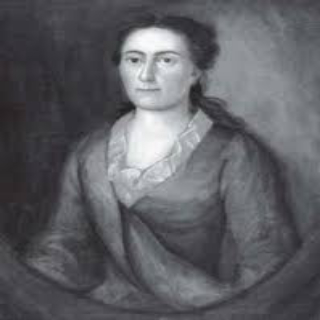 The Backdrop
For the sake of context, let’s remember that Jonathan and Sarah’s whole lives were lived in the colonies of the New World — colonies, not one country. Thirteen small British colonies hugged the Atlantic coast. And a vast western wilderness stretched who knew how far into the unknown.
New England and the other colonies were Britain’s fragile fingertip grasp on the edge of the continent. The colonists were British citizens surrounded by territories of other nations. Florida and the Southwest were Spain’s. The Louisiana Territory was France’s. The French, in particular, were eager to ally themselves with local Indians against the British. Today the Edwards story should elicit the sight of garrisons on hilltops, the sounds of shots in the distance, the discomfort of soldiers billeting in their homes, the shock and terror of news about massacres in nearby settlements. This was the backdrop, to a greater or lesser degree, throughout much of their lives.
The Courtship of Jonathan Edwards and Sarah Pierrepont
In 1723, at age nineteen, Jonathan had already graduated from Yale and had been a pastor in New York for a year. When his time in that church ended, he accepted a job at Yale and returned to New Haven where Sarah Pierrepont lived. It’s possible that Jonathan had been aware of her for three or four years, since his student days at Yale. In those student days, when he was about sixteen, he probably would have seen her when he attended New Haven’s First Church where her father had been pastor until his death in 1714 (Iain H. Murray, Jonathan Edwards: A New Biography [Banner of Truth, 1987], 91).
Now, on his return in 1723, Jonathan was twenty and Sarah was thirteen. It was not unusual for girls to be married by about sixteen.
As this school term’s work began for him, it seems he may have been somewhat distracted from his usual studiousness. A familiar story finds him daydreaming over his Greek grammar book, which he probably intended to be studying to prepare to teach. Instead we find now on the front page of that grammar book a record of his real thoughts.
They say there is a young lady in [New Haven] who is loved of that Great Being, who made and rules the world, and that there are certain seasons in which this Great Being, in some way or other invisible, comes to her and fills her mind with exceeding sweet delight; and that she hardly cares for anything, except to meditate on Him. . . . [Y]ou could not persuade her to do any thing wrong or sinful, if you would give her all the world, lest she should offend this Great Being. She is of a wonderful sweetness, calmness, and universal benevolence of mind; especially after this Great God has manifested himself to her mind. She will sometimes go about from place to place, singing sweetly; and seems to be always full of joy and pleasure. . . . She loves to be alone, walking in the fields and groves, and seems to have some one invisible always conversing with her. (Quoted in ibid., 92)
All the biographers mention the contrast between the two of them. Sarah was from one of the most distinguished families in Connecticut. Her education had been the best a woman of that era typically received. She was accomplished in the social skills of polite society. She enjoyed music and perhaps knew how to play the lute. (In the year of their marriage, one of the shopping reminders for Jonathan when he traveled was to pick up lute strings [George M. Marsden, Jonathan Edwards: A Life [Yale University Press, 2003], 110]. That may have been for a wedding musician, or it may have been for Sarah herself.) People who knew her mentioned her beauty and her way of putting people at ease. Samuel Hopkins, who knew her later, stressed her “peculiar loveliness of expression, the combined result of goodness and intelligence” (Quoted in Elisabeth D. Dodds, *Marriage to a Difficult Man: The Uncommon Union of Jonathan and Sarah Edward*s [Audubon Press, 2003], 15).
Jonathan, on the other hand, was introverted, shy, and uneasy with small talk. He had entered college at thirteen, and graduated valedictorian. He ate sparingly in an age of groaning dining tables, and he was not a drinker. He was tall and gangly and awkwardly different. He was not full of social graces. He wrote in his journal: “A virtue which I need in a higher degree is gentleness. If I had more of an air of gentleness, I should be much mended” (Quoted in Dodds, Marriage to a Difficult Man, 17). (In that time, gentleness meant “appropriate social grace,” as we use the word today in *gentle*man.)
One thing they had in common was a love for music. He pictured music as the most nearly perfect way for people to communicate with each other.
The best, most beautiful, and most perfect way that we have of expressing a sweet concord of mind to each other, is by music. When I would form in my mind an idea of a society in the highest degree happy, I think of them as expressing their love, their joy, and the inward concord and harmony and spiritual beauty of their souls by sweetly singing to each other. (Quoted in Marsden, Jonathan Edwards, 106)
That imagery was just the first thought-step into a leap from human realities to heavenly realities, where he saw sweet human intimacy as only a simple ditty compared to the symphony of harmonies of intimacy with God.
As Sarah grew older, and Jonathan grew somewhat mellower, they began to spend more time together. They enjoyed walking and talking together, and he apparently found in her a mind that matched her beauty. In fact, she introduced him to a book she owned by Peter van Mastricht, a book that later was influential in his thinking about the Covenant (Dodds, Marriage to a Difficult Man, 21). They became engaged in the spring of 1725.
Jonathan was a man whose nature was to bear uncertainties in thought and theology as if they were physical stress. The years of waiting until Sarah was old enough to marry must have added even greater pressure. Here are some words he used to describe himself, from a couple of weeks of his journal in 1725, a year and a half before they would marry:
December 29 Dull and lifeless
January 9 Decayed
January 10 Recovering
(Quoted in ibid., 19)
Perhaps it was his emotions for Sarah that sometimes caused him to fear sinning with his mind. In an effort to remain pure, he resolved, “When I am violently beset with temptation or cannot rid myself of evil thoughts, to do some sum in arithmetic or geometry or some other study, which necessarily engages all my thoughts and unavoidably keeps them from wandering” (Quoted in ibid.).
The Beginnings of Their Married Life
Jonathan Edwards and Sarah Pierrepont were finally married on July 28, 1727. She was seventeen. He was twenty-four. He wore a new powdered wig and a new set of white clerical bands given him by his sister Mary. Sarah wore a boldly-patterned green satin brocade (Ibid., 22).
“Jonathan apparently found in Sarah a mind that matched her beauty.”
We get only glimmers and glimpses into the heart of their love and passion. One time, for instance, Jonathan used the love of a man and a woman as an illustration of our limited grasp of another person’s love toward God. “When we have the idea of another’s love to a thing, if it be the love of a man to a woman . . . we have not generally any further idea at all of his love, we only have an idea of his actions that are the effects of love. . . . We have a faint, vanishing notion of their affections” (Ibid.).
Jonathan had become the pastor in Northampton, following in the footsteps of his grandfather, Solomon Stoddard. He began there in February 1757, just five months before their wedding in New Haven.
Sarah could not slip unnoticed into Northampton. Based on the customs of the time, Elisabeth Dodds imagines Sarah’s arrival in the Northampton church:
Any beautiful newcomer in a small town was a curio, but when she was also the wife of the new minister, she caused intense interest. The rigid seating charts of churches at that time marked a minister’s family as effectively as if a flag flew over the pew. . . . So every eye in town was on Sarah as she swished in wearing her wedding dress.
Custom commanded that a bride on her first Sunday in church wear her wedding dress and turn slowly so everyone could have a good look at it. Brides also had the privilege of choosing the text for the first Sunday after their wedding. There is no record of the text Sarah chose, but her favorite verse was “Who shall separate us from the love of Christ?” (Romans 8:35), and it is possible that she chose to hear that one expounded.
She took her place in the seat that was to symbolize her role — a high bench facing the congregation, where everyone could notice the least flicker of expression. Sarah had been prepared for this exposed position every Sunday of her childhood on the leafy common of New Haven, but it was different to be, herself, the Minister’s Wife. Other women could yawn or furtively twitch a numbed foot in the cold of a January morning in an unheated building. Never she. (Ibid., 25)
Marsden says, “By fall 1727 [about three months after the wedding] Jonathan had dramatically recovered his spiritual bearings, specifically his ability to find the spiritual intensity he had lost for three years” (Marsden, Jonathan Edwards, 111).
What made the difference? Perhaps he was better fitted for a church situation than for the academic setting at Yale. In addition, it seems likely to me that the recovery was closely related to their marriage. For at least three years prior to this, in addition to his rigorous academic pursuits, he had also been restraining himself sexually and yearning for the day when he and Sarah would be one. When their life together began, he was like a new man. He had found his earthly home and haven.
And as Sarah stepped into this role of wife, she freed him to pursue the philosophical, scientific, and theological wrestlings that made him the man we honor.
Edwards was a man to whom people reacted. He was different. He was intense. His moral force was a threat to people who settled for routine. After he’d thought through the biblical truth and implications of a theological or church issue, he didn’t back down from what he’d discovered.
For instance, he came to realize that only believers should take Communion in the church. The Northampton church was not happy when he went against the easier standards of his grandfather who had allowed Communion even for unbelievers if they weren’t participating in obvious sin. This kind of controversy meant that Sarah, in the background, was also twisted and bumped by the opposition that he faced. He was a thinker who held ideas in his mind, mulling them over, taking them apart and putting them together with other ideas, and testing them against other parts of God’s truth. Such a man reaches the heights when those separate ideas come together into a larger truth. But he also is the kind of man who can slide into deep pits on the way to a truth (Dodds, Marriage to a Difficult Man, 57).
A man like that is not easy to live with. But Sarah found ways to make a happy home for him. She made him sure of her steady love, and then she created an environment and routine where he was free to think. She learned that when he was caught up in a thought, he didn’t want to be interrupted for dinner. She learned that his moods were intense. He wrote in his journal: “I have had very affecting views of my own sinfulness and vileness; very frequently to such a degree as to hold me in a kind of loud weeping . . . so that I have often been forced to shut myself up” (Quoted in ibid., 31).
The town saw a composed man. Sarah knew what storms there were inside him. She knew the at-home Jonathan.
Samuel Hopkins wrote:
While she uniformly paid a becoming deference to her husband and treated him with entire respect, she spared no pains in conforming to his inclination and rendering everything in the family agreeable and pleasant; accounting it her greatest glory and there wherein she could best serve God and her generation [and ours, we might add], to be the means in this way of promoting his usefulness and happiness. (Quoted in ibid., 29-30, emphasis added)
So life in the Edwards house was shaped in large degree by Jonathan’s calling. One of his journal entries said, “I think Christ has recommended rising early in the morning by his rising from the grave very early” (Quoted in ibid., 28). So it was Jonathan’s habit to awake early. The family’s routine through the years was to wake early with him, to hear a chapter from the Bible by candlelight, and to pray for God’s blessing on the day ahead.
It was his habit to do physical labor sometime each day for exercise — for instance, chopping wood, mending fences, or working in the garden. But Sarah had most of the responsibility for overseeing the care of the property.
Often he was in his study for thirteen hours a day. This included lots of preparation for Sundays and for Bible teaching. But it also included the times when Sarah came in to visit and talk or when parishioners stopped by for prayer or counsel.
“When their life together began, Jonathan was like a new man.”
In the evening the two of them might ride into the woods for exercise and fresh air and to talk. And in the evening they would pray together again.
The Growing Family
Beginning on August 25, 1728, children came into the family — eleven in all — at about two-year intervals: Sarah, Jerusha, Esther, Mary, Lucy, Timothy, Susannah, Eunice, Jonathan, Elizabeth, and Pierpont. This was the beginning of Sarah’s next great role, that of mother.
In 1900 A.E. Winship made a study contrasting two families. One had hundreds of descendants who were a drain on society. The other, descendants of Jonathan and Sarah Edwards, were outstanding for their contributions to society. He wrote of the Edwards clan:
Whatever the family has done, it has done ably and nobly. . . . And much of the capacity and talent, intelligence and character of the more than 1400 of the Edwards family is due to Mrs. Edwards.
By 1900 when Winship made his study, this marriage had produced:
thirteen college presidents
sixty-five professors
100 lawyers and a dean of a law school
thirty judges
sixty-six physicians and a dean of a medical school
eighty holders of public office, including:
three U.S. senators
mayors of three large cities
governors of three states
a vice president of the U.S.
a controller of the U.S. Treasury
Members of the family wrote 135 books. . . . edited 18 journals and periodicals. They entered the ministry in platoons and sent one hundred missionaries overseas, as well as stocking many mission boards with lay trustees (Dodds, Marriage to a Difficult Man, 31-32).
Winship goes on to list kinds of institutions, industries, and businesses that have been owned or directed by Edwards’s descendants. “There is scarcely a Great American industry that has not had one of this family among its chief promoters.” We might well ask with Elisabeth Dodds, “Has any other mother contributed more vitally to the leadership of a nation?” (Ibid., 32)
Six of the Edwards children were born on Sundays. At that time some ministers wouldn’t baptize babies born on Sundays, because they believed babies were born on the day of the week on which they had been conceived, and that wasn’t deemed an appropriate Sabbath activity. All of the Edwards children lived at least into adolescence. That was amazing in an era when death was always very close, and at times there was resentment among other families.
The Household
In our centrally-heated houses, it’s difficult to imagine the tasks that were Sarah’s to do or delegate: breaking ice to haul water, bringing in firewood and tending the fire, cooking and packing lunches for visiting travelers, making the family’s clothing (from sheep-shearing to spinning and weaving to sewing), growing and preserving produce, making brooms, doing laundry, tending babies and nursing illnesses, making candles, feeding poultry and produce, overseeing butchering, teaching the boys whatever they didn’t learn at school, and seeing that the girls learned homemaking creativity. That’s only a fraction of that for which she was responsible.
How could she have known the gift she was giving us as she freed Jonathan to fulfill his calling?
Once when Sarah was out of town and Jonathan was in charge, he wrote almost desperately, “We have been without you almost as long as we know how to be” (Quoted in Marsden, Jonathan Edwards, 323).
Much of what we know about the inner workings of the Edwards family comes from Samuel Hopkins, who lived with them for a while. He wrote:
She had an excellent way of governing her children; she knew how to make them regard and obey her cheerfully, without loud angry words, much less heavy blows. . . . If any correction was necessary, she did not administer it in a passion; and when she had occasion to reprove and rebuke she would do it in few words, without warmth [that is, vehemence] and noise. . . .
Her system of discipline was begun at a very early age and it was her rule to resist the first, as well as every subsequent exhibition of temper or disobedience in the child . . . wisely reflecting that until a child will obey his parents he can never be brought to obey God. (Quoted in Dodds, Marriage to a Difficult Man, 35-36)
Their children were eleven different people, proving that Sarah’s discipline did not squash their personalities — perhaps because an important aspect of their disciplined life was that, as Samuel Hopkins wrote, “for [her children] she constantly and earnestly prayed and bore them on her heart before God . . . and that even before they were born” (Quoted in ibid., 37).
Dodds says:
Sarah’s way with their children did more for Edwards than shield him from hullabaloo while he studied. The family gave him incarnate foundation for his ethic. . . . The last Sunday [Edwards] stood in the Northampton pulpit as pastor of the church he put in this word for his people: “Every family ought to be . . . a little church, consecrated to Christ and wholly influenced and governed by His rules. And family education and order are some of the chief means of grace. If these fail, all other means are like to prove ineffectual” (Ibid., 44-45).
As vital as Sarah’s role was, we mustn’t picture her raising the children alone. Jonathan and Sarah’s affection for each other and the regular family devotional routine were strong blocks in the children’s foundation. And Jonathan played an integral part in their lives. When they were old enough, he would often take one or another along when he traveled. At home, Sarah knew Jonathan would give one hour every day to the children. Hopkins describes his “entering freely into the feelings and concerns of his children and relaxing into cheerful and animate conversation accompanied frequently with sprightly remarks and sallies of wit and humor . . . then he went back to his study for more work before dinner” (Quoted in ibid., 40). This was a different man than the parish usually saw.
It is possible to piece together a lot about the Edwards household because they were paper savers. Paper was expensive and had to be ordered from Boston. So Jonathan saved old bills, shopping lists, and first drafts of letters to stitch together into small books, using the blank side for sermon writing. Since his sermons were saved, this record of everyday, sometimes almost modern details was saved as well. For instance, many of the shopping lists included a reminder to buy chocolate. (Ibid., 38; Ola Elizabeth Winslow, Jonathan Edwards, 1703-1758: A Biography [Macmillan, 1940], 136)
It was understood by travelers in that colonial time that if a town had no inn or if the inn was unsavory, the parson’s house was a welcoming overnight place. So from the beginning in Northampton, Sarah exercised her gifts of hospitality. Their home was well-known, busy, and praised.
The Wider Sphere of Influence
Sarah was not only mother and wife and hostess — she also felt spiritual responsibility for those who entered her house. A long line of young apprentice pastors showed up on their doorstep over the years, hoping to live with them and soak up experience from Jonathan. That’s why Samuel Hopkins was living with them and had the occasion to observe their family. He arrived at the Edwards home in December 1741. Here’s his account of the welcome he received.
When I arrived there, Mr. Edwards was not at home, but I was received with great kindness by Mrs. Edwards and the family and had encouragement that I might live there during the winter. . . . I was very gloomy and was most of the time retired in my chamber. After some days, Mrs. Edwards came . . . and said as I was now become a member of the family for a season, she felt herself interested in my welfare and as she observed that I appeared gloomy and dejected, she hoped I would not think she intruded [by] her desiring to know and asking me what was the occasion of it. . . . I told her . . . I was in a Christless, graceless state . . . upon which we entered into a free conversation and. . . she told me that she had [prayed] respecting me since I had been in the family; that she trusted I should receive light and comfort and doubted not that God intended yet to do great things by me. (Quoted in Dodds, Marriage to a Difficult Man, 50)
Sarah had seven children at the time — ages thirteen down to one and a half — and yet she also took this young man under her wing and encouraged him. He remembered it all his life.
The impact of Sarah Edwards’s assurance in God’s working did not stop in that personal conversation. Hopkins went on to become a pastor in Newport, Rhode Island, a town dependent on the slave economy. He raised a strong voice against it, even though many were offended. But one young man was impressed. William Ellery Channing had been adrift till then, looking for purpose in his life. He had long talks with Hopkins, went back to Boston, became a pastor who influenced Emerson and Thoreau, and had a large part in the abolitionist movement. (This chain of influence is described by Dodds in Marriage to a Difficult Man, 50-51)
We all have quiet conversations that might be forgotten. Sarah’s with Samuel would have been forgotten except for Hopkins’s journal. Their talk was part of a chain that led onward at least as far as Emerson and Thoreau, and that certainly wasn’t the end of it — we just don’t have the records of what happened next, and next, and next. We usually don’t know how God winds the threads of our lives on and on and on.
Hopkins obviously admired Sarah Edwards. He wrote that “she made it her rule to speak well of all, so far as she could with truth and justice to herself and others. . . .” This sounds a lot like Jonathan’s early flyleaf musings about Sarah — confirmation that he hadn’t been blinded by love.
When Hopkins watched the relationship between Jonathan and Sarah he saw that:
In the midst of these complicated labors . . . [Edwards] found at home one who was in every sense a help mate for him, one who made their common dwelling the abode of order and neatness, of peace and comfort, of harmony and love, to all its inmates, and of kindness and hospitality to the friend, the visitant, and the stranger. (Ibid., 64)
Another person who observed the Edwards family was George Whitefield, when he visited America during the Awakening. He came to Northampton for a weekend in October 1740 and preached four times. Also, on Saturday morning he spoke to the Edwards children in their home. Whitefield wrote that when he preached on Sunday morning, Jonathan wept during almost the whole service. The Edwards family had a great effect on Whitefield as well:
Felt wonderful satisfaction in being at the house of Mr. Edwards. He is a Son himself, and hath also a Daughter of Abraham for his wife. A sweeter couple I have not yet seen. Their children were dressed not in silks and satins, but plain, as becomes the children of those who, in all things ought to be examples of Christian simplicity. She is a woman adorned with a meek and quiet spirit, talked feelingly and solidly of the Things of God, and seemed to be such a help meet for her husband, that she caused me to renew those prayers, which, for many months, I have put up to God, that he would be pleased to send me a daughter of Abraham to be my wife. (Winslow, Jonathan Edwards, 1703-1758, 188)
The next year Whitefield married a widow whom John Wesley described as a “woman of candour and humanity” (Dodds, Marriage to a Difficult Man, 74-75).
The Spiritual Turning Point
The second phase of the Awakening crested in the spring and summer of 1741, the same time Jonathan was asking the church for a set salary due to the financial demands of his large family. This caused the parish to watch very closely the lifestyle of the Edwards family, to be on the lookout for extravagance. A salary committee of the church ruled that Sarah had to keep an itemized statement of all expenditures.
In January 1742 we come to an event in Sarah’s life that was a turning point for her. Our efforts to understand this period remind us of the difficult task a biographer has in trying to record fairly a person’s life, and how hard it can be to evaluate what you read in biography or history.
An obvious problem arises when a biographer’s worldview makes him blind to important aspects of his subject’s life. Iain Murray sees this problem when he takes note of prominent Edwards biographers and observes that Ola Winslow (1940) rejected Edwards’s theology and that later, in Perry Miller (1949), “anti-supernatural animus comes to its fullest expression” (Murray, Jonathan Edwards, xxix).
It’s amazing to think that someone could write a highly-acclaimed biography of Edwards that lauds his philosophy but rejects his view of God and anything supernatural. And then, from our perspective as readers, what if that lopsided view were all we knew about Edwards? That’s the challenge for a biography reader — trying to find and recognize a well-balanced approach.
“Has any other mother contributed more vitally to the leadership of a nation?” –Elisabeth Dodds
In January 1742 Sarah underwent a crisis that is approached very differently by different biographers, leaving us with the challenge of trying to understand what really happened.
Winslow, who rejected Edwards’s theology, used the account of Sarah’s experience to minimize the impact of Jonathan’s acceptance of outward, active manifestations of the Holy Spirit. Winslow wrote, “The fact that his wife was given to these more extreme manifestations no doubt inclined him to a more hospitable attitude toward them. . . .” (Winslow, Jonathan Edwards, 1703-1758, 205) The implication seems to be that under normal circumstances he would have been less accepting of such “enthusiasm,” but his perception was skewed by having to account for Sarah’s experience.
Miller, who rejected the idea of anything supernatural, could only conclude that Sarah’s story provided Jonathan with a proof-case to use against those who thought “enthusiasm” was from Satan. Miller’s implication seems to be that although we modern people know such manifestations couldn’t really be supernatural, Edwards was oldfashioned and mistakenly thought something supernatural was going on. So, Miller might say, it was convenient for Edwards to have an experience at hand to try to use as proof against doubters.
Dodds describes Sarah as “limply needful, grotesque — jabbering, hallucinating, idiotically fainting” (Dodds, Marriage to a Difficult Man, 81). She calls it a breaking point and attributes it to Sarah’s previous stoicism, her coping with her difficult husband and many children, the financial stresses, Jonathan’s criticism of her handling of a certain person, and her jealousy over the success of a visiting pastor while Jonathan was away from home. Dodds says we can’t know if it was a religious transport or a nervous breakdown (Ibid., 90).
Over against all these interpretations stands Sarah’s own account of this time. She speaks unambiguously of the experience as a spiritual encounter.
What really happened? We would be wise to hear some of Sarah’s own words, as transcribed by Jonathan. He published her account in “Some Thoughts Concerning the Present Revival of Religion” (The section that tells Sarah’s story is published as Appendix E in Marriage to a Difficult Man [2003], 209-216). For privacy’s sake, he didn’t reveal her name or gender.
The soul dwelt on high, was lost in God, and seemed almost to leave the body. The mind dwelt in a pure delight that fed and satisfied it; enjoying pleasure without the least sting, or any interruption. . . .
[There were] extraordinary views of divine things, and religious affections, being frequently attended with very great effects on the body. Nature often sinking under the weight of divine discoveries, and the strength of the body was taken away. The person was deprived of all ability to stand or speak. Sometimes the hands were clinched, and the flesh cold, but the senses remaining. Animal nature was often in a great emotion and agitation, and the soul so overcome with admiration, and a kind of omnipotent joy, as to cause the person, unavoidably to leap with all the might, with joy and mighty exultation (Jonathan Edwards, “Some Thoughts Concerning the Present Revival in New England,” in The Works of Jonathan Edwards, [1834; reprint, Banner of Truth, 1974], 1:376).
The thoughts of the perfect humility with which the saints in heaven worship God, and fall down before his throne, have often overcome the body, and set it into a great agitation (Ibid., 377).
There is more. And rather than finding yourself subject to my choice of what to emphasize, you can read it for yourself in “Some Thoughts Concerning the Present Revival of Religion in New England” (Ibid., 376-378. Also published as Appendix A in Dodds, Marriage to a Difficult Man, 187).
We mustn’t imagine that she was shut away by herself during all this time. Jonathan was away from home all except the first two days. So she was responsible for the home — caring for the seven children and the guests and attending special gatherings at church. Probably no one grasped at the time how completely God was shaking and shaping her when she was alone.
This was only a month after Samuel Hopkins had moved into their home, so his impressions of the family were being formed in the midst of Sarah’s most life-changing days.
Was Sarah’s experience psychological or spiritual? Did it spring from the frustrations and pressures of her life? I suppose that none of us ever has totally pure motives or actions or causes in our spiritual activities, but there is no doubt that both Jonathan and Sarah recognized her experiences as being from God and for her spiritual delight and benefit. They have proved themselves to be people whose judgment in spiritual matters we can usually trust. So I don’t feel inclined to explain away her understanding of her experiences. Nor would I want to minimize Jonathan’s confirmation, implicit in his making the account public.
Stresses over finances, distress at having upset her husband, jealousy about another’s ministry — all those things were real in Sarah’s life. But we have seen from our own experience that God reveals himself through what is happening to us and around us. God used such things to show Sarah she needed him, to uncover her own weakness. And then, when the almost-physical sensations of God’s presence came upon her, he was all the more precious and sweet to her, because of what he had forgiven and overcome for her.
Also I think back to Jonathan’s early description of her, written in his Greek book. Granted, he was an infatuated lover. But he didn’t make up his description out of nothing. He was writing about a certain kind of person, and we can see the shape of her, even if it is through Jonathan’s rose-colored glasses.
. . . there are certain seasons in which this Great Being, in some way or other invisible, comes to her and fills her mind with exceeding sweet delight; and that she hardly cares for anything, except to meditate on Him. (Murray, Jonathan Edwards, 92)
That is very close to how she described this adult experience. And remember that as a thirteen-year-old, she loved “to be alone, walking in the fields and groves, and seems to have some one invisible always conversing with her” (Ibid.).
Thirteen-year-olds who are energized by being alone usually grow up to be adults who are energized by being alone. Where is that solitude for a woman with a newborn every other year, with a steady stream of travelers and apprentices living in her house, and with a town who notices every twitch of her life?
Here are some other reasons I believe she experienced God, and not just psychological distress or breakdown.
First, I don’t know anyone who has, for no apparent reason, suddenly snapped out of psychological breakdown and been just fine after that. (Dodds seems to try to evade this argument by suggesting that when Jonathan had her sit down and tell him everything that had happened, he was acting as an unwitting forerunner of psychotherapy [Edwards, “Thoughts on the Revival,” 378]).
Second, Jesus said, “You will recognize them by their fruits” (Matthew 7:16). Sarah’s life was different after these weeks — different in the ways you would expect after God had specially visited someone. Jonathan said she exhibited
a great meekness, gentleness, and benevolence of spirit and behaviour; and a great alteration in those things that formerly used to be the person’s failings; seeming to be much overcome and swallowed up by the late great increase of grace, to the observation of those who are most conversant and most intimately acquainted. (Ibid.)
He also reassured his reader that she had not become too heavenly minded to be any earthly good.
Oh how good, said the person once, is it to work for God in the daytime, and at night to lie down under his smiles! High experiences and religious affections in this person have not been attended with any disposition at all to neglect the necessary business of a secular calling . . . but worldly business has been attended with great alacrity, as part of the service of God: the person declaring that, it being done thus, it was found to be as good as prayer. (Dodds, Marriage to a Difficult Man, 216)
Her changed life bore the fingerprint of God, not of psychological imbalance. It is clear that Jonathan agreed with her belief that she had encountered God:
If such things are enthusiasm, and the fruits of a distempered brain, let my brain be evermore possessed of that happy distemper! If this be distraction, I pray God that the world of mankind may be all seized with this benign, meek, beneficent, beatifical, glorious distraction! (Edwards, “Thoughts on the Revival,” 378)
The Wilderness
After more than twenty years, Jonathan was ousted from his church in Northampton. I’m not going to dwell on that, because it’s a fairly well-known part of his life. But it is worth a moment of our time to empathize with the emotional and financial stress it would have been for Sarah. Her husband had been rejected. But until he had another position, they had to remain in Northampton. So for one year Sarah lived in a hostile setting and managed their large household with no salary coming in.
In Stockbridge there was a community of Indians and a few whites. They were urgently searching for a pastor at the same time that Jonathan was seeking God’s next step for his life. In 1750 the Edwardses moved to Stockbridge, out on the western side of Massachusetts, on the pioneer edge of the British fingerhold on the continent.
In 1871 Harpers New Monthly Magazine ran an article featuring Stockbridge. This was more than one hundred years after Edwards’s death, and yet he had come to bear international esteem surpassed (perhaps!) only by George Washington. Many paragraphs described his noteworthy role in the history of the town of Stockbridge. And though decades had passed, they hadn’t forgotten the Northampton controversy that led to Jonathan’s call to Stockbridge.
There succeeded to that vacant office in the wild woods one whose name is not only highly honored throughout this land, but better known and more honored abroad, perhaps, than that of any of our countrymen except Washington. As a preacher, a philosopher, and a person of devoted piety he is unsurpassed. . . . But . . . after a most successful ministry of more than 20 years, a controversy had arisen between him and his people, and they had thrust him out from them rudely and almost in disgrace. The subsequent adoption of his views, not only at Northampton but throughout the churches of New England, has abundantly vindicated his position in that lamentable controversy. . . .
He was not too great in his own estimation to accept the place now offered him [in the small outpost of Stockbridge]. . . .
Edwards was almost a thinking machine. . . .
That a man thus thoughtful should yet be indifferent to many things of practical importance would not be strange. Accordingly we are told that the care of his domestic and secular affairs was devolved almost entirely upon his wife, who happily, while of kindred spirit with him in many respects, and fitted to be his companion, was also capable of assuming the cares which were thus laid upon her. It is said that Edwards did not know his own cows, nor even how many belonged to him. About all the connection he had with them seems to have been involved in the act of driving them to and from pasture occasionally, which he was willing to do for the sake of needful exercise.
A story is told in this connection, which illustrates his obliviousness of small matters. As he was going for the cows once, a boy opened the gate for him with a respectful bow. Edwards acknowledged the kindness and asked the boy whose son he was. “Noah Clark’s boy,” was the reply. . . . On his return, the same boy . . . opened the gate for him again. Edwards [asked again who he was]. . . . “The same man’s boy I was a quarter of an hour ago, Sir” (“A New England Village,” Harper’s New Monthly Magazine [accessed 12-31-03]).
THE LAST CHAPTER
This was a family who had hardly tasted death, yet they were very aware of its constant nearness. How easily might a woman die in childbirth. How easily might a child die of fever. How easily might one be struck by a shot or an arrow of war. How easily might a fireplace ignite a house fire, with all asleep and lost.
When Jonathan wrote to his children, he often reminded them — not morbidly, but almost as a matter of fact — how close death might be. For Jonathan, the fact of death led automatically to the need for eternal life. He wrote to their ten-year-old Jonathan, Jr., about the death of a playmate. “This is a loud call of God to you to prepare for death. . . . Never give yourself any rest unless you have good evidence that you are converted and become a new creature” (Marsden, Jonathan Edwards, 412).
A family tragedy was the opening page of the final chapter of their lives.
Their daughter Esther was the wife of Aaron Burr, the president of the College of New Jersey, which would later be called Princeton. On September 24, 1757, this son-in-law of Jonathan and Sarah died suddenly, leaving Esther and two small children. This would be the first of five family deaths in a year.
Aaron Burr’s death left the presidency open at the College of New Jersey, and Edwards was invited to become president of the college. Jonathan had been extremely productive in his thinking and writing during the six Stockbridge years; so it was not easy to leave. But in January 1758 he set off for Princeton, expecting his family to join him in the spring.
George Marsden pictures the moment:
He left Sarah and his children in Stockbridge, as 17-year-old Susannah later reported, “as affectionately as if he should not come again.” When he was outside the house, he turned and declared, “I commit you to God” (Ibid., 491).
He had hardly moved into the President’s House at Princeton when he received news that his father had died. As Marsden says, “A great force in his life was finally gone, though the power of the personality had faded some years earlier” (Ibid.).
In this final chapter of Jonathan’s and Sarah’s lives, there are key moments that encapsulate and confirm God’s work through Sarah Edwards in the main roles she had been given by him.
Sarah’s Role as a Mother, with the Desire to Raise Godly Children
When Aaron Burr died, we catch a glimpse of how well the mother had prepared the daughter for unexpected tragedy. Esther wrote to her mother, Sarah, two weeks after he died:
God has seemed sensibly near, in such a supporting and comfortable manner that I think I have never experienced the like. . . . I doubt not but I have your and my honoured father’s prayers, daily, for me, but give me leave to entreat you to request earnestly of the Lord that I may never . . . faint under this his severe stroke. . . . O I am afraid I shall conduct myself so as to bring dishonour on . . . the religion which I profess. (Dodds, Marriage to a Difficult Man, 160)
At the darkest moment of her life, she fervently desired not to dishonor God.
Sarah’s Role as the Wife of Jonathan
Soon after Jonathan arrived in Princeton, Jonathan was inoculated for smallpox. This was still an experimental procedure. He contracted the disease, and on March 22, 1758, he died, while Sarah was still back in Stockbridge, packing for the family’s move to Princeton. Fewer than three months had passed since he had said good-bye at their doorstep. During the last minutes of his life, his thoughts and words were for his beloved wife. He whispered to one of his daughters:
It seems to me to be the will of God, that I must shortly leave you; therefore give my kindest love to my dear wife, and tell her, that the uncommon union, which has so long subsisted between us, has been of such a nature, as I trust is spiritual, and therefore will continue for ever: and I hope she will be supported under so great a trial, and submit cheerfully to the will of God. (Sereno E. Dwight, “Memoirs of Jonathan Edwards,” in Works, 1:clxxviii)
A week and a half later Sarah wrote to Esther (it had been only six months since Esther’s husband had died):
My very dear child, What shall I say? A holy and good God has covered us with a dark cloud. O that we may kiss the rod, and lay our hands upon our mouths! The Lord has done it. He has made me adore his goodness, that we had him so long. But my God lives; and he has my heart. O what a legacy my husband, and your father, has left us! We are all given to God; and there I am, and love to be. Your affectionate mother, Sarah Edwards (Ibid., 1:clxxix)
Esther never read her mother’s letter. On April 7, less than two weeks after her father’s death, Esther died of a fever, leaving behind little Sally and Aaron, Jr. Sarah traveled to Princeton to stay with her grandchildren for a while and then take them back to Stockbridge with her.
Her Role as a Child of God
In October Sarah was traveling toward Stockbridge with Esther’s children. While stopping in the home of friends, she was overcome with dysentery, and her life on earth ended. It was October 2, 1758. She was forty-nine. The people with her reported that “she apprehended her death was near, when she expressed her entire resignation to God and her desire that he might be glorified in all things; and that she might be enabled to glorify him to the last; and continued in such a temper, calm and resigned, till she died” (Dodds, Marriage to a Difficult Man, 169).
“At the darkest moment of her life, she fervently desired not to dishonor God.”
Hers was the fifth Edwards death in a year, and the fourth Edwards family grave in the Princeton Cemetery during that year.
Who Was Sarah Edwards
She was the supporter and protector and home-builder for Jonathan Edwards, whose philosophy and passion for God is still vital 300 years after his birth.
She was the godly mother and example to eleven children who became the parents of outstanding citizens of this country, and — immensely more important to her — many are also citizens of heaven.
She was the hostess and comforter and encourager of Samuel Hopkins, and who knows how many others, who went on to minister to others, who went on to minister to others, who went on . . .
She was an example to George Whitefield, and who knows how many others, of a godly wife.
At the heart of all she was, she was a child of God, who from early years experienced sweet, spiritual communion with him, and who over the years grew in grace, and who at least once was very dramatically visited by God in a way that changed her life.
The Backdrop
For the sake of context, let’s remember that Jonathan and Sarah’s whole lives were lived in the colonies of the New World — colonies, not one country. Thirteen small British colonies hugged the Atlantic coast. And a vast western wilderness stretched who knew how far into the unknown.
New England and the other colonies were Britain’s fragile fingertip grasp on the edge of the continent. The colonists were British citizens surrounded by territories of other nations. Florida and the Southwest were Spain’s. The Louisiana Territory was France’s. The French, in particular, were eager to ally themselves with local Indians against the British. Today the Edwards story should elicit the sight of garrisons on hilltops, the sounds of shots in the distance, the discomfort of soldiers billeting in their homes, the shock and terror of news about massacres in nearby settlements. This was the backdrop, to a greater or lesser degree, throughout much of their lives.
The Courtship of Jonathan Edwards and Sarah Pierrepont
In 1723, at age nineteen, Jonathan had already graduated from Yale and had been a pastor in New York for a year. When his time in that church ended, he accepted a job at Yale and returned to New Haven where Sarah Pierrepont lived. It’s possible that Jonathan had been aware of her for three or four years, since his student days at Yale. In those student days, when he was about sixteen, he probably would have seen her when he attended New Haven’s First Church where her father had been pastor until his death in 1714 (Iain H. Murray, Jonathan Edwards: A New Biography [Banner of Truth, 1987], 91).
Now, on his return in 1723, Jonathan was twenty and Sarah was thirteen. It was not unusual for girls to be married by about sixteen.
As this school term’s work began for him, it seems he may have been somewhat distracted from his usual studiousness. A familiar story finds him daydreaming over his Greek grammar book, which he probably intended to be studying to prepare to teach. Instead we find now on the front page of that grammar book a record of his real thoughts.
They say there is a young lady in [New Haven] who is loved of that Great Being, who made and rules the world, and that there are certain seasons in which this Great Being, in some way or other invisible, comes to her and fills her mind with exceeding sweet delight; and that she hardly cares for anything, except to meditate on Him. . . . [Y]ou could not persuade her to do any thing wrong or sinful, if you would give her all the world, lest she should offend this Great Being. She is of a wonderful sweetness, calmness, and universal benevolence of mind; especially after this Great God has manifested himself to her mind. She will sometimes go about from place to place, singing sweetly; and seems to be always full of joy and pleasure. . . . She loves to be alone, walking in the fields and groves, and seems to have some one invisible always conversing with her. (Quoted in ibid., 92)
All the biographers mention the contrast between the two of them. Sarah was from one of the most distinguished families in Connecticut. Her education had been the best a woman of that era typically received. She was accomplished in the social skills of polite society. She enjoyed music and perhaps knew how to play the lute. (In the year of their marriage, one of the shopping reminders for Jonathan when he traveled was to pick up lute strings [George M. Marsden, Jonathan Edwards: A Life [Yale University Press, 2003], 110]. That may have been for a wedding musician, or it may have been for Sarah herself.) People who knew her mentioned her beauty and her way of putting people at ease. Samuel Hopkins, who knew her later, stressed her “peculiar loveliness of expression, the combined result of goodness and intelligence” (Quoted in Elisabeth D. Dodds, *Marriage to a Difficult Man: The Uncommon Union of Jonathan and Sarah Edward*s [Audubon Press, 2003], 15).
Jonathan, on the other hand, was introverted, shy, and uneasy with small talk. He had entered college at thirteen, and graduated valedictorian. He ate sparingly in an age of groaning dining tables, and he was not a drinker. He was tall and gangly and awkwardly different. He was not full of social graces. He wrote in his journal: “A virtue which I need in a higher degree is gentleness. If I had more of an air of gentleness, I should be much mended” (Quoted in Dodds, Marriage to a Difficult Man, 17). (In that time, gentleness meant “appropriate social grace,” as we use the word today in *gentle*man.)
One thing they had in common was a love for music. He pictured music as the most nearly perfect way for people to communicate with each other.
The best, most beautiful, and most perfect way that we have of expressing a sweet concord of mind to each other, is by music. When I would form in my mind an idea of a society in the highest degree happy, I think of them as expressing their love, their joy, and the inward concord and harmony and spiritual beauty of their souls by sweetly singing to each other. (Quoted in Marsden, Jonathan Edwards, 106)
That imagery was just the first thought-step into a leap from human realities to heavenly realities, where he saw sweet human intimacy as only a simple ditty compared to the symphony of harmonies of intimacy with God.
As Sarah grew older, and Jonathan grew somewhat mellower, they began to spend more time together. They enjoyed walking and talking together, and he apparently found in her a mind that matched her beauty. In fact, she introduced him to a book she owned by Peter van Mastricht, a book that later was influential in his thinking about the Covenant (Dodds, Marriage to a Difficult Man, 21). They became engaged in the spring of 1725.
Jonathan was a man whose nature was to bear uncertainties in thought and theology as if they were physical stress. The years of waiting until Sarah was old enough to marry must have added even greater pressure. Here are some words he used to describe himself, from a couple of weeks of his journal in 1725, a year and a half before they would marry:
December 29 Dull and lifeless
January 9 Decayed
January 10 Recovering
(Quoted in ibid., 19)
Perhaps it was his emotions for Sarah that sometimes caused him to fear sinning with his mind. In an effort to remain pure, he resolved, “When I am violently beset with temptation or cannot rid myself of evil thoughts, to do some sum in arithmetic or geometry or some other study, which necessarily engages all my thoughts and unavoidably keeps them from wandering” (Quoted in ibid.).
The Beginnings of Their Married Life
Jonathan Edwards and Sarah Pierrepont were finally married on July 28, 1727. She was seventeen. He was twenty-four. He wore a new powdered wig and a new set of white clerical bands given him by his sister Mary. Sarah wore a boldly-patterned green satin brocade (Ibid., 22).
“Jonathan apparently found in Sarah a mind that matched her beauty.”
We get only glimmers and glimpses into the heart of their love and passion. One time, for instance, Jonathan used the love of a man and a woman as an illustration of our limited grasp of another person’s love toward God. “When we have the idea of another’s love to a thing, if it be the love of a man to a woman . . . we have not generally any further idea at all of his love, we only have an idea of his actions that are the effects of love. . . . We have a faint, vanishing notion of their affections” (Ibid.).
Jonathan had become the pastor in Northampton, following in the footsteps of his grandfather, Solomon Stoddard. He began there in February 1757, just five months before their wedding in New Haven.
Sarah could not slip unnoticed into Northampton. Based on the customs of the time, Elisabeth Dodds imagines Sarah’s arrival in the Northampton church:
Any beautiful newcomer in a small town was a curio, but when she was also the wife of the new minister, she caused intense interest. The rigid seating charts of churches at that time marked a minister’s family as effectively as if a flag flew over the pew. . . . So every eye in town was on Sarah as she swished in wearing her wedding dress.
Custom commanded that a bride on her first Sunday in church wear her wedding dress and turn slowly so everyone could have a good look at it. Brides also had the privilege of choosing the text for the first Sunday after their wedding. There is no record of the text Sarah chose, but her favorite verse was “Who shall separate us from the love of Christ?” (Romans 8:35), and it is possible that she chose to hear that one expounded.
She took her place in the seat that was to symbolize her role — a high bench facing the congregation, where everyone could notice the least flicker of expression. Sarah had been prepared for this exposed position every Sunday of her childhood on the leafy common of New Haven, but it was different to be, herself, the Minister’s Wife. Other women could yawn or furtively twitch a numbed foot in the cold of a January morning in an unheated building. Never she. (Ibid., 25)
Marsden says, “By fall 1727 [about three months after the wedding] Jonathan had dramatically recovered his spiritual bearings, specifically his ability to find the spiritual intensity he had lost for three years” (Marsden, Jonathan Edwards, 111).
What made the difference? Perhaps he was better fitted for a church situation than for the academic setting at Yale. In addition, it seems likely to me that the recovery was closely related to their marriage. For at least three years prior to this, in addition to his rigorous academic pursuits, he had also been restraining himself sexually and yearning for the day when he and Sarah would be one. When their life together began, he was like a new man. He had found his earthly home and haven.
And as Sarah stepped into this role of wife, she freed him to pursue the philosophical, scientific, and theological wrestlings that made him the man we honor.
Edwards was a man to whom people reacted. He was different. He was intense. His moral force was a threat to people who settled for routine. After he’d thought through the biblical truth and implications of a theological or church issue, he didn’t back down from what he’d discovered.
For instance, he came to realize that only believers should take Communion in the church. The Northampton church was not happy when he went against the easier standards of his grandfather who had allowed Communion even for unbelievers if they weren’t participating in obvious sin. This kind of controversy meant that Sarah, in the background, was also twisted and bumped by the opposition that he faced. He was a thinker who held ideas in his mind, mulling them over, taking them apart and putting them together with other ideas, and testing them against other parts of God’s truth. Such a man reaches the heights when those separate ideas come together into a larger truth. But he also is the kind of man who can slide into deep pits on the way to a truth (Dodds, Marriage to a Difficult Man, 57).
A man like that is not easy to live with. But Sarah found ways to make a happy home for him. She made him sure of her steady love, and then she created an environment and routine where he was free to think. She learned that when he was caught up in a thought, he didn’t want to be interrupted for dinner. She learned that his moods were intense. He wrote in his journal: “I have had very affecting views of my own sinfulness and vileness; very frequently to such a degree as to hold me in a kind of loud weeping . . . so that I have often been forced to shut myself up” (Quoted in ibid., 31).
The town saw a composed man. Sarah knew what storms there were inside him. She knew the at-home Jonathan.
Samuel Hopkins wrote:
While she uniformly paid a becoming deference to her husband and treated him with entire respect, she spared no pains in conforming to his inclination and rendering everything in the family agreeable and pleasant; accounting it her greatest glory and there wherein she could best serve God and her generation [and ours, we might add], to be the means in this way of promoting his usefulness and happiness. (Quoted in ibid., 29-30, emphasis added)
So life in the Edwards house was shaped in large degree by Jonathan’s calling. One of his journal entries said, “I think Christ has recommended rising early in the morning by his rising from the grave very early” (Quoted in ibid., 28). So it was Jonathan’s habit to awake early. The family’s routine through the years was to wake early with him, to hear a chapter from the Bible by candlelight, and to pray for God’s blessing on the day ahead.
It was his habit to do physical labor sometime each day for exercise — for instance, chopping wood, mending fences, or working in the garden. But Sarah had most of the responsibility for overseeing the care of the property.
Often he was in his study for thirteen hours a day. This included lots of preparation for Sundays and for Bible teaching. But it also included the times when Sarah came in to visit and talk or when parishioners stopped by for prayer or counsel.
“When their life together began, Jonathan was like a new man.”
In the evening the two of them might ride into the woods for exercise and fresh air and to talk. And in the evening they would pray together again.
The Growing Family
Beginning on August 25, 1728, children came into the family — eleven in all — at about two-year intervals: Sarah, Jerusha, Esther, Mary, Lucy, Timothy, Susannah, Eunice, Jonathan, Elizabeth, and Pierpont. This was the beginning of Sarah’s next great role, that of mother.
In 1900 A.E. Winship made a study contrasting two families. One had hundreds of descendants who were a drain on society. The other, descendants of Jonathan and Sarah Edwards, were outstanding for their contributions to society. He wrote of the Edwards clan:
Whatever the family has done, it has done ably and nobly. . . . And much of the capacity and talent, intelligence and character of the more than 1400 of the Edwards family is due to Mrs. Edwards.
By 1900 when Winship made his study, this marriage had produced:
thirteen college presidents
sixty-five professors
100 lawyers and a dean of a law school
thirty judges
sixty-six physicians and a dean of a medical school
eighty holders of public office, including:
three U.S. senators
mayors of three large cities
governors of three states
a vice president of the U.S.
a controller of the U.S. Treasury
Members of the family wrote 135 books. . . . edited 18 journals and periodicals. They entered the ministry in platoons and sent one hundred missionaries overseas, as well as stocking many mission boards with lay trustees (Dodds, Marriage to a Difficult Man, 31-32).
Winship goes on to list kinds of institutions, industries, and businesses that have been owned or directed by Edwards’s descendants. “There is scarcely a Great American industry that has not had one of this family among its chief promoters.” We might well ask with Elisabeth Dodds, “Has any other mother contributed more vitally to the leadership of a nation?” (Ibid., 32)
Six of the Edwards children were born on Sundays. At that time some ministers wouldn’t baptize babies born on Sundays, because they believed babies were born on the day of the week on which they had been conceived, and that wasn’t deemed an appropriate Sabbath activity. All of the Edwards children lived at least into adolescence. That was amazing in an era when death was always very close, and at times there was resentment among other families.
The Household
In our centrally-heated houses, it’s difficult to imagine the tasks that were Sarah’s to do or delegate: breaking ice to haul water, bringing in firewood and tending the fire, cooking and packing lunches for visiting travelers, making the family’s clothing (from sheep-shearing to spinning and weaving to sewing), growing and preserving produce, making brooms, doing laundry, tending babies and nursing illnesses, making candles, feeding poultry and produce, overseeing butchering, teaching the boys whatever they didn’t learn at school, and seeing that the girls learned homemaking creativity. That’s only a fraction of that for which she was responsible.
How could she have known the gift she was giving us as she freed Jonathan to fulfill his calling?
Once when Sarah was out of town and Jonathan was in charge, he wrote almost desperately, “We have been without you almost as long as we know how to be” (Quoted in Marsden, Jonathan Edwards, 323).
Much of what we know about the inner workings of the Edwards family comes from Samuel Hopkins, who lived with them for a while. He wrote:
She had an excellent way of governing her children; she knew how to make them regard and obey her cheerfully, without loud angry words, much less heavy blows. . . . If any correction was necessary, she did not administer it in a passion; and when she had occasion to reprove and rebuke she would do it in few words, without warmth [that is, vehemence] and noise. . . .
Her system of discipline was begun at a very early age and it was her rule to resist the first, as well as every subsequent exhibition of temper or disobedience in the child . . . wisely reflecting that until a child will obey his parents he can never be brought to obey God. (Quoted in Dodds, Marriage to a Difficult Man, 35-36)
Their children were eleven different people, proving that Sarah’s discipline did not squash their personalities — perhaps because an important aspect of their disciplined life was that, as Samuel Hopkins wrote, “for [her children] she constantly and earnestly prayed and bore them on her heart before God . . . and that even before they were born” (Quoted in ibid., 37).
Dodds says:
Sarah’s way with their children did more for Edwards than shield him from hullabaloo while he studied. The family gave him incarnate foundation for his ethic. . . . The last Sunday [Edwards] stood in the Northampton pulpit as pastor of the church he put in this word for his people: “Every family ought to be . . . a little church, consecrated to Christ and wholly influenced and governed by His rules. And family education and order are some of the chief means of grace. If these fail, all other means are like to prove ineffectual” (Ibid., 44-45).
As vital as Sarah’s role was, we mustn’t picture her raising the children alone. Jonathan and Sarah’s affection for each other and the regular family devotional routine were strong blocks in the children’s foundation. And Jonathan played an integral part in their lives. When they were old enough, he would often take one or another along when he traveled. At home, Sarah knew Jonathan would give one hour every day to the children. Hopkins describes his “entering freely into the feelings and concerns of his children and relaxing into cheerful and animate conversation accompanied frequently with sprightly remarks and sallies of wit and humor . . . then he went back to his study for more work before dinner” (Quoted in ibid., 40). This was a different man than the parish usually saw.
It is possible to piece together a lot about the Edwards household because they were paper savers. Paper was expensive and had to be ordered from Boston. So Jonathan saved old bills, shopping lists, and first drafts of letters to stitch together into small books, using the blank side for sermon writing. Since his sermons were saved, this record of everyday, sometimes almost modern details was saved as well. For instance, many of the shopping lists included a reminder to buy chocolate. (Ibid., 38; Ola Elizabeth Winslow, Jonathan Edwards, 1703-1758: A Biography [Macmillan, 1940], 136)
It was understood by travelers in that colonial time that if a town had no inn or if the inn was unsavory, the parson’s house was a welcoming overnight place. So from the beginning in Northampton, Sarah exercised her gifts of hospitality. Their home was well-known, busy, and praised.
The Wider Sphere of Influence
Sarah was not only mother and wife and hostess — she also felt spiritual responsibility for those who entered her house. A long line of young apprentice pastors showed up on their doorstep over the years, hoping to live with them and soak up experience from Jonathan. That’s why Samuel Hopkins was living with them and had the occasion to observe their family. He arrived at the Edwards home in December 1741. Here’s his account of the welcome he received.
When I arrived there, Mr. Edwards was not at home, but I was received with great kindness by Mrs. Edwards and the family and had encouragement that I might live there during the winter. . . . I was very gloomy and was most of the time retired in my chamber. After some days, Mrs. Edwards came . . . and said as I was now become a member of the family for a season, she felt herself interested in my welfare and as she observed that I appeared gloomy and dejected, she hoped I would not think she intruded [by] her desiring to know and asking me what was the occasion of it. . . . I told her . . . I was in a Christless, graceless state . . . upon which we entered into a free conversation and. . . she told me that she had [prayed] respecting me since I had been in the family; that she trusted I should receive light and comfort and doubted not that God intended yet to do great things by me. (Quoted in Dodds, Marriage to a Difficult Man, 50)
Sarah had seven children at the time — ages thirteen down to one and a half — and yet she also took this young man under her wing and encouraged him. He remembered it all his life.
The impact of Sarah Edwards’s assurance in God’s working did not stop in that personal conversation. Hopkins went on to become a pastor in Newport, Rhode Island, a town dependent on the slave economy. He raised a strong voice against it, even though many were offended. But one young man was impressed. William Ellery Channing had been adrift till then, looking for purpose in his life. He had long talks with Hopkins, went back to Boston, became a pastor who influenced Emerson and Thoreau, and had a large part in the abolitionist movement. (This chain of influence is described by Dodds in Marriage to a Difficult Man, 50-51)
We all have quiet conversations that might be forgotten. Sarah’s with Samuel would have been forgotten except for Hopkins’s journal. Their talk was part of a chain that led onward at least as far as Emerson and Thoreau, and that certainly wasn’t the end of it — we just don’t have the records of what happened next, and next, and next. We usually don’t know how God winds the threads of our lives on and on and on.
Hopkins obviously admired Sarah Edwards. He wrote that “she made it her rule to speak well of all, so far as she could with truth and justice to herself and others. . . .” This sounds a lot like Jonathan’s early flyleaf musings about Sarah — confirmation that he hadn’t been blinded by love.
When Hopkins watched the relationship between Jonathan and Sarah he saw that:
In the midst of these complicated labors . . . [Edwards] found at home one who was in every sense a help mate for him, one who made their common dwelling the abode of order and neatness, of peace and comfort, of harmony and love, to all its inmates, and of kindness and hospitality to the friend, the visitant, and the stranger. (Ibid., 64)
Another person who observed the Edwards family was George Whitefield, when he visited America during the Awakening. He came to Northampton for a weekend in October 1740 and preached four times. Also, on Saturday morning he spoke to the Edwards children in their home. Whitefield wrote that when he preached on Sunday morning, Jonathan wept during almost the whole service. The Edwards family had a great effect on Whitefield as well:
Felt wonderful satisfaction in being at the house of Mr. Edwards. He is a Son himself, and hath also a Daughter of Abraham for his wife. A sweeter couple I have not yet seen. Their children were dressed not in silks and satins, but plain, as becomes the children of those who, in all things ought to be examples of Christian simplicity. She is a woman adorned with a meek and quiet spirit, talked feelingly and solidly of the Things of God, and seemed to be such a help meet for her husband, that she caused me to renew those prayers, which, for many months, I have put up to God, that he would be pleased to send me a daughter of Abraham to be my wife. (Winslow, Jonathan Edwards, 1703-1758, 188)
The next year Whitefield married a widow whom John Wesley described as a “woman of candour and humanity” (Dodds, Marriage to a Difficult Man, 74-75).
The Spiritual Turning Point
The second phase of the Awakening crested in the spring and summer of 1741, the same time Jonathan was asking the church for a set salary due to the financial demands of his large family. This caused the parish to watch very closely the lifestyle of the Edwards family, to be on the lookout for extravagance. A salary committee of the church ruled that Sarah had to keep an itemized statement of all expenditures.
In January 1742 we come to an event in Sarah’s life that was a turning point for her. Our efforts to understand this period remind us of the difficult task a biographer has in trying to record fairly a person’s life, and how hard it can be to evaluate what you read in biography or history.
An obvious problem arises when a biographer’s worldview makes him blind to important aspects of his subject’s life. Iain Murray sees this problem when he takes note of prominent Edwards biographers and observes that Ola Winslow (1940) rejected Edwards’s theology and that later, in Perry Miller (1949), “anti-supernatural animus comes to its fullest expression” (Murray, Jonathan Edwards, xxix).
It’s amazing to think that someone could write a highly-acclaimed biography of Edwards that lauds his philosophy but rejects his view of God and anything supernatural. And then, from our perspective as readers, what if that lopsided view were all we knew about Edwards? That’s the challenge for a biography reader — trying to find and recognize a well-balanced approach.
“Has any other mother contributed more vitally to the leadership of a nation?” –Elisabeth Dodds
In January 1742 Sarah underwent a crisis that is approached very differently by different biographers, leaving us with the challenge of trying to understand what really happened.
Winslow, who rejected Edwards’s theology, used the account of Sarah’s experience to minimize the impact of Jonathan’s acceptance of outward, active manifestations of the Holy Spirit. Winslow wrote, “The fact that his wife was given to these more extreme manifestations no doubt inclined him to a more hospitable attitude toward them. . . .” (Winslow, Jonathan Edwards, 1703-1758, 205) The implication seems to be that under normal circumstances he would have been less accepting of such “enthusiasm,” but his perception was skewed by having to account for Sarah’s experience.
Miller, who rejected the idea of anything supernatural, could only conclude that Sarah’s story provided Jonathan with a proof-case to use against those who thought “enthusiasm” was from Satan. Miller’s implication seems to be that although we modern people know such manifestations couldn’t really be supernatural, Edwards was oldfashioned and mistakenly thought something supernatural was going on. So, Miller might say, it was convenient for Edwards to have an experience at hand to try to use as proof against doubters.
Dodds describes Sarah as “limply needful, grotesque — jabbering, hallucinating, idiotically fainting” (Dodds, Marriage to a Difficult Man, 81). She calls it a breaking point and attributes it to Sarah’s previous stoicism, her coping with her difficult husband and many children, the financial stresses, Jonathan’s criticism of her handling of a certain person, and her jealousy over the success of a visiting pastor while Jonathan was away from home. Dodds says we can’t know if it was a religious transport or a nervous breakdown (Ibid., 90).
Over against all these interpretations stands Sarah’s own account of this time. She speaks unambiguously of the experience as a spiritual encounter.
What really happened? We would be wise to hear some of Sarah’s own words, as transcribed by Jonathan. He published her account in “Some Thoughts Concerning the Present Revival of Religion” (The section that tells Sarah’s story is published as Appendix E in Marriage to a Difficult Man [2003], 209-216). For privacy’s sake, he didn’t reveal her name or gender.
The soul dwelt on high, was lost in God, and seemed almost to leave the body. The mind dwelt in a pure delight that fed and satisfied it; enjoying pleasure without the least sting, or any interruption. . . .
[There were] extraordinary views of divine things, and religious affections, being frequently attended with very great effects on the body. Nature often sinking under the weight of divine discoveries, and the strength of the body was taken away. The person was deprived of all ability to stand or speak. Sometimes the hands were clinched, and the flesh cold, but the senses remaining. Animal nature was often in a great emotion and agitation, and the soul so overcome with admiration, and a kind of omnipotent joy, as to cause the person, unavoidably to leap with all the might, with joy and mighty exultation (Jonathan Edwards, “Some Thoughts Concerning the Present Revival in New England,” in The Works of Jonathan Edwards, [1834; reprint, Banner of Truth, 1974], 1:376).
The thoughts of the perfect humility with which the saints in heaven worship God, and fall down before his throne, have often overcome the body, and set it into a great agitation (Ibid., 377).
There is more. And rather than finding yourself subject to my choice of what to emphasize, you can read it for yourself in “Some Thoughts Concerning the Present Revival of Religion in New England” (Ibid., 376-378. Also published as Appendix A in Dodds, Marriage to a Difficult Man, 187).
We mustn’t imagine that she was shut away by herself during all this time. Jonathan was away from home all except the first two days. So she was responsible for the home — caring for the seven children and the guests and attending special gatherings at church. Probably no one grasped at the time how completely God was shaking and shaping her when she was alone.
This was only a month after Samuel Hopkins had moved into their home, so his impressions of the family were being formed in the midst of Sarah’s most life-changing days.
Was Sarah’s experience psychological or spiritual? Did it spring from the frustrations and pressures of her life? I suppose that none of us ever has totally pure motives or actions or causes in our spiritual activities, but there is no doubt that both Jonathan and Sarah recognized her experiences as being from God and for her spiritual delight and benefit. They have proved themselves to be people whose judgment in spiritual matters we can usually trust. So I don’t feel inclined to explain away her understanding of her experiences. Nor would I want to minimize Jonathan’s confirmation, implicit in his making the account public.
Stresses over finances, distress at having upset her husband, jealousy about another’s ministry — all those things were real in Sarah’s life. But we have seen from our own experience that God reveals himself through what is happening to us and around us. God used such things to show Sarah she needed him, to uncover her own weakness. And then, when the almost-physical sensations of God’s presence came upon her, he was all the more precious and sweet to her, because of what he had forgiven and overcome for her.
Also I think back to Jonathan’s early description of her, written in his Greek book. Granted, he was an infatuated lover. But he didn’t make up his description out of nothing. He was writing about a certain kind of person, and we can see the shape of her, even if it is through Jonathan’s rose-colored glasses.
. . . there are certain seasons in which this Great Being, in some way or other invisible, comes to her and fills her mind with exceeding sweet delight; and that she hardly cares for anything, except to meditate on Him. (Murray, Jonathan Edwards, 92)
That is very close to how she described this adult experience. And remember that as a thirteen-year-old, she loved “to be alone, walking in the fields and groves, and seems to have some one invisible always conversing with her” (Ibid.).
Thirteen-year-olds who are energized by being alone usually grow up to be adults who are energized by being alone. Where is that solitude for a woman with a newborn every other year, with a steady stream of travelers and apprentices living in her house, and with a town who notices every twitch of her life?
Here are some other reasons I believe she experienced God, and not just psychological distress or breakdown.
First, I don’t know anyone who has, for no apparent reason, suddenly snapped out of psychological breakdown and been just fine after that. (Dodds seems to try to evade this argument by suggesting that when Jonathan had her sit down and tell him everything that had happened, he was acting as an unwitting forerunner of psychotherapy [Edwards, “Thoughts on the Revival,” 378]).
Second, Jesus said, “You will recognize them by their fruits” (Matthew 7:16). Sarah’s life was different after these weeks — different in the ways you would expect after God had specially visited someone. Jonathan said she exhibited
a great meekness, gentleness, and benevolence of spirit and behaviour; and a great alteration in those things that formerly used to be the person’s failings; seeming to be much overcome and swallowed up by the late great increase of grace, to the observation of those who are most conversant and most intimately acquainted. (Ibid.)
He also reassured his reader that she had not become too heavenly minded to be any earthly good.
Oh how good, said the person once, is it to work for God in the daytime, and at night to lie down under his smiles! High experiences and religious affections in this person have not been attended with any disposition at all to neglect the necessary business of a secular calling . . . but worldly business has been attended with great alacrity, as part of the service of God: the person declaring that, it being done thus, it was found to be as good as prayer. (Dodds, Marriage to a Difficult Man, 216)
Her changed life bore the fingerprint of God, not of psychological imbalance. It is clear that Jonathan agreed with her belief that she had encountered God:
If such things are enthusiasm, and the fruits of a distempered brain, let my brain be evermore possessed of that happy distemper! If this be distraction, I pray God that the world of mankind may be all seized with this benign, meek, beneficent, beatifical, glorious distraction! (Edwards, “Thoughts on the Revival,” 378)
The Wilderness
After more than twenty years, Jonathan was ousted from his church in Northampton. I’m not going to dwell on that, because it’s a fairly well-known part of his life. But it is worth a moment of our time to empathize with the emotional and financial stress it would have been for Sarah. Her husband had been rejected. But until he had another position, they had to remain in Northampton. So for one year Sarah lived in a hostile setting and managed their large household with no salary coming in.
In Stockbridge there was a community of Indians and a few whites. They were urgently searching for a pastor at the same time that Jonathan was seeking God’s next step for his life. In 1750 the Edwardses moved to Stockbridge, out on the western side of Massachusetts, on the pioneer edge of the British fingerhold on the continent.
In 1871 Harpers New Monthly Magazine ran an article featuring Stockbridge. This was more than one hundred years after Edwards’s death, and yet he had come to bear international esteem surpassed (perhaps!) only by George Washington. Many paragraphs described his noteworthy role in the history of the town of Stockbridge. And though decades had passed, they hadn’t forgotten the Northampton controversy that led to Jonathan’s call to Stockbridge.
There succeeded to that vacant office in the wild woods one whose name is not only highly honored throughout this land, but better known and more honored abroad, perhaps, than that of any of our countrymen except Washington. As a preacher, a philosopher, and a person of devoted piety he is unsurpassed. . . . But . . . after a most successful ministry of more than 20 years, a controversy had arisen between him and his people, and they had thrust him out from them rudely and almost in disgrace. The subsequent adoption of his views, not only at Northampton but throughout the churches of New England, has abundantly vindicated his position in that lamentable controversy. . . .
He was not too great in his own estimation to accept the place now offered him [in the small outpost of Stockbridge]. . . .
Edwards was almost a thinking machine. . . .
That a man thus thoughtful should yet be indifferent to many things of practical importance would not be strange. Accordingly we are told that the care of his domestic and secular affairs was devolved almost entirely upon his wife, who happily, while of kindred spirit with him in many respects, and fitted to be his companion, was also capable of assuming the cares which were thus laid upon her. It is said that Edwards did not know his own cows, nor even how many belonged to him. About all the connection he had with them seems to have been involved in the act of driving them to and from pasture occasionally, which he was willing to do for the sake of needful exercise.
A story is told in this connection, which illustrates his obliviousness of small matters. As he was going for the cows once, a boy opened the gate for him with a respectful bow. Edwards acknowledged the kindness and asked the boy whose son he was. “Noah Clark’s boy,” was the reply. . . . On his return, the same boy . . . opened the gate for him again. Edwards [asked again who he was]. . . . “The same man’s boy I was a quarter of an hour ago, Sir” (“A New England Village,” Harper’s New Monthly Magazine [accessed 12-31-03]).
THE LAST CHAPTER
This was a family who had hardly tasted death, yet they were very aware of its constant nearness. How easily might a woman die in childbirth. How easily might a child die of fever. How easily might one be struck by a shot or an arrow of war. How easily might a fireplace ignite a house fire, with all asleep and lost.
When Jonathan wrote to his children, he often reminded them — not morbidly, but almost as a matter of fact — how close death might be. For Jonathan, the fact of death led automatically to the need for eternal life. He wrote to their ten-year-old Jonathan, Jr., about the death of a playmate. “This is a loud call of God to you to prepare for death. . . . Never give yourself any rest unless you have good evidence that you are converted and become a new creature” (Marsden, Jonathan Edwards, 412).
A family tragedy was the opening page of the final chapter of their lives.
Their daughter Esther was the wife of Aaron Burr, the president of the College of New Jersey, which would later be called Princeton. On September 24, 1757, this son-in-law of Jonathan and Sarah died suddenly, leaving Esther and two small children. This would be the first of five family deaths in a year.
Aaron Burr’s death left the presidency open at the College of New Jersey, and Edwards was invited to become president of the college. Jonathan had been extremely productive in his thinking and writing during the six Stockbridge years; so it was not easy to leave. But in January 1758 he set off for Princeton, expecting his family to join him in the spring.
George Marsden pictures the moment:
He left Sarah and his children in Stockbridge, as 17-year-old Susannah later reported, “as affectionately as if he should not come again.” When he was outside the house, he turned and declared, “I commit you to God” (Ibid., 491).
He had hardly moved into the President’s House at Princeton when he received news that his father had died. As Marsden says, “A great force in his life was finally gone, though the power of the personality had faded some years earlier” (Ibid.).
In this final chapter of Jonathan’s and Sarah’s lives, there are key moments that encapsulate and confirm God’s work through Sarah Edwards in the main roles she had been given by him.
Sarah’s Role as a Mother, with the Desire to Raise Godly Children
When Aaron Burr died, we catch a glimpse of how well the mother had prepared the daughter for unexpected tragedy. Esther wrote to her mother, Sarah, two weeks after he died:
God has seemed sensibly near, in such a supporting and comfortable manner that I think I have never experienced the like. . . . I doubt not but I have your and my honoured father’s prayers, daily, for me, but give me leave to entreat you to request earnestly of the Lord that I may never . . . faint under this his severe stroke. . . . O I am afraid I shall conduct myself so as to bring dishonour on . . . the religion which I profess. (Dodds, Marriage to a Difficult Man, 160)
At the darkest moment of her life, she fervently desired not to dishonor God.
Sarah’s Role as the Wife of Jonathan
Soon after Jonathan arrived in Princeton, Jonathan was inoculated for smallpox. This was still an experimental procedure. He contracted the disease, and on March 22, 1758, he died, while Sarah was still back in Stockbridge, packing for the family’s move to Princeton. Fewer than three months had passed since he had said good-bye at their doorstep. During the last minutes of his life, his thoughts and words were for his beloved wife. He whispered to one of his daughters:
It seems to me to be the will of God, that I must shortly leave you; therefore give my kindest love to my dear wife, and tell her, that the uncommon union, which has so long subsisted between us, has been of such a nature, as I trust is spiritual, and therefore will continue for ever: and I hope she will be supported under so great a trial, and submit cheerfully to the will of God. (Sereno E. Dwight, “Memoirs of Jonathan Edwards,” in Works, 1:clxxviii)
A week and a half later Sarah wrote to Esther (it had been only six months since Esther’s husband had died):
My very dear child, What shall I say? A holy and good God has covered us with a dark cloud. O that we may kiss the rod, and lay our hands upon our mouths! The Lord has done it. He has made me adore his goodness, that we had him so long. But my God lives; and he has my heart. O what a legacy my husband, and your father, has left us! We are all given to God; and there I am, and love to be. Your affectionate mother, Sarah Edwards (Ibid., 1:clxxix)
Esther never read her mother’s letter. On April 7, less than two weeks after her father’s death, Esther died of a fever, leaving behind little Sally and Aaron, Jr. Sarah traveled to Princeton to stay with her grandchildren for a while and then take them back to Stockbridge with her.
Her Role as a Child of God
In October Sarah was traveling toward Stockbridge with Esther’s children. While stopping in the home of friends, she was overcome with dysentery, and her life on earth ended. It was October 2, 1758. She was forty-nine. The people with her reported that “she apprehended her death was near, when she expressed her entire resignation to God and her desire that he might be glorified in all things; and that she might be enabled to glorify him to the last; and continued in such a temper, calm and resigned, till she died” (Dodds, Marriage to a Difficult Man, 169).
“At the darkest moment of her life, she fervently desired not to dishonor God.”
Hers was the fifth Edwards death in a year, and the fourth Edwards family grave in the Princeton Cemetery during that year.
Who Was Sarah Edwards
She was the supporter and protector and home-builder for Jonathan Edwards, whose philosophy and passion for God is still vital 300 years after his birth.
She was the godly mother and example to eleven children who became the parents of outstanding citizens of this country, and — immensely more important to her — many are also citizens of heaven.
She was the hostess and comforter and encourager of Samuel Hopkins, and who knows how many others, who went on to minister to others, who went on to minister to others, who went on . . .
She was an example to George Whitefield, and who knows how many others, of a godly wife.
At the heart of all she was, she was a child of God, who from early years experienced sweet, spiritual communion with him, and who over the years grew in grace, and who at least once was very dramatically visited by God in a way that changed her life.












_by__A.B.%20Bruce_-480.webp)