
Others like the harvest volume ii Features >>
About the Book
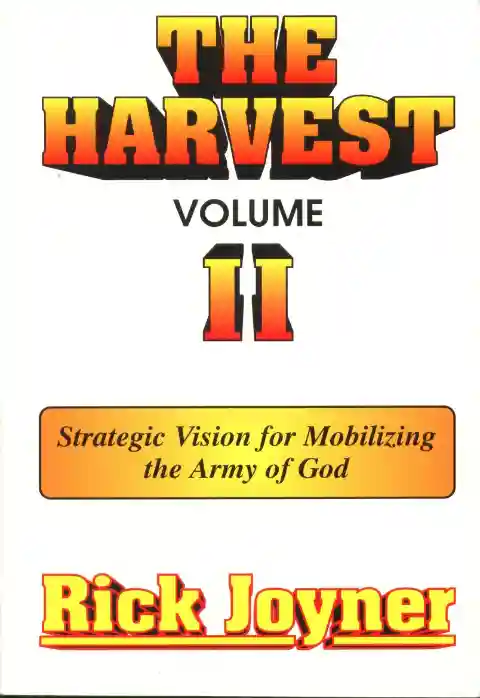
"THE HARVEST VOLUME II" by Rick Joyner is a Christian book that explores themes of spiritual growth, awakening, and revival. The author offers insights into the importance of personal transformation and discovering one's purpose in life. Joyner uses biblical teachings and personal anecdotes to inspire readers to seek a deeper relationship with God and fulfill their true potential.
Charles Wesley
"O for a thousand tongues to sing / My dear Redeemer's praise / The glories of my God and King, / The triumphs of his grace!"
He was said to have averaged 10 poetic lines a day for 50 years. He wrote 8,989 hymns, 10 times the volume composed by the only other candidate (Isaac Watts) who could conceivably claim to be the world's greatest hymn writer. He composed some of the most memorable and lasting hymns of the church: "Hark! The Herald Angels Sing," "And Can It Be," "O for a Thousand Tongues to Sing," "Love Divine, All Loves Excelling," "Jesus, Lover of My Soul," "Christ the Lord Is Risen Today," "Soldiers of Christ, Arise," and "Rejoice! the Lord Is King!"
And yet he is often referred to as the "forgotten Wesley."
His brother John is considered the organizational genius behind the founding of Methodism. But without the hymns of Charles, the Methodist movement may have gone nowhere. As one historian put it, "The early Methodists were taught and led as much through [Charles's] hymns as through sermons and [John] Wesley's pamphlets."
Language scholar
Charles Wesley was the eighteenth of Samuel and Susannah Wesley's nineteen children (only 10 lived to maturity). He was born prematurely in December 1707 and appeared dead. He lay silent, wrapped in wool, for weeks.
When older, Charles joined his siblings as each day his mother, Susannah, who knew Greek, Latin, and French, methodically taught them for six hours. Charles then spent 13 years at Westminster School, where the only language allowed in public was Latin. He added nine years at Oxford, where he received his master's degree. It was said that he could reel off the Latin poet Virgil by the half hour.
It was off to Oxford University next, and to counteract the spiritual tepidity of the school, Charles formed the Holy Club, and with two or three others celebrated Communion weekly and observed a strict regimen of spiritual study. Because of the group's religious regimen, which later included early rising, Bible study, and prison ministry, members were called "methodists."
In 1735 Charles joined his brother John (they were now both ordained), to become a missionary in the colony of Georgia—John as chaplain of the rough outpost and Charles as secretary to Governor Oglethorpe.
Shot at, slandered, suffering sickness, shunned even by Oglethorpe, Charles could have echoed brother John's sentiments as they dejectedly returned to England the following year: "I went to America to convert the Indians, but, oh, who will convert me?"
It turned out to be the Moravians. After returning to England, Charles taught English to Moravian Peter Böhler, who prompted Charles to look at the state of his soul more deeply. During May 1738, Charles began reading Martin Luther's volume on Galatians while ill. He wrote in his diary, "I labored, waited, and prayed to feel 'who loved me, and gave himself for me.'" He shortly found himself convinced, and journaled, "I now found myself at peace with God, and rejoice in hope of loving Christ." Two days later he began writing a hymn celebrating his conversion.
Evangelistic preacher
At evangelist George Whitefield's instigation, John and Charles eventually submitted to "be more vile" and do the unthinkable: preach outside of church buildings. In his journal entries from 1739 to 1743, Charles computed the number of those to whom he had preached. Of only those crowds for whom he stated a figure, the total during these five years comes to 149,400.
From June 24 through July 8, 1738, Charles reported preaching twice to crowds of ten thousand at Moorfields, once called "that Coney Island of the eighteenth century." He preached to 20,000 at Kennington Common plus gave a sermon on justification before the University of Oxford.
On a trip to Wales in 1747, the adventurous evangelist, now 40 years old, met 20-year-old Sally Gwynne, whom he soon married. By all accounts, their marriage was a happy one.
Charles continued to travel and preach, sometimes creating tension with John, who complained that "I do not even know when and where you intend to go." His last nationwide trip was in 1756. After that, his health led him gradually to withdraw from itinerant ministry. He spent the remainder of his life in Bristol and London, preaching at Methodist chapels.
Magnificent obsession
Throughout his adult life, Charles wrote verse, predominantly hymns for use in Methodist meetings. He produced 56 volumes of hymns in 53 years, producing in his lyrics what brother John called a "distinct and full account of scriptural Christianity."
The Methodists became known (and sometimes mocked) for their exuberant singing of Charles's hymns. A contemporary observer recorded, "The song of the Methodists is the most beautiful I ever heard … They sing in a proper way, with devotion, serene mind and charm."
Charles Wesley quickly earned admiration for his ability to capture universal Christian experience in memorable verse. In the following century, Henry Ward Beecher declared, "I would rather have written that hymn of Wesley's, 'Jesus, Lover of My Soul,' than to have the fame of all the kings that ever sat on the earth." The compiler of the massive Dictionary of Hymnology, John Julian, concluded that "perhaps, taking quantity and quality into consideration, [Charles Wesley was] the greatest hymn-writer of all ages."
who is the fairest in the land - lessons for young men on attraction
Some single men miss wonderful women because they’re fixated on all the wrong things. Whether suffering from worldly ideals or an inflated sense of self, somehow all of the Christian women they meet are never quite their “type.” This is not all men, to be sure, but it is some men. I was once one of them. I wrote before on the possibility that the woman some men hold out for does not actually exist. Some responded, wanting to lay aside their search for the full-time Christian, part-time model — who is nothing less than exotic, enchanting, ethereal — and come to appreciate the imperishable beauty of the existent, born-again daughters of God around them. These men wanted to know how . How do you begin to change the eye’s definition of beauty or shape the heart’s attractions? They wanted to break free from the pit of unrealistic expectations. They no longer desired to keep as many doors open as possible, and wanted to lay aside their fear of “forsaking all others.” They desired deliverance from that subtly dangerous question: “Who is the fairest in the land?” The following counsel, by no means exhaustive, may offer helpful steps in the right direction. 1. Live for Something Higher Than Her Men should not spend more energy looking for the perfect spouse than they do on becoming a godly future husband. If they have no garden to tend, why would they need a helper? If a man has no vision for his life, why would he invite a woman to sit idly next to him on a bus traveling nowhere? At different seasons of my life I lived as though marriage was my mission. With nothing higher to put my hands to, I could sculpt many romantic fantasies. Godly men, however, invite women into a mission bigger than the relationship itself; they seek a helpmate to adventure with in service of Christ. This need not mean a clean and tidy ten-year plan, but it is nothing less than knowing the Lord Jesus Christ, following him, and desiring to win souls and advance his glory in our spheres of influence. And living for Christ always entails putting to death our lust (Colossians 3:5). A man who consistently indulges in pornography and gives himself to sexual fantasy endangers his soul and anyone close to him. He also inevitably develops expectations shaped not by God and his word, but by the collage of digitally-enhanced images swimming around in his head. His “type” will gravitate more and more towards lust than beauty, more toward the physically distorted than the spiritually attractive. His “love” will devour for its own gratification rather than sacrifice for a bride and children in the name of Christ. If you want to be attracted to the true and imperishable beauty in godly women, live for the glory of Christ and give up the fleshly drug that fills the mind with prostitutes (Psalm 101:3). God places emphasis on a woman’s godliness far above her physical appearance. He cherishes the beauty that does not fade or wrinkle. And so can you, if you are his son. Instead of only inquiring about a woman’s spiritual character after we are attracted physically, intentionally search out the inner beauty in the Christian women around you, ask God for help to love what he loves, and then see if they do not become more and more attractive to you. 2. Anticipate the Loveliness in Possession Men who sit in the restaurant looking meticulously through the menu, for hours and hours, drinking the free water but never ordering, do not know the pleasure of God’s covenant meal. They do not eat from the table of marital love. Perpetual daters have never savored the rare sweetness of these words: “I am my beloved’s and my beloved is mine” (Song of Solomon 6:3). They pass, like I once did, on the three-course meal of possessing, belonging, and enjoying a creature fit for them within the safety of commitment. Solomon addresses his bride saying, “O most beautiful among women” (Song of Solomon 1:8). As a single man, I often wondered if I would ever be able to truthfully say that to my wife. Surely, I will eventually meet another more physically beautiful.  Time catches up to us all, even the most beautiful faces. Surely he flirted with flattery , I thought, when he said, “You are altogether beautiful, my love; there is no flaw in you” (Song of Solomon 4:7). No flaw? Of course there was. She herself bid him not to gaze at her imperfections from the very beginning (Song of Solomon 1:6). I was ignorant of how covenant enhances the beauty of the beautiful, how her being his  made her fairer than any other, how covenant changes the lover himself, even as his beloved ages. He spoke to her, “ My  dove, my  perfect one, is the only one” (Song of Solomon 6:9). She wasn’t someone else’s; she was his and he was hers (Song of Solomon 1:8; 1 Corinthians 7:4). What did he care for flowers on other hillsides, flowers he could not hold or enjoy, while this one, unlike any other flower God ever made or gave, now grew on his  hill? “Who is this who looks down like the dawn, beautiful as the moon, bright as the sun, awesome as an army with banners?” (Song of Solomon 6:10). His  wife. His wife, as should be the case with all men, was the most beautiful woman in the world to him , for she was his. And he was hers. If God gives us a wife, she is our one lily among the brambles (Song of Solomon 2:2). She is the one we walk with, talk with, laugh with, cry with, make memories with. She is our lover, our companion, our crown. There is no other. And this love ages well. Even when we can no longer walk, we can still rejoice in the wife of our youth, “a lovely deer, a graceful doe” (Proverbs 5:19). Others may not look at her weathered skin, grey hair, and changed body as the fairest in the land, but we still do. We have changed with her. After years of setting our hearts on her, our one, our ideals conform to who she is, to the woman God’s grace has made her. And on that day, I am credibly told, we delight in a beauty whose physical allure is merely a petal. 3. Ask Instead “Can I Love Her?” A paradigm-shifting question for young men to ask is not whether they already love the girl they see, but can they love her — until death do you part. Tim Keller writes, “Wedding vows are not a declaration of present love but a mutually binding promise of future love” ( Meaning of Marriage , 79). I admit this is baffling to today’s conceptions of dating and romance. It is old advice given by many others, including the Puritans. Puritan love . . . was not so much the cause as it was the product of marriage. It was the chief duty of husband and wife toward each other, but it did not necessarily form a sufficient reason for marriage. . . . The advice was not that couples should not marry unless they love  each other but that they should not marry unless they can  love each other. (Edmund Morgan, The Puritan Family , 54) Love can be the product of marriage, not just the cause of it. I knew enough about my wife to know that I could love her (largely, because I knew God did). We did not have years of history together. We married after only knowing each other for nine months, half of which was spent continents apart, but I knew the quality of woman she was and everyone in her life corroborated that beauty. After following Christ, it was the best decision of my life. Once you and your wife have answered the question of can  with “I do,” the question for husbands becomes: “Will you continue  to love her?” And by God’s grace, our answer will most certainly be, “Yes, with all my heart.” This is something you can resolve and pledge. That’s what wedding vows are. In Love with a Shadow In the Lord of the Rings, The Return of the King , the warrior-king Aragorn says of a girl who fell in love with him, or rather the ideal picture of him as king, In me she loves only a shadow and a thought: a hope of glory and great deeds, and lands far. . . . Men, do not fall in love with thoughts and shadows, of great romance, mighty deeds, and lands far away, all while unthinkingly passing over future queens of heaven and earth. Retain standards that God calls you to have, and question the rest. Make war on rebel lusts. Consider the beauty a covenant bestows. Begin asking, “ Can  I love her?” And above all, get serious about living for Christ.