
GIP Library icon

LOG IN TO REVIEW
About the Book


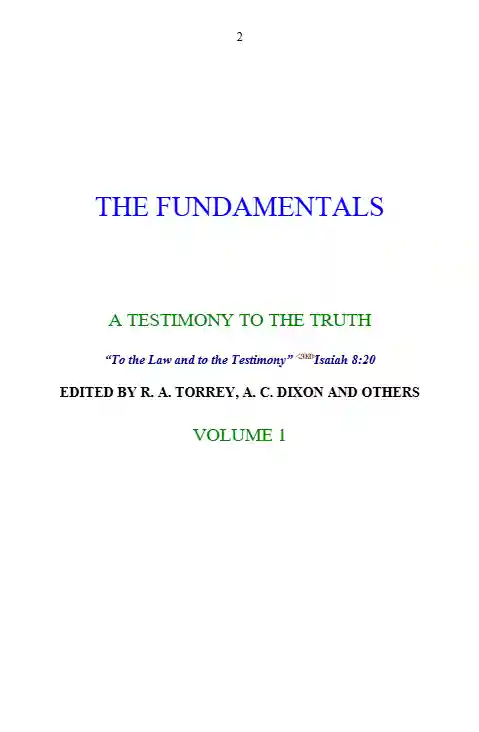
"The Fundamentals: A Testimony To The Truth" is a collection of essays written by various Christian authors, edited by R.A. Torrey and A.C. Dixon. The book covers a range of topics related to Christian beliefs and practices, focusing on key doctrines such as the deity of Christ, the inspiration of the Bible, and the importance of salvation. It serves as a foundational text for understanding core Christian beliefs and defending them against potential challenges or misconceptions.

John Knox
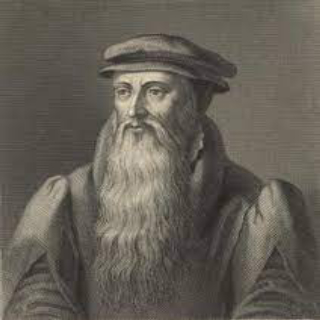
John Knox "The sword of justice is God's, and if princes and rulers fail to use it, others may." He was a minister of the Christian gospel who advocated violent revolution. He was considered one of the most powerful preachers of his day, but only two of the hundreds of sermons he preached were ever published. He is a key figure in the formation of modern Scotland, yet there is only one monument erected to him in Scotland, and his grave lies beneath a parking lot. John Knox was indeed a man of many paradoxes, a Hebrew Jeremiah set down on Scottish soil. In a relentless campaign of fiery oratory, he sought to destroy what he felt was idolatry and to purify Scotland's religion. Taking up the cause John Knox was born around 1514, at Haddington, a small town south of Edinburgh. Around 1529 he entered the University of St. Andrews and went on to study theology. He was ordained in 1536, but became a notary, then a tutor to the sons of local lairds (lower ranking Scottish nobility). Dramatic events were unfolding in Scotland during Knox's youth. Many were angry with the Catholic church, which owned more than half the real estate and gathered an annual income of nearly 18 times that of the crown. Bishops and priests were often mere political appointments, and many never hid their immoral lives: the archbishop of St. Andrews, Cardinal Beaton, openly consorted with concubines and sired 10 children. The constant sea traffic between Scotland and Europe allowed Lutheran literature to be smuggled into the country. Church authorities were alarmed by this "heresy" and tried to suppress it. Patrick Hamilton, an outspoken Protestant convert, was burned at the stake in 1528. In the early 1540s, Knox came under the influence of converted reformers, and under the preaching of Thomas Guilliame, he joined them. Knox then became a bodyguard for the fiery Protestant preacher George Wishart, who was speaking throughout Scotland. In 1546, however, Beaton had Wishart arrested, tried, strangled, and burned. In response, a party of 16 Protestant nobles stormed the castle, assassinated Beaton, and mutilated his body. The castle was immediately put to siege by a fleet of French ships (Catholic France was an ally to Scotland). Though Knox was not privy to the murder, he did approve of it, and during a break in the siege, he joined the besieged party in the castle. During a Protestant service one Sunday, preacher John Rough spoke on the election of ministers, and publicly asked Knox to undertake the office of preacher. When the congregation confirmed the call, Knox was shaken and reduced to tears. He declined at first, but eventually submitted to what he felt was a divine call. It was a short-lived ministry. In 1547, after St. Andrews Castle had again been put under siege, it finally capitulated. Some of the occupants were imprisoned. Others, like Knox, were sent to the galleys as slaves. Traveling preacher Nineteen months passed before he and others were released. Knox spent the next five years in England, and his reputation for preaching quickly blossomed. But when Catholic Mary Tudor took the throne, Knox was forced to flee to France. He made his way to Geneva, where he met John Calvin. The French reformer described Knox as a "brother … laboring energetically for the faith." Knox for his part, was so impressed with Calvin's Geneva, he called it, "the most perfect school of Christ that was ever on earth since the days of the apostles." Knox traveled on to Frankfurt am Main, where he joined other Protestant refugees—and quickly became embroiled in controversy. The Protestants could not agree on an order of worship. Arguments became so heated that one group stormed out of a church one Sunday, refusing to worship in the same building as Knox. Back in Scotland, Protestants were redoubling their efforts, and congregations were forming all over the country. A group that came to be called "The Lords of the Congregation" vowed to make Protestantism the religion of the land. In 1555, they invited Knox to return to Scotland to inspire the reforming task. Knox spent nine months preaching extensively and persuasively in Scotland before he was forced to return to Geneva. Fiery blasts of the pen Away from his homeland again, he published some of his most controversial tracts: In his Admonition to England he virulently attacked the leaders who allowed Catholicism back in England. In The First Blast of the Trumpet Against the Monstrous Regiment of Women he argued that a female ruler (like English Queen Mary Tudor) was "most odious in the presence of God" and that she was "a traitoress and rebel against God." In his Appellations to the Nobility and Commonality of Scotland, he extended to ordinary people the right—indeed the duty—to rebel against unjust rulers. As he told Queen Mary of Scotland later, "The sword of justice is God's, and if princes and rulers fail to use it, others may." Knox returned to Scotland in 1559, and he again deployed his formidable preaching skills to increase Protestant militancy. Within days of his arrival, he preached a violent sermon at Perth against Catholic "idolatry," causing a riot. Altars were demolished, images smashed, and religious houses destroyed. In June, Knox was elected the minister of the Edinburgh church, where he continued to exhort and inspire. In his sermons, Knox typically spent half an hour calmly exegeting a biblical passage. Then as he applied the text to the Scottish situation, he became "active and vigorous" and would violently pound the pulpit. Said one note taker, "he made me so to grew [quake] and tremble, that I could not hold pen to write." The Lords of the Congregation militarily occupied more and more cities, so that finally, in the 1560 Treaty of Berwick, the English and French agreed to leave Scotland. (The English, now under Protestant Elizabeth I, had come to the aid of the Protestant Scots; the French were aiding the Catholic party). The future of Protestantism in Scotland was assured. The Parliament ordered Knox and five colleagues to write a Confession of Faith, the First Book of Discipline, and The Book of Common Order—all of which cast the Protestant faith of Scotland in a distinctly Calvinist and Presbyterian mode. Knox finished out his years as preacher of the Edinburgh church, helping shape the developing Protestantism in Scotland. During this time, he wrote his History of the Reformation of Religion in Scotland. Though he remains a paradox to many, Knox was clearly a man of great courage: one man standing before Knox's open grave said, "Here lies a man who neither flattered nor feared any flesh." Knox's legacy is large: his spiritual progeny includes some 750,000 Presbyterians in Scotland, 3 million in the United States, and many millions more worldwide.

The Pursuit of True Discipleship

I learned as a very new Christian that if I was going to grow in the image of Christ I had to guard my heart. Here’s what that looked like for me. Very early on in my Christian walk, when I was almost 21 years old, I knew that I needed to be a woman of the Word. I began to guard my heart and my life by regularly engaging in the Bible. What’s important to know is that the most effective way to stay actively engaged in the Bible is not only to read the Word by yourself but also to read it with a small group. Everything you do personally is then maximized and multiplied when you’re in a group with a room full of women. The Holy Spirit is speaking to each and every one in the group as everyone is doing her daily reading throughout the week.  The Lord has created each of us completely differently, unique from each other. So in a group we read the same passages every single week together, and yet the Lord speaks to us differently through every season of life we’re in. When we get to sit around the table or sit around someone’s living room and share exactly what we have each heard from the Lord, it’s a beautiful process that the Holy Spirit uses in our individual lives but also in the lives of all of those women who are meeting together. So this is a two-fold process. Not only do we grow personally, but we’re also growing as a unit — and that's a beautiful thing. I really hope you’re excited about what this might look like in your life.  "Actively choose to put yourself in an atmosphere and environment to follow after Him, to constantly be changed into His image on this side of eternity." So, what is a disciple? I love to answer that question, because I think sometimes we make it more difficult than it actually is. Simply put, a disciple is a lifelong learner of Jesus Christ — someone who truly follows after Him all the days of her life. You actively choose to put yourself in an atmosphere and environment to follow after Him, to constantly be changed into His image on this side of eternity. Discipleship, then, means to intentionally equip believers with the Word of God, through accountable relationships and empowered by the Holy Spirit, in order to replicate faithful followers of Christ. Every single phrase in that definition is very important. One, it’s intentional. Two, we are equipping believers with the Word of God. From the beginning we must understand that the centerpiece of discipleship is God’s Word. Everything must always revolve around the centerpiece, because only God’s Word in the Spirit will change the hearts and the lives of people. We must intentionally equip believers with the Word of God. We’re doing that through accountable relationships and through the empowerment of the Holy Spirit. The end goal is always to replicate that process to make more disciples. John 8:31-32 says, “Then Jesus said to the Jews who had believed him, ‘If you continue in my word, you really are my disciples. You will know the truth, and the truth will set you free.’” I don't know about you, but I can always use more truth and freedom in my life — freedom from sin, freedom from bondage, and everything else that holds on to us in this world. We need to be women who say, I'm going to abide in Christ. I’m going to remain in His Word because remaining in His Word means that I am truly a disciple. Kandi Gallaty
Feedback
Suggestionsuggestion box
x