
GIP Library icon

LOG IN TO REVIEW
About the Book


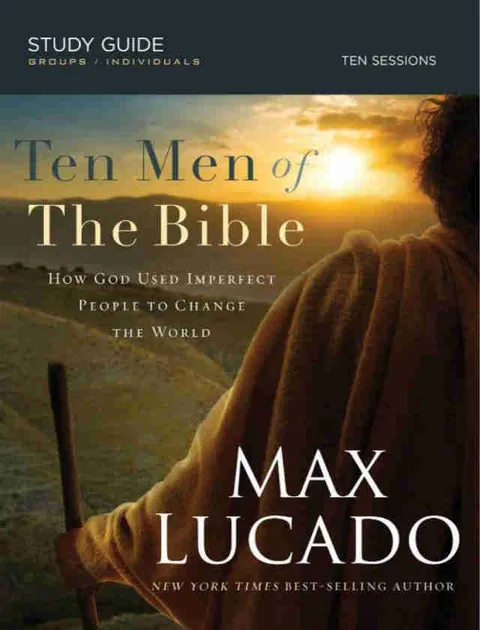
"Ten Men of the Bible" by Max Lucado explores the lives of ten biblical figures, including Abraham, Joseph, and Daniel, and draws lessons from their stories to inspire readers in their own faith journeys. Lucado offers insights into the struggles, victories, and transformations of these men, showing how God used them for His purposes and how He can work in the lives of modern believers as well.

Steven Curtis Chapman

Steven Curtis Chapman Steven Curtis Chapman is an American Christian musician, singer, song writer, record producer, actor, author and social activist. He is the only artist in the history of music to have won 56 Gospel Music Association Dove Awards and is also a proud receiver of 5 Grammy Awards. His music is known for being a unique cross between country music, soft rock and orchestrated pop, which made him a prominent artist in the contemporary Christian music circuit of the 1980s. Chapman grew up in a humble environment where he found his calling for music, owing to his father’s inclination towards country music. He learnt to play instruments like guitar and piano just by hanging around in his father’s music store, listening to him play along with his friends. He took up music seriously when he moved to Nashville and got recognized by Sparrow Records, a company he stayed with for a long period in his career. He has released 19 studio albums and has sold over 10 million albums until now. Chapman is a family oriented person just like his father and has a big family comprising of his wife Mary Beth and 3 biological and 2 adopted children. He is a vocal advocate for adoption and has worked socially to eradicate the problem of youth violence. Childhood & Early Life Steven Curtis Chapman was born on November 21, 1962 in Paducah, Kentucky, to Herb and Judy Chapman. His father was a country singer and songwriter, who turned down opportunities to become a successful singer to concentrate on his family. His mother was a stay-at-home mom. His father owned a music store, a business he managed from his basement and used to play music with his friends. Such creative environment at home influenced Chapman’s life from very early on and he bought his first guitar at 6. Chapman joined as a pre-med student at Georgetown College in Kentucky but after few semesters he moved to Anderson College, Indiana. But he ultimately dropped the idea of studying and went to Nashville to pursue his first love, music. During 1980s, he wrote a song ‘Built to Last’, which gained huge popularity after getting recorded by a gospel group ‘The Imperials’. The success of the song fetched Chapman a songwriting deal with Sparrow Records. Career Chapman’s first official album ‘First Hand’ was released in 1987. The album was an instant hit with singles like ‘Weak Days’ and topped at number 2 on the Contemporary Christian Music chart. The album had a mix of country music with soft rock and pop. In 1988, following the success of his first album, Chapman released ‘Real Life Conversations’. Its hit single ‘His Eyes’ received the ‘Contemporary Recorded Song of the Year’ award from the ‘Gospel Music Association’. He co-wrote it with James Isaac Elliot. After a few years, he made a swift turn to mainstream music with his album ‘The Great Adventure’ in 1992. It earned him two Grammy awards for the album and for the title song of the album. After gaining consistent success with albums like ‘Heaven in the Real World (1994), ‘Signs of Life (1996) and ‘Speechless (1999), Chapman’s next great album ‘Declaration’ came out in 2001, for which he toured 70 cities. In 2003, ‘All About Love’ was released and it ranked at Top 15 on the Christian Music charts. It was released under Sparrow Records and Chapman very humbly credited his wife Mary Beth for being the inspiration for his album. ‘All Things New’ was released in 2004 and the album added another Grammy to Chapman’s proud award collection. This time he received it in the category of Best Pop/Contemporary Gospel Album. It was also nominated for the Dove Award. In 2005, ‘All I Really Want for Christmas’ was released, which was Chapman’s another successful Christmas album after ‘The Music of Christmas’. It had traditional holiday tunes and favorites like ‘Go Tell It on the Mountain’ and Silver Bells’. Chapman took his music to greater levels by taking his concert to South Korea for the U.S. troops who were serving there in 2006. It was the first Christian concert that ever performed for the American army in that country. In 2007, he released ‘This Moment’ which included hit singles like ‘Cinderella’, for which he was chosen for WOW Hits 2009. He also went on his ‘Winter Jam’ tour and took his sons’, Caleb and Will’s band along. ‘Beauty Will Rise’, Chapman’s seventeenth album, was released in 2009. It is said that he wrote the songs of the album after getting inspired by his daughter Maria Sue’s sad and untimely demise. It included songs like ‘Meant to Be’ and ‘Re:creation’. In 2012, Chapman finally parted ways with Sparrow Records, the record company that he remained loyal to for so many years. He was signed on by Sony’s Provident Label Group and came out with a Christmas album called ‘JOY’. ‘The Glorious Unfolding’ was released in 2013 under Reunion Records and it peaked on number 27 on the Billboard 200 and was number 1 Top Christian Album. The album was produced by Chapman himself and Brent Milligan. Major Works Chapman’s ‘The Great Adventure’ in 1992 was a turning point in his musical career because until now he was making soft and contemporary country music but with ‘The Great Adventure’ he targeted the mainstream audience and tasted huge commercial success for the first time. Awards & Achievements Chapman is the winner of five Grammy awards for albums like ‘For the Sake of the Call’ ‘The Great Adventure’ ‘The Live Adventure’, ‘Speechless’ and ‘All Things New’. He has also received 56 Gospel Music Association Dove Awards, more than any other artist. Personal Life & Legacy Chapman got married to Mary Beth in 1984 after they first met at Anderson University in Indiana. They have three biological children: Emily, Caleb and Will and three adopted children: Shaohannah, Stevey and Maria, together. In 2008, Chapman’s youngest son Will ran over his car by accident on his adopted daughter Maria Sue Chunxi Chapman. She was running towards him to meet him but he did not see her and she was pronounced dead on arrival at the hospital. Trivia Chapman’s wife Mary Beth Chapman has written and released a book about losing her youngest daughter called ‘Choosing to SEE: A Journey of Struggle and Hope’. Chapman and his wife have written three children's books with adoption themes: ‘Shaoey And Dot: Bug Meets Bundle’ (2004), ‘Shaoey and Dot: The Christmas Miracle’ (2005), and ‘Shaoey and Dot: A Thunder and Lightning Bug Story’ (2006). He has received an Honorary Doctorate of Music from Anderson University.

What Does It Mean to Be Real

Nobody likes a fake. Even in our airbrush culture, we despise counterfeits and crave authenticity. Everyone wants to be real. But what does it mean to be real? No one really knows. Or so it seems. Try an experiment. Listen to people talk about what it means to be a Christian. Do you know what you will hear? Lots of competing answers and plenty of confusion. Perhaps you recall when 2012 presidential hopeful, Senator Rick Santorum, claimed that President Barack Obama’s policies were based on “a different theology.” Reporters, of course, pounced on this juicy piece of journalist red meat. “Did Senator Santorum,” they asked, “have the audacity, not of hope, but political incorrectness, to call into question the president’s claim to be a Christian?” When Senator Santorum was pressed, he gave a politically savvy response: “If the president says he’s a Christian, he’s a Christian.” End of story. Next question, please. His answer satisfied reporters, and thousands of others following the story. It was as if he said, “To profess faith is to possess faith.” And what could be less objectionable, or more American, than that? But one wonders what Jesus thinks of what Santorum said. More Than Mere Talk Is it enough simply to  say  we’re real, or should we be able to  see  we’re real? And if so, what should we see? Are there marks of authentic faith we should see in our lives, or in the lives of others? And what about the watching world? What should they see in the lives of real Christians? Now, more than a decade into the twenty-first century, the evangelical church faces huge challenges to its ministry and mission — radical pluralism, aggressive secularism, political polarization, skepticism about religion, revisionist sexual ethics, postmodern conceptions of truth. But perhaps the greatest threat to the church’s witness is one of our own making —  an image problem.  Many outside the church view Christians as  unchristian  in their attitudes and actions — bigoted, homophobic, hypocritical, materialistic, judgmental, self-serving, overly political. Several years ago, David Kinnaman and Gabe Lyons showed this in their book  Unchristian , which landed like a bombshell on a happy-go-lucky evangelicalism, causing many of us to do some serious soul-searching. The evangelical church’s image problem doesn’t bode well for its future. In fact, the data suggests that evangelical Christianity is declining in North America. Despite the church’s best efforts to appeal to the disillusioned, we continue to see alarming trends. Droves of people, especially from younger generations, are leaving the church and don’t plan to return. This has driven some to even predict the end of evangelicalism (See David Fitch,  The End of Evangelicalism? ). One True Soil The reasons for this discouraging state of affairs are complex, not cookie-cutter. But we know one thing is certain:  When Christians are confused about what it means to be real, the spiritual decline of the church will follow. In our increasingly post-Christian culture, where confusion about what it means to be real abounds, and where distrust of organized religion has reached an all-time high, the church needs to  get real . We must clarify for ourselves, and for a watching world, what it means to live a life of authentic faith. While Christians are confused about what it means to be real, Jesus is not. “Thus you will recognize them by their fruits,” he says (Matthew 7:20). You know you’re real if you bear fruit, he tells us. Fruit is the telltale sign of authentic faith because fruit doesn’t lie. “For no good tree bears bad fruit, nor again does a bad tree bear good fruit, for each tree is known by its own fruit. For figs are not gathered from thornbushes, nor are grapes picked from a bramble bush” (Luke 6:43–44). Jesus underscores this point in his famous parable about the sower (Matthew 13:1–23). The parable itself is straightforward. A farmer sows seed in a field, and the seed represents the good news of the kingdom. It is sown on four different kinds of soil, each representing a different response to the message of the kingdom. Simple enough, right? But here’s the punch line:  Only one type of soil bears fruit. Counterfeits Exposed The seed sown on the first soil hardly gets started. Satan comes and snatches it away. But what’s even more troubling is the outcome of the seed sown on the second and third soils. Why? Because both respond  positively  to the message, at least initially. These seeds appear to take root and begin growing into something real. Yet as the story continues, we learn that neither seed bears fruit. Neither lasts to the end, and thus neither seed is real. Some of the seeds fail to develop roots, and they don’t persevere when life gets hard and their faith is tested. All we see from this seed is a burst of enthusiasm, but no staying power. Perhaps this is someone who got excited about fellowship or forgiveness, but lacked love for Christ. They only have the  appearance  of being real. Over time, their faith proved counterfeit. We assume the third seed had a similarly joyful response to the message. Yet this soon dissipates because of revived interest in the things of the world — a career promotion, a new vacation home, saving toward their 401(k) plan. These concerns choke any fledgling faith, and the person falls away. New People with New Lives Why does Jesus tell his disciples this sobering parable? Why such a blunt story about the distinction between authentic and inauthentic responses to his message? Evidently, Jesus doesn’t equate professing faith with possessing faith, as we so often do. Instead, he warns his disciples that only one things matters — bearing fruit Although provocative, I think Jesus’s point is simple.  Real is something you can see.  There is a  visible difference  between real and not-real Christians. It’s not enough to  say  you’re real; you should be able to  see  you’re real. Real faith is something you can see. Being real is more than regularly attending church, feeling good about God, or “accepting” Jesus as your Savior; it goes beyond being baptized, receiving Communion, reciting the creed, or joining in church membership. As important as these things are, being real runs deeper than these things. Real Christians are new creatures. Physically, they won’t look different than others, at least not in the way they dress or keep their hair. Yet real Christians are radically changed — they’ve experienced a new birth, received a new heart, and enjoy new desires. Which makes them altogether new people who live new lives. And it shows. If you’re real, it will reveal itself in your life. Real Christians bear the marks of authentic faith in ways that can be seen, heard, and felt. When you know what you’re looking for, you can see the marks of real in their lives — and in your own.

Feedback
Suggestionsuggestion box
x