





GIP Library icon

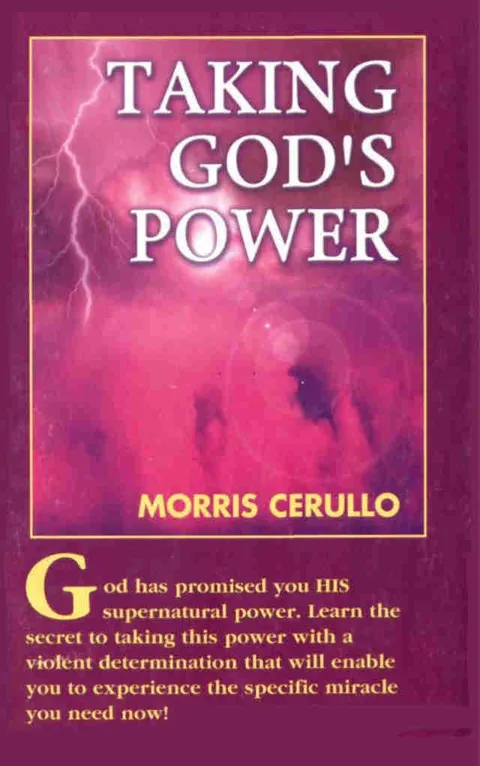
Taking God's Power Taking God's Power

Taking God's Power Order Printed Copy

  • Author: Morris Cerullo
  • Size: 702KB | 34 pages
  • |
Continue with
Google Twitter
LOG IN TO REVIEW
About the Book


"Taking God's Power" by Morris Cerullo explores the concept of tapping into God's power to overcome obstacles and fulfill one's purpose. The book offers practical steps and guidance on how to access and unleash the supernatural power of God in everyday life. Through personal anecdotes and biblical teachings, Cerullo inspires readers to walk in faith and experience the transformative power of God in their lives.

Mosab Hassan Yousef

Mosab Hassan Yousef Mosab Hassan Yousef (Arabic: مصعب حسن يوسف; nicknamed "The Green Prince"; born 5 May 1978) is a Palestinian who worked undercover for Israel's internal security service Shin Bet from 1997 to 2007. Shin Bet considered him its most valuable source within the Hamas leadership. The information Yousef supplied prevented dozens of suicide attacks and assassinations of Israelis, exposed numerous Hamas cells, and assisted Israel in hunting down many militants, and incarcerating his own father, Hamas leader Sheikh Hassan Yousef. In March 2010, he published his autobiography titled Son of Hamas. In 1999, Yousef converted to Christianity, and in 2007 he moved to the United States. His request for political asylum in the United States was granted pending a routine background check in 2010. Biography Mosab Hassan Yousef (later Joseph) was born in Ramallah, a city 10 kilometers (6.2 mi) north of Jerusalem. His father, Sheikh Hassan Yousef, was a Hamas leader who spent many years in Israeli prisons. He is the oldest of five brothers and three sisters. When Yousef was growing up, he wanted to be a fighter because that was according to him what was expected of Palestinian children in the West Bank. Yousef was first arrested when he was ten, during the First Intifada, for throwing rocks at Israeli settlers. He was further arrested and jailed by Israel numerous times. As his father's eldest son, he was seen as his heir apparent, and became an important part of the Hamas organization. Yousef said he saw the light after a stint with his dad’s comrades in an Israeli jail during the mid-1990s. At Megiddo Prison, he witnessed Hamas inmates leading a brutal year-long campaign to weed out supposed Israeli collaborators. "During that time, Hamas tortured and killed hundreds of prisoners,” he said, recalling vivid memories of needles being inserted under finger nails and bodies charred with burning plastics. Many, if not all, had nothing to do with Israeli intelligence. “I will never forget their screams,” he continued. “I started asking myself a question. What if Hamas succeeded in destroying Israel and building a state. Will they destroy our people in this way?” Yousef's doubts about Islam and Hamas began forming when he realized Hamas' brutality, and that he hated how Hamas used the lives of suffering civilians and children to achieve its goals. Yousef was held by Shin Bet agents in 1996. While in prison, he was shocked by Shin Bet's interrogation methods, which he considered humane, when compared to how Hamas operatives tortured imprisoned suspected collaborators. He decided to accept a Shin Bet offer to become an informant. Espionage career Beginning with his release from prison in 1997, Yousef was considered the Shin Bet's most reliable source in the Hamas leadership, earning himself the nickname "The Green Prince" – using the color of the Islamist group's flag, and "prince" because of his pedigree as the son of one of the movement's founders. The intelligence he supplied to Israel led to the exposure of many Hamas cells, as well as the prevention of dozens of suicide bombings and assassination attempts on Jews. He has claimed that he did not inform for money, but rather that his motivations were ideological and religious, and that he only wanted to save lives.[13] In order to thwart any suspicions of collaboration, the Shin Bet staged an arrest attempt, telling the Israel Defense Forces to launch an operation to arrest him, and then provided him intelligence allowing him to escape at the last minute, after which he went into hiding for the rest of his career. Yousef says he supplied intelligence only on the condition that the "targets" would not be killed, but arrested. This led to the detention of several key Palestinian leaders, including Ibrahim Hamid, a Hamas commander in the West Bank, and Marwan Barghouti. Also, Yousef claims to have thwarted a 2001 plot to assassinate Shimon Peres, then foreign minister and later President of Israel. According to his former Shin Bet officer, "Many people owe him their lives and don't even know it." Conversion to Christianity According to his story, Yousef met a British missionary in 1999 who introduced him to Christianity. Between the years 1999 and 2000, Yousef gradually embraced Christianity. In 2005, he was secretly baptized in Tel Aviv by an unidentified Christian tourist. He left the West Bank for the United States in 2007, and lived some time in San Diego, California, where he joined the Barabbas Road Church. In August 2008, Yousef publicly revealed his Christianity, and renounced Hamas and the Arab leadership, thereby endangering himself and exposing his family in Ramallah to persecution. Yousef has also claimed that his aim was to bring peace to the Middle East; he hopes to return to his homeland when there is peace. Yousef has stated that despite his conversion to Christianity, he is "against religion", and does not adhere to any denomination of Christianity. He has stated, "Religion steals freedom, kills creativity, turns us into slaves and against one another. Yes, I am talking about Christianity as well as Islam. Most Christians I have seen, seem to have missed the point, that Jesus redeemed us from religion. Religion is nothing but man's attempts to get back to God. Whether it is Islam, Christianity, Judaism, Buddhism, Hinduism, animism, any ism. Religion can't save mankind. Only Jesus could save mankind through his death and resurrection. And Jesus is the only way to God." Autobiography Yousef's co-authored autobiography, Son of Hamas: A Gripping Account of Terror, Betrayal, Political Intrigue, and Unthinkable Choices, written with the assistance of Ron Brackin, was published in March 2010. Yousef's brother Ouwais denounced the report about his brother's activities, saying: "It was full of lies; it's all lies." Ouwais also revealed that the last contact between his family and Mosab took place more than a year before the news of his spying. Sheikh Hassan Yousef, Mosab's father, while in an Israeli prison, disowned his son for spying for Israel. The Haaretz report on Yousef was described by Hamas MP Mushir al-Masri as "psychological war being waged against the Palestinian people... [it] did not deserve a response". Deportation threats and political asylum For a time, Yousef was threatened with deportation from the U.S., after his request for political asylum was denied, since statements in his book about working for Hamas were interpreted as "providing material support to a U.S.-designated terrorist organization", despite Yousef's explanation that they were "intended to undermine the group". His case then proceeded to the deportation stage, despite Yousef's advocates' warning that he would likely be executed by the Palestinian Authority if deported to the West Bank. On 24 June 2010, Shin Bet handler Gonen Ben Itzhak, who for 10 years worked with Yousef under the cryptonym "Loai", revealed his own identity in order to testify on behalf of Yousef at an immigration hearing in San Diego. Ben-Yitzhak described Yousef as a "true friend", and said, "he risked his life every day in order to prevent violence". Partially as a result of this, Immigration Court Judge Richard J. Bartolomei, Jr., ruled on 30 June 2010, that Yousef would be allowed to remain in the United States after being fingerprinted and passing a routine background check. He is a frequent guest speaker on various American news channels, where he talks about the atrocities committed by Hamas. Films A documentary adaptation of Son of Hamas titled The Green Prince, directed and written by Nadav Schirman, premiered at the 2014 Sundance Film Festival, where it won the Audience Award for World Cinema: Documentary. The Green Prince will be re-made into a live-action feature film. Yousef is collaborating with US-based actor and film producer Sam Feuer in the production of two films: a feature film adaptation of Yousef's book Son of Hamas and documentary The Green Prince, and a historical depiction of the life of the Muslim prophet Muhammad based on the accounts of eighth-century historian Ibn Ishaq. Views and controversies Some elements of Yousef's story have been questioned. Former Shin Bet Deputy Chief Gideon Ezra described Yousef's claims as "too good to be true", and stated that, "there are hundreds of collaborators like him. He is not unusual. He just decided to write a book about it." The conversion to Christianity narrative promoted by Yousef and his book publishers remains unsubstantiated as well. Critics have alleged that Yousef claimed he was a Christian (for a longer period of time) in order to help secure asylum in the United States. This tactic is common for Muslim immigrants seeking to avoid deportation to countries where apostasy laws exist. However, he has since become an active figure in evangelical non-denominational Christianity in America, and has appeared on programs such as The 700 Club. Interest in the book from Christian readers helped make it a New York Times best-seller. During an appearance on The 700 Club to promote his book "Son of Hamas", he was welcomed and interviewed by host Pat Robertson. At an "End Times Prophecy" conference in 2010, hosted by California-based evangelist Greg Laurie, Yousef told the crowd in attendance that Islam is "the biggest lie in human history." He further suggested at the conference that the Quran should not be legal in the United States ("banned on American soil"). In May 2016, talking to a Jerusalem Post conference in New York, Yousef claimed that at one time that he was working for, and being paid by, Israel, the United States, the Palestinian Authority, and Hamas, all at the same time. He went on to say that Islam as a whole is comparable to Nazism, and must be defeated.

Lord, Make Us Diligent and Desperate

“Lord, make me as holy as a pardoned sinner can be made.” This prayer, often found on the lips of Robert Murray McCheyne, strikes a chord in every Christian soul. When the Holy Spirit makes his home in us, holiness ceases to be the stuffy obligation we thought it was. All of a sudden, holiness feels like heaven in our hearts, and every earthly longing bows the knee to this burning, bright desire: “Lord, make me holy.” As we look ahead to a new year, how might we expect the Holy Spirit to fulfill that longing? One answer may not be surprising, but it is easily forgotten and neglected. To make us holy, the Spirit leads us on the pathways of Scripture, prayer, and the other means of grace. And along the way, he shapes our posture to align with two fundamental truths: Holiness cannot be found apart from the Spirit’s means of grace; therefore, we must be diligent in the use of them. Holiness cannot be found in the means of grace themselves; therefore, we must be desperate for the Spirit to work through them. Diligence and desperation: these are the postures that honor the Spirit’s means of grace. And by his design, they are our only hope for true holiness. Lord, Make Us Diligent Some of us hesitate to associate the sanctifying work of the Spirit with a word like diligence. We can be prone to think of the Spirit’s ministry in terms of spontaneity and flexibility, not discipline and diligence. But unless we read the Bible attentively, pray devotedly, and gather for worship regularly, the holiness that comes from the Spirit will not be ours. In other words: no diligence, no holiness. “No Christian drifts into holiness. The flesh is too weak, the devil too deceitful, and the world too alluring.” The Bible’s description of the growing Christian hums with activity and effort. Such a Christian does not read the Bible merely when he gets around to it; instead, he aims to meditate “day and night” (Psalm 1:2) — thinking over the word (2 Timothy 2:7), attending to the word (Proverbs 2:2), storing up the word (Psalm 119:11). He does not pray a few vague petitions on his way to work; rather, he endeavors to “continue steadfastly in prayer” (Colossians 4:2), devoting his whole mind to the task (1 Peter 4:7) as he struggles on behalf of himself and others (Colossians 4:12). And he does not simply gather with the church when his schedule allows; he exhorts (and is exhorted) “every day” (Hebrews 3:13), “not neglecting to meet” with his brothers and sisters (Hebrews 10:25). Just as no twig drifts upstream, so no Christian drifts into holiness. The flesh is too weak, the devil too deceitful, and the world too alluring. When it comes to holiness, the Spirit speaks the same command to us as the one he spoke two thousand years ago: strive (Hebrews 12:14). Holy Habits Sometimes, of course, our striving toward holiness does not seem like striving at all. We feel carried along by the Spirit, filled with a power that scorns sin and sends us with joy to the means of grace. These are precious experiences. But they can lead us astray if we begin to expect that the path to holiness will always feel like flying on eagles’ wings. The reality is that much of our progress toward holiness requires painful, painstaking effort — though not joyless — carried along by a stubborn faith that clings to God’s promise. J.I. Packer offers the realism many of us need to hear: “Holiness teaching that skips over disciplined persistence in the well-doing that forms holy habits is . . . weak; habit-forming is the Spirit’s ordinary way of leading us on in holiness” (Keep in Step with the Spirit, 90). In the moment, of course, “habit-forming” may not feel very spiritual — at least if by spiritual we mean an uplifted or ecstatic emotional state. It will probably feel like ordinary hard work. But keeping in step with the Spirit is sometimes as simple as, well, taking the next difficult step in faith: Throw the covers off and get up. Resist the urge to get lost in your phone or email. Push through distractions in your prayers. Whatever it takes, keep the reward in view, and form the habits that put you in the places where the wind of the Spirit blows. So, as we pray for more holiness in the year ahead, we might also ask, “Lord, make us diligent.” Lord, Make Us Desperate And yet, woe to us if diligence is our only watchword in the pursuit of holiness. The Pharisee in Jesus’s parable could claim diligence — far more than many of us can claim. “I am not like other men, extortioners, unjust, adulterers, or even like this tax collector. I fast twice a week; I give tithes of all that I get” (Luke 18:11–12). All the means of grace are on display in this man. He knows the Scriptures. He prays. He gathers in the temple. And he is lost. “Whatever it takes, form the habits that put you in the places where the wind of the Spirit blows.” Diligence, if left without the seasoning of humble desperation, becomes the bitterest of all roots. As John Murray writes, “If we are not keenly sensitive to our own helplessness, then we can make the use of means of sanctification the minister of self-righteousness and pride” (Redemption Accomplished and Applied, 156). If we devote ourselves to the means of grace without depending on the God of grace, then the means may only serve our self-righteousness. In the pursuit of holiness, as in every other area of life, the first of Jesus’s Beatitudes abides: “Blessed are the poor in spirit” (Matthew 5:3). Blessed are those who know they can see nothing on their own (1 Corinthians 2:14). Blessed are those who can say with the apostle, “We do not know what to pray for as we ought” (Romans 8:26). Blessed are those who, like the tax collector in the parable, know that mercy is their only hope (Luke 18:13). Diligence can put our face in front of the Bible, but it cannot show us wonders there (Psalm 119:18). Only the Spirit can do that — and he loves to do so for the desperate. ‘Give Me Life!’ The author of Psalm 119 models what desperate diligence might sound like in practice. All throughout the psalm, notes of diligence and notes of desperation meld into a harmony that can come only from the Holy Spirit. To call the psalmist diligent puts it mildly: “With my whole heart I seek you” (Psalm 119:10). “I will keep your law continually, forever and ever” (Psalm 119:44). “I hasten and do not delay to keep your commandments” (Psalm 119:60). “Your testimonies are my meditation” (Psalm 119:99). “Seven times a day I praise you for your righteous rules” (Psalm 119:164). Here is diligence indeed. Yet it is the diligence of a man who knows, deep down, that he is hopeless apart from his God. Hear his desperation: “My soul clings to the dust; give me life according to your word!” (Psalm 119:25). “Put false ways far from me and graciously teach me your law!” (Psalm 119:29). “Incline my heart to your testimonies, and not to selfish gain!” (Psalm 119:36). “May my heart be blameless in your statutes, that I may not be put to shame!” (Psalm 119:80). “I am your servant; give me understanding, that I may know your testimonies!” (Psalm 119:125). The psalmist knew what we often forget: holiness requires hard work, but it is never the product of mere hard work. From first to last, holiness is a gift of grace. And so, we pray not only, “Lord, make us diligent,” but, “Lord, make us desperate.” Lord, Show Us Christ By diligence and desperation, the Spirit leads us onward to holiness. But if we are going to embody these two postures in the upcoming year, then we need to remember what we really mean by holiness. Too easily, we talk about holiness merely as a set of abstract moral virtues — patience, love, peace, generosity, boldness — and not as what it really is: Christlikeness. To be holy is to be near Christ and like Christ; the pursuit of holiness, therefore, is the pursuit of him. If we conceive of holiness merely as moral virtue, then our diligence and desperation will likely dry up after a time. But if Christ is at the center of our pursuit, then we have a goal glorious enough to summon all of our energy, all of our longings, all of our attention, all through the year. “Diligence can put our face in front of the Bible, but it cannot show us wonders there.” Rise up early for Christ, read and meditate and memorize for Christ, pray and fast for Christ, gather and worship for Christ — not to be more accepted by him than you already are, but to enjoy him more than you already do. Whatever else we gain this year cannot compare with knowing him, loving him, trusting him more dearly than we do now. “Oh, if ye saw the beauty of Jesus, and smelled the fragrance of his love,” Samuel Rutherford once wrote, “you would run through fire and water to be at him” (The Letters of Samuel Rutherford, 111). This, ultimately, is the Holy Spirit’s passion and purpose in all the means of grace: to glorify Christ in our eyes so that we become like him (John 16:14; 2 Corinthians 3:18). So, if we want God to make us as holy as pardoned sinners can be made, we will ask for more diligence and desperation. And underneath both of these, we will say, “God, show us Christ.” Article by Scott Hubbard

Feedback
Suggestionsuggestion box
x