
GIP Library icon

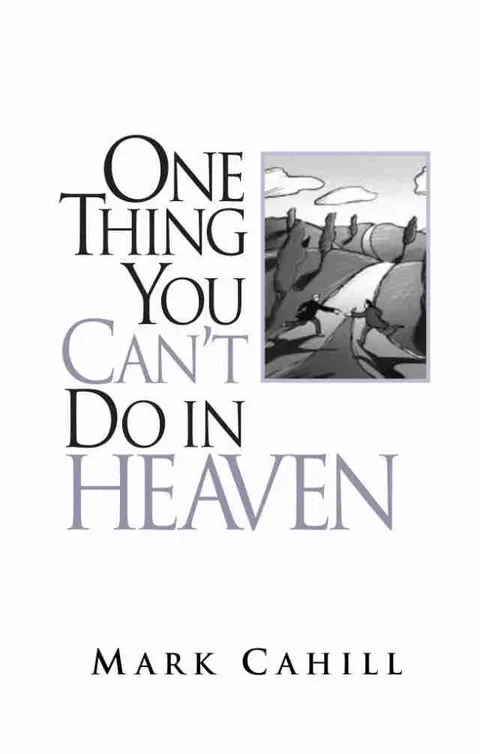
One Thing You Can't Do In Heaven One Thing You Can't Do In Heaven

One Thing You Can't Do In Heaven Order Printed Copy

  • Author: Mark Cahill
  • Size: 1.62MB | 220 pages
  • |
Continue with
Google Twitter
LOG IN TO REVIEW

No comment! Reading in progess...

- henryk user (a year ago)

About the Book


"One Thing You Can't Do in Heaven" by Mark Cahill is a Christian non-fiction book that challenges readers to consider their beliefs about eternity and the afterlife. The author argues that there is one crucial thing individuals cannot do in heaven, and that is to share the gospel and lead others to Christ. Through personal stories and practical advice, Cahill encourages readers to actively engage in evangelism and fulfill their purpose on earth before it's too late.

Lee Strobel

Lee Strobel Lee Strobel (Lee Patrick Strobel) is a former American investigative journalist and a Christian Author who has written several books, including four which received ECPA (Evangelical Christian Publishers Association) Christian Book Awards (1994, 1999, 2001, 2005) and a series which addresses challenges to the veracity of Christianity. He is a former host of the television program called Faith Under Fire on PAX TV and he runs a video apologetic web site. Lee Strobel Age He was born on January 25, 1952 in Arlington Heights, Illinois, U.S. Lee Strobel Family | Chicago Tribune Less information has been revealed about his father, mother and siblings if he has any. He attended the University of Missouri where he received a Journalism degree. He later earned his Masters of Studies in Law degree from Yale Law School. He became a journalist for the Chicago Tribune and other newspapers for 14 years. The UPI Illinois Editors Association newspaper award program gave him a first place for public service (the Len H. Small Memorial award) for his coverage of the Pinto crash trial of Ford Motor in Winamac, Indiana in 1980. Later, he became the assistant managing editor of the Daily Herald, before leaving journalism in 1987. Lee Strobel Wife | Daughter He married Leslie Strobel and they are blessed with two children; a son called Kyle who is an an Assistant Professor of Spiritual Theology and Formation at the Talbot School of Theology and a daughter called Alison who is a novelist. Lee Strobel Church He was an atheist when he began investigating the Biblical claims about Christ after his wife’s conversion. Prompted by the results of his investigation, he became a Christian on November 8, 1981. He was a teaching pastor of Willow Creek Community Church in South Barrington, Illinois, from 1987 to 2000, before shifting his focus to writing and producing his TV show, Faith Under Fire. He later was awarded an honorary doctoral degree by Southern Evangelical Seminary in recognition of his contributions to Christian apologetics in 2007. Lee Strobel Books He has written several books just to list a few. 1998 – The Case for Christ: A Journalist’s Personal Investigation of the Evidence for Jesus 2000 – The Case for Faith: A Journalist Investigates the Toughest Objections to Christianity 2004 – The Case for a Creator 2005 – The Case for Christmas: A Journalist Investigates the Identity of the Child in the Manger 2007 – The Case for the Real Jesus 2013 – The Case for Grace: A Journalist Explores the Evidence of Transformed Lives 2014 – The Case for Christianity Answer Book 2015 – The Case for Hope: Looking Ahead with Courage and Confidence 2018 – The Case for Miracles: A Journalist Investigates Evidence for the Supernatural Lee Strobel Net Worth From his work as a former investigative journalist and from his work as a Christian apologetic author, he has gained a great fortune. Besides that, he lives with his wife in his home that he bought. He has an estimated net worth of $8 million. Lee Strobel Movie His movies include; 2004 – Jesus: Fact or Fiction. 2007 – Jesus: The Great Debate. 2017 – The Case for Christ Lee Strobel The Case For Christ The Case For Christ is one of the books that Lee has written. This book summarizes Lee’s interviews with thirteen evangelical Christian scholars—Craig Blomberg, Bruce Metzger, Edwin Yamauchi, John McRay, Gregory Boyd, Ben Witherington III, Gary Collins, D. A. Carson, Louis Lapides, Alexander Metherell, William Lane Craig, Gary Habermas, and J. P. Moreland—in which they defend their views regarding the historical reliability of the New Testament. His personal encounters with these scholars and their beliefs led to the 2017 film of the same name. Lee Strobel The Case For Miracles The Case for Miracles: A Journalist Investigates Evidence for the Supernatural is one of the books that he has written. This book starts with an unlikely interview in which America’s foremost skeptic builds a seemingly persuasive case against the miraculous. But then Strobel travels the country to quiz scholars to see whether they can offer solid answers to atheist objections. Along the way, he encounters astounding accounts of healings and other phenomena that simply cannot be explained away by naturalistic causes. The book features the results of exclusive new scientific polling that shows miracle accounts are much more common than people think. Lee Strobel Testimony This is a summary of the detailed transcript of his testimony; For most of my life I was an atheist. I thought the idea of an all-loving, all-powerful creator of the universe–I thought it was stupid. I mean, my background is in journalism and law. I tend to be a skeptical person. I was the legal editor of the Chicago Tribune. So I needed evidence before I’d believe anything. One day my wife came up to me–she’d been agnostic–and she said after a period of spiritual investigation she had decided to become a follower of Jesus Christ. And I thought, you know, this is the worst possible news I could get. I thought she was going to turn into some sexually repressed prude who was going to spend all her time serving the poor in skid row somewhere. I thought this was the end of our marriage. But in the ensuing months, I saw positive changes in her values, in her character, in the way she related to me and the children. It was winsome; and it was attractive; and it made me want to check things out. So I went to church one day, ah, mainly to see if I could get her out of this cult that she had gotten involved in. But I heard the message of Jesus articulated for the first time in a way that I could understand it. That forgiveness is a free gift, and that Jesus Christ died for our sins, that we might spend eternity with Him. And I walked out saying–I was still an atheist–but also saying, “If this is true, this has huge implications for my life.” And so I used my journalism training and legal training to begin an investigation into whether there was any credibility to Christianity or to any other world faith system for that matter. Lee Strobel The Case For Easter The Case for Easter: A Journalist Investigates the Evidence for the Resurrection is one of his books that answers the following questions. Did Jesus of Nazareth really rise from the dead?Of the many world religions, only one claims that its founder returned from the grave. The resurrection of Jesus Christ is the very cornerstone of Christianity. But a dead man coming back to life? In our sophisticated age, when myth has given way to science, who can take such a claim seriously? Some argue that Jesus never died on the cross. Conflicting accounts make the empty tomb seem suspect. And post-crucifixion sightings of Jesus have been explained in psychological terms.How credible is the evidence for—and against—the resurrection? and many others. Lee Strobel Quotes “Only in a world where faith is difficult can faith exist.” “If your friend is sick and dying, the most important thing he wants is not an explanation; he wants you to sit with him. He’s terrified of being alone more than anything else. So, God has not left us alone.” “Faith is only as good as the one in whom it’s invested.” “To be honest, I didn’t want to believe that Christianity could radically transform someone’s character and values. It was much easier to raise doubts and manufacture outrageous objections that to consider the possibility that God actually could trigger a revolutionary turn-around in such a depraved and degenerate life.” “Abruptly, Templeton cut short his thoughts. There was a brief pause, almost as if he was uncertain whether he should continue. ‘Uh 
 but 
 no,’ he said slowly, ‘he’s the most 
’ He stopped, then started again. ‘In my view,’ he declared, ‘he is the most important human being who ever existed.’ That’s when Templeton uttered the words I neer expected to hear from him. ‘ And if I may put it this way,’ he said in a voice that began to crack, ‘I 
 miss 
 him!’ With that tears flooded his eyes. He turned his head and looked downward, raising his left hand to shield his face from me. His shoulders bobbed as he wept.” Lee Strobel Website His website is leestrobel.com

hero in an unmarked grave - the unusual modesty of john calvin

On May 27, 1564, just after eight o’clock in the evening, a nurse urgently summoned Theodore Beza (1519–1605) to Calvin’s bedside. “We found he had already died,” Calvin’s friend and fellow pastor later wrote. “On that day, then, at the same time with the setting sun, this splendid luminary was withdrawn from us.” 1  Calvin was 54 years old. Calvin’s death sent a shock wave throughout Geneva and beyond. Beza writes, “That night and the following day there was a general lamentation throughout the city . . . all lamenting the loss of one who was, under God, a common parent and comfort.” He records that two days later “the entire city” gathered at the St. Pierre Cathedral to honor their beloved pastor. Despite Calvin’s prominence, the funeral was unusually simple, “with no extraordinary pomp.” 2  But Calvin’s burial was particularly unusual. Unmarked Grave Eighteen years earlier, on February 18, 1546, fellow Reformer Martin Luther died at the age of 63. As was common practice for ministers, Luther’s remains were interred inside the church where he had faithfully served. His casket lies in Wittenberg’s Castle Church, near the pulpit, seven feet below the floor of the nave. Luther’s successor and fellow Reformer, Philip Melanchthon (1490–1560), is buried beside him. So also William Farel (1489–1565), who first called Calvin to Geneva in 1536, is buried in the cathedral of NeuchĂątel, where he spent the final years of his ministry. When Calvin’s friend and successor Theodore Beza died in 1605, he was buried next to the pulpit of St. Pierre, the Genevan church in which he and Calvin ministered together. But Calvin’s remains lie elsewhere. Rather than being interred in St. Pierre, Calvin’s body was carried outside the city wall to a marshy burial ground for commoners called Plainpalais. With close friends in attendance, Calvin’s body was wrapped in a simple shroud, enclosed in a rough casket, and lowered into the earth. Beza writes that Calvin’s plot was unlisted and, “as he [had] commanded, without any gravestone.” 3 Why did Calvin command that he be buried, contrary to common practice, in an unmarked grave? Some speculate that he wanted to discourage religious pilgrims from visiting his resting place or to prevent accusations from the Roman church that he desired veneration as a saint. 4  But the answer lies somewhere deeper — in Calvin’s understanding of Christian modesty. Forgotten Meaning of Modesty When we speak of modesty today, we most often mean dressing or behaving in such a way as to avoid impropriety or indecency. But modesty more generally refers to the quality of being unassuming or moderate in the estimation of oneself. For centuries, the church understood the connection. Immodest dress was not simply ostentatious or sexually suggestive; it reflected an overemphasis on appearance. As Jesus warned, outward appearance can mask impiety (Matthew 6:16) or pride (Luke 18:12). This is why both Gentile women converts in Ephesus and the Jewish Christians addressed in Hebrews are urged to consider how their outward appearance relates to the disposition of the heart. Excessive adornment could be evidence of self-importance (1 Timothy 2:9). Acceptable worship requires a posture of reverence, not pretension (Hebrews 12:28). Thus, a modest person represents himself neither too highly nor too meanly because he understands both the dignity and the humility of being transformed by the grace of God. “Modesty is simply the outward reflection of true Christian humility.” Modesty, then, is simply the outward reflection of true Christian humility. It obliterates pride by embracing the reality that a Christian is both creaturely and beloved. In this light, self-importance becomes absurd. Grandiosity becomes laughable. Celebrity becomes monstrous. We Are Not Our Own For Calvin, the gospel radically reshapes our view of self. As those created in God’s image, provisioned by his goodness, redeemed by his mercy, transformed by his grace, and called to his mission, those who belong to Christ no longer live for themselves. “Now the great thing is this,” Calvin writes, “we are consecrated and dedicated to God in order that we may thereafter think, speak, meditate, and do, nothing except to his glory.” Calvin continues, If we, then, are not our own but the Lord’s, it is clear what error we must flee and whither we must direct all the acts of our life.  We are not our own : let not our reason nor our will, therefore, sway our plans and deeds.  We are not our own : let us not therefore see it as our goal to seek what is expedient for us according to the flesh.  We are not our own : in so far as we can, let us therefore forget ourselves and all that is ours. Conversely, we are God’s : let us therefore live for him and die for him.  We are God’s : let his wisdom and will therefore rule all our actions.  We are God’s : let all the parts of our life accordingly strive toward him as our only lawful goal. Oh how much has that man profited who, having been taught that he is not his own, has taken away dominion and rule from his own reason that he may yield it to God! For, as consulting our self-interest is the pestilence that most effectively leads to our destruction, so  the sole haven of salvation is to be wise in nothing through ourselves but to follow the leading of the Lord alone . 5 “Modesty blossoms when we experience the freedom from having to prove ourselves to God or one another.” Modesty and humility flow from a heart transformed by the Spirit of Christ. “As soon as we are convinced that God cares for us,” Calvin writes, “our minds are easily led to patience and humility.” 6  The Spirit shapes us with a kind of moderation that “gives the preference to others” and that guards us from being “easily thrown into agitation.” 7  Modesty blossoms when we experience the freedom from having to prove ourselves to God or one another. ‘Modesty, His Constant Friend’ Calvin’s life reflected this reality. Despite the doors that were opened to him through his writing and network of connections, he was committed to “studiously avoiding celebrity.” 8  When the  Institutes  was published in 1536, he was so successful in his object to “not acquire fame” that no one in Basel knew that he was its author. For the rest of his life, wherever he went, he took care to “conceal that I was the author of that performance.” 9  Calvin even sought to avoid a wider ministry in Geneva, having “resolved to continue in the same privacy and obscurity.” He was drawn into the limelight only when William Farel warned him “with a dreadful imprecation” that turning down the post would be refusing God’s call to service. 10  In brief autobiographical comments he wrote the year that he died, we see a glimmer of his own surprise over God’s sovereign hand through his life. God so led me about through different turnings and changes that he never permitted me to rest in any place, until, in spite of my natural disposition, he brought me forth to public notice. . . . I was carried, I know not how, as it were by force to the Imperial assemblies, where, willing or unwilling, I was under the necessity of appearing before the eyes of many. 11 It is no surprise, then, that a few days before his death, Calvin exhorted his friends to not be those who “ostentatiously display themselves and, from overweening confidence, insist that all their opinions should be approved by others.” Instead, he pleaded with them to “conduct themselves with modesty, keeping far aloof from all haughtiness of mind.” 12  For Beza, Calvin’s modesty — forged by his vision of God’s glory, Christ’s redeeming love, and the Spirit’s animating power — was his defining characteristic. After Calvin’s burial, Beza captured it in verse: Why in this humble and unnoticed tomb Is Calvin laid — the dread of falling Rome; Mourn’d by the good, and by the wicked fear’d By all who knew his excellence revered? From whom ev’n virtue’s self might virtue learn, And young and old its value may discern? ’Twas modesty, his constant friend on earth, That laid this stone, unsculptured with a name; Oh! happy ground, enrich’d with Calvin’s worth, More lasting far than marble is thy fame! 13 Free to Be Forgotten In old Geneva, on the grounds of the college Calvin founded, stands an immense stone memorial to four leaders of the Protestant Reformation. At its center are towering reliefs of Calvin, Beza, Farel, and John Knox (1513–1572). Calvin would surely detest it. But the monument is a metaphor. We live in a culture that fears obscurity and irrelevance. We measure ourselves against others and build our own platforms in the hope that we will not be forgotten. We attempt to distinguish ourselves at the expense of the humility and modesty that honors Christ. Calvin would have us be free from such striving. For however anyone may be distinguished by illustrious endowments, he ought to consider with himself that they have not been conferred upon him that he might be self-complacent, that he might exalt himself, or even that he might hold himself in esteem. Let him, instead of this, employ himself in correcting and detecting his faults, and he will have abundant occasion for humility. In others, on the other hand, he will regard with honor whatever there is of excellences and will, by means of love, bury their faults. The man who will observe this rule, will feel no difficulty in preferring others before himself. And this, too, Paul meant when he added, that they ought not to have everyone a regard to themselves, but to their neighbors, or that they ought not to be devoted to themselves. Hence it is quite possible that a pious man, even though he should be aware that he is superior, may nevertheless hold others in greater esteem. 14 We may rightly regard Calvin as a hero of the faith, but he didn’t ultimately see himself that way. Humility had taught him to walk modestly before God and others — and, in the end, the freedom to lie down in a forgotten grave. Theodore Beza, “The Life of John Calvin” in  Tracts Related to the Reformation  (Edinburgh: Calvin Translation Society, 1844), 1:xcv. ↩ Beza,  Tracts , 1:xcvi. ↩ Beza,  Tracts , 1:xcvi. ↩ Eighteenth-century guidebooks indeed list the disused Plainpalais cemetery as an important stop for tourists, though they warn that pilgrims will search for Calvin’s resting place in vain. By the nineteenth century, keepers of the burial ground staked out a “likely-enough” site for Calvin’s grave (complete with a rudimentary marker) simply to avoid the irritation of being so frequently asked. ↩ John Calvin,  Institutes of the Christian Religion , ed. John T. McNeill, trans. Ford Lewis Battles (Louisville, KY: Westminster John Knox Press, 2011), 3.7.1 (emphasis mine). ↩ John Calvin,  Commentaries on the Catholic Epistles , trans. John Owen (Edinburgh: T. Constable,1855), 149. ↩ John Calvin,  Commentaries on the Epistles of Paul the Apostle to the Philippians, Colossians, and Thessalonians , trans. John Pringle (Edinburgh: T. Constable, 1851) 52–53. ↩ John Calvin,  Commentary on the Psalms , trans. James Anderson (Edinburgh: Edinburg Printing Company, 1845), 1:xli, xlii. ↩ Calvin,  Psalms , 1:xlii. ↩ Calvin,  Psalms , 1:xlii. ↩ Calvin,  Psalms , 1:xli, xliii. ↩ Beza,  Tracts , 1:xci. ↩ Beza was widely known for his literary works. As a humanist, he became famous for his collection of Latin poems in  Juvenilia , published just before his conversion in 1548. He continued to write poetry, satires, and dramas until the end of his life. Francis Sisbon’s nineteenth-century translation attempts to capture the sense of the Latin in a more familiar poetic form (Theodore Beza,  The Life of John Calvin , trans. Francis Sibson, [Philadelphia: J. Whetham, 1836], 94). For the original text, see Calvin and Beza,  Tracts , 1:xcvi. ↩ Calvin,  Commentaries on the Epistles of Paul , 53. ↩

Feedback
Suggestionsuggestion box
x