
GIP Library icon

LOG IN TO REVIEW
About the Book


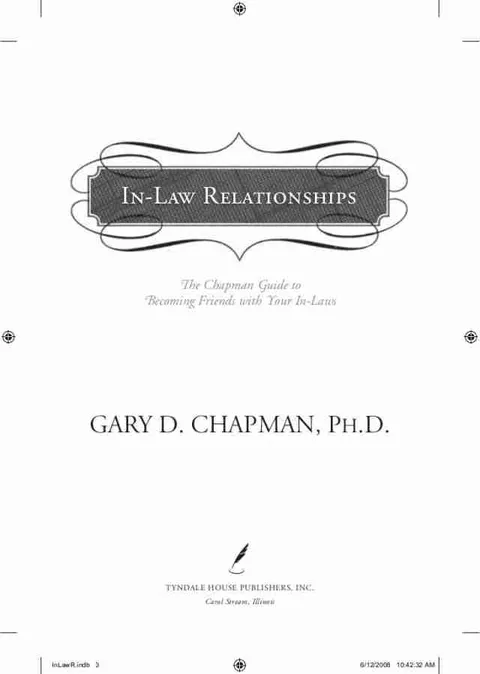
"In-Law Relationships" by Gary Chapman explores the dynamics of relationships with in-laws and provides practical advice on how to navigate the complexities of these connections. Chapman offers insights on how to build healthy, respectful relationships with in-laws and deal with common challenges that arise in these interactions. The book emphasizes the importance of communication, setting boundaries, and showing love and respect to foster positive relationships with in-laws.

Helen Roseveare

Helen Roseveare “If Christ be God and died for me, then no sacrifice can be too great for me to make for him.” That was her mission’s motto. In 1953, Helen sailed for the Congo with hopes of serve Christ as a medical missionary with WEC (Worldwide Evangelization Crusade). For so many years she’d dreamed of being a missionary. As a young girl, she’d hear stories of her aunt and uncle’s experiences on the mission field, and now she was eager to have her own stories to tell. In 1925, Helen Roseveare was born in England. Because education was a high priority for her father, Helen was sent to a prestigious all girls school when she was 12. After that, she went to Cambridge. It was during her time in college that she became a Christian, truly understanding the gospel for the first time. She left her Anglo-Catholic background and became an evangelical. Her focus was to finish her medical degree and prepare herself for the mission field. After she became a doctor, Helen sailed to minister in the Congo. She was highly intelligent and efficient, but her role as a woman created struggles with her fellow missionaries and nationals. In that time period, single missionaries were seen as second-class citizens of the mission station. In the Congo, the medical needs were overwhelming. She couldn’t just stand by and watch all the suffering around her. She was determined to make a difference. She dreamed of establishing a training center where nurses would be taught the Bible and basic medicine and then sent back to their villages to handle routine cases, teach preventive medicine, and serve as lay evangelists. She didn’t have approval from her colleagues, who believed that medical training for nationals was not a valid use of time, evangelism and discipleship were more important. Despite the conflict with them, after only two years after arriving in the Congo, she had build a combination hospital/ training center in Ibambi, and her first four students had passed their government medical exams. Her colleagues weren’t as excited about her progress as she was. They felt that she was wasting time, so they decided that she would better serve the Congo by relocating in Nebobongo, living in an old leprosy camp that had become overgrown by the jungle. Helen argued that she must stay and continue the nursing training in Ibambi, but they insisted that she move. It was a major setback, but she went. Starting from scratch again, she built another hospital there and continued training African nurses. Still, she was strong-willed and seemed to be a threat to many of her male colleagues. In 1957, they decided to relocate John Harris, a young British doctor, and his wife to Nebobongo to make him Helen’s superior. Dr. Harris even took charge of leading the Bible class that she’d taught. She was devastated. She’d been her own boss for too long, and although she tried to let go of control, she just couldn’t. Everything that had been hers was now his. This resulted in tension between them, of course. Her independence was her greatest strength, but also a definite weakness. She did not know how to submit to imperfect leadership. In 1958, after over a year of struggling with who was in control in Nebobongo, Helen left for England for a furlough. She was disillusioned with missionary work and felt like she might not ever go back to the Congo. Back in England, she really struggled with why she had all these issues between herself and the male leaders in the Congo. She began to convince herself that her problem was her singleness. What she needed was a doctor-husband to work with her and be on her side during the power struggles! She didn’t think that was too much to ask. So, she asked God for a husband, and told Him that she wouldn’t go back as a missionary until she was married. She met a young doctor and decided he would be the one. (She wasn’t very patient in waiting on the Lord’s timing.) She bought new clothes, permed her hair, and resigned from the mission, all to try and win his love. He did care for her, but not enough to marry her. Helen was heartbroken, mostly because she’d wasted so much time and money trying to force her plan into reality - without God. Still single, Helen returned to the mission and left for Congo in 1960. It was a tense time for that country. They had been seeking independence for a long time, so a huge civil war was on the verge of beginning. Many missionaries left because the risk was so high. Helen had no plans of going home. She believed that God had truly called her back to Congo and that He would protect her if she stayed. She was joined by a few other single women, who made it difficult for the men, they didn’t want to look like sissies. She was given charge of the medical base in Nebobongo because John Harris and his wife left on furlough. She had so many opportunities to minister in the midst of the turmoil. She was sure that God had her right where He wanted her to be. She continued to learn to see God in the details of her life, to trust him more fully. She had been coming closer to total trust in God all of her life, between bouts of depression, sometimes feeling that she was not really a Christian because she was capable of spells of anger and bitterness and other sins. “I was unable to reach the standard I myself had set, let alone God’s. Try as I would, I met only frustration in this longing to achieve, to be worthy.” She came to recognize that hatred of sin is a gift of the Holy Spirit. Rebels were gaining strength, and there were reports of missionaries being attacked. Helen endured a burglary and an attempted poisoning, but always in her mind the situation was improving. She felt that she had to stay, because there was so much need and so many people depending on her. On August 15, the rebels took control of Nebobongo, and Helen was in captivity for the next 5 months. On the night of October 29, Helen was overpowered by rebel soldiers in her little bungalow. She tried to escape, but they found her and dragged her to her feet, struck her over the head and shoulders, flung her to the ground, kicked her, struck her over and over again. She was pushed back into her house and raped brutally without mercy. Helen suffered more sexual brutality before her release. God used this in her life to minister to other single women missionaries who feared that they’d lost their purity due to a rape and thus their salvation. Helen knew that her relationship with God had not been damaged. She had not failed God in any way because of the rapes. Finally, on December 31, 1964 she was rescued. Helen had a sense of joy and relief, but also a sense of deep sorrow as she heard of many of her friends’ martyrdom. Helen returned to Africa for the third time in March of 1966. She served for 7 more years, but it was full of turmoil and disappointment. The Congo had changed since the war. There was a new spirit of independence and nationalism. They no longer respected the doctor who’d sacrificed so much for them. Helen left Africa in 1973 with a broken spirit. Her 20 years of service in Africa ended in defeat and discouragement. When she got home, she went through a very, very lonely period in her life. She turned to God. He was all she had. Instead of bitterness there was a new spirit of humility and a new appreciation for what Jesus had done for her on the cross. God was molding her for her next ministry. She became an internationally acclaimed spokes-woman for Christian missions. Her candid honesty was refreshing in a profession known as one of super sainthood. Helen mobilized people by showing them that God used imperfect people with real struggles to be his ambassadors to the unreached world. By Rebecca HIckman SOURCES Roseveare, Helen: Give Me This Mountain (1966) Roseveare, Helen: He Gave Us a Valley (1976) Tucker, Ruth A.: From Jerusalem to Irian Jaya

Can I Follow My New Heart

“Why shouldn’t I follow my heart? If I am a Christian — if God has caused me to be ‘born again’ and has given me ‘a new heart’ — isn’t my new heart trustworthy?” Readers have raised some version of this objection when I’ve exhorted Christians, “Don’t follow your heart.” And the objection is warranted. After all, the Bible clearly teaches that in this era of the new covenant, God writes his law on our new hearts so that we willingly follow him (Jeremiah 31:31–34; Hebrews 8:8–12). This would seem to not merely imply, but even mandate, that Christians should follow their hearts. But the Bible’s description of what a regenerated person actually experiences in this age reveals a more spiritually and psychologically complex picture — one that I believe gives Christians biblical warrant to cultivate a healthy suspicion of what they recognize as their hearts’ desires. So, while we may, and hopefully will, reach a point in our lives as Christians where it’s right, at times, to follow our hearts, allow me to make a brief case that the phrase actually undermines Christians as they labor and struggle to discern their various desires, and that Scripture itself discourages us from thinking this way. War Within How might we summarize the complex picture the Bible paints of the born-again experience in this already-not-yet age? The New Testament explains that when the Spirit brings us from spiritual death to spiritual life (John 5:24; Romans 6:13), we enter a strange new reality. Our regenerated new self emerges, “created after the likeness of God in true righteousness and holiness.” And yet our “old self, which belongs to [our] former manner of life,” is still “corrupt through deceitful desires” (Ephesians 4:22–24). We are “born of the Spirit” (John 3:6) while still inhabiting the “flesh,” our “body of death” in which “nothing good dwells” (Romans 7:18, 24). “The hearts of regenerated people are not yet fully free from the influence of their flesh.” When Christians are born again, we enter into a lifelong internal war where “the desires of the flesh are against the Spirit, and the desires of the Spirit are against the flesh, for these are opposed to each other, to keep you from doing the things you want to do” (Galatians 5:17). Stepping back and viewing these desires objectively, “the works of the flesh” that result from fleshly desires “are evident,” and so is “the fruit of the Spirit” (Galatians 5:19–23). But Christians often struggle — on the ground, in real time — to discern the desires of the Spirit from the desires of the flesh. This is why the New Testament Epistles are full of exhortations and corrections addressed to Christians. James tells his readers (and us at relevant times) that their “passions are at war within” them (James 4:1). Peter warns his readers (and us), “Do not be conformed to the passions of your former ignorance” (1 Peter 1:14). Paul describes this internal experience of warring passions as “wretched” (Romans 7:24). And he admonishes the Colossian Christians (and us) with strong language: “Put to death therefore what is earthly in you: sexual immorality, impurity, passion, evil desire, and covetousness, which is idolatry” (Colossians 3:5). Why did these apostles feel the need to speak this way to regenerated people? Because the hearts of these regenerated people were not yet fully free from the influence of their flesh, their old selves. Follow the Spirit Much of the Christian life is a war to die to remaining sin and live by the Spirit. John Piper calls it “the main battle of the Christian life”: The main battle is to see our hearts renovated, recalibrated, so that we don’t want to do those sinful external behaviors, and don’t just need willpower not to do them, but the root has been severed and we have different desires. In other words, the goal of change — of sanctification, of the Christian life — is to be so changed that we can and ought to follow our desires. That’s exactly right. And when we have been so changed through progressive sanctification, so renovated that our hearts (and therefore our desires, dispositions, motives, emotions, and passions) are, as Piper says, “calibrated to Christ,” then we should follow our hearts. However, at any given time within our churches, small groups, friendships, and families, different Christians are at different places for different reasons in this heart-renovation process. Some hearts are more sanctified, and therefore more reliable to follow, than others. I think that’s why we don’t hear the apostles generally counsel us to follow our hearts in our fight of faith against remaining sin, but rather to follow the Holy Spirit. Let Not Sin Reign Paul is the one who delves most deeply into this issue: “I say, walk by the Spirit, and you will not gratify the desires of the flesh” (Galatians 5:16). He devotes most of Romans 6–8 to explaining the nature of the strange new-self/old-self, Spirit/flesh reality of the Christian life, including Romans 8:13: “If you live according to the flesh you will die, but if by the Spirit you put to death the deeds of the body, you will live.” Paul lays the theological foundation of our understanding by explaining “that our old self was crucified with [Christ] in order that [our] body of sin might be brought to nothing, so that we would no longer be enslaved to sin” (Romans 6:6). Our new selves were “raised with Christ” (Colossians 3:1) so that “we too might walk in newness of life” (Romans 6:4). Therefore, we “must consider [ourselves] dead to sin and alive to God in Christ Jesus” (Romans 6:11). In light of this, Paul admonishes us, Let not sin therefore reign in your mortal body, to make you obey its passions. Do not present your members to sin as instruments for unrighteousness, but present yourselves to God as those who have been brought from death to life, and your members to God as instruments for righteousness. For sin will have no dominion over you, since you are not under law but under grace. (Romans 6:12–14) And how do we do this? By learning to “set [our] minds on the things of the Spirit” and not on “the things of the flesh” (Romans 8:5) — by learning to follow the Spirit, to “walk by the Spirit” (Galatians 5:16), because “all who are led by the Spirit of God are sons of God” (Romans 8:14). Follow the Treasure One of the reasons I find “follow your heart” generally unhelpful as counsel for Christians is that many of us, from the time we were young, have absorbed this as a pop-cultural creed that says if we just look deep into our hearts, we’ll be shown our deepest truth, and discover the way we should go. Given the significant amount our sinful flesh still influences our hearts, it’s not hard to see how this phrase can easily increase confusion when applying it to the Christian life. “Some hearts are more sanctified, and therefore more reliable to follow, than others.” I also don’t believe the Bible encourages that idea since, when it comes to engaging our hearts, far and away what we hear in it is counsel to “direct our hearts,” not to follow them. We see that clearly in Paul’s instructions above. God made our hearts to follow, not to lead. And what do our hearts follow? Jesus gives the clearest answer: “Where your treasure is, there your heart will be also” (Matthew 6:21). In time, our heart always pursues (follows) our treasure. When we are born again, the eyes of our hearts are enlightened (Ephesians 1:18) and, through faith, we begin to see the Treasure: God himself in Christ. And since our heart learns to pursue the object that stirs its greatest affections, its treasure, I suggest we not counsel each other to “follow your heart,” but instead to “follow the Treasure.” Looking into our hearts for direction can be spiritually hazardous. It is usually more helpful for us to direct our hearts to what is most valuable and delightful. Which is why I believe David counsels us, “Delight yourself in the Lord, and he will give you the desires of your heart” (Psalm 37:4). Article by Jon Bloom

Feedback
Suggestionsuggestion box
x