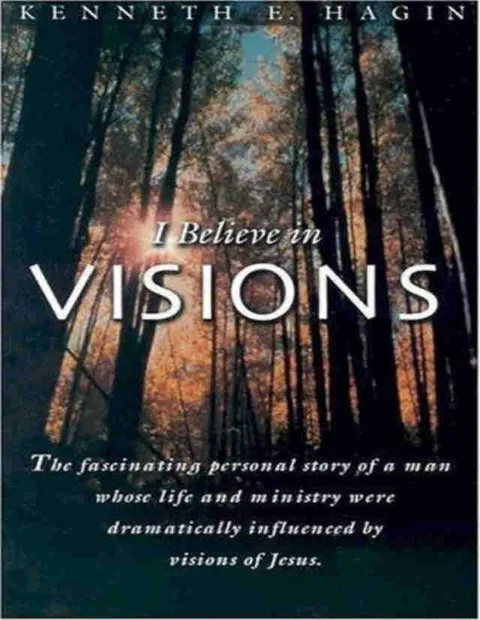






About the Book
"I Believe In Visions" by Kenneth Hagin is a book that focuses on the author's personal experiences with visions and how they have impacted his faith and ministry. Hagin also discusses the importance of listening to God and being led by the Holy Spirit in order to fulfill one's purpose and destiny. The book encourages readers to believe in the supernatural and trust in God's guidance in their own lives.
Charles Finney
Childhood and Teen years
Charles Grandison Finney was born the year after Wesley died on 29th August, 1792 in Warren, Connecticut. In 1794 his family moved to New York state, eventually settling at Henderson, near Lake Ontario. Although he received only a brief formal education he decided to study law and joined the practice of a local lawyer, Benjamin Wright. He was also very musical, played the cello and directed the choir at the local Presbyterian Church pastured by Rev. George Gale.
His conversion
His conversion on October 10th 1821 reads like something out of the book of Acts. Smitten with conviction from Bible reading he decided to âsettle the question of my soulâs salvation at once, that if it were possible, I would make my peace with God.â (Autobiography)
This conviction increased to an unbearable level over the next couple of days and came to an head when he was suddenly confronted with an âinward voice.â He was inwardly questioned about his spiritual condition and finally received revelation about the finished work of Christ and his own need to give up his sins and submit to Christâs righteousness.
As he sought God in a nearby wood he was overwhelmed with an acute sense of his own wickedness and pride but finally submitted his life to Christ. Back at work that afternoon he was filled with a profound sense of tenderness, sweetness and peace. When work was over and he bade his employer goodnight, he then experienced a mighty baptism in the Holy Spirit, which was recorded as vividly as the day he experienced it, though it was penned some fifty years later.
The next morning Finney announced to a customer that he was leaving his law studies to become a preacher of the Gospel.
Charles Finney licensed to preach
He was licensed to preach in 1823 and ordained as an evangelist in 1824. His penetrating preaching was quite different from many local ministers and included an obvious attempt to break away from the traditional and, as he saw it, dead, orthodox Calvinism. He married to Lydia Andrews in October 1824 and was also joined by Daniel Nash (1774-1831), known popularly as âFather Nash.â Undoubtedly Nashâs special ministry of prayer played a great part in Finneyâs growing success as an evangelist.
Things really took off when he preached in his old church, where Rev. Gale still ministered. Numerous converts and critics followed! Similar results were experienced in nearby towns of Rome and Utica. Soon newspapers were reporting his campaigns and he began drawing large crowds with dramatic responses.
Soon he was preaching in the largest cities of the north with phenomenal results. Campaign after campaign secured thousands of converts.
The high point of Finneyâs revival career was reached at Rochester, New York, during his 1830-1 meetings. Shopkeepers closed their businesses and the whole city seemed to centre on the revivalist. Responding to his irresistible logic and passionate arguments many of his converts were lawyers, merchants and those from a higher income and professional status.
His Preaching
Finney openly preached a modified Calvinism, influenced with his own theology of conversion and used what were perceived to be ârevivalistic techniques.â
These âmeansâ included the use of the anxious bench (a special place for those under conviction), protracted meetings, women allowed to pray in mixed meetings, publicly naming those present resisting God in meetings and the hurried admission of new converts into church membership. Opponents viewed his preaching of the law as âscare tacticsâ and his persuasive appeals for sinners to come to Christ for salvation were seen as over-emphasising the responsibility of men and ignoring the sovereignty of God.
His theology and practise soon became known as the âNew Measuresâ and attracted many opponents from the Old School Presbyterians led by Asahel Nettleton (himself no stranger to true revival and , the revivalistic Congregationalists headed by Lyman Beecher.
Pastor at Chatham Street Chapel
Finney accepted an appointment as pastor of Chatham Street Chapel in New York City in 1832 where he remained until 1837. It was during this time that he delivered a series of sermons published in 1835 as âLectures on Revivals of Religion.â Here he clearly stated his views regarding revivals being products of the correct use of human means. Such was the controversy that he left the Presbyterian denomination and joined the Congregationalists in 1836.
Oberlin College
The next year he became professor of theology at Oberlin College (Ohio) where he taught until his death. He was President here from 1851 until 1866, but still continued regular revival meetings in urban settings (twice in England, 1848, 1851) until 1860. During his stay at Oberlin he produced his, Lectures to Professing Christians (1836), Sermons on Important Subjects (1839) and his famous Memoirs.
The Father of Modern Revivalism
There is no doubt that Charles Grandison Finney well-deserves the title âThe Father of Modern Revivalism.â He was an evangelistic pioneer whose model was followed by a long line of revivalists from D. L. Moody to Billy Graham. His writing have made a massive impact on the entire evangelical world and particularly the âLectures on Revivalsâ which has, arguably, ignited more fires of revival than any other single piece literature in evangelical history.
This âPrince of Revivalistsâ passed away peacefully at Oberlin on Sunday, 16th August, 1875 aged almost 83 years.
Bibliography: I Will Pour Out My Spirit, R. E. Davies, 1997; Ed: A. Scott Moreau, Baker Evangelical Dictionary of World Missions, 2000; Dictionary of Evangelical Biography 1730-1860, Vol. 1, 1995.
Tony Cauchi
Lord, Teach Us to Work
One human life in all the Scriptures towers above the others. All who came before anticipated him, and all who follow after orient to him. And thanks to the biographical sketches found in the four Gospels of the New Testament, we know more details about Jesusâs everyday life than any other biblical figure. Moses and David, and Peter and Paul, who all both wrote much and had much written about them, are not unveiled with the same richness, depth, and detail as Christ. And for good reason. None compares to God himself dwelling among us in fully human soul and body. And no one accomplished the work that he accomplished. âThe Gospels not only show us a man who worked, but also one who didnât only work.â All four accounts are Gospels, driving toward his final week, his arrest, his trial, his death, the long pause of Holy Saturday, and then, at last, his resurrection. And so, as careful readers of the Gospels, we beware gathering up details about Jesusâs life and unhitching them from where his whole life was going. Still, we do have more to learn from the life of Christ than the events of his final week (which comprise less than half the Gospels). One theme, especially pronounced in the Gospel of John, is what we might see as the âwork ethicâ of Christ. Jesus Worked Observe, first, that Jesus did work â and consider what he meant by work rather than what we might assume. The night before he died, he prayed to his Father, as his men listened, âI glorified you on earth, having accomplished the work that you gave me to doâ (John 17:4). In a sense, his whole life had been a single work â a âlifeâs workâ we might say. He had a calling and commission. His Father gave him work to do. And this was good â a blessing, not a curse. Jesus did not begrudge this work. Instead, he experienced a kind of satisfaction in doing the work his Father had assigned him. In fact, his soul fed on accomplishing his Fatherâs work, as he testified standing by the well in Samaria. âMy food is to do the will of him who sent me and to accomplish his workâ (John 4:34). Jesus also speaks in John 9 about stewarding time in such a life. Here he sounds like Mosesâs prayer to âteach us to number our daysâ (Psalm 90:12) and Paulâs exhortation to â[make] the best use of the timeâ (Ephesians 5:15â16). âNight is coming, when no one can work,â he says, and knowing that, âwe must work the works of him who sent me while it is dayâ (John 9:4). He had an appointed season of earthly life. Eternity would come, but for now, he was on the clock. He had work to accomplish. âAs long as I am in the world, I am the light of the worldâ (John 9:5). He even âworkedâ on the Sabbath, or at least was accused of it. And he answered the charge not by saying he wasnât working, but that âMy Father is working until now, and I am workingâ (John 5:17). He Didnât Only Work The Gospels not only show us a man who worked, but also one who didnât only work. His life was more than his work. He rested and retreated, and called his weary disciples away to rest with him. When they had returned from their commission, and âtold him all that they had done and taughtâ (and teaching, done well, can be really hard work), he said to them, âCome away by yourselves to a desolate place and rest a while.â For many were coming and going, and they had no leisure even to eat. And they went away in the boat to a desolate place by themselves. (Mark 6:30â32) Jesus also slept. He may have stayed up all night to pray before choosing his twelve, and eschewed sleep to pray in the garden, but those were unusual circumstances. He slept in peace on a storm-tossed ship until his disciples frantically woke him, and as the great personal fulfillment of the Psalms, he did not despise Solomonâs wisdom in Psalm 127:2, It is in vain that you rise up early and go late to rest, eating the bread of anxious toil; for he gives to his beloved sleep. What His Work Accomplished That Jesus worked (and didnât only work) is plain enough, but what did his work mean? Much of what we have from the Gospels about his work is from his own mouth. First, he was conscious that his work bore witness to his Father. Indeed, his life-work was to glorify his Father, to make him known truly and admired duly (John 17:4, 6, 26). âEvery indication we have of Jesusâs life and ministry is that he was (and was known as) a worker, not an idler.â And Jesusâs works demonstrated that the Father had sent him. âThe works that the Father has given me to accomplish, the very works that I am doing, bear witness about me that the Father has sent meâ (John 5:36; also John 10:25, 32). Not just that he was sent as a mere man. The way he taught (with authority, Matthew 7:29; Mark 1:22, 27; Luke 4:32; John 7:17), and the miracles he performed, pointed to his being more than a prophet â to the almost unspeakable truth that this is God himself. Even though you do not believe me, believe the works, that you may know and understand that the Father is in me and I am in the Father. (John 10:38) Do you not believe that I am in the Father and the Father is in me? The words that I say to you I do not speak on my own authority, but the Father who dwells in me does his works. Believe me that I am in the Father and the Father is in me, or else believe on account of the works themselves. (John 14:10â11) His works, performed in the world with human words and hands, showed who he was, and whose he was â just as those who rejected him showed through their works who was their father (John 8:38â41). Industry Without Frenzy Every indication we have of Jesusâs life and ministry is that he was (and was known as) a worker, not an idler. Not only did he labor in obscurity as a tradesman for thirty years, supporting his family as the man of the house after the death of Joseph, but the tenor of his ministry was one of energy and industry, not laziness or lethargy. His life was not without weariness (John 4:6); nor was it without physical rest and spiritual retreat (Mark 6:31). He did not think of his work as his own but as his Fatherâs. And for the sake of the faith of the people his Father had given him, he expended the energy God gave him, day in and day out, to carry out his calling. We get the clear impression from the Gospels that he was busy. He was in great demand. His days were long. Yet we never get the sense that he was anxious or frenzied (even when a desperate father tries to whisk him away to save a dying daughter, Mark 5:22â36). His life was busy but not hurried. He knew his calling and gave himself to it. Not without sleep or leisure, but he didnât live to rest. We Work for Good For those of us who claim him as Lord, it is sobering to realize that on multiple occasions Jesus calls us âlaborersâ (Matthew 20:1, 2, 8, 14). Not only did he say the gospel âlaborer deserves his wagesâ (Luke 10:7; Matthew 10:10), but he instructed us, as his workmen, to pray for more: The harvest is plentiful, but the laborers are few; therefore pray earnestly to the Lord of the harvest to send out laborers into his harvest. (Matthew 9:37â38; Luke 10:2) Jesus calls us to work, to expend energy and effort, for the good of others. This is what makes our acts good works: that our work is good for others, not just self. âLet your light shine before others, so that they may see your good works and give glory to your Father who is in heavenâ (Matthew 5:16). We Learn Humble Limits In Christ, we work, but we quickly learn, and happily acknowledge, the limits of our labors. We learn, with Peter, that Christâs word is effective in a way that our work is not. âMaster, we toiled all night and took nothing! But at your word I will let down the netsâ (Luke 5:5). Our work in this world depends on his to be genuinely fruitful and of lasting value. In fact, in particular times and ways, our not working (as in justification by faith alone) is a way to accentuate Christâs provision and work for us (Romans 4:5). There is a time to flee, in his grace, with our own feet for freedom from Egypt, and a time to stand back âand see the salvation of the Lord, which he will work for you today. . . . The Lord will fight for you, and you have only to be silentâ (Exodus 14:13â14). Our work is fruit. His work is root. At bottom, we are like lilies of the field that âneither toil nor spin,â says Jesus, âyet I tell you, even Solomon in all his glory was not arrayed like one of theseâ (Matthew 6:28â29; Luke 12:27). âJesus had a call and gave himself to it. Not without sleep or leisure, but he didnât live to rest.â The foundation of Jesusâs work ethic as an example to us is the uniqueness of his work for us. The culmination of his work was his death and resurrection for sinners in a way we cannot imitate. There is a completed course (Luke 13:32), a unique finished work (John 19:30), an inimitable work we dare not seek to replace with our own. Christ does indeed call us to be laborers but not first and foremost. And when he does summon us into the fields, he invites us into a kind of rest: Come to me, all who labor and are heavy laden, and I will give you rest. Take my yoke upon you, and learn from me, for I am gentle and lowly in heart, and you will find rest for your souls. For my yoke is easy, and my burden is light. (Matthew 11:28â30) Donât misunderstand. He doesnât call us merely into rest. But into a kind of labor, in him, that is true rest â into a kind of rest in which we receive his yoke and burden, and yet they are easy and light. While he himself works so diligently, he is gentle toward us, and lowly in heart. So, the labor into which we enter, in his service, is humble work. We acknowledge and admit, however pioneering and enterprising our work may seem, that where it counts most, we are building on the work, and reaping the harvest, of others â first Christ himself, and also our fellows in him. âI sent you to reap that for which you did not labor,â he says to his disciples. âOthers have labored, and you have entered into their laborâ (John 4:38). In humility, we do not pretend to start kingdom work from scratch, claim it as our own, and make ourselves out to be the hero. Rather, God calls us to build upon the faithful labors of others. Our work is not a tribute to our greatness. In humility, we embrace the context into which God calls us, and do our level best to build, to take the next modest steps. How We Work Finally, what might the life and work of Christ teach us for how we are to work? First, we own that our working and Jesusâs giving (grace) are not at odds. We work because he is at work. âWhoever does what is true comes to the light, so that it may be clearly seen that his works have been carried out in Godâ (John 3:21), that is, in âthe strength that God suppliesâ (1 Peter 4:11). Our works, yet carried out in the work of God. And we can hardly say enough about what it means for us, in Christ, to have his Holy Spirit. In fact, Jesus empowers us to do âgreater works,â in some sense, than he did because he goes to his Father to send us his Spirit. âTruly, truly, I say to you, whoever believes in me will also do the works that I do; and greater works than these will he do, because I am going to the Fatherâ (John 14:12). Then, he teaches us to look to the reward, as he himself did (Hebrews 12:1â2). As the apostle Paul reminds us, in the context of âworking hard,â Jesus himself said, âIt is more blessed to give than to receiveâ (Acts 20:35). He not only said it, but lived it, and commends it. We learn to embrace the costs of hard work, looking past the friction and barriers in the moment, to the blessing to come. In His Work In Christ, we work â and we do so in his own energy. No one modeled this quite like Paul. Or spoke about it as often as Paul. There is a strength in Christ in which he calls us to work. Christ himself was the source of Paulâs own strength: âI thank him who has given me strength, Christ Jesus our Lordâ (1 Timothy 1:12). So, Paul writes to his protĂ©gĂ©, âMy child, be strengthened by the grace that is in Christ Jesusâ (2 Timothy 2:1). And to the Ephesians, âBe strong in the Lord and in the strength of his mightâ (Ephesians 6:10). And to the Philippians he testifies, âI can do all things through him who strengthens meâ (Philippians 4:13). Not just a strength in Christ but a strength of Christ. Jesus, the God-man, gives his own divine-human energy by his Spirit to empower our work. When Paul toils, as he says in Colossians 1:29, he is âstruggling with all [Christâs] energy that he powerfully works within me.â So, in Christ, and for him, and by him, we work, and do so in a strength that Christ himself provides. For justification before God, we lay down our efforts, and in the everyday Christian life, we take up the energy of the God-man himself and we walk. Because âwe are his workmanship, created in Christ Jesus for good works, which God prepared beforehand, that we should walk in themâ (Ephesians 2:10). Article by David Mathis