
GIP Library icon

LOG IN TO REVIEW
About the Book


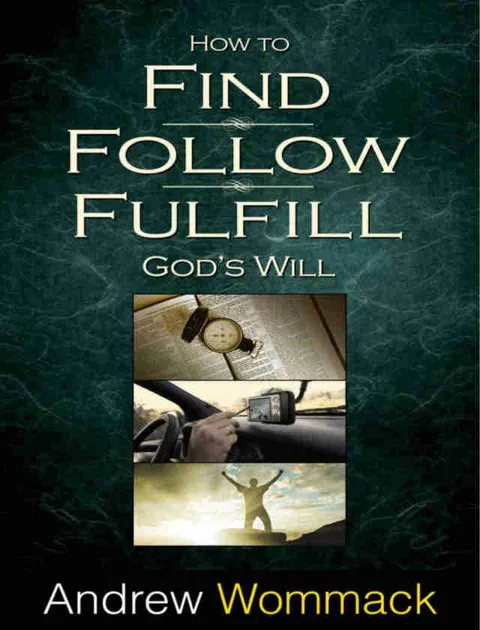
"How to Find, Follow, Fulfill God's Will" by Andrew Wommack offers practical guidance on discovering and living in alignment with God's purpose for your life. Wommack delves into biblical principles and personal anecdotes to help readers navigate challenges and make decisions that honor God's will. The book encourages readers to trust in God's plan and seek His direction in every aspect of their lives.

David Wilkerson

David Wilkerson BEGINNINGS Christian evangelist, David Ray Wilkerson was born May 19 1931 in Hammond, Indiana. He was born into a family of Pentecostal Christian preachers; both his father and paternal grandfather were ministers. David was baptized with the Holy Spirit at the age of thirteen and began to preach when he was fourteen. After high school he entered the Central Bible College (affiliated with the Assemblies of God) in Springfield, Missouri. In 1952 he was ordained as a minister. CALLED BY THE HOLY SPIRIT, MOVED WITH COMPASSION Wilkerson married his wife, Gwen in 1953 and served as a pastor in small churches in Scottdale and Philipsburg, Pennsylvania, during the early years of their marriage. But his life changed drastically in 1958 when he was brought to tears after looking at a pen drawing of seven New York City teenagers in Life Magazine. The article detailed the court trial of these young boys, charged with murder. Cross and the Switchblade The boys were members of a teenage gang called the Dragons who were accused of brutally attacking and killing Michael Farmer, a fifteen-year-old who had polio. Two days later, after hearing a clear call from the Holy Spirit telling him “Go to New York City and help those boys”, Wilkerson arrived at the courthouse in New York City. His plan was to ask the judge for permission to talk to the boys to share God’s love with them. The judge refused his request and Wilkerson was removed from the courtroom. He returned home, but his quiet country life was about to change – forever. NICKY CRUZ: “JESUS LOVES YOU, NICKY” Wilkerson returned to New York one day each week, driving over 350 miles from his home in Pennsylvania. He sought God’s direction while walking the streets, preaching, and meeting with gang members and drug addicts. David soon met Nicky Cruz, warlord of Brooklyn gang – the Mau Maus – the most violent teenage gang in New York. Nicky threatened to kill Wilkerson the first day the two met. David responded to Nicky’s threats by telling him, “God has the power to change your life.” Nicky cursed, hit Wilkerson, spit in his face, and told him, “I don’t believe in what you say and you get out of here.” Wilkerson replied, “You could cut me up into a 1000 pieces and lay them in the street. Every piece will still love you.” For two weeks Nicky couldn’t stop thinking about David Wilkerson’s words of love – “I love you, Nicky.” THE POWER OF JESUS’ LOVE In July 1958, soon after Wilkerson’s confrontation with Nicky Cruz, Wilkerson scheduled an evangelistic rally for New York gangs, at the St. Nicholas Boxing Arena. Nearly every member of Nicky’s gang, as well as their rival gangs, attended the rally. The atmosphere was tense until Wilkerson prayed and the power of the Holy Spirit fell. When he gave an altar call, Nicky and most of his gang surrendered their lives to Jesus. “David Wilkerson came with a message of hope and love,” Cruz said. “I felt the power of Jesus like a rushing wind that took my breath away. I fell on my knees and confessed Christ.” After his conversion, Nicky went to a Bible College in La Puente, CA, where he met his future wife, Gloria. After graduation he became an evangelist, returned to Brooklyn, NY, and led more of the Mau Maus to Christ. He founded Nicky Cruz Outreach and began traveling around the world ministering to hundreds of thousands each year. In a 1998 article, the Wall Street Journal proclaimed Nicky as the “Billy Graham of the streets.” A MINISTRY IS BORN: TEEN CHALLENGE Although David Wilkerson never met with the seven teenage gang members that first drew him to New York City, he founded Teen-Age Evangelism (later called Adult & Teen Challenge) from his heart cry to reach gang members with God’s love. The first Center in Brooklyn, NY, opened in 1960. Adult & Teen Challenge is a faith-based, addiction recovery program that teaches Biblical principles as part of a daily program that ministers healing to teenagers, adults, and families. It is affiliated with the Assemblies of God. Teen Challenge offers a wide range of programs: one to two-year residential recovery programs, re-entry programs to help graduates transition back into independent living, non-residential Community Groups run by seasoned leaders, and prevention programs to educate school-aged students about the destructive consequences of substance abuse. Teen Challenge students are taught to reject old identities such as, “addict”, “failure”, “hopeless”, and see themselves as new creations in Christ – changed from the inside out. Teen Challenge stands alone as the most effective substance abuse recovery program to date. The success of this ministry is attributed to its foundation in Biblical principles, prayer for conversion, and baptism with the Holy Spirit. THE PROVEN CURE FOR THE DRUG EPIDEMIC David Wilkerson’s life’s work still stands as a testament to the power of the indwelling Holy Spirit to bring miraculous healing and new life in Christ, to all. Even to drug-addicted, violent young gang members full of hate and sin. Compared to Short-Term Inpatient (STI) drug treatment programs and Narcotics/Alcoholics Anonymous, Teen Challenge graduates have higher abstinence rates, less frequent relapses, significantly higher full-time employment rates, and are much less likely to return to treatment. “Once an addict, always an addict” is not taught, nor proclaimed at Teen Challenge. Transformed graduates of the program do not need on-going, daily meetings such as Narcotics Anonymous (NA) or Alcoholics Anonymous (AA). YOU SHALL RECEIVE POWER… Wilkerson attributed Teen Challenge’s unequaled success rate to the power of the Holy Spirit. “The Holy Spirit is in charge. As long as He remains in charge, the program will thrive. The minute we try to do things by our own power we will fail.” No matter how many years addicted, again and again, the testimony of Teen Challenge students remains the same. They are introduced to the love of God when they are born again, but complete victory/deliverance from addiction doesn’t come until baptism in the Holy Spirit. One student said, “I wasn’t lonely anymore. I didn’t want any more drugs. I loved everybody. For the first time in my life, I felt clean.” Many graduates of Teen Challenge are so completely transformed they decide to go to seminary, then into ministry. Many return to Teen Challenge as staff members to help others overcome their addictions and find new life. TESTIMONIES OF TEEN CHALLENGE Harry Davis – “I discovered Teen Challenge in 1989 at age 63. I did every drug in the world for 50 years. I’m 71 now and I work in the kitchen at the Brooklyn Center.” Canzada Edmonds – “Love is what made the difference for me. When I was ready to give up, they showed me, love. They showed me compassion. They showed me through Christ I could live a victorious life. Then they taught me how to be a lady.” Steve Hill – “Its greatest impact was in the area of discipline and structure. If it wasn’t for Teen Challenge, I would either be dead or in the penitentiary.” EXPANDING GOD’S KINGDOM Wilkerson went on to found Youth Crusades (1967), CURE Corps, and World Challenge (1971) to propel the Gospel worldwide. In 1986, Wilkerson’s heart was again broken for the lost. As he walked down 42nd Street, he saw prostitutes, young children (under the age of 12) high on crack cocaine, runaways, and drug addicts. He cried and prayed, “God You’ve got to do something.” Wilkerson’s answer came quickly. In the next hour, the Holy Spirit spoke – “Well, you know the city. You’ve been here. You do it.’” Wilkerson was obedient and Times Square Church opened its doors in October 1987. For nine years, from 1999 to 2008, Wilkerson traveled around the world preaching at conferences encouraging Christian ministers and their families, to “renew their passion for Christ.” He challenged them to ask, “What would happen, Lord, if I …?” A LEGACY OF FAITH For over forty years, David Wilkerson’s evangelical ministry included preaching, teaching, and writing. He authored over 30 books including, The Cross and the Switchblade (which became a Hollywood film in 1970), Revival on Broadway, It Is Finished, Hungry for More of Jesus, Have You Felt Like Giving Up Lately?, and The Vision. Wilkerson always challenged his church to commit to obey Jesus’ teachings. He preached Christian beliefs of God’s holiness, righteousness, and love, and delivered powerful messages to encourage righteous living and total dependence on God. He would say, “holiness may seem to be an antiquated term by our standards, but not by God’s. Followers of Christ are still called to be holy, as God is holy” (1 Pet. 1:16). Wilkerson never lost his heartache over the devastating effects rampant sin wreaks on a life, home, and family. He preached many fiery sermons about sin; having seen and experienced firsthand, countless lives ravaged by the evils of violence and addiction. ABSENT FROM THE BODY, PRESENT WITH THE LORD On April 27, 2011, while driving in Texas, Wilkerson collided head-on with a tractor-trailer. He was pronounced dead at the scene. His wife Gwen was injured but survived. Wilkerson and his wife had four children (two sons who are ministers, and two daughters who are married to ministers) and eleven grandchildren. FINAL WORDS FROM NICKY CRUZ “He can take a bullet, he can be killed, but he stood because [he was] obedient to Jesus. Jesus sent him there to bring the message to the gangs. I almost killed him then because I really was totally full of hate. That was when he told me that Jesus loved me. Wilkerson never lost his heart for the world’s needy people.” “David reminded me of Jesus,” Cruz said. “Two precious things that fascinate me about Christ – He had active eyes, and always was there looking at the needs of the people. Dave had this heart of compassion just like Jesus.”

Parable of an Unhealthy Soul

How do works of obedience relate to the free, unmerited gift of God’s grace in the life of a Christian? This has been a recurring controversial and confusing issue since the earliest days of the church. If we are justified by God’s grace alone, through faith alone, in Christ’s sufficient substitutionary work alone, and not by any work of ours (Romans 3:8), then why are we warned and instructed to “strive . . . for the holiness without which no one will see the Lord” (Hebrews 12:14)? If our works don’t save us, then how can our not working (like not striving for holiness) prevent us from being saved? Before we turn to the apostle Peter for help, hear a parable of an unhealthy soul. Diligence Reveals Real Faith There was a man who was forty pounds overweight. Despite knowing it was dangerous to his health, for years he had indulged in too much of the wrong kinds of foods and neglected the right kinds of exercise. One day, his doctor told him he was in the early stages of developing type-2 diabetes. Not only that, but his vital signs also pointed to high risks of heart attack, stroke, and various cancers. If he didn’t make specific changes, his doctor warned, the man would surely die prematurely. So, the man heeded his doctor’s warnings. He made every effort to put new systems into place that encouraged healthy habits of eating and activity and discouraged his harmful old habits, preferences, and cravings. After twelve months, the man’s health was beginning to be transformed. He had lost most of his excess weight, felt better, had more energy, and no longer lived under the chronic, depressing cloud of knowing he was living in harmful self-indulgence. When his doctor next saw him, he was very pleased and said to the man, “Well done! You are no longer at heightened risk of premature death.” The man continued in his new ways and lived well into old age. Question: Was the man’s health restored through his faith in the gracious knowledge provided to him pertaining to life and healthiness, or was it restored through his diligent efforts to put this knowledge into practice? How Faith Works Do you see the problem with the question? It poses a false dichotomy. The man’s faith and his works were organically inseparable. If he didn’t have faith in what the doctor told him, he wouldn’t have heeded the doctor’s warning — there would have been no health-restoring works. If he didn’t obey the doctor’s instructions, whatever “faith” he may have claimed to have in his doctor would have been “dead faith” (James 2:26) — that faith would not have saved him from his health-destroying ways. This parable, imperfect as it is, is a picture of the biblical teaching on sanctification. In a nutshell, the New Testament teaches that the faith that justifies us is the same faith that sanctifies us. This faith is “the gift of God, not a result of works” (Ephesians 2:8–9). It’s just that this saving faith, by its nature, perseveres, and works to make us holy. We passively receive this gift of faith freely given to us by God. But faith, once received, does not leave a soul passive. It becomes the driving force behind our actions, the way we live. By its nature, faith believes the “precious and very great promises” of God (2 Peter 1:4), and the evidence that real faith is present in us manifests, over time, through the ways we act on those promises. The New Testament calls these actions “works of faith” (1 Thessalonians 1:3) or the “obedience of faith” (Romans 1:5). True works of faith don’t “nullify the grace of God” (Galatians 2:21); they are evidence that we have truly received the grace of God, and are themselves further expressions of grace. Now, let me show you one place where Scripture clearly teaches this. And as I do, imagine yourself as the unhealthy soul in my parable sitting in your doctor’s office — and your doctor is the apostle Peter. Dr. Peter has just examined your spiritual health and has some serious concerns. So, as a good physician, he gives you a firm exhortation. Escaping Through Promises [God’s] divine power has granted to us all things that pertain to life and godliness, through the knowledge of him who called us to his own glory and excellence, by which he has granted to us his precious and very great promises, so that through them you may become partakers of the divine nature, having escaped from the corruption that is in the world because of sinful desire. (2 Peter 1:3–4) Dr. Peter begins by telling you that God has granted to you all things. He agrees with his colleague, Dr. Paul, that God has granted you life, breath, and everything, including the day you were born, the places you’ll live, and how long (Acts 17:25–26). God has granted you regeneration (Ephesians 2:4–5), the measure of your faith (Romans 12:3), spiritual gifts (1 Corinthians 12:7–11), and capacity to work hard (1 Corinthians 15:10). And God has given you his “precious and very great promises so that through them” you may escape the power of sin and be transformed into his nature. Everything, from beginning to end, is God’s grace, since “a person cannot receive even one thing unless it is given him from heaven” (John 3:27). Make Every Effort For this very reason, make every effort to supplement your faith with virtue, and virtue with knowledge, and knowledge with self-control, and self-control with steadfastness, and steadfastness with godliness, and godliness with brotherly affection, and brotherly affection with love. (2 Peter 1:5–7) Notice Dr. Peter’s words: For this reason (because God has granted you everything), make every effort (act with faith in all God has promised you). In other words, prove the reality of your profession of faith, by doing whatever it takes to actively cultivate habits of grace, that nurture the character qualities necessary to live out the “obedience of faith” through doing tangible acts of good to bless others. What Negligence Reveals For if these qualities are yours and are increasing, they keep you from being ineffective or unfruitful in the knowledge of our Lord Jesus Christ. For whoever lacks these qualities is so nearsighted that he is blind, having forgotten that he was cleansed from his former sins. (2 Peter 1:8–9) “Diligence will reveal genuine faith because that is how faith works.” Dr. Peter’s prescription is clear and simple: if you cultivate these holy qualities, they will foster spiritual health and fruitfulness; if you don’t, you will experience spiritual decline and demise. Diligence will reveal genuine faith because that is how faith works: it leads to action. Negligence will reveal your lack of faith because “dead faith” doesn’t work. Now, this is a warning, not a condemnation. Peter knows well that all disciples have seasons of setbacks and failure. But he also knows, with Paul, that some disciples “profess to know God, but they deny him by their works” (Titus 1:16) — their profession of faith is not supported by the “obedience of faith.” Peter doesn’t want you to be one of those statistics, so he ends his firm exhortation to you on a hopeful note. Pursue Diligence by Faith Therefore, brothers, be all the more diligent to confirm your calling and election, for if you practice these qualities you will never fall. For in this way there will be richly provided for you an entrance into the eternal kingdom of our Lord and Savior Jesus Christ. (2 Peter 1:10–11) Just so you’re clear, Dr. Peter emphasizes the organic, inseparable relationship between God’s grace and your “works of faith.” He says, “Be diligent to confirm your calling and election.” You don’t call yourself to Christ; Christ calls you by his grace (John 15:16). You don’t elect yourself to salvation; God elects you by his grace (Ephesians 1:4–6). But you do have an essential contribution to make to your eternal spiritual health. You confirm the reality of God’s saving grace in your life through diligently obeying by faith all that Jesus commands you (Matthew 28:20) — or not. “You can confirm the reality of God’s saving grace in your life — or not.” This is Dr. Peter’s prescription for your assurance of salvation: your diligent obedience through faith, your making every effort to pursue holiness, is evidence that your faith is real and that the Holy Spirit is at work in you to make you a partaker in the divine nature. This is why Scripture commands us, “Strive for . . . the holiness without which no one will see the Lord” (Hebrews 12:14). It’s not that our striving, our “making every effort” to obey God, somehow merits us salvation. Rather, our striving is God’s gracious, ordained means — fed by his promises and supplied by his Spirit — to make us holy as he is holy (1 Peter 1:16) and to provide us “entrance into the eternal kingdom of our Lord and Savior Jesus Christ.” God’s grace is no less gracious because he chooses to grant it not only apart from our works (in justification) but also through our diligent “works of faith” (in sanctification) — especially since these works are evidence that our faith is real. Article by Jon Bloom

Feedback
Suggestionsuggestion box
x