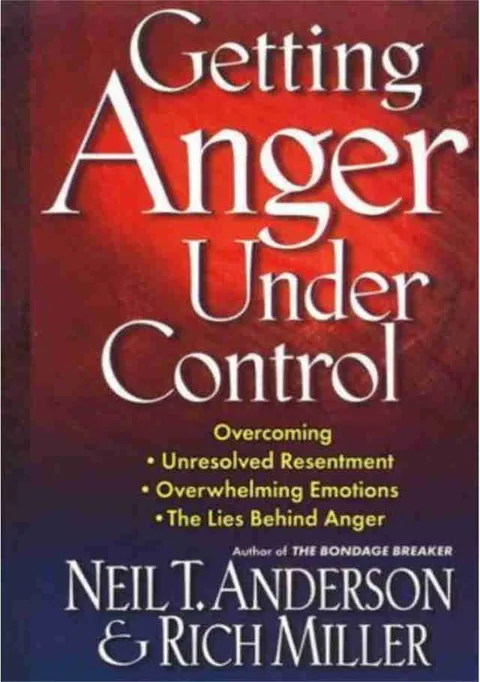

Getting Anger Under Control Order Printed Copy
- Author: Niel Anderson, Rich Miller
- Size: 1.06MB | 427 pages
- |
Others like getting anger under control Features >>

Conquering Controlling Powers
Seizing God Given Opportunities

Letting Go Of Your Past
Putting On The Mind Of Christ
Spirit, Soul, & Body

God Built - Forged By God In The Bad And Good Of Life
The Messenger Of The Cross
Introduction To Biblical Counseling
Changes That Heal
Overcoming Evil In The Last Day
About the Book
"Getting Anger Under Control" provides practical strategies and insights on managing anger in a healthy way. The authors, Neil Anderson and Rich Miller, offer biblical perspectives and psychological principles to help readers understand and control their anger effectively. This book is a valuable resource for individuals seeking to improve their emotional wellbeing and relationships by addressing issues of anger.
John Owen
John Owen’s life was incredibly difficult.
Born in 1616 and dying in 1683, Owen lived through the deaths of his first wife and all of his children, several of whom died in very early childhood. He supported his last surviving daughter when her marriage broke down. He contributed to a political revolution, watched it fail, saw the monarchy restored and wreak a terrible revenge on republicans, and lived in and around London during the persecution that followed. For twenty years he would have seen the decapitated heads of his friends on display around the city. He died fearing that the dissenting churches had largely abandoned the doctrine of the Trinity and justification by grace alone through faith alone in Christ alone; and, with Charles II about to be replaced by his openly Catholic brother James, believing that the English Reformation was almost over.
Owen was one of the most published writers in the seventeenth century.
He published around 8 million words. These writings included books on theology and spirituality, politics and economics, and ranged in length from the largest commentary ever published on the epistle to the Hebrews to a short Latin poem that has never been reprinted. For not all of Owen’s works have been kept in print. The most widely circulating nineteenth-century edition, most of which is published by the Banner of Truth, did not include Owen’s sermon manuscripts that are kept in various English libraries, nor the book for children that Owen published in 1652.
Owen was one of England’s earliest children’s authors.
The catechisms that Owen published (1645) outlined what he expected children in his congregation to know. These catechisms were published before the Westminster Assembly published its better-known examples. But Owen’s catechisms are in many ways simpler. The Primer (1652), which Owen prepared after the death of several of his children during the years of poor harvests and disease at the end of the 1640s, showed what Owen expected of an ideal Christian home. Its routine would be built around Bible reading and prayer, he believed, and his little book included sample prayers that children could learn to pray in mornings, evenings, and at meals. Owen argued that those who led church services should take account of the needs of children. Services that were too long, he believed, did no one any good. Adult believers should not need written prayers, he believed, and these should be banned from public worship. But children were different and needed all the help they could get.
Owen enjoyed many warm friendships.
His social network included many of the most famous writers in seventeenth-century England. Among his friends and rivals were John Milton, Andrew Marvell, John Bunyan, and Lucy Hutchinson. Owen fell out with Milton and became the subject of one of his sonnets. Owen helped Marvell publish one of his most controversial political pamphlets. He encouraged his publisher, Nathanial Ponder, to publish Bunyan’s Pilgrim’s Progress. And he appears to have supported Lucy Hutchinson during her move into London, when she attended and took notes upon his preaching and translated large parts of his Theologoumena Pantodapa (1661)—a translation of which has been published with the title Biblical Theology. Owen’s letters reveal his kindness and care as a pastor, especially to mothers grieving their children’s death.
Owen was deeply political.
He preached to Members of Parliament on the day after the execution of Charles I, and pinned his hopes for the reformation of church and society on their efforts to transform England into a protestant republic. During the 1650s, under the leadership of Oliver Cromwell, Owen served on important committees that sought to establish a religious foundation for the new regime. But he grew dismayed by the ways in which the Cromwell family, and the administration they led, seemed to turn away from godly values. In 1658, he worked with leading army officers to create a crisis that, he likely hoped, would call the regime back to its earlier ideals. It failed, and instead created the crisis that was resolved by the restoration of the monarchy, the return of Charles II, and the persecution of dissenters that followed. During the Restoration, Owen kept his head down, and, as persecution slackened in the later 1660s, published pamphlets that argued that dissenters were the economic lifeblood of the English nation. But he was chastened by his attempts at political intervention and came increasingly to realize that his focus should be on things eternal.
Owen often changed his mind.
As his developing attitudes to political intervention suggest, Owen committed himself to some beliefs and behaviors that he came to regret. In his early years, he changed his churchmanship from Presbyterianism to Congregationalism. He innovated as a Congregationalist, installing as a co-elder and preacher a man who would not be ordained for several years. He argued for the weekly celebration of the Lord’s Supper, though it is not clear that he ever persuaded any of his congregations to practice it. He thought carefully about the end times and came to believe that, in the latter days, a large number of Jewish people would be converted to Christianity and would return to live in the Promised Land. He dismissed a great deal of discussion about the millennium, but became convinced that the binding of Satan had yet to be achieved. Owen changed his mind because he kept on studying the Bible.
Owen was biblical, through and through, and depended just as much on the Holy Spirit.
He certainly believed in a learned ministry–after all, he had taught theology at Oxford and done his best to promote godliness within the student body. But he also trusted the Holy Spirit to guide ordinary Christians in small group Bible studies that did not need to be policed by a formally trained expert. Aside from his own Bible study, which advanced on the serious scholarship represented by the three thousand titles that were included in the catalog of his library published soon after his death, Owen encouraged church members to meet together to study Scripture in private.
Owen trusted the Bible and the work of the Spirit after writing about both.
Owen was not a philosophically-driven, rationalist theologian. His writing abounds in biblical citations. It is molded and contoured by biblical revelation. But he warned that Christians could approach their study of the Bible with absolutely no spiritual advantage to themselves. Christians who approached the study of the Bible without absolute dependence upon the Spirit who inspired and preserved it would gain no more benefit than Jewish readers did from their Scriptures, he argued. Christians should never choose between entire dependence upon the Bible and the Spirit.
Owen believed that the goal of the Christian life was knowing God.
Before Owen, no one had ever shown clearly how Christians relate to each person of the Trinity. Owen described the goal of the gospel as revealing the love of the Father, who sent the Son as a redeemer of his people, who would be indwelt, provided with gifts, and united together by the Spirit. Owen’s Communion with God is among his most celebrated achievements—and no wonder. It is the exhalation of his devotion to Father, Son, and Spirit, and the discovery of the limitless love of God.
Owen is much easier to read than many people imagine.
There is a mystique to Owen—a widespread feeling that his books are too difficult and best left to expert theologians. But Owen’s greatest books were written as sermons for an audience of teenagers. Publishers have begun to modernize Owen’s language in new editions of his works. Now more than ever, it’s time to pick up Owen and find his encouragement for the Christian life.
triune decision-making - how god guides tough choices
When we face a big decision, sometimes the decision-making process can feel more like a game show than a guided path. We can easily slip into the thinking that God is hosting “Let’s Make a Deal,” where we have to choose one of a slew of suitcases, hoping we pick the right one. When we face multiple doors and potential pathways, the freedom to choose can feel like crippling anxiety and pressure. Thankfully, our God does not play games with us, nor does he leave us to our own devices when making decisions. Contrary to popular belief, decisions are not puzzles to solve, but privileges to steward with the guidance of our triune God. Triune Guidance God offers triune guidance to his children as we face the decisions of life, from the minute to the monumental. Rather than stand far off from us, watching as we make decisions in consternation, he comes near to us, offering to guide us gently through a process that ultimately leads to more of himself. “Contrary to popular belief, decisions are not puzzles to solve, but privileges to steward.” As the Father who stands outside of time, God knows all that will happen and assures us that none of his plans will be thwarted (Isaiah 14:27; Job 42:2). He providentially steers all of creation, even the decisions of humans made in his image, working all things according to his everlasting and good purposes (Ephesians 1:11; Romans 8:28). He knows the number of hairs on our heads, the length of our days, and the tears we shed as we wrestle to make decisions (Luke 12:7; Psalm 139:16; Psalm 56:8). As the Son who stepped into time, Jesus is the pioneer and perfecter of our faith (Hebrews 12:1–3). He knows what it feels like to live within the limits of time and space, as he made decisions daily during his time on earth. While the first Adam led the way into disastrous, self-centered decision-making, as the second Adam, Christ always made decisions in light of the goodness of his Father (Romans 6:17–21). His perfect decisions cleared the path so that we can make our present decisions in the presence of the triune God. As the Spirit who makes his home within us, the Holy Spirit guides us into all truth, convicting us of our selfish propensities and pointing us to God’s promises as we make decisions (John 16:12–15). He offers us comfort and peace when we feel dizzied by the sheer amount of decisions we make daily. Triune Perspective In addition to these timeless truths that anchor our souls in the sea of decisions, a Trinitarian perspective can also serve as a practical help in the process. When we face decisions large or small, we are limited by our own perspective as embodied creatures. We simply cannot see or imagine all the possible angles, try as we may. God does not live within these limitations. As John Frame wisely notes, God “sees all things from every possible perspective” ( Theology in Three Dimensions , 4–5). While the Trinity is a unity (meaning all of God does all that God does), Frame’s triperspectivalism creates a framework that helps us approach complex truths from three different angles or perspectives within the Trinity. The normative, the situational, and the existential perspectives (which correlate to Father, Son, and Holy Spirit) can serve as different entry points for considering decisions. The normative  perspective relates to God’s authority. God acts as our loving authority, providing principles and revealing truths by which we can understand the normative human experience. As Creator and Father, God sets the standards by which his creatures operate best in his world. When we approach a decision from the normative perspective, we ask, “What does God’s word say about the decision set before me?” The situational  perspective relates to God’s control. Through his eternal Word, God perfectly controls and orders the movement of every proton and every person. If God is in complete control over all things (which he is), then we can trust that he has perfectly ordered our present circumstances with their opportunities, challenges, and limitations. When we approach a decision from the situational perspective, we assess the realities and circumstances in which we find ourselves. The existential  perspective relates to God’s presence. The triune God has always sought to be close to his people, and by the Holy Spirit, he now lives within every believer. He is closer than even the air we breathe. The Spirit searches and permeates the deep waters of human hearts and personalities (1 Corinthians 2:10–13; Proverbs 20:5). When we approach a decision from the existential perspective, then, we are asking more internal questions about personal desires and feelings. Three Perspectives in Action If we can get past the length of the word triperspectivalism , we will begin to see the depth of practical wisdom we can glean from this approach to decisions. For example, when a couple is praying through a potential marriage, walking through the decision from the normative, the situational, and the existential can provide helpful insight. In Scripture, God is clear that marriage is between a man and a woman and that believers are to be equally yoked spiritually ( normative ). If the couple’s friends and family are not opposed to the union, and present circumstances seem to allow it ( situational ), the couple is then free to consider whether they desire to commit to each other in the covenant of marriage ( existential ). Let’s consider a different example. A young couple is eager to grow their family and has prayed and processed through adoption. They know that physical adoption is one of the most powerful pictures of the spiritual adoption we have received through Christ into the household of God (normative). They have been going through the prerequisite steps of training, they have conducted a home study, and they have even begun to check out agencies. There are countless options in their county, all of which they are able to pursue (situational); however, they both feel especially pulled toward the foster-care system, even though they know it will likely present unique challenges (existential). While God is pleased with all forms of adoption, they plan to forgo international and private adoption after much praying and processing within their local church. “God promises to use the decision-making process as a means to make us more like him and to give us more of him.” Finally, let’s look at a more ordinary, everyday decision through these three perspectives. A child has been invited to play in a sports tournament on a Sunday. The family has already prioritized worship in the local church (normative). The child knows that he will miss the first game because attendance at worship is a high point of the family’s weekly rhythms; however, he really wants to play in the afternoon game (existential). The parent of another player offers a ride to the second game that does not interfere with the rest of the plans for the day (situational). The parents are left to discuss what the child thinks is the best way to serve as a team member (existential). Guided Process to More of God When we are facing a significant decision, it is natural to be overwhelmed at the various paths set before us. But no matter which of the potential pathways you choose, remember that Jesus has opened up the most significant pathway for us already: he has opened up the path to fellowship with God through his own body (John 14:6). He has not left us alone to see how we fare in our decisions, as if he were a game show host. Rather, he takes us by the hand and leads us toward glory (Psalm 73:23–24). And along the way, he promises to use the decision-making process as a means to make us more like him and to give us more of him, who is our great reward (Genesis 15:1).