





About the Book
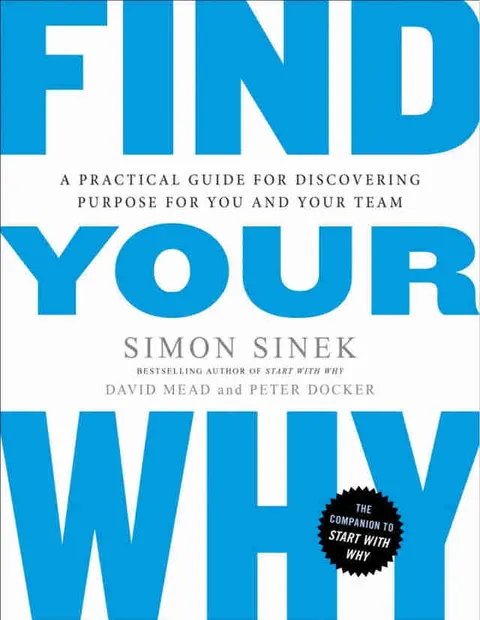
"Find Your Why" by Simon Sinek is a step-by-step guide to discovering your purpose and finding fulfillment in your personal and professional life. The book outlines a process for identifying your unique set of values, strengths, and passions, and using them to clarify your mission and create a meaningful life. Sinek emphasizes the importance of understanding and aligning with your "why" in order to live with authenticity and passion.
William Carey
"Expect great things; attempt great things."
At a meeting of Baptist leaders in the late 1700s, a newly ordained minister stood to argue for the value of overseas missions. He was abruptly interrupted by an older minister who said, "Young man, sit down! You are an enthusiast. When God pleases to convert the heathen, he'll do it without consulting you or me."
That such an attitude is inconceivable today is largely due to the subsequent efforts of that young man, William Carey.
Plodder Carey was raised in the obscure, rural village of Paulerpury, in the middle of England. He apprenticed in a local cobbler's shop, where the nominal Anglican was converted. He enthusiastically took up the faith, and though little educated, the young convert borrowed a Greek grammar and proceeded to teach himself New Testament Greek.
When his master died, he took up shoemaking in nearby Hackleton, where he met and married Dorothy Plackett, who soon gave birth to a daughter. But the apprentice cobbler's life was hard—the child died at age 2—and his pay was insufficient. Carey's family sunk into poverty and stayed there even after he took over the business.
"I can plod," he wrote later, "I can persevere to any definite pursuit." All the while, he continued his language studies, adding Hebrew and Latin, and became a preacher with the Particular Baptists. He also continued pursuing his lifelong interest in international affairs, especially the religious life of other cultures.
Carey was impressed with early Moravian missionaries and was increasingly dismayed at his fellow Protestants' lack of missions interest. In response, he penned An Enquiry into the Obligations of Christians to Use Means for the Conversion of the Heathens. He argued that Jesus' Great Commission applied to all Christians of all times, and he castigated fellow believers of his day for ignoring it: "Multitudes sit at ease and give themselves no concern about the far greater part of their fellow sinners, who to this day, are lost in ignorance and idolatry."
Carey didn't stop there: in 1792 he organized a missionary society, and at its inaugural meeting preached a sermon with the call, "Expect great things from God; attempt great things for God!" Within a year, Carey, John Thomas (a former surgeon), and Carey's family (which now included three boys, and another child on the way) were on a ship headed for India.
Stranger in a strange land
Thomas and Carey had grossly underestimated what it would cost to live in India, and Carey's early years there were miserable. When Thomas deserted the enterprise, Carey was forced to move his family repeatedly as he sought employment that could sustain them. Illness racked the family, and loneliness and regret set it: "I am in a strange land," he wrote, "no Christian friend, a large family, and nothing to supply their wants." But he also retained hope: "Well, I have God, and his word is sure."
He learned Bengali with the help of a pundit, and in a few weeks began translating the Bible into Bengali and preaching to small gatherings.
When Carey himself contracted malaria, and then his 5-year-old Peter died of dysentery, it became too much for his wife, Dorothy, whose mental health deteriorated rapidly. She suffered delusions, accusing Carey of adultery and threatening him with a knife. She eventually had to be confined to a room and physically restrained.
"This is indeed the valley of the shadow of death to me," Carey wrote, though characteristically added, "But I rejoice that I am here notwithstanding; and God is here."
Gift of tongues
In October 1799, things finally turned. He was invited to locate in a Danish settlement in Serampore, near Calcutta. He was now under the protection of the Danes, who permitted him to preach legally (in the British-controlled areas of India, all of Carey's missionary work had been illegal).
Carey was joined by William Ward, a printer, and Joshua and Hanna Marshman, teachers. Mission finances increased considerably as Ward began securing government printing contracts, the Marshmans opened schools for children, and Carey began teaching at Fort William College in Calcutta.
In December 1800, after seven years of missionary labor, Carey baptized his first convert, Krishna Pal, and two months later, he published his first Bengali New Testament. With this and subsequent editions, Carey and his colleagues laid the foundation for the study of modern Bengali, which up to this time had been an "unsettled dialect."
Carey continued to expect great things; over the next 28 years, he and his pundits translated the entire Bible into India's major languages: Bengali, Oriya, Marathi, Hindi, Assamese, and Sanskrit and parts of 209 other languages and dialects.
He also sought social reform in India, including the abolition of infanticide, widow burning (sati), and assisted suicide. He and the Marshmans founded Serampore College in 1818, a divinity school for Indians, which today offers theological and liberal arts education for some 2,500 students.
By the time Carey died, he had spent 41 years in India without a furlough. His mission could count only some 700 converts in a nation of millions, but he had laid an impressive foundation of Bible translations, education, and social reform.
His greatest legacy was in the worldwide missionary movement of the nineteenth century that he inspired. Missionaries like Adoniram Judson, Hudson Taylor, and David Livingstone, among thousands of others, were impressed not only by Carey's example, but by his words "Expect great things; attempt great things." The history of nineteenth-century Protestant missions is in many ways an extended commentary on the phrase.
my wedding was supposed to be today
I made a life plan when I was ten years old (yeah, I know, crazy). It included all the normal things: graduate high school, go to college, travel the world. With regard to romance, though, I always assumed I would get married at 23, because “Why not?” and “Surely I’ll have met somebody by then.” So, in my late teens, I arbitrarily picked a date (today, April 22, 2017) as my likely wedding day because (a) it’s a few months before my 24th birthday and (b) I’ve always wanted a spring wedding. I added details about kids and jobs and travel along the way, but my plan has remained mostly unchanged. Pretty straightforward, right? Except the God I serve isn’t always a straightforward God. He is straightforward in what he wants from me: to act justly, love kindness, and to walk humbly with him (Micah 6:8), and to set nothing above him in my heart, mind, or soul (Deuteronomy 6:5). But what about beyond that? What about my wedding day? “I have had to learn to battle the temptations that creep into unwanted waiting and unwanted singleness.” Much to the woe of my control-desiring heart, he leaves much of it a surprise and mystery. To those who do not know him or trust him, the way he makes us wait may seem like stinginess or even evil. But in truth, he wants something better for us: for our trust and joy in him to flourish. As a planner, I must learn to live day-by-day by faith, not by sight, knowing that whatever he gives me is truly, deeply good for me (Romans 8:28). No matter how much his plans diverge from mine, no matter how much heartbreak those plans bring, no matter how far out of my comfort zone he pushes or pulls me, he is not only ultimately good, but his plans for me are also always better. Three Ways to Wait So, here on my “wedding day,” I’ve been single for several years now, including all of my five years as a Christian. I wasn’t asked out on a single date during college (and haven’t been since), so I have had to learn to battle the temptations that creep into unwanted waiting and unwanted singleness. Here are three lessons I have picked up in the fight. 1. Trust God to give you every good gift at the perfect time. While we wait, we will be tempted to doubt God’s love and ability. We are talking about the Lord who has built and leveled the nations throughout generations. He is the Lord who flooded the whole earth and held back the Red Sea long enough for his people to walk through on dry ground. Surely this great Lord of history can handle a small thing like the date of my wedding. And that’s what a wedding is: one day of millions of days. Not to say it isn’t important, but it also isn’t anywhere near ultimate. “My purity is not for me. My wedding is not for me. Marriage will not be for me. It is all for God.” Marriage is a gift. A gift isn’t earned or bargained for, and neither is a spouse. Pursuing maturity in Christ should be a consistent theme in any believer’s life, but never as currency to spend on something else. We pursue Christ not to “earn” a spouse, but in order to know Christ (Philippians 3:10). The gift isn’t given because the gift-receiver is fit enough, or tall enough, or smart enough. It is freely given because the gift-Giver is good. You cannot “earn” your way or “behave” your way to a spouse. God must give him or her to you in his own way, and at his time. 2. Make God the treasure and anchor of your life. While we wait, we will be tempted to envy others. There are many people getting married today that are not following the Lord and have (sometimes flagrantly) disobeyed him in the process. Regardless, if Jesus is our greatest treasure, we do not obey in order to gain a husband or a wife, and we do not groan under the perceived unfairness of unrepentant people getting married. My purity is not for me. My wedding is not for me. Marriage (if it happens for me) will not be for me. All these things are for the Lord and for his glory, not for me so that my life turns out “fairly.” Instead of praying for fairness in this life, we pray with Jesus, “Not my will, but yours, be done” (Luke 22:42). I pray that all couples getting married today would know my Lord and Savior, but many won’t. They will not have my anchor and firm foundation when life and marriage are hard (and they will be). What is there to envy? If single people lived so assured of God’s love that we were secure and satisfied in the absence of a spouse, perhaps the Lord would use us to witness to married men and women whose marriages have disappointed them or fallen apart. 3. Refuse to settle for someone who does not love Jesus. While we wait, we will be tempted to settle. We should not draw comfort from the assurance that God has someone for each of us to marry. He may not. Even if he doesn’t, or even if that person comes into our lives ten years late (by our schedule), that does not give us the right to rebel, disobey, or run away. None of us is entitled to marriage. I am not entitled to marriage. “Our romantic lives should look strange to the world, and so should our joy in singleness.” Our only constraint in seeking a spouse is to marry someone within the body of believers (2 Corinthians 6:14). It’s a simple guideline, and yet so easy to compromise. But if we’re to have marriages that glorify the eternal God at all, we cannot fall into the trap of setting aside faith, and basing our crushes and choices on temporal qualities like physical appearance or material wealth. I say “trap” because that’s what a spouse not centered on Christ will undoubtedly become. Recall what happened to Solomon, touted the wisest man in history: For when Solomon was old his wives turned away his heart after other gods, and his heart was not wholly true to the Lord his God, as was the heart of David his father. For Solomon went after Ashtoreth the goddess of the Sidonians, and after Milcom the abomination of the Ammonites. So Solomon did what was evil in the sight of the Lord and did not wholly follow the Lord, as David his father had done. (1 Kings 11:4–6) Heartbreakingly, this lust-following idol-worshiper is the same man who, in his youth, “loved the Lord, walking in the statutes of David his father” (1 Kings 3:3). The difference a few decades and poor choices in romance can make, right? A man to whom God gave wisdom, and whose future in loving and serving the Lord started out as promising as his father David’s, ends up unabashedly worshiping abominations — gods that cannot see or hear, let alone give wisdom or deserve worship. Many of those wives were probably pretty physically attractive (he was a king, after all), but they helped turn his heart into something ugly and steer his path away from the Lord. Rather than chafe at our only restriction in romance, followers of Christ should rejoice in the blessing of not being enslaved in the search for financial security or good looks or athletic ability. Our romantic lives should look strange to the world, and so should our joy in singleness. The Spirit empowers us to be countercultural lights pointing forward to our one true Bridegroom and our one true wedding day (Revelation 19:7).