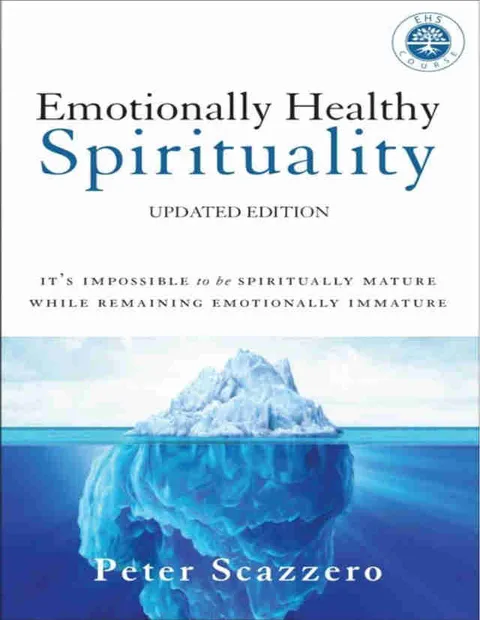

Emotionally Healthy Spirituality Order Printed Copy
- Author: Peter Scazzero
- Size: 1.58MB | 190 pages
- |
Others like emotionally healthy spirituality Features >>
Saints At War: Spiritual Warfare
The Holy Spirit And His Gifts
The Emotionally Healthy Leader
-160.webp)
The Spiritual Man
The Art Of War For Spiritual Battle
.epub-160.webp)
Falling Upward: A Spirituality For The Two Halves Of Life
Dressed To Kill (Spiritual Warfare And Armour)
.epub-160.webp)
The Price Of Spiritual Power

7 Things The Holy Spirit Will Do For You
-160.webp)
Uprooting The Spirit Of Fear
About the Book
"Emotionally Healthy Spirituality" by Peter Scazzero explores the connection between emotional health and spiritual growth, arguing that true spiritual maturity requires emotional maturity. Scazzero introduces practical tools and principles for developing a holistic approach to spiritual growth that includes emotional self-awareness, healthy relational boundaries, and authenticity in one's relationship with God and others. Through personal anecdotes and biblical wisdom, the book encourages readers to prioritize emotional health as a vital component of their spiritual journey.
Fanny Crosby

Your Body Will Be Whole
During my surgical training, I helped care for an aging professor who bemoaned his declining health. His mind still moved in academic circles, pondering the high points of chemistry and physics, but arthritis had so fused the bones in his neck that he couldn’t nestle into a pillow anymore. Cancer riddled his chest, and squandered nutrients, until his frame wasted to skeletal proportions. The simple routine of enjoying a meal pitched him into coughing, and pneumonia festered from the secretions that pooled in his lungs. One day, after one of many bronchoscopies to clear his airways and ward off a ventilator, he motioned to me and mumbled something. I drew closer, listening for his raspy voice above the hiss of the oxygen mask. “Don’t get old,” he said. Wages of Sin While our medical conditions and paths in life vary, all of us will join this professor in his grief at some point, if our Lord tarries, as we endure the failure of our earthly bodies. “The consequences of sin penetrate even to our vessels and bones.” It’s easy to dismiss this truth when we’re healthy and can so easily enjoy the fruits of God’s exquisite design. When we savor the rush of air through our lungs as we run, or the vigor of our limbs as we dance, the precision and fluidity of God’s creation moves us to thanksgiving. We join with the psalmist in his praise: “You formed my inward parts; you knitted me together in my mother’s womb. I praise you, for I am fearfully and wonderfully made” (Psalm 139:13–14). And yet, our vitality has a time limit. When we neglect the truth that the body is a temple for the Holy Spirit, we prime ourselves for disease (1 Corinthians 6:19–20). The cigarettes we smoke blacken our lungs; our overindulgences at the dinner table coat our arteries in cholesterol; our extra glasses of alcohol inflame and destroy the liver. Even when we aim to steward our bodies well, our health eventually fails, because “the wages of sin is death” (Romans 6:23). The consequences of sin penetrate even to our vessels and bones, unraveling the physiological systems that God has meticulously interwoven. As we age, our immune system deteriorates, and we succumb to infections. Calcium hardens our arteries, driving our blood pressure dangerously high. Our bones thin, our spine weakens, and we stoop toward the dust from which we came. Even our face reveals the march of time, as the production of elastin in our skin dwindles and creases deepen around our eyes. This inching toward death, with our bodies slowly falling apart as the years march by, awaits us all. As Paul reminds us, “Sin came into the world through one man, and death through sin, and so death spread to all men because all sinned” (Romans 5:12). The brokenness that afflicts the world also afflicts our earthly bodies, ushering us from the bloom of youth into pain, fragility, and ultimately the grave. For many of us, humiliation and pain, frustration and grief accompany us on our decline. Redemption of the Body Yet we have hope. As we toil in the shadow of the cross, despising our tally of diagnoses and wrangling with ever-mounting aches and pains, we cling to the promise that when Christ returns, “he will wipe away every tear from [our] eyes, and death shall be no more, neither shall there be mourning, nor crying, nor pain anymore, for the former things have passed away” (Revelation 21:4). We confess our belief in the “resurrection of the body” through the Apostles’ Creed, because the New Testament teaches that the transformation already begun in us through the Holy Spirit will come to completion in the new heavens and the new earth. “We know that the whole creation has been groaning together in the pains of childbirth until now,” Paul writes. “And not only the creation, but we ourselves, who have the firstfruits of the Spirit, groan inwardly as we wait eagerly for adoption as sons, the redemption of our bodies” (Romans 8:22–23). In saving us from all our sins, Christ has also saved us from their wages, including the heavy toll upon our bodies. Christianity, then, doesn’t promise that our souls will float in heaven, wrenched from their corporeal vessels. Instead, when we pine for Christ’s return, we anticipate a complete renewal: a softening of the heart, a sanctification of the mind, and even a renewal of the bodies that in their present form so easily wither and break. And all so we might know God and enjoy him forever, for his glory. Spiritual Body While still tethered to the aches and groans of this mortal coil, it’s hard to envision a body unsullied by sin. “What will it look like?” we may wonder. “How will it be different?” When the church at Corinth raised such questions, they drove Paul to exasperation. Corinth was a metropolis steeped in pagan influences, including a Greek philosophy that viewed the body as debased and corrupt, and the spirit as sublime. This thinking proved a stumbling block to some early Christians in Corinth, who struggled to accept the truth of the resurrection. How, they wondered, could the Son of God rise in the flesh, when the body was material and depraved? Paul balked at such questions, and highlighted that the Corinthians’ thinking reflected the limitations of human experience rather than the wisdom of God: Someone will ask, “How are the dead raised? With what kind of body do they come?” You foolish person! What you sow does not come to life unless it dies. And what you sow is not the body that is to be, but a bare kernel, perhaps of wheat or of some other grain. But God gives it a body as he has chosen, and to each kind of seed its own body. . . . So is it with the resurrection of the dead. What is sown is perishable; what is raised is imperishable. It is sown in dishonor; it is raised in glory. It is sown in weakness; it is raised in power. It is sown a natural body; it is raised a spiritual body. (1 Corinthians 15:35–38, 42–44) “The body will transform from something perishable and weak to something imperishable and powerful.” In this rebuttal, Paul argues that our resurrected, spiritual body will be something totally new, dramatically different from the body we leave in the grave. Just as a plant bursts forth from its seed, so also the resurrection body will arise from the earthly body that is sown, but a radical change will occur. Through the resurrection, the body will transform from something that is perishable, dishonorable, and weak — like a dormant seed — to something wholly new: imperishable, glorious, and powerful. In short, the resurrection will transform us into the image of Christ. A Body Like His Through Christ, God has adopted us as his own children, and shares with us the inheritance of his Son, including a body made new. Paul writes, Our citizenship is in heaven, and from it we await a Savior, the Lord Jesus Christ, who will transform our lowly body to be like his glorious body, by the power that enables him even to subject all things to himself. (Philippians 3:20–21) So also, John writes, See what kind of love the Father has given to us, that we should be called children of God; and so we are. . . . Beloved, we are God’s children now, and what we will be has not yet appeared; but we know that when he appears we shall be like him, because we shall see him as he is. (1 John 3:1–2) While we may struggle to wrap our minds around the resurrection promise, when we look to Christ — risen, glorified, joined with the Father in love for eternity — we see a glimpse of the future that awaits us when he returns and we come before his throne. Paul calls Jesus the “firstfruits” because his resurrection serves as a preamble for the path we will follow (1 Corinthians 15:20). “As in Adam all die, so also in Christ shall all be made alive” (1 Corinthians 15:22). While we cannot wholly understand how our redeemed bodies will look, or how they will feel, we have tremendous hope in the promise that, whatever the details, they will resemble Christ. Our bodies will be like his: clean, new, glorious, powerful, imperishable. Bodies Made New This promise offers a balm for the weary soul. As our earthly bodies bend and break, as our strength wanes and our groans lengthen, we cling to the hope that a day is coming when all the aches will fade away. Jesus has saved us from wrath, both body and soul. He has triumphed even over death (1 Corinthians 15:55). And through the Father’s great mercy, we share in his victory. Our sufferings within these mortal coils may drive us to our knees. But when Christ returns, and we kneel before his throne, by his grace we will “[put] on the imperishable” (1 Corinthians 15:54), raise rejuvenated voices, and praise him with bodies made new. Article by Kathryn Butler