-480.webp)

Die Empty: Unleash Your Best Work Every Day Order Printed Copy
- Author: Todd Henry
- Size: 1.3MB | 176 pages
- |
Others like die empty: unleash your best work every day Features >>





About the Book
"Die Empty" by Todd Henry is a motivational book that encourages readers to bring their best work to the world every day by harnessing their creativity, focusing on their priorities, and taking risks. The book emphasizes the importance of not holding back, but instead unleashing one's potential to live a fulfilling and impactful life. Henry challenges readers to develop a sense of urgency and purpose in their work to avoid leaving their best contributions unrealized.
Aimee Semple McPherson
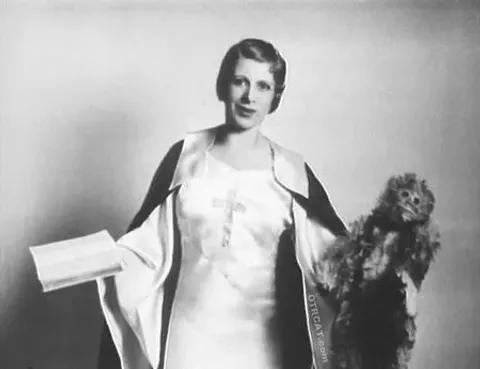 Aimee Semple McPherson was born on Oct. 9, 1890, on a farm in Salford Ontario, Canada. Her father, James Kennedy, was a farmer and came from a Methodist background. Her mother, Mildred, known as “Millie,” came from a Salvation Army background.
Although she was raised in a Christian home, she began to question the Bible during her teen years.
When she was 17, she attended a revival Pentecostal meeting presented by evangelist Robert Semple, where she heard the message of repentance. He also spoke of baptism in the Holy Spirit, an experience for which she hungered. After receiving the infilling of the Holy Spirit, she also was filled with a great love and compassion for souls and a fervent passion to serve the Lord throughout her whole life.
The meeting Aimee attended changed her life not only spiritually but also romantically. The evangelist Robert Semple later become Aimee’s husband. They were married when she was 18. Their ministry desires were compatible. After their ministry trips in Chicago and the Ingersoll area, they headed to China as missionaries.
In 1910 while in China, Robert and Aimee contracted Malaria within months of arriving in Hong Kong. Robert didn’t survive, leaving Aimee pregnant and a widow at 19. When her daughter, Roberta Star, was a month old, Aimee returned to United States to raise her. Aimee and Roberta lived in New York with Aimee’s mother.
She assisted her mother raising money for the Salvation Army. It was there she met and married a Christian businessman named Harold McPherson. They had a son, Rolf Kennedy McPherson. After a decline in health, two major surgeries and a near-death experience, God asked her one last time, “Now, will you go?” She answered yes to God’s call and almost immediately was healed. She never again questioned the call to preach the gospel.
Aimee is known for founding the Foursquare Gospel Church in 1918. She also was a woman ahead of her time, possessing boldness in her speaking ability and creative ways to communicate the gospel.
The name Foursquare Gospel originated from the Book of Ezekiel. It represents the four phases of the gospel of Jesus Christ. In the face of the Man, she saw Jesus our Saviour. In the face of the lion, she saw Jesus the mighty Baptiser with the Holy Spirit and fire. In the face of the ox, she saw Jesus the Great Burden Bearer. In the face of an eagle, she saw Jesus the coming King, who will return in power and glory. It was, in Aimee’s opinion, “a perfect gospel. A complete gospel for body, for spirit and for eternity.”
Her ministry was dynamic. She witnessed thousands saved and healed during her evangelistic meetings. Being creative and theatrical, Aimee used drama, music and opera to appeal to the audience. Bands, choirs and other crowd-pleasing touches enhanced her dynamic preaching. Though she was well-versed in the Bible, Aimee’s success wasn’t based on her knowledge, but rather the delivery of her messages.
She also was known as a faith healer, with claims of physical healing occurring during her meetings. Her faith healing demonstrations were written about extensively in the media, as they were a large focus of her early ministry. Aimee was an evangelistic pioneer, determined to spread the message of the Pentecostal faith, and used her fervour and flamboyance to win a huge following.
She had achieved what no one had yet done in ministry, which was to build a 5,000-seat auditorium in an influential area of Los Angeles. This paved the way for other female evangelists during a time when women were not accepted in the pulpit. She also launched the first Christian radio station and established a Bible college. By 1917, she had started her own magazine The Bridal Call, for which she wrote many articles about women’s roles in religion; she portrayed the link between Christians and Jesus as a marriage bond.
Jan. 1, 1923, the new Angelus Temple was opened in a flamboyant style. Aimee was seated on a red velvet throne dressed in a nurse’s uniform and cape. Accompanying her were 200 singers, three bands, two orchestras and six quartets. The Angelus Temple was featured on a float in Pasadena’s Tournament of Roses parade, while the extravagant dedication service was given full coverage in The New York Times. What became the home of The Church of the Foursquare Gospel filled four times each Sunday and twice weekly. Aimee also ministered at highly sought-after healing services during the week.
Reporters marveled at her oral skills, saying, “Never did I hear such language from a human being. Without one moment’s intermission, she would talk from an hour to an hour and a half, holding her audience spellbound.” Rather than using fire-and-brimstone preaching, Aimee resorted to a style of joyous celebration, representing the loving face of God.
She also brought old-time religion into the modern age, using illustrated sermons to help people understand the gospel better. Also, stage productions were incorporated, drawing people who usual didn’t attend church. In an era prior to television, these services proved entertaining, and she used this method to present the message of salvation through faith in Jesus.
Aimee welcomed all walks of life. She preached to the high class of society, as well as the poor and disadvantaged. She treated everyone equally regardless of race, gender or status.
In the 1920s, Aimee became a well-known voice among civic leaders, politicians, actors and actresses, and pastors from various denominations. Her sermons were reprinted in hundreds of newspapers in Canada, the United States and Mexico and were read by millions. In 1927, she opened a commissary to feed the marginalized and supply them with clothing and other necessities. Aimee set up a 24/7 soup kitchen at her temple in 1936 to help families through the Great Depression .She also became involved with war bond rallies and linked religion to patriotism in her sermons when America joined the Second World War in 1941.
Aimee’s legacy is threefold. Using the dramatic arts to reach the lost (an innovative tool) and the latest technology to spread the gospel. She reached out to the poor, helping thousands in the Los Angeles area who were starving. She taught a full-gospel message and regularly saw thousands of healings and miracles in her meetings.
Aimee passed away due to an accidental overdose in 1944 and was buried in Forest Lawn Memorial Park Cemetery in California. Her son, Rolf, has kept her memory and ministry alive by carrying the ministry for 40 four years. The Foursquare church is still standing strong with 8 million members worldwide.
Aimee Semple McPherson was born on Oct. 9, 1890, on a farm in Salford Ontario, Canada. Her father, James Kennedy, was a farmer and came from a Methodist background. Her mother, Mildred, known as “Millie,” came from a Salvation Army background.
Although she was raised in a Christian home, she began to question the Bible during her teen years.
When she was 17, she attended a revival Pentecostal meeting presented by evangelist Robert Semple, where she heard the message of repentance. He also spoke of baptism in the Holy Spirit, an experience for which she hungered. After receiving the infilling of the Holy Spirit, she also was filled with a great love and compassion for souls and a fervent passion to serve the Lord throughout her whole life.
The meeting Aimee attended changed her life not only spiritually but also romantically. The evangelist Robert Semple later become Aimee’s husband. They were married when she was 18. Their ministry desires were compatible. After their ministry trips in Chicago and the Ingersoll area, they headed to China as missionaries.
In 1910 while in China, Robert and Aimee contracted Malaria within months of arriving in Hong Kong. Robert didn’t survive, leaving Aimee pregnant and a widow at 19. When her daughter, Roberta Star, was a month old, Aimee returned to United States to raise her. Aimee and Roberta lived in New York with Aimee’s mother.
She assisted her mother raising money for the Salvation Army. It was there she met and married a Christian businessman named Harold McPherson. They had a son, Rolf Kennedy McPherson. After a decline in health, two major surgeries and a near-death experience, God asked her one last time, “Now, will you go?” She answered yes to God’s call and almost immediately was healed. She never again questioned the call to preach the gospel.
Aimee is known for founding the Foursquare Gospel Church in 1918. She also was a woman ahead of her time, possessing boldness in her speaking ability and creative ways to communicate the gospel.
The name Foursquare Gospel originated from the Book of Ezekiel. It represents the four phases of the gospel of Jesus Christ. In the face of the Man, she saw Jesus our Saviour. In the face of the lion, she saw Jesus the mighty Baptiser with the Holy Spirit and fire. In the face of the ox, she saw Jesus the Great Burden Bearer. In the face of an eagle, she saw Jesus the coming King, who will return in power and glory. It was, in Aimee’s opinion, “a perfect gospel. A complete gospel for body, for spirit and for eternity.”
Her ministry was dynamic. She witnessed thousands saved and healed during her evangelistic meetings. Being creative and theatrical, Aimee used drama, music and opera to appeal to the audience. Bands, choirs and other crowd-pleasing touches enhanced her dynamic preaching. Though she was well-versed in the Bible, Aimee’s success wasn’t based on her knowledge, but rather the delivery of her messages.
She also was known as a faith healer, with claims of physical healing occurring during her meetings. Her faith healing demonstrations were written about extensively in the media, as they were a large focus of her early ministry. Aimee was an evangelistic pioneer, determined to spread the message of the Pentecostal faith, and used her fervour and flamboyance to win a huge following.
She had achieved what no one had yet done in ministry, which was to build a 5,000-seat auditorium in an influential area of Los Angeles. This paved the way for other female evangelists during a time when women were not accepted in the pulpit. She also launched the first Christian radio station and established a Bible college. By 1917, she had started her own magazine The Bridal Call, for which she wrote many articles about women’s roles in religion; she portrayed the link between Christians and Jesus as a marriage bond.
Jan. 1, 1923, the new Angelus Temple was opened in a flamboyant style. Aimee was seated on a red velvet throne dressed in a nurse’s uniform and cape. Accompanying her were 200 singers, three bands, two orchestras and six quartets. The Angelus Temple was featured on a float in Pasadena’s Tournament of Roses parade, while the extravagant dedication service was given full coverage in The New York Times. What became the home of The Church of the Foursquare Gospel filled four times each Sunday and twice weekly. Aimee also ministered at highly sought-after healing services during the week.
Reporters marveled at her oral skills, saying, “Never did I hear such language from a human being. Without one moment’s intermission, she would talk from an hour to an hour and a half, holding her audience spellbound.” Rather than using fire-and-brimstone preaching, Aimee resorted to a style of joyous celebration, representing the loving face of God.
She also brought old-time religion into the modern age, using illustrated sermons to help people understand the gospel better. Also, stage productions were incorporated, drawing people who usual didn’t attend church. In an era prior to television, these services proved entertaining, and she used this method to present the message of salvation through faith in Jesus.
Aimee welcomed all walks of life. She preached to the high class of society, as well as the poor and disadvantaged. She treated everyone equally regardless of race, gender or status.
In the 1920s, Aimee became a well-known voice among civic leaders, politicians, actors and actresses, and pastors from various denominations. Her sermons were reprinted in hundreds of newspapers in Canada, the United States and Mexico and were read by millions. In 1927, she opened a commissary to feed the marginalized and supply them with clothing and other necessities. Aimee set up a 24/7 soup kitchen at her temple in 1936 to help families through the Great Depression .She also became involved with war bond rallies and linked religion to patriotism in her sermons when America joined the Second World War in 1941.
Aimee’s legacy is threefold. Using the dramatic arts to reach the lost (an innovative tool) and the latest technology to spread the gospel. She reached out to the poor, helping thousands in the Los Angeles area who were starving. She taught a full-gospel message and regularly saw thousands of healings and miracles in her meetings.
Aimee passed away due to an accidental overdose in 1944 and was buried in Forest Lawn Memorial Park Cemetery in California. Her son, Rolf, has kept her memory and ministry alive by carrying the ministry for 40 four years. The Foursquare church is still standing strong with 8 million members worldwide.
What Does It Mean to Be Real
Nobody likes a fake. Even in our airbrush culture, we despise counterfeits and crave authenticity. Everyone wants to be real. But what does it mean to be real? No one really knows. Or so it seems. Try an experiment. Listen to people talk about what it means to be a Christian. Do you know what you will hear? Lots of competing answers and plenty of confusion. Perhaps you recall when 2012 presidential hopeful, Senator Rick Santorum, claimed that President Barack Obama’s policies were based on “a different theology.” Reporters, of course, pounced on this juicy piece of journalist red meat. “Did Senator Santorum,” they asked, “have the audacity, not of hope, but political incorrectness, to call into question the president’s claim to be a Christian?” When Senator Santorum was pressed, he gave a politically savvy response: “If the president says he’s a Christian, he’s a Christian.” End of story. Next question, please. His answer satisfied reporters, and thousands of others following the story. It was as if he said, “To profess faith is to possess faith.” And what could be less objectionable, or more American, than that? But one wonders what Jesus thinks of what Santorum said. More Than Mere Talk Is it enough simply to say we’re real, or should we be able to see we’re real? And if so, what should we see? Are there marks of authentic faith we should see in our lives, or in the lives of others? And what about the watching world? What should they see in the lives of real Christians? Now, more than a decade into the twenty-first century, the evangelical church faces huge challenges to its ministry and mission — radical pluralism, aggressive secularism, political polarization, skepticism about religion, revisionist sexual ethics, postmodern conceptions of truth. But perhaps the greatest threat to the church’s witness is one of our own making — an image problem. Many outside the church view Christians as unchristian in their attitudes and actions — bigoted, homophobic, hypocritical, materialistic, judgmental, self-serving, overly political. Several years ago, David Kinnaman and Gabe Lyons showed this in their book Unchristian , which landed like a bombshell on a happy-go-lucky evangelicalism, causing many of us to do some serious soul-searching. The evangelical church’s image problem doesn’t bode well for its future. In fact, the data suggests that evangelical Christianity is declining in North America. Despite the church’s best efforts to appeal to the disillusioned, we continue to see alarming trends. Droves of people, especially from younger generations, are leaving the church and don’t plan to return. This has driven some to even predict the end of evangelicalism (See David Fitch, The End of Evangelicalism? ). One True Soil The reasons for this discouraging state of affairs are complex, not cookie-cutter. But we know one thing is certain: When Christians are confused about what it means to be real, the spiritual decline of the church will follow. In our increasingly post-Christian culture, where confusion about what it means to be real abounds, and where distrust of organized religion has reached an all-time high, the church needs to get real . We must clarify for ourselves, and for a watching world, what it means to live a life of authentic faith. While Christians are confused about what it means to be real, Jesus is not. “Thus you will recognize them by their fruits,” he says (Matthew 7:20). You know you’re real if you bear fruit, he tells us. Fruit is the telltale sign of authentic faith because fruit doesn’t lie. “For no good tree bears bad fruit, nor again does a bad tree bear good fruit, for each tree is known by its own fruit. For figs are not gathered from thornbushes, nor are grapes picked from a bramble bush” (Luke 6:43–44). Jesus underscores this point in his famous parable about the sower (Matthew 13:1–23). The parable itself is straightforward. A farmer sows seed in a field, and the seed represents the good news of the kingdom. It is sown on four different kinds of soil, each representing a different response to the message of the kingdom. Simple enough, right? But here’s the punch line: Only one type of soil bears fruit. Counterfeits Exposed The seed sown on the first soil hardly gets started. Satan comes and snatches it away. But what’s even more troubling is the outcome of the seed sown on the second and third soils. Why? Because both respond positively to the message, at least initially. These seeds appear to take root and begin growing into something real. Yet as the story continues, we learn that neither seed bears fruit. Neither lasts to the end, and thus neither seed is real. Some of the seeds fail to develop roots, and they don’t persevere when life gets hard and their faith is tested. All we see from this seed is a burst of enthusiasm, but no staying power. Perhaps this is someone who got excited about fellowship or forgiveness, but lacked love for Christ. They only have the appearance of being real. Over time, their faith proved counterfeit. We assume the third seed had a similarly joyful response to the message. Yet this soon dissipates because of revived interest in the things of the world — a career promotion, a new vacation home, saving toward their 401(k) plan. These concerns choke any fledgling faith, and the person falls away. New People with New Lives Why does Jesus tell his disciples this sobering parable? Why such a blunt story about the distinction between authentic and inauthentic responses to his message? Evidently, Jesus doesn’t equate professing faith with possessing faith, as we so often do. Instead, he warns his disciples that only one things matters — bearing fruit Although provocative, I think Jesus’s point is simple. Real is something you can see. There is a visible difference between real and not-real Christians. It’s not enough to say you’re real; you should be able to see you’re real. Real faith is something you can see. Being real is more than regularly attending church, feeling good about God, or “accepting” Jesus as your Savior; it goes beyond being baptized, receiving Communion, reciting the creed, or joining in church membership. As important as these things are, being real runs deeper than these things. Real Christians are new creatures. Physically, they won’t look different than others, at least not in the way they dress or keep their hair. Yet real Christians are radically changed — they’ve experienced a new birth, received a new heart, and enjoy new desires. Which makes them altogether new people who live new lives. And it shows. If you’re real, it will reveal itself in your life. Real Christians bear the marks of authentic faith in ways that can be seen, heard, and felt. When you know what you’re looking for, you can see the marks of real in their lives — and in your own.