
Others like baptism in the holy spirit Features >>

The Person And Work Of The Holy Spirit

How Can I Be Filled With The Holy Spirit

God's Will Is The Holy Spirit
Overcoming Familiar Spirits (Deliverance From Unseen Demonic Enemies And Spiritual Debt)
Uprooting The Spirit Of Fear
Sweet Influence Of The Holy Spirit
Fruits Of The Spirit
Mystery Of The Holy Sprirt
The Price Of Spiritual Power
The Holy Spirit — The Missing Ingredient
About the Book
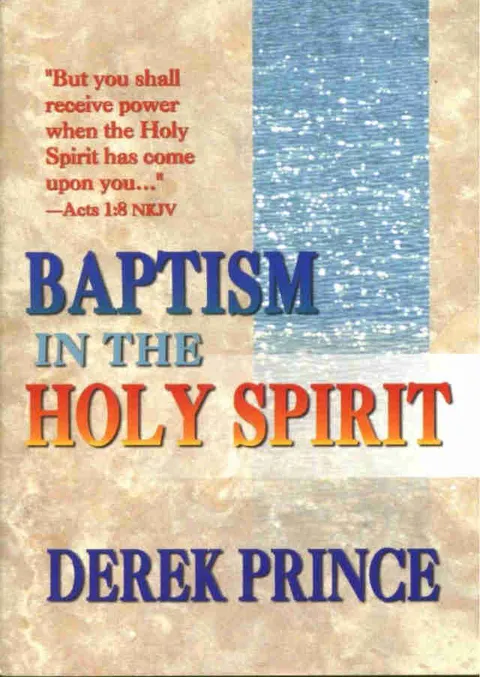
"Baptism in the Holy Spirit" by Derek Prince explores the biblical foundation, benefits, and practical implications of receiving the baptism in the Holy Spirit. This book is a comprehensive guide for believers seeking a deeper relationship with the Holy Spirit and a greater understanding of spiritual gifts and empowerment for Christian living.
John MacArthur
John MacArthur is the pastor-teacher of Grace Community Church in Sun Valley, California, as well as an author, conference speaker, chancellor of The Master’s University and Seminary, and featured teacher with the Grace to You media ministry.
After graduating from Talbot Theological Seminary, John came to Grace Community Church in 1969. The emphasis of his pulpit ministry is the careful study and verse-by-verse exposition of the Bible, with special attention devoted to the historical and grammatical background behind each passage. Under John’s leadership, Grace Community Church’s two morning worship services fill the three-thousand-seat auditorium to capacity. Several thousand members participate every week in dozens of fellowship groups and training programs, most led by lay leaders and each dedicated to equipping members for ministry on local, national, and international levels.
In 1985, John became president of The Master’s College (formerly Los Angeles Baptist College; since 2016, The Master’s University). Located in Santa Clarita, California, it is a distinctly Christian, accredited, liberal arts institution offering undergraduate and graduate degree programs. In 1986, John founded The Master’s Seminary, a graduate school dedicated to training men for full-time pastoral and missionary work.
John is also chairman and featured teacher with Grace to You. Founded in 1969, Grace to You is the nonprofit organization responsible for developing, producing, and distributing John’s books, audio resources, and the Grace to You radio and television programs. Grace to You radio airs more than a thousand times daily throughout the English-speaking world, reaching major population centers with biblical truth. It also airs over a thousand times a day in Spanish, reaching twenty-seven countries across Europe and Latin America. Grace to You television airs weekly on DirecTV in the United States, and is available for free on the Internet worldwide. John’s 3,300-plus sermons, spanning more than five decades of ministry, are available for free download on this website.
John has written hundreds of study guides and books, including The Gospel According to Jesus, Our Sufficiency in Christ, Strange Fire, Ashamed of the Gospel, The Murder of Jesus, The Prodigal Son, Twelve Ordinary Men, The Truth War, The Jesus You Can’t Ignore, Slave, One Perfect Life, The Gospel According to Paul, Parables, and One Faithful Life. John’s books have been translated into more than two dozen languages. The MacArthur Study Bible, the cornerstone resource of his ministry, is available in English (NKJ, NAS, and ESV), Spanish, Russian, German, French, Portuguese, Italian, Arabic, and Chinese.
In 2015 The MacArthur New Testament Commentary was completed. In thirty-four volumes, John takes you detail by detail, verse by verse, through the entire New Testament.
John and his wife, Patricia, live in Southern California and have four married children: Matt, Marcy, Mark, and Melinda. They also enjoy the enthusiastic company of their fifteen grandchildren.
Blessed Are the Unoffendable
I remember the flush of embarrassment that came to my face as I realized that my friend was letting me know I hadn’t been invited to be a part of the group of women she was meeting with regularly — and not by accident. I tried to navigate the moment, relieving the tension by telling her not to worry about it. I let her know that my plate was full with doctors’ appointments and kids’ activities. “I couldn’t join the group even if I were asked!” I laughed, doing all I could to keep her from feeling sorry for me. And my words were true. I really did have a plate too full to add anything else. I really didn’t want her to worry about it. Yet my hot cheeks and thumping heart told the secret I was trying to conceal — I was fighting the impulse to take offense. Shutting the Gates I knew well enough how destructive becoming offended can be. Proverbs 18:19 says, “A brother offended is more unyielding than a strong city.” What horrible strength there is in taking up an offense! Offended people can become unassailable. Recalcitrant. Too hard-hearted to hear an appeal. When we are offended, we believe ourselves to have the moral high ground; therefore, we feel justified in making the one who has offended us a villain. I thought I was on the inside of this particular group of friends, only to discover I was not. My sense of where I fit in with others was challenged in a painful way. I could choose to accept it with goodwill toward these sisters and lean on my Savior who has called me his friend, or I could get tough — hard as nails — like an unyielding strong city whose gates have been shut and whose pride has locked out the offending parties. “Offended people become unassailable. Recalcitrant. Too hard-hearted to hear an appeal.” The Scriptures show us many instances of Jesus causing offense. He offends his hometown crowd. He offends Pharisees and scribes. He is the stone of stumbling and rock of offense. This is no big surprise to Christians. We aren’t shocked that the Pharisees or the hometown crowd are resentful and outraged by his superior understanding and his mighty deeds. From our vantage point, it isn’t too hard to see that when Jesus challenges their view of reality, he’s always right. We can see their blind spots and pride and how that pride makes them easily offended. But it’s much harder to spot the pride when we’re the one being offended, and when the offender is someone other than the perfect Jesus. The Drug of Offendedness What do we do when we’re offended by one another? What do we do if the offense given or taken is a result of carelessness, or thin skin, or personality differences, or unintentionally missing the mark, or sinfulness in ourselves or others? First, remember that when others are offensive in a truly sinful way, their offense is against God first and foremost. Sin against us feels personal, because it often is personal. But it’s significantly more personal to God, who doesn’t just relate to us, but who created us. God is patient with those who have offended his holiness. But he will not wait forever. And for those who are united to his Son through faith, their offenses against him have been extinguished at the cross. Second, it is good to remember that God has made a way for us to deal with a legitimate offense. We can follow the instructions of our Lord and go to that person directly in the hopes of gaining our brother (Matthew 18:15). We don’t ever need to stay offended. Even when we don’t gain our brother by going to him, we don’t have to live in our offended state; we can lay that down at the cross. And laying our offense there, we can take a posture that is eager for reconciliation, should God grant it. But what about when there is no intentional or discernible sin? What about the kind of situation that I found myself in — the one where I had not been sinned against, yet my hurt feelings were poised to harden into offendedness? It helps to acknowledge that taking offense is a powerful drug. It’s a powerful drug precisely because it gives us power. Remember the proverb — the offended brother is more unyielding than a strong city! “Taking offense is a powerful drug. It’s a powerful drug precisely because it gives us power.” When we turn hurt feelings into offendedness, we go from vulnerable to impenetrable. When we’re hurt by someone else’s words or actions, it’s tempting to try to protect ourselves with anger or self-righteousness that masquerades as having been offended. It’s easier to imagine the ones who have hurt us as villains rather than own that our hurt often has to do with our insecurities and fragility more than with the objective sinfulness of others. Good Sense and Glory Proverbs 19:11 says, “Good sense makes one slow to anger, and it is his glory to overlook an offense.” Good sense and glory are in short supply these days. Rather than slow down and give our rational minds a chance to inform our wildly thumping hearts, we let our feelings inform our response. Rather than overlook an offense, we go conjuring them up from every possible infraction, mounting chips on our shoulders. Everything another person says that we disagree with is a devilish opportunity for taking up an offense. Anything another person does that is different than how we would do it strengthens the resolve of the unyielding, hardened heart. Too often, we can’t merely disagree with people; we are personally offended by the words, opinions, and actions of others, even when they have no bearing on our personal lives. And if we can’t find a way to be personally offended ourselves, too many have begun taking up an offense on behalf of another. Rather than cover an offense in the interest of love and refusing to repeat a matter (Proverbs 17:9), the society around us urges us to lend and borrow offenses as a currency of backward virtue. Blessed Are the Unoffendable There is more than insecurity and fragility underneath our proclivity to take up an offense, although those problems are constantly feeding it. At root, our easily offended hearts are full of pride and idolatry. We have set ourselves as the standard of what is right and good and what must be honored — any perceived challenge to that assumption results in anger, resentment, and the taking up of an offense. But we’re not the standard; God is — which is wonderful news for sinners. Because he is the standard, because only he can see into hearts and discern the motives of each of us, we can be free to assume the best of others, trusting that he will judge perfectly in the end. We can have the good sense to be slow to anger. We can become gloriously unoffendable. Won’t you lay down the offendedness you’ve nursed against others, and rest in the salvation of the God who is slow to anger and abounding in steadfast love? He is patient in delaying judgment, but judgment will come. Today is the day to crucify the counterfeit power of offendedness and take hold of the gospel — which is the power of God for salvation to all who believe (Romans 1:16).