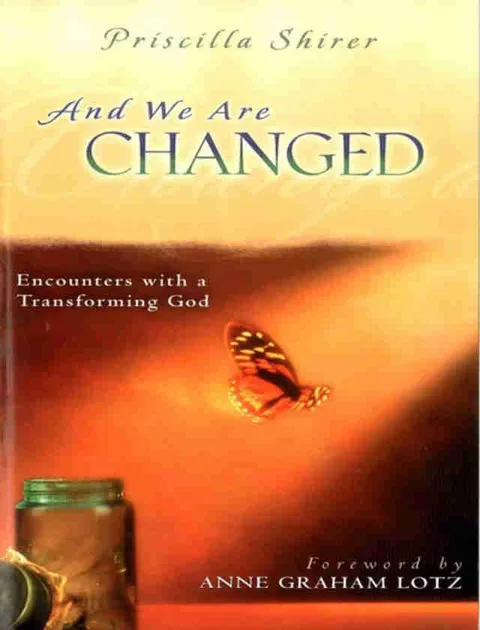

And We Are Changed: Encounters With A Transforming God Order Printed Copy
- Author: Priscilla Shirer
- Size: 981KB | 276 pages
- |
Others like and we are changed: encounters with a transforming god Features >>
And The Angels Were Silent
Letters Of Samuel Rutherford - With A Sketch Of His Life
Experiencing The Depths Of Jesus Christ
The Desires Of Ages
Good Morning Holy Spirit (Revised And Expanded)
Drawing Near: A Life Of Intimacy With God

Fasting

Mornings With Tozer Daily Devotional
Jesus, The One And Only

Because Of Bethlehem
About the Book
"And We Are Changed" by Priscilla Shirer is a collection of powerful stories and personal encounters with God that explores the transformative power of faith and the impact it has on our lives. Through these stories, Shirer demonstrates how encountering God can lead to profound changes and growth in our spiritual journey. The book encourages readers to seek a deeper relationship with God and trust in His ability to transform their lives.
Gregory Thaumaturgus
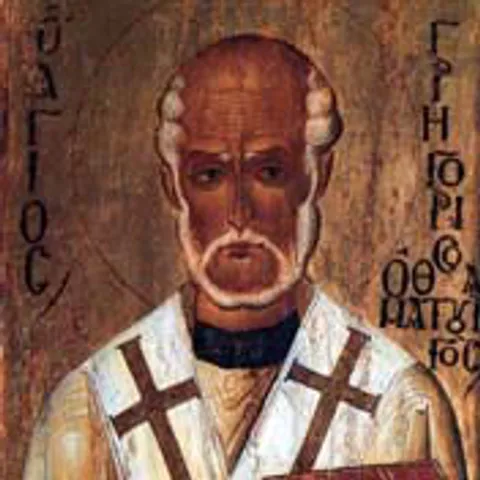 Gregory the Wonderworker’s Early life
Gregory was born in a Pontus, a region on the southern coast of the Black Sea, located in the modern-day eastern Black Sea Region of Turkey, around 212-13. His was a wealthy home and his parents named him Theodore (Gift of God) despite their pagan beliefs. When he was 14 years old his father died and soon after, he and his brother, Athenodorus, were anxious to study law at Beirut, Lebanon, then one of the four of five famous schools in the Hellenic world.
Influence of Origen
However, on the way, they first had to escort their sister to rejoin her husband, who was a government official assigned to Caesarea in Palestine (modern Haifa, Israel). When they arrived they learned that the celebrated scholar Origen, head of the catechetical school of Alexandria, lived there.
Inquisitiveness led them to hear and speak with the Origen and his irresistible charm quickly won their hearts. They soon dropped their desires for a life in Roman law, became Christian believers and pupils of Origen, learning philosophy and theology, for somewhere between five and eight years. Origen also baptised Gregory.
Pastor (then Bishop) of Neoceasarea
Gregory returned to his native Pontus with the intention of practicing oratory, but also to write a book proving the truth of Christianity, revealing his evangelistic heart. But his plans were disrupted when locals noticed his passion for Christ and his spiritual maturity. There were just seventeen Christians in Neoceasarea when Gregory arrived and this small group persuaded him to lead them as their bishop. (‘bishop’ simply meant a local overseer). At the time, Neocaesarea was a wicked, idolatrous province.
Signs of the Spirit
By his saintly life, his direct and lively preaching, helping the needy and settling quarrels and complaints, Gregory began to see many converts to Christ. But it was the signs and wonders that particularly attracted people to Christ.
En route to Neocaesarea from Amasea, Gregory expelled demons from a pagan temple, its priest converted to Christ immediately.
Once, when he was conversing with philosophers and teachers in the city square, a notorious harlot came up to him and demanded payment for the sin he had supposedly committed with her. At first Gregory gently remonstrated with her, saying that she perhaps mistook him for someone else.
But the loose woman would not be silenced. He then asked a friend to give her the money. Just as the woman took the unjust payment, she immediately fell to the ground in a demonic fit, and the fraud became evident. Gregory prayed over her, and the devil left her. This was the beginning of Gregory’s miracles. It was at this time he became known as ‘Gregory Thaumaturgus,’ ‘Gregory the Miracle Worker’ (or Wonderworker).
At one point Gregory wanted to flee from the worldly affairs into which influential townsmen persistently sought to push him. He went into the desert, where by fasting and prayer he developed an intimacy with God and received gifts of knowledge, wisdom and prophecy. He loved life in the wilderness and wanted to remain in solitude with God until the end of his days, but the Lord willed otherwise.
His theological contribution
Though he was primarily an evangelist and pastor, Gregory also had a deep theological understanding.
His principal work ‘The Exposition of Faith’, was a theological apology for Trinitarian belief. It incorporated his doctrinal instructions to new believers, expressed his arguments against heretical groups and was widely influential amongst leaders in the Patristic period: Basil the Great, Gregory the Theologian, and Gregory of Nyssa (The Cappadocian Fathers). It was the forerunner of the Nicene Creed that was to appear in the early 4th century.
In summary
He gave himself to the task of the complete conversion of the population of his diocese. The transformation in Neocaesarea was astonishing. Persuasive preaching, numerous healings and miraculous signs had a powerful effect. Such was his success that it was said that when Gregory became bishop (c 240) he found only seventeen Christians in his diocese; when he died only seventeen remained pagan (Latourette 1953:76).
Basil the Great’s Testimony
Basil the Great (330-379, Bishop of Caesarea, in his work ‘On the Spirit’ wrote the following account of Gregory the wonder-worker.
“But where shall I rank the great Gregory, and the words uttered by him? Shall we not place among Apostles and Prophets a man who walked by the same Spirit as they; who never through all his days diverged from the footprints of the saints; who maintained, as long as he lived, the exact principles of evangelical citizenship?
I am sure that we shall do the truth a wrong if we refuse to number that soul with the people of God, shining as it did like a beacon in the Church of God: for by the fellow-working of the Spirit the power which he had over demons was tremendous, and so gifted was he with the grace of the word ‘for obedience to the faith among. . .the nations.’ that, although only seventeen Christians were handed over to him, he brought the whole people alike in town and country through knowledge to God.
He too by Christ’s mighty name commanded even rivers to change their course, and caused a lake, which afforded a ground of quarrel to some covetous brethren, to dry up. Moreover, his predictions of things to come were such as in no wise to fall short of those of the great prophets. To recount all his wonderful works in detail would be too long a task. By the superabundance of gifts, wrought in him by the Spirit, in all power and in signs and in marvels, he was styled a second Moses by the very enemies of the Church.
Thus, in all that he through grace accomplished, alike by word and deed, a light seemed ever to be shining, token of the heavenly power from the unseen which followed him. To this day he is a great object of admiration to the people of his own neighborhood, and his memory, established in the churches ever fresh and green, is not dulled by length of time. (Schaff and Wace nd., Series 2. 8:46-47).
“Gregory was a great and conspicuous lamp, illuminating the church of God.” —Basil the Great.
Gregory the Wonderworker’s Early life
Gregory was born in a Pontus, a region on the southern coast of the Black Sea, located in the modern-day eastern Black Sea Region of Turkey, around 212-13. His was a wealthy home and his parents named him Theodore (Gift of God) despite their pagan beliefs. When he was 14 years old his father died and soon after, he and his brother, Athenodorus, were anxious to study law at Beirut, Lebanon, then one of the four of five famous schools in the Hellenic world.
Influence of Origen
However, on the way, they first had to escort their sister to rejoin her husband, who was a government official assigned to Caesarea in Palestine (modern Haifa, Israel). When they arrived they learned that the celebrated scholar Origen, head of the catechetical school of Alexandria, lived there.
Inquisitiveness led them to hear and speak with the Origen and his irresistible charm quickly won their hearts. They soon dropped their desires for a life in Roman law, became Christian believers and pupils of Origen, learning philosophy and theology, for somewhere between five and eight years. Origen also baptised Gregory.
Pastor (then Bishop) of Neoceasarea
Gregory returned to his native Pontus with the intention of practicing oratory, but also to write a book proving the truth of Christianity, revealing his evangelistic heart. But his plans were disrupted when locals noticed his passion for Christ and his spiritual maturity. There were just seventeen Christians in Neoceasarea when Gregory arrived and this small group persuaded him to lead them as their bishop. (‘bishop’ simply meant a local overseer). At the time, Neocaesarea was a wicked, idolatrous province.
Signs of the Spirit
By his saintly life, his direct and lively preaching, helping the needy and settling quarrels and complaints, Gregory began to see many converts to Christ. But it was the signs and wonders that particularly attracted people to Christ.
En route to Neocaesarea from Amasea, Gregory expelled demons from a pagan temple, its priest converted to Christ immediately.
Once, when he was conversing with philosophers and teachers in the city square, a notorious harlot came up to him and demanded payment for the sin he had supposedly committed with her. At first Gregory gently remonstrated with her, saying that she perhaps mistook him for someone else.
But the loose woman would not be silenced. He then asked a friend to give her the money. Just as the woman took the unjust payment, she immediately fell to the ground in a demonic fit, and the fraud became evident. Gregory prayed over her, and the devil left her. This was the beginning of Gregory’s miracles. It was at this time he became known as ‘Gregory Thaumaturgus,’ ‘Gregory the Miracle Worker’ (or Wonderworker).
At one point Gregory wanted to flee from the worldly affairs into which influential townsmen persistently sought to push him. He went into the desert, where by fasting and prayer he developed an intimacy with God and received gifts of knowledge, wisdom and prophecy. He loved life in the wilderness and wanted to remain in solitude with God until the end of his days, but the Lord willed otherwise.
His theological contribution
Though he was primarily an evangelist and pastor, Gregory also had a deep theological understanding.
His principal work ‘The Exposition of Faith’, was a theological apology for Trinitarian belief. It incorporated his doctrinal instructions to new believers, expressed his arguments against heretical groups and was widely influential amongst leaders in the Patristic period: Basil the Great, Gregory the Theologian, and Gregory of Nyssa (The Cappadocian Fathers). It was the forerunner of the Nicene Creed that was to appear in the early 4th century.
In summary
He gave himself to the task of the complete conversion of the population of his diocese. The transformation in Neocaesarea was astonishing. Persuasive preaching, numerous healings and miraculous signs had a powerful effect. Such was his success that it was said that when Gregory became bishop (c 240) he found only seventeen Christians in his diocese; when he died only seventeen remained pagan (Latourette 1953:76).
Basil the Great’s Testimony
Basil the Great (330-379, Bishop of Caesarea, in his work ‘On the Spirit’ wrote the following account of Gregory the wonder-worker.
“But where shall I rank the great Gregory, and the words uttered by him? Shall we not place among Apostles and Prophets a man who walked by the same Spirit as they; who never through all his days diverged from the footprints of the saints; who maintained, as long as he lived, the exact principles of evangelical citizenship?
I am sure that we shall do the truth a wrong if we refuse to number that soul with the people of God, shining as it did like a beacon in the Church of God: for by the fellow-working of the Spirit the power which he had over demons was tremendous, and so gifted was he with the grace of the word ‘for obedience to the faith among. . .the nations.’ that, although only seventeen Christians were handed over to him, he brought the whole people alike in town and country through knowledge to God.
He too by Christ’s mighty name commanded even rivers to change their course, and caused a lake, which afforded a ground of quarrel to some covetous brethren, to dry up. Moreover, his predictions of things to come were such as in no wise to fall short of those of the great prophets. To recount all his wonderful works in detail would be too long a task. By the superabundance of gifts, wrought in him by the Spirit, in all power and in signs and in marvels, he was styled a second Moses by the very enemies of the Church.
Thus, in all that he through grace accomplished, alike by word and deed, a light seemed ever to be shining, token of the heavenly power from the unseen which followed him. To this day he is a great object of admiration to the people of his own neighborhood, and his memory, established in the churches ever fresh and green, is not dulled by length of time. (Schaff and Wace nd., Series 2. 8:46-47).
“Gregory was a great and conspicuous lamp, illuminating the church of God.” —Basil the Great.
enjoy your possessions before they possess you
Take an inventory of your life. What do you own right now? Whatever possessions you have are no accident, and not a product of mere happenstance. At the micro level, Jesus promises to care for even the minutest everyday details, like pocket money and food and clothes. As we see in Scripture, in these small possessions, God calls us to live with moral standards because we are susceptible to sinning our way into big problems (like unreasonable consumer debt). God calls us to be wise with money and to work and live economically fruitful lives, and to be careful with our possessions. At the macro level, all wealth distribution and re-distribution is the work of our sovereign God (Ecclesiastes 5:18–6:2). All of our possessions are his, and he gives (and takes away) as he sees fit. God makes the poor and he makes the rich (1 Samuel 2:7). So how does God decide to distribute wealth in the lives of his creatures? This plays out in many different ways. God may give you many possessions, but not give you the power to enjoy those gifts — a great tragedy (Ecclesiastes 6:1–2). God may give you accumulated wealth, and give you the power to enjoy those gifts — a great blessing (Ecclesiastes 5:19, Proverbs 10:22). God may give you possessions, but through future persecution, he may take all those possessions away from you in the end (Hebrews 10:34). God may call you to a life of unalleviated poverty (2 Corinthians 6:10; 8:9). God may give you a life of wealth (2 Chronicles 32:29). God may give you a life in the middle — neither poverty nor wealth (Proverbs 30:8). God may bless you with great wealth, then take it all away and reduce your portfolio to ash, and then restore you with doubled wealth (Job). God may make you wealthy and then call you to voluntary poverty in order to show the world that he is your greatest treasure (Matthew 19:21; Mark 10:21; Luke 18:22). None of these situations is normative, if God sovereignly dispenses possessions to us as he sees fit (which he does). When it comes to possessions, our experiences will vary greatly. But no matter how much (or how little) we possess, there are four things that will help us rightly enjoy the gifts God has given us. 1. Money is temporary. Money existed before us, and it will exist after us, too. The streams of commerce have been flowing for millennia, and one day we will be gone and the currents of economic stimulus will flow to the next generation. We exist in time with money and possessions, but everything of value we own will be passed on to others. Which means in a very real sense, money is temporary. It carries the face of a Caesar or a president to remind us its value is as temporary as world rulers and the rise and fall of nations. So give back to Caesar what is Caesar’s. In other words, the Christian is called to possess all things as though we don’t possess anything (1 Corinthians 7:30). Hold the money, use the money, save the money, steward the money. But also recognize the cash in our wallets is the Monopoly money of this present age. The cash itself has no eternal face value. We entered this life with empty hands, we leave it with empty hands, and to live in the middle with a lust for cash is like holding a sharp dagger backwards and gutting our own souls (1 Timothy 6:6–10). This is true of cars and houses, too. C.S. Lewis said the secret to genuinely delighting in one’s own house is through sacrifice, through a certain crucifixion of the self’s relationship to it. We sacrifice our house, we release our grip on it, and then it becomes an object of joy. When it comes to possessions, true delight is found on the other side of disinterest (Letters 2.788). The takeaway: We don’t boast in our possessions; we boast that God possesses us (Jeremiah 9:23–24). Here our stewardship comes into focus. Material blessing is our temporary stewardship, but delighting in God and his gifts is our true and eternal vocation. 2. Enjoy your possessions now. As we have seen, we don’t always know what God is doing in our lives when it comes to our material possessions. He has different plans for us all. But he intends all of his children to enjoy the gifts he has given us. If you have pants, a shirt, and a sandwich you can be content in life, and if you can be content with a little, you can enjoy God’s goodness to you in every one of the millions of simple gifts he gives to you every day (1 Timothy 6:8). In fact, few things in this life are better than to enjoy your life and the good gifts from God in a spirit of fear and obedience and faith toward God (Ecclesiastes 8:15; 9:7–10; 10:19; 12:13). If you are prone to grumble more than express gratitude, pray and ask that God would give you the power to enjoy his gifts rightly — a gift in itself. As the book of Ecclesiastes makes clear: One of the rarest and most precious gifts is the gift of enjoying our daily gifts. 3. Enjoy your possessions by sharing them. The man who cannot enjoy God’s good gifts every day is often the man who wrongly thinks he must own gifts before enjoying them. We don’t have to own something to find joy in it. Beautiful art is intended to be shared in museums and galleries, not to be locked in the secluded basement of a billionaire. The delight of exclusivity is a delusion — a false delight. Christians get this. The delight of sharing is what drove the early church to share everything they owned (Acts 2:45; 4:32; 1 John 3:17). They gave money. They cared for the poor. They helped the missionaries. A group of wealthy women funded gospel work (Luke 8:2–3). There is a special delight in our possessions when we don’t think of them as “mine” but make use of them to increase the delight of others. 4. Enjoy what you do not own. Finally — and perhaps the whole reason why I wrote this article in the first place — God calls us to enjoy what we can never possess. I cannot own many of the greatest gifts God has given me. I do not own my wife; I do not own my kids; I don’t own my time, or the oceans, or the rain, or the sunshine, or the majestic mountain ranges — certainly not in any sense in which I own my minivan (my name is on the title). The man who loves the ocean so much that he sells all that he has and buys a beachfront property with his own private sand and closes it off from others so that he can exclusively use it is the man whose joy will die by exclusivity. He cannot enjoy possessions because the possessions possess him. On the other hand, the man who buys beachfront property in order to freely share that property with his friends and family will find his joy doubled. By his seaside generosity, this man will bless many others in great ways. But perhaps the most blessed of all is the man who doesn’t need to own beachfront property at all. He has learned to enjoy every beach in the world for its sheer beauty. He is freed from the desire to enjoy only what he possesses. This seems to be the way Romans 1 pushes us to contemplate. To be truly human is to express a Godward gratitude in the delights of creation. And if that is true, then we discover that what it means to delight in this world is a category that explodes all the categories of what the world promises us in possession. Old Tom Bombadil The beautiful literary example of a man who delights in what he doesn’t possess is found in the character Tom Bombadil, tucked into the early storyline of Tolkien’s The Lord of the Rings. In the epic unfolding storyline, Tom Bombadil is a mysterious figure who is quick to laughter and who seems to live in a blessed state of joy. But his life also bears no impact on the central drama that is unfolding around him. (Thus, Tom Bombadil never appears in the movies.) Tom’s role in the overall story is subtle and easy to miss. Early in the journey, Frodo and company wander into his lands, into a respite of joy in stark contrast to the darkness they would soon face. “Who is Tom Bombadil?” a curious Frodo later asks Tom’s wife, Goldberry. “He is the Master of wood, water, and hill.” “Then all this strange land belongs to him?” “No, indeed!” No, indeed! The woods, the water, and the hills that fill Tom Bombadil with delight are not his to possess — they are his to tend and to enjoy. To be sure, Tom is not an allegory against owning property, nor is he an allegory for passivism. As Tolkien also makes clear, it will take warfare against Sauron to stop the encroaching evil in order to preserve the lifestyle that Tom and Goldberry enjoy. As if we need the confirmation, Tolkien makes it clear in his letters that Tom is an intentional enigma. Tom incarnates a contrast. Tom represents a soul that has been freed from the greed of possession in order to delight in created beauty. He has renounced control and therefore finds the means of power to be valueless, too. As a result, Tom Bombadil can hold Frodo’s great ring of power with no danger to himself or anyone else. The ring wields no power over Tom because Tom has no interest in possessing the power of the ring. When the lust for possession is broken, when gratitude takes its place, and when one can simply delight in the glories of creation, then some of evil’s darkest schemes in the human heart are broken. Tom Bombadil is a model of delighting in what we do not possess, and then of sharing what we do possess — like dinner fellowship around the yellow cream, honeycomb, white bread and butter at his table. May we shine like such glad-hearted, grateful enigmas in our own world.