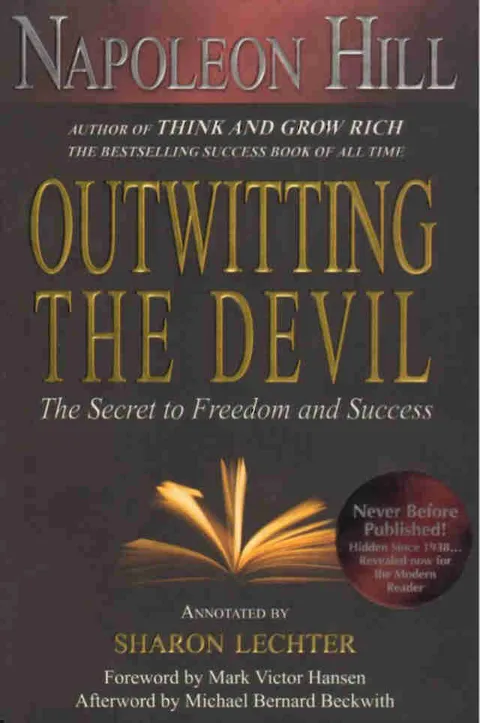

Others like outwitting the devil Features >>
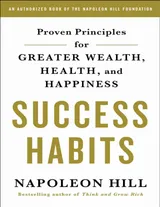
Success Habits

Building A Millionaire Mindset

30 Secrets To The Top
The Search For Significance
Anointed For Business

Making Vision Stick

Give And Take - A Revolutionary Approach To Success

Value Investing
-160.webp)
Better Decisions, Fewer Regrets (5 Questions To Help You Determine Your Next Move)
The Leader Who Had No Title
About the Book
"Outwitting the Devil" by Napoleon Hill is a self-help book that explores the author's conversation with the Devil, in which they discuss the factors that hold people back from achieving success and happiness. Hill provides insights and strategies for overcoming fear, procrastination, and other obstacles on the path to personal fulfillment and success. The book emphasizes the power of positive thinking, persistence, and self-discipline in outwitting the Devil and achieving one's goals.
Jerry Bridges
 Jerry Bridges entered into the joy of his Master on Sunday evening, March 6, 2016, at Penrose Hospital in Colorado Springs, the day after he suffered cardiac arrest. He was 86 years old.
Childhood
Gerald Dean Bridges was born on December 4, 1929, in a cotton-farming home in Tyler, Texas, to fundamentalist parents, six weeks after the Black Tuesday stock market crash that led to the Great Depression.
Jerry was born with several disabilities: he was cross-eyed, he was deaf in his right ear (which was not fully developed), and he had spine and breastbone deformities. But given his family’s poverty, they were unable to afford medical care for these challenges.
The separatist church in East Texas where the Bridges were members had an altar call after every service. Jerry walked the aisle three times, at the ages of 9, 11, and 13. But he later realized that he had not been born again.
His mother Lillian passed away in 1944 when he was 14.
Conversion
In August of 1948, as an 18-year-old college student right before his sophomore year began, Jerry was home alone one night in bed. He acknowledged to the Lord that he was not truly a Christian, despite growing up in a Christian home and professing faith. He prayed, ”God whatever it takes, I want Christ to be my Savior.”
The next week in his dorm room at the University of Oklahoma he was working on a school assignment and reached for a textbook, when he noticed the little Bible his parents had given him in high school. He figured that since he was now a Christian, he ought to start reading it daily, which he did (and never stopped doing for the rest of his days).
The Navy
After graduating with an engineering degree on a Navy ROTC scholarship, he went on active duty with the Navy, serving as an officer during the Korean conflict (1951-1953). A fellow officer invited him to go to a Navigator Bible study. Jerry went and he was hooked. He had never experienced anything like this before.
When stationed on ship in Japan, he got to know several staff members of the Navigators quite well. One day, after Jerry had been in Japan for six months, a Navy worker asked him why he didn’t just throw in his lot with the Navigators and come to work for them. The very next day, December 26, 1952, Jerry failed a physical exam due to the hearing loss in his right ear, and he was given a medical discharge in July 1953, after being in the Navy for only two years. Jerry was not overly disappointed, surmising that perhaps this was the Lord’s way of steering him to the Navigators.
When he returned to the U.S., he began working for Convair, an airplane manufacturing company in southern California, writing technical papers for shop and flight line personnel. It was there that he learned to write simply and clearly—skills the Lord would later use to instruct and edify thousands of people from his pen.
The Navigators
Jerry was single at the time, living in the home of Navigator Glen Solum, a common practice in the early days of The Navigators. In 1955 Jim invited Jerry to go with him to a staff conference at the headquarters of The Navigators in Glen Eyrie at Colorado Springs. It was there that Jerry sensed a call from the Lord to be involved with vocational ministry. He was resistant to the idea of going on staff, but felt conviction and prayed to the Lord, “Whatever you want.” The following day he met Dawson Trotman, the 49-year-old founder of The Navigators, who wanted to interview Jerry for a position, which he received and accepted. Jerry was put in charge of the correspondence department—answering letters, handling receipts, and mainly the NavLog newsletter to supporters.
When Trotman died in June of 1956 (saving a girl who was drowning), Jim Downing took a position equivalent to a chief operations operator. A Navy man, Jim Downing knew that Jerry had also served in the Navy and tapped him to be his assistant.
Jerry struggled at times in his role, unsure if this was his calling since his position was so different from the typical campus reps. After ten years on staff he told the Lord, “I’m going to do this for the rest of my life. If you want me out of The Navigators you’ll have to let me know.”
Beginning in 1960, Jerry served for three years in Europe as administrative assistant to the Navigators’ Europe Director. In January of 1960, he read a booklet entitled The Doctrine of Election, which he first considered heresy but then embraced the following day.
In October of 1963, at the age of 34, he married his first wife, Eleanor Miller of The Navigators following a long-distance relationship. Two children followed: Kathy in 1966, and Dan in 1967. From 1965 to 1969 Jerry served as office manager for The Navigators’ headquarters office at Glen Eyrie.
From 1969 to 1979 Jerry served as the Secretary-Treasurer for The Navigators. It was during this time that NavPress was founded in 1975. Their first publications began by transcribing and editing audio material from their tape archives and turning them into booklets. They produced one by Jerry on Willpower. Leroy Eims—who started the Collegiate ministry—encouraged Jerry to try his hand at writing new material. Jerry had been teaching at conferences on holiness, so he suggested a book along those lines.
In 1978, NavPress published The Pursuit of Holiness, which has now sold over 1.5 million copies. Jerry assumed it would be his only book. A couple of years later, after reading about putting off the old self and putting on the new self from Ephesians 4, he decided to write The Practice of Godliness—on developing a Christlike character. That book went on to sell over half a million copies, and his 1988 book on Trusting God has sold nearly a million copies.
Jerry served as The Navigators’ Vice President for Corporate Affairs from 1979 to 1994. It was in this season of ministry that Eleanor developed non-Hodgkin’s lymphoma. She went to be with the Lord on November 9, 1988, just three weeks after their 25th wedding anniversary. On November 24, 1989, Jerry married Jane Mallot, who had known the Bridges family since the early ’70s.
Jerry’s final position with The Navigator’s was in the area of staff development with the Collegiate Mission. He saw this ministry as developing people, rather than teaching people how to do ministry. In addition to his work with The Navigators, he also maintained an active writing and teaching ministry, traveling the world to instruct and equip pastors and missionaries and other workers through conferences, seminars, and retreats.
Lessons
In 2014, Jerry published a memoir of his life, tracing the providential hand of God through his own story: God Took Me by the Hand: A Story of God’s Unusual Providence (NavPress, 2014). He closes the work with seven spiritual lessons he learned in his six decades of the Christian life:
The Bible is meant to be applied to specific life situations.
All who trust in Christ as Savior are united to Him in a loving way just as the branches are united to the vine.
The pursuit of holiness and godly character is neither by self-effort nor simply letting Christ “live His life through you.”
The sudden understanding of the doctrine of election was a watershed event for me that significantly affected my entire Christian life.
The representative union of Christ and the believer means that all that Christ did in both His perfect obedience and His death for our sins is credited to us.
The gospel is not just for unbelievers in their coming to Christ.
We are dependent on the Holy Spirit to apply the life of Christ to our lives.
His last book, The Blessing of Humility: Walk within Your Calling, will be published this summer by NavPress.
Legacy
One of the great legacies of Jerry Bridges is that he combined—to borrow some titles from his books—the pursuit of holiness and godliness with an emphasis on transforming grace. He believed that trusting God not only involved believing what he had done for us in the past, but that the gospel empowers daily faith and is transformative for all of life.
In 2009 he explained to interviewer Becky Grosenbach the need for this emphasis within the culture of the ministry he had given his life to:
When I came on staff almost all the leaders had come out of the military and we had pretty much a military culture. We were pretty hard core. We were duty driven. The WWII generation. We believed in hard work. We were motivated by saying “this is what you ought to do.” That’s okay, but it doesn’t serve you over the long haul. And so 30 years ago there was the beginning of a change to emphasize transforming grace, a grace-motivated discipleship.
In the days ahead, many will write tributes of this dear saint (see, e.g., this one from his friend, prayer partner, and sometimes co-author Bob Bevington). I would not be able to improve upon the reflections and remembrances of those who knew him better than I did. But I do know that he received from the Lord the ultimate acclamation as he entered into the joy of his Master and received the words we all long to hear, “Well done, my good and faithful servant.” There was nothing flashy about Jerry Bridges. He was a humble and unassuming man—strong in spirit, if not in voice or frame. And now we can rejoice with him in his full and final healing as he beholds his beloved Savior face to face. Thank you, God, for this man who helped us see and know you more.
Jerry Bridges wrote more than 20 books over the course of nearly 40 years:
The Pursuit of Holiness (NavPress, 1978)
The Practice of Godliness (NavPress, 1983)
True Fellowship (NavPress, 1985) [later published as The Crisis of Caring (P&R, 1992); finally republished with a major revision as True Community (NavPress, 2012)]
Trusting God (NavPress, 1988)
Transforming Grace (NavPress, 1991)
The Discipline of Grace (NavPress, 1994)
The Joy of Fearing God (Waterbrook, 1997)
I Exalt You, O God (Waterbrook, 2000)
I Give You Glory, O God (Waterbrook, 2002)
The Gospel for Real Life (NavPress, 2002)
The Chase (NavPress, 2003) [taken from Pursuit of Holiness]
Growing Your Faith (NavPress, 2004)
Is God Really in Control? (NavPress, 2006)
The Fruitful Life (NavPress, 2006)
Respectable Sins (NavPress, 2007) [student edition, 2013]
The Great Exchange [co-authored with Bob Bevington] (Crossway, 2007)
Holiness Day by Day (NavPress, 2008) [a devotional drawing from his earlier writing on holiness]
The Bookends of the Christian Life [co-authored with Bob Bevington] (Crossway, 2009)
Who Am I? (Cruciform, 2012)
The Transforming Power of the Gospel (NavPress, 2012)
31 Days Toward Trusting God (NavPress, 2013) [abridged from Trusting God]
God Took Me by the Hand (NavPress, 2014)
The Blessing of Humility: Walk within Your Calling (NavPress, 2016)
For an audio library of Jerry Bridges’ talks, go here.
Funeral
Visitation for Jerry Bridges was held on Thursday, March 10, 2016, from 5 to 8 pm, at Shrine of Remembrance (1730 East Fountain Blvd, Colorado Springs, CO 80910).
The memorial service was held on Friday, March 11, 2016, at 2 pm at Village Seven Presbyterian Church (4055 Nonchalant Circle South, Colorado Springs, CO 80917).
Jerry Bridges entered into the joy of his Master on Sunday evening, March 6, 2016, at Penrose Hospital in Colorado Springs, the day after he suffered cardiac arrest. He was 86 years old.
Childhood
Gerald Dean Bridges was born on December 4, 1929, in a cotton-farming home in Tyler, Texas, to fundamentalist parents, six weeks after the Black Tuesday stock market crash that led to the Great Depression.
Jerry was born with several disabilities: he was cross-eyed, he was deaf in his right ear (which was not fully developed), and he had spine and breastbone deformities. But given his family’s poverty, they were unable to afford medical care for these challenges.
The separatist church in East Texas where the Bridges were members had an altar call after every service. Jerry walked the aisle three times, at the ages of 9, 11, and 13. But he later realized that he had not been born again.
His mother Lillian passed away in 1944 when he was 14.
Conversion
In August of 1948, as an 18-year-old college student right before his sophomore year began, Jerry was home alone one night in bed. He acknowledged to the Lord that he was not truly a Christian, despite growing up in a Christian home and professing faith. He prayed, ”God whatever it takes, I want Christ to be my Savior.”
The next week in his dorm room at the University of Oklahoma he was working on a school assignment and reached for a textbook, when he noticed the little Bible his parents had given him in high school. He figured that since he was now a Christian, he ought to start reading it daily, which he did (and never stopped doing for the rest of his days).
The Navy
After graduating with an engineering degree on a Navy ROTC scholarship, he went on active duty with the Navy, serving as an officer during the Korean conflict (1951-1953). A fellow officer invited him to go to a Navigator Bible study. Jerry went and he was hooked. He had never experienced anything like this before.
When stationed on ship in Japan, he got to know several staff members of the Navigators quite well. One day, after Jerry had been in Japan for six months, a Navy worker asked him why he didn’t just throw in his lot with the Navigators and come to work for them. The very next day, December 26, 1952, Jerry failed a physical exam due to the hearing loss in his right ear, and he was given a medical discharge in July 1953, after being in the Navy for only two years. Jerry was not overly disappointed, surmising that perhaps this was the Lord’s way of steering him to the Navigators.
When he returned to the U.S., he began working for Convair, an airplane manufacturing company in southern California, writing technical papers for shop and flight line personnel. It was there that he learned to write simply and clearly—skills the Lord would later use to instruct and edify thousands of people from his pen.
The Navigators
Jerry was single at the time, living in the home of Navigator Glen Solum, a common practice in the early days of The Navigators. In 1955 Jim invited Jerry to go with him to a staff conference at the headquarters of The Navigators in Glen Eyrie at Colorado Springs. It was there that Jerry sensed a call from the Lord to be involved with vocational ministry. He was resistant to the idea of going on staff, but felt conviction and prayed to the Lord, “Whatever you want.” The following day he met Dawson Trotman, the 49-year-old founder of The Navigators, who wanted to interview Jerry for a position, which he received and accepted. Jerry was put in charge of the correspondence department—answering letters, handling receipts, and mainly the NavLog newsletter to supporters.
When Trotman died in June of 1956 (saving a girl who was drowning), Jim Downing took a position equivalent to a chief operations operator. A Navy man, Jim Downing knew that Jerry had also served in the Navy and tapped him to be his assistant.
Jerry struggled at times in his role, unsure if this was his calling since his position was so different from the typical campus reps. After ten years on staff he told the Lord, “I’m going to do this for the rest of my life. If you want me out of The Navigators you’ll have to let me know.”
Beginning in 1960, Jerry served for three years in Europe as administrative assistant to the Navigators’ Europe Director. In January of 1960, he read a booklet entitled The Doctrine of Election, which he first considered heresy but then embraced the following day.
In October of 1963, at the age of 34, he married his first wife, Eleanor Miller of The Navigators following a long-distance relationship. Two children followed: Kathy in 1966, and Dan in 1967. From 1965 to 1969 Jerry served as office manager for The Navigators’ headquarters office at Glen Eyrie.
From 1969 to 1979 Jerry served as the Secretary-Treasurer for The Navigators. It was during this time that NavPress was founded in 1975. Their first publications began by transcribing and editing audio material from their tape archives and turning them into booklets. They produced one by Jerry on Willpower. Leroy Eims—who started the Collegiate ministry—encouraged Jerry to try his hand at writing new material. Jerry had been teaching at conferences on holiness, so he suggested a book along those lines.
In 1978, NavPress published The Pursuit of Holiness, which has now sold over 1.5 million copies. Jerry assumed it would be his only book. A couple of years later, after reading about putting off the old self and putting on the new self from Ephesians 4, he decided to write The Practice of Godliness—on developing a Christlike character. That book went on to sell over half a million copies, and his 1988 book on Trusting God has sold nearly a million copies.
Jerry served as The Navigators’ Vice President for Corporate Affairs from 1979 to 1994. It was in this season of ministry that Eleanor developed non-Hodgkin’s lymphoma. She went to be with the Lord on November 9, 1988, just three weeks after their 25th wedding anniversary. On November 24, 1989, Jerry married Jane Mallot, who had known the Bridges family since the early ’70s.
Jerry’s final position with The Navigator’s was in the area of staff development with the Collegiate Mission. He saw this ministry as developing people, rather than teaching people how to do ministry. In addition to his work with The Navigators, he also maintained an active writing and teaching ministry, traveling the world to instruct and equip pastors and missionaries and other workers through conferences, seminars, and retreats.
Lessons
In 2014, Jerry published a memoir of his life, tracing the providential hand of God through his own story: God Took Me by the Hand: A Story of God’s Unusual Providence (NavPress, 2014). He closes the work with seven spiritual lessons he learned in his six decades of the Christian life:
The Bible is meant to be applied to specific life situations.
All who trust in Christ as Savior are united to Him in a loving way just as the branches are united to the vine.
The pursuit of holiness and godly character is neither by self-effort nor simply letting Christ “live His life through you.”
The sudden understanding of the doctrine of election was a watershed event for me that significantly affected my entire Christian life.
The representative union of Christ and the believer means that all that Christ did in both His perfect obedience and His death for our sins is credited to us.
The gospel is not just for unbelievers in their coming to Christ.
We are dependent on the Holy Spirit to apply the life of Christ to our lives.
His last book, The Blessing of Humility: Walk within Your Calling, will be published this summer by NavPress.
Legacy
One of the great legacies of Jerry Bridges is that he combined—to borrow some titles from his books—the pursuit of holiness and godliness with an emphasis on transforming grace. He believed that trusting God not only involved believing what he had done for us in the past, but that the gospel empowers daily faith and is transformative for all of life.
In 2009 he explained to interviewer Becky Grosenbach the need for this emphasis within the culture of the ministry he had given his life to:
When I came on staff almost all the leaders had come out of the military and we had pretty much a military culture. We were pretty hard core. We were duty driven. The WWII generation. We believed in hard work. We were motivated by saying “this is what you ought to do.” That’s okay, but it doesn’t serve you over the long haul. And so 30 years ago there was the beginning of a change to emphasize transforming grace, a grace-motivated discipleship.
In the days ahead, many will write tributes of this dear saint (see, e.g., this one from his friend, prayer partner, and sometimes co-author Bob Bevington). I would not be able to improve upon the reflections and remembrances of those who knew him better than I did. But I do know that he received from the Lord the ultimate acclamation as he entered into the joy of his Master and received the words we all long to hear, “Well done, my good and faithful servant.” There was nothing flashy about Jerry Bridges. He was a humble and unassuming man—strong in spirit, if not in voice or frame. And now we can rejoice with him in his full and final healing as he beholds his beloved Savior face to face. Thank you, God, for this man who helped us see and know you more.
Jerry Bridges wrote more than 20 books over the course of nearly 40 years:
The Pursuit of Holiness (NavPress, 1978)
The Practice of Godliness (NavPress, 1983)
True Fellowship (NavPress, 1985) [later published as The Crisis of Caring (P&R, 1992); finally republished with a major revision as True Community (NavPress, 2012)]
Trusting God (NavPress, 1988)
Transforming Grace (NavPress, 1991)
The Discipline of Grace (NavPress, 1994)
The Joy of Fearing God (Waterbrook, 1997)
I Exalt You, O God (Waterbrook, 2000)
I Give You Glory, O God (Waterbrook, 2002)
The Gospel for Real Life (NavPress, 2002)
The Chase (NavPress, 2003) [taken from Pursuit of Holiness]
Growing Your Faith (NavPress, 2004)
Is God Really in Control? (NavPress, 2006)
The Fruitful Life (NavPress, 2006)
Respectable Sins (NavPress, 2007) [student edition, 2013]
The Great Exchange [co-authored with Bob Bevington] (Crossway, 2007)
Holiness Day by Day (NavPress, 2008) [a devotional drawing from his earlier writing on holiness]
The Bookends of the Christian Life [co-authored with Bob Bevington] (Crossway, 2009)
Who Am I? (Cruciform, 2012)
The Transforming Power of the Gospel (NavPress, 2012)
31 Days Toward Trusting God (NavPress, 2013) [abridged from Trusting God]
God Took Me by the Hand (NavPress, 2014)
The Blessing of Humility: Walk within Your Calling (NavPress, 2016)
For an audio library of Jerry Bridges’ talks, go here.
Funeral
Visitation for Jerry Bridges was held on Thursday, March 10, 2016, from 5 to 8 pm, at Shrine of Remembrance (1730 East Fountain Blvd, Colorado Springs, CO 80910).
The memorial service was held on Friday, March 11, 2016, at 2 pm at Village Seven Presbyterian Church (4055 Nonchalant Circle South, Colorado Springs, CO 80917).
A Strange and Holy Calm
My wife and I are investing in calmness therapy for our twin 11-year-old boys. It’s called youth baseball. The financial expenses pale in comparison to the deposits of time. Baseball not only facilitates brain and body development, and teaches teamwork, but also produces contexts for learning to handle pressure and deal with failure. In other words, it provides avenues to cultivate self-control — the one virtue the apostle Paul saw fit to set before young men in Titus 2. After multiple charges each for older men, older women, and younger women (Titus 2:2–5), he gives a single focus for the young men: “urge the younger men to be self-controlled” (Titus 2:6). Do not misunderstand. We do not want our boys to be unemotional; and they are not. They’re competitive, and they’re kids, prone to react without proper emotional restraint. Which is why youth baseball can be one valuable tool, among others, in seeking to build men. We want them to learn how to be composed under pressure, when the moment requires it, and give release to their emotions in the proper time and place. We want them to learn to keep their head when others are losing theirs, to not lose control in outrage or self-pity but keep a sober mind, aware that how they carry themselves and treat teammates, umpires, and the opposing team is far more important than winning a game. At times, we cheer, and celebrate a win after the final out has been made. At other moments, we process the disappointment of errors, strikeouts, and losses. But in the ups and downs of the game — and in life off the field — our passions can push us to celebrate prematurely, or wallow extensively. We want our boys to learn how to stay calm in the storm, not by repressing emotions but learning to master them. In the heat of the moment, we want them to keep their wits, tell themselves truth, and stay calm enough to faithfully take the next step for their own good, and the good of others. More than baseball players, we want our boys to become Christian men. He held his peace In a day when outbursts of emotion are not only accepted, but respected, and encouraged, it can be more difficult to raise men who learn to righteously “hold their peace.” It’s a curious phrase at key junctures in the history of God’s people. Some outburst of rage, or rash expression of anger or retaliation, is expected, yet a man of God, we’re told, “held his peace.” First, we see it in the patriarch Jacob, when he hears that Shechem, prince of the land, “had defiled his daughter Dinah.” We expect an explosion. But “Jacob held his peace” until his sons could come in from the field (Genesis 34:5). It’s not that Jacob ignores or minimizes this outrageous act against his daughter, and family, but he maintains self-control until his counselors can gather and decide how to respond. Two of his sons, Simeon and Levi, do not exercise the same restraint and become Jacob’s foil. They come against Shechem with swords, and in doing so, bring “trouble on [Jacob] by making [him] stink to the inhabitants of the land” (Genesis 34:30). So also Aaron, Moses’s brother and the first high priest. When his sons “offered unauthorized fire” before God and were consumed (Leviticus 10:1–2), we might expect Aaron to erupt with rage against heaven at the loss of his sons. Instead, Moses reports, “Aaron held his peace” (Leviticus 10:3) — not because he didn’t care, or wasn’t severely grieved, but because he revered God with a righteous fear and trusted God’s goodness, that he had done no wrong, painful as Aaron’s loss was. King Saul, at the outset of his reign, before his falls from grace, demonstrated admirable restraint when dishonored. As the rest of the nation acknowledges and embraces him as its first king, the critics emerge, “some worthless fellows,” with their cynicism: “How can this man save us?” As king, Saul now has the power to dispose of such men, quickly and quietly. “But he held his peace,” reports Samuel, in an admirable demonstration of his early magnanimity (1 Samuel 10:27). Slow to Anger Most noteworthy, though, is God himself. He says, through Isaiah, to his rebellious people, “For a long time I have held my peace; I have kept still and restrained myself” (Isaiah 42:14). God has not ignored or discounted their sin; nor has he raged in an outburst of unrestrained fury against them. Later he pleads, “Have I not held my peace, even for a long time, and you do not fear me?” (Isaiah 57:11). Now he will act in justice, giving vent to his righteous anger, but none may reasonably charge him with rushing to judgment or the slightest impatience. “In times that socialize us for outrage and outbursts, we need men who know how to hold their peace.” In times that socialize us for outrage and outbursts, we need men not just like Jacob, Aaron, and a young Saul — who know how to hold their peace when the moment requires it — but also like God himself, who the Scriptures describe repeatedly as “slow to anger.” Significantly, when God reveals himself to Moses in response to the request “Show me your glory,” the first words the prophet hears are “a God merciful and gracious, slow to anger” (Exodus 34:6). Such divine composure , as we might call it, would become a legacy for the Israelites, that their God was slow to anger. Not without anger . He clearly stood ready to punish the guilty in time. And never before it was time, and never with an intensity that was unjust or in any way that wronged those he punished or disciplined. Yet, given the rebellion of his people, often outrageous, he was enduringly patient and markedly “slow to anger,” as prophets and psalmists alike would cherish (Nehemiah 9:17; Joel 2:13; Psalms 86:15; 103:8; 145:8). So Too His People The collected Proverbs of the nation made this striking application: As your God, so too his people . If God himself, by all accounts and remembrances, is indeed slow to anger, how can his people not seek to be like him? Whoever is slow to anger has great understanding, but he who has a hasty temper exalts folly. (Proverbs 14:29) A hot-tempered man stirs up strife, but he who is slow to anger quiets contention. (Proverbs 15:18) Whoever is slow to anger is better than the mighty, and he who rules his spirit than he who takes a city. (Proverbs 16:32) Good sense makes one slow to anger, and it is his glory to overlook an offense. (Proverbs 19:11) Here we see how God is forming and shaping his people: to have “great understanding”; to “quiet contention”; to be “better than the mighty”; to manifest “good sense” and the rare glory, in a world like ours, to overlook an offense. This God would save his people from hasty tempers, from exalting folly, from stirring up strife. So too in the New Testament, James extends this legacy to his Christian readers: “Let every person be quick to hear, slow to speak, slow to anger” (James 1:19). Jesus whipped and wept But what of Christ himself, God incarnate? In Jesus, we find full and holy humanity, along with expressions we might not label “calm,” yet are manifestly righteous. We do not picture Christ as calm when he made a whip of cords, cleared the temple, and overturned tables (John 2:15) — actions that prompted his disciples to remember Psalm 69:9: “Zeal for your house will consume me.” Nor would we call him “calm” when he came to Bethany in the wake of Lazarus’s death. “Deeply moved in his spirit and greatly troubled” (John 11:33), Jesus wept — visibly enough that onlookers said, “See how he loved him!” (John 11:35–36). Then he came to the tomb and was “deeply moved again” (John 11:38). Nor would we think of his anguish in the garden as serenity. “Being in agony he prayed more earnestly; and his sweat became like great drops of blood falling down to the ground” (Luke 22:44). We don’t typically think of calmness as accompanied by “loud cries and tears” — but even here in Gethsemane, in his distress, he did not abandon reverence but was heard because of it (Hebrews 5:7). We would go too far to pretend that Christ was always calm. There were moments he was righteously and manifestly moved by holy emotions. Though neither in the temple, nor in Bethany, nor in the garden, did he lose control. Apart from a few exceptions, the Christ we encounter in the Gospels is stunningly calm. What composure, what self-control, what holy calmness he shows again and again when failed by his disciples, interrupted by the sick, imposed upon by the well-meaning, challenged by the sophisticated, and disrespected by the authorities. The one to whom our Christian growth conforms is one who was decidedly, manifestly calm, with only the rarest of, and most fitting, exceptions. Not stressed to rule the stars But just as helpful today, as we seek to live with the pattern of holy calm that echoes our Lord’s, is his unshakable composure right now, seated on heaven’s throne. Indeed, we are not yet fully glorified. We are not yet beyond the reach of earthly storms, injuries, strange behavior, and surprising acts of evil in this unreasonable world. But our captain is. As his soldiers, we draw on his calmness as absolute sovereign and utterly invincible. His holy composure and admirable serenity are not only our model to follow but also, and most significantly, our hope to lean on. Unlike the priests in the first covenant, standing daily in God’s service, ever in motion, “offering repeatedly the same sacrifices, which can never take away sins . . . when Christ had offered for all time a single sacrifice for sins, he sat down at the right hand of God” (Hebrews 10:11–12). The priests stood, but as John Piper comments, Christ is not standing. He is not in perpetual motion. . . . He does happen to rule the world. And care for his church. But he doesn’t need to stand up to do it. According to Psalm 8:3, he made the stars with his fingers. It is no stress for him to rule one, infinitesimal planet without jumping out of his seat like a basketball coach, or pacing back and forth like a general waiting for news from the front lines. The accession of Christ to the throne of the universe — and his sitting on his throne with complete equanimity — is a signal to all his enemies, and to us, that this war has been won. “The enemies of Christ hate calm and fearless responses in Christ’s people.” The enemies of Christ hate calm and fearless responses in Christ’s people. They signal to Christ’s foes that their destruction is coming (Philippians 1:28). But more than that, holy calm, in the midst of our storms, makes us available to love others in the thick of crises, rather than being absorbed in our reaction. Oh, for Christians like this in our day of outrage and outburst. And for men like this especially — for husbands and fathers and pastors — to be a non-anxious presence in our homes and churches. For men who lean on the stressless, complete equanimity of Christ, showing holy calmness through the emotionally trying and explosive moments in life and leadership, ready to be responsive without being reactive, engaged and even industrious without being frantic, able to hold their peace when needed, and bring genuine concord in our skirmishes, knowing the war has been won.