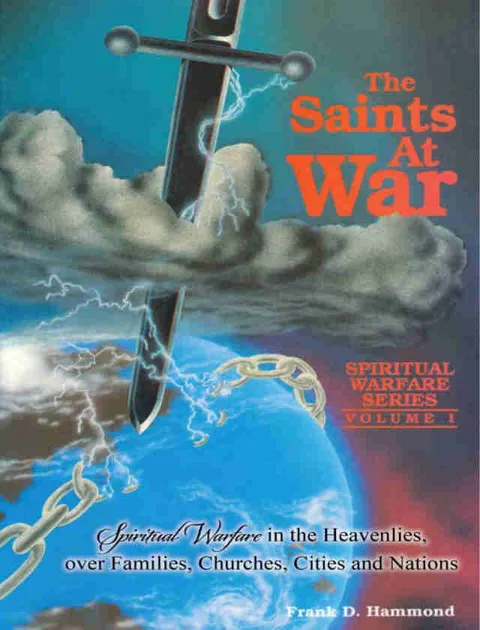

Saints At War: Spiritual Warfare Order Printed Copy
- Author: Frank D. Hammond
- Size: 3.6MB | 153 pages
- |
Others like saints at war: spiritual warfare Features >>
Dressed To Kill (Spiritual Warfare And Armour)
Waging Spiritual Warfare
The Spiritual Man
The Spiritual Man
48 Laws Of Spiritual Power
The Art Of War For Spiritual Battle
The Price Of Spiritual Power
Falling Upward: A Spirituality For The Two Halves Of Life
If Satan Cant Steal Your Dreams... He Cant Control Your Destiny
Rise And Progress Of Religion In The Soul
About the Book
"Saints at War: Spiritual Warfare" by Frank D. Hammond explores the spiritual battles that Christians face and offers guidance on how to effectively fight against the forces of evil. The book provides practical strategies and biblical insight to help individuals engage in spiritual warfare and overcome spiritual obstacles.
Lee Strobel

Lee Strobel (Lee Patrick Strobel) is a former American investigative journalist and a Christian Author who has written several books, including four which received ECPA (Evangelical Christian Publishers Association) Christian Book Awards (1994, 1999, 2001, 2005) and a series which addresses challenges to the veracity of Christianity. He is a former host of the television program called Faith Under Fire on PAX TV and he runs a video apologetic web site.
Lee Strobel Age
He was born on January 25, 1952 in Arlington Heights, Illinois, U.S.
Lee Strobel Family | Chicago Tribune
Less information has been revealed about his father, mother and siblings if he has any. He attended the University of Missouri where he received a Journalism degree. He later earned his Masters of Studies in Law degree from Yale Law School. He became a journalist for the Chicago Tribune and other newspapers for 14 years. The UPI Illinois Editors Association newspaper award program gave him a first place for public service (the Len H. Small Memorial award) for his coverage of the Pinto crash trial of Ford Motor in Winamac, Indiana in 1980. Later, he became the assistant managing editor of the Daily Herald, before leaving journalism in 1987.
Lee Strobel Wife | Daughter
He married Leslie Strobel and they are blessed with two children; a son called Kyle who is an an Assistant Professor of Spiritual Theology and Formation at the Talbot School of Theology and a daughter called Alison who is a novelist.
Lee Strobel Church
He was an atheist when he began investigating the Biblical claims about Christ after his wife’s conversion. Prompted by the results of his investigation, he became a Christian on November 8, 1981. He was a teaching pastor of Willow Creek Community Church in South Barrington, Illinois, from 1987 to 2000, before shifting his focus to writing and producing his TV show, Faith Under Fire. He later was awarded an honorary doctoral degree by Southern Evangelical Seminary in recognition of his contributions to Christian apologetics in 2007.
Lee Strobel Books
He has written several books just to list a few.
1998 – The Case for Christ: A Journalist’s Personal Investigation of the Evidence for Jesus
2000 – The Case for Faith: A Journalist Investigates the Toughest Objections to Christianity
2004 – The Case for a Creator
2005 – The Case for Christmas: A Journalist Investigates the Identity of the Child in the Manger
2007 – The Case for the Real Jesus
2013 – The Case for Grace: A Journalist Explores the Evidence of Transformed Lives
2014 – The Case for Christianity Answer Book
2015 – The Case for Hope: Looking Ahead with Courage and Confidence
2018 – The Case for Miracles: A Journalist Investigates Evidence for the Supernatural
Lee Strobel Net Worth
From his work as a former investigative journalist and from his work as a Christian apologetic author, he has gained a great fortune. Besides that, he lives with his wife in his home that he bought. He has an estimated net worth of $8 million.
Lee Strobel Movie
His movies include;
2004 – Jesus: Fact or Fiction.
2007 – Jesus: The Great Debate.
2017 – The Case for Christ
Lee Strobel The Case For Christ
The Case For Christ is one of the books that Lee has written. This book summarizes Lee’s interviews with thirteen evangelical Christian scholars—Craig Blomberg, Bruce Metzger, Edwin Yamauchi, John McRay, Gregory Boyd, Ben Witherington III, Gary Collins, D. A. Carson, Louis Lapides, Alexander Metherell, William Lane Craig, Gary Habermas, and J. P. Moreland—in which they defend their views regarding the historical reliability of the New Testament. His personal encounters with these scholars and their beliefs led to the 2017 film of the same name.
Lee Strobel The Case For Miracles
The Case for Miracles: A Journalist Investigates Evidence for the Supernatural is one of the books that he has written. This book starts with an unlikely interview in which America’s foremost skeptic builds a seemingly persuasive case against the miraculous. But then Strobel travels the country to quiz scholars to see whether they can offer solid answers to atheist objections. Along the way, he encounters astounding accounts of healings and other phenomena that simply cannot be explained away by naturalistic causes. The book features the results of exclusive new scientific polling that shows miracle accounts are much more common than people think.
Lee Strobel Testimony
This is a summary of the detailed transcript of his testimony;
For most of my life I was an atheist. I thought the idea of an all-loving, all-powerful creator of the universe–I thought it was stupid. I mean, my background is in journalism and law. I tend to be a skeptical person. I was the legal editor of the Chicago Tribune. So I needed evidence before I’d believe anything.
One day my wife came up to me–she’d been agnostic–and she said after a period of spiritual investigation she had decided to become a follower of Jesus Christ. And I thought, you know, this is the worst possible news I could get. I thought she was going to turn into some sexually repressed prude who was going to spend all her time serving the poor in skid row somewhere. I thought this was the end of our marriage.
But in the ensuing months, I saw positive changes in her values, in her character, in the way she related to me and the children. It was winsome; and it was attractive; and it made me want to check things out. So I went to church one day, ah, mainly to see if I could get her out of this cult that she had gotten involved in.
But I heard the message of Jesus articulated for the first time in a way that I could understand it. That forgiveness is a free gift, and that Jesus Christ died for our sins, that we might spend eternity with Him. And I walked out saying–I was still an atheist–but also saying, “If this is true, this has huge implications for my life.” And so I used my journalism training and legal training to begin an investigation into whether there was any credibility to Christianity or to any other world faith system for that matter.
Lee Strobel The Case For Easter
The Case for Easter: A Journalist Investigates the Evidence for the Resurrection is one of his books that answers the following questions. Did Jesus of Nazareth really rise from the dead?Of the many world religions, only one claims that its founder returned from the grave. The resurrection of Jesus Christ is the very cornerstone of Christianity. But a dead man coming back to life? In our sophisticated age, when myth has given way to science, who can take such a claim seriously? Some argue that Jesus never died on the cross. Conflicting accounts make the empty tomb seem suspect. And post-crucifixion sightings of Jesus have been explained in psychological terms.How credible is the evidence for—and against—the resurrection? and many others.
Lee Strobel Quotes
“Only in a world where faith is difficult can faith exist.”
“If your friend is sick and dying, the most important thing he wants is not an explanation; he wants you to sit with him. He’s terrified of being alone more than anything else. So, God has not left us alone.”
“Faith is only as good as the one in whom it’s invested.”
“To be honest, I didn’t want to believe that Christianity could radically transform someone’s character and values. It was much easier to raise doubts and manufacture outrageous objections that to consider the possibility that God actually could trigger a revolutionary turn-around in such a depraved and degenerate life.”
“Abruptly, Templeton cut short his thoughts. There was a brief pause, almost as if he was uncertain whether he should continue.
‘Uh … but … no,’ he said slowly, ‘he’s the most …’ He stopped, then started again. ‘In my view,’ he declared, ‘he is the most important human being who ever existed.’
That’s when Templeton uttered the words I neer expected to hear from him. ‘ And if I may put it this way,’ he said in a voice that began to crack, ‘I … miss … him!’
With that tears flooded his eyes. He turned his head and looked downward, raising his left hand to shield his face from me. His shoulders bobbed as he wept.”
Lee Strobel Website
His website is leestrobel.com
To Heaven and Back with No Fanfare
Suppose you had an absolutely stunning supernatural experience, like being in a car accident and having an out-of-body experience so that you were sure you had died and gone to heaven for a few minutes before returning to your body and being brought back to life. How would you handle that experience? Most of us would be consumed with telling others about it. We might even write a book about it, and go on a speaking circuit. It’s just too amazing to keep to ourselves. And more than likely we would feel empowered to use that very experience to authorize our views of heaven. We might feel as if this extraordinary experience gave us extraordinary influence. Who could contradict us? We had been there! To Heaven and Back Paul did have an experience something like that. But here’s the amazing thing: He mentions it only one time in his thirteen letters, and he never once makes it the warrant for believing anything he says. In fact, the only reason he brings it up is to say that this kind of privilege is precisely not what he will boast in. Rather, he will boast in his weaknesses. Here’s the experience — he even describes it as if it were another person so as not to exalt himself: I must go on boasting. Though there is nothing to be gained by it, I will go on to visions and revelations of the Lord. I know a man in Christ who fourteen years ago was caught up to the third heaven — whether in the body or out of the body I do not know, God knows. And I know that this man was caught up into paradise — whether in the body or out of the body I do not know, God knows — and he heard things that cannot be told, which man may not utter. On behalf of this man I will boast, but on my own behalf I will not boast, except of my weaknesses. (2 Corinthians 12:1–5) We know he is talking about himself, even though he says, “I know a man . . .” because two verses later he says, “To keep me from becoming conceited because of the surpassing greatness of the revelations, a thorn was given me in the flesh” (2 Corinthians 12:7). So he himself is the one who had this extraordinary experience. It is astonishing that Paul introduces this absolutely stunning experience of being “caught up into paradise” only to give it a passing “boast” and then turn all his attention to the real marks of an apostle — namely, suffering for Christ’s sake. Why Minimize the Marvelous? Paul never mentions this experience again. He does not use it to pull rank. He shifts all the focus off of the dramatic and onto the painful reality of suffering with joy. Why? Because it is merely human to boast about extraordinary experiences like visions and out-of-body encounters with God. It requires no great grace or power of God to boast in things that seem to set you apart as privileged. But to boast about weaknesses, and to be content with insults and hardships and persecutions and calamities — that is not what ordinary sinful humans are like. That requires supernatural grace. This is what Paul wants to focus on as the evidence of his apostleship. In fact, he says that the Lord Jesus gave him a thorn in the flesh (we never know what it is) precisely so that he would be hindered from boasting as a superhero of spiritual experience. When Paul pleaded that Jesus would take the thorn away, the Lord answered, “My grace is sufficient for you, for my power is made perfect in weakness” (2 Corinthians 12:9). So Paul concluded, Therefore I will boast all the more gladly of my weaknesses, so that the power of Christ may rest upon me. For the sake of Christ, then, I am content with weaknesses, insults, hardships, persecutions, and calamities. For when I am weak, then I am strong. (2 Corinthians 12:9–10) Instead of circling back again and again to his once-in-a-lifetime out-of-body experience, Paul mentions it once, and then shifts all the focus onto the truths that people can see and think about and test in his writing and his life. Rooted in Public Reality In other words, the truth of Christianity is not rooted in mystical experiences that only a few people have. It is rooted in God-given revelation through writings that are open for all to see and study and test. It is validated in real lives that others can see and examine. So, instead of directing people to his private experience, Paul says, We behaved in the world with simplicity and godly sincerity, not by earthly wisdom but by the grace of God, and supremely so toward you. For we are not writing to you anything other than what you read and understand and I hope you will fully understand. (2 Corinthians 1:12–13) “The truth of Christianity is not rooted in mystical experiences that only a few people have.” If you were to ask Paul, “How can we share your insight into the mystery of Christ?” he would not answer, “I’m sorry. Those mysteries are reserved for the select few who have rare mystical experiences.” What he would say is this: “When you read this, you can perceive my insight into the mystery of Christ” (Ephesians 3:4). His way of opening heaven was not by appealing to unsharable experiences. His way was by appealing to shareable truths written for all to see and understand and experience. Life on Display Behind these writings he put his own life as evidence of reality. Not his life in the rare moments of mystical experience, but his life as a flesh-and-blood man who had to deal with all the hardships of life and ministry. What you have learned and received and heard and seen in me — practice these things, and the God of peace will be with you. (Philippians 4:9) Brothers, join in imitating me, and keep your eyes on those who walk according to the example you have in us. (Philippians 3:17) Be imitators of me, as I am of Christ. (1 Corinthians 11:1) In other words, Paul’s way of leading us into the truth and glory of Christ was not to talk about his privilege of an out-of-body experience of paradise. Instead, his way was to live an open life of total devotion to Jesus, through much suffering, and to write Spirit-given words (1 Corinthians 2:13) that are open to all — readable, public, ready for all to examine. This is a mark of humble, serious, personal reality. It is unusual, contrary to ordinary human proclivities, attractive. It has won my heart. Article by John Piper