








-160.webp)
-160.webp)

-%20Karen%20Kingsbury-160.webp)
About the Book
"I, Isaac, Take Thee, Rebekah" is a Christian book that explores the topic of marriage from a biblical perspective. Author Ravi Zacharias uses the story of Isaac and Rebekah from the Bible to provide insight and advice on relationships, communication, and commitment within marriage. The book offers practical guidance for couples seeking to build a strong and lasting marriage founded on love and faith in God.
Jim Elliot
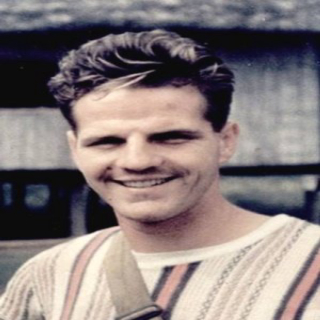 EARLY LIFE
Jim Elliot began his life in Portland, Oregon in the USA. His mother, Clara, was a chiropractor and his father, Fred, was a minister. They married and settled in Seattle, WA where they welcomed their first son, Robert in 1921.
Later they relocated the family to Portland where Herbert arrived in 1924, Jim in 1927, and Jane in 1932.
Jim knew Christ from an early age and was never afraid to speak about Him to his friends. At age six Jim told his mother, “Now, mama, the Lord Jesus can come whenever He wants. He could take our whole family because I’m saved now, and Jane is too young to know Him yet.”
THE YEARS THAT CEMENTED HIS DESIRE TO SERVE THE LORD IN MISSIONS
Jim entered Benson Polytechnic High School in 1941. He carried a small Bible with him and, an excellent speaker; he was often found speaking out for Christ. He and his friends were not afraid to step out and find adventure. One thing Jim didn’t have time for in those early years were girls. He was once quoted as telling a friend, “Domesticated males aren’t much use for adventure.”
In 1945 Jim traveled to Wheaton, IL to attend Wheaton College. His main goal while there was to devote himself to God. He recognized the importance of discipline in pursuing this goal. He would start each morning with prayer and Bible study. In his journal he wrote, “None of it gets to be ‘old stuff’ for it is Christ in print, the Living Word. We wouldn’t think of rising in the morning without a face-wash, but we often neglect the purgative cleansing of the Word of the Lord. It wakes us up to our responsibility.”
Jim’s desire to serve God by taking His gospel to unreached people of the world began to grow while at Wheaton. The summer of 1947 found him in Mexico and that time influenced his decision to minister in Central America after he finished college.
Jim met Elisabeth Howard during his third year at Wheaton. He did ask her for a date which she accepted and then later cancelled. They spent the next years as friends and after she finished at Wheaton they continued to correspond. As they came to know each other there was an attraction, but Jim felt he needed to unencumbered by worldly concerns in order to devote himself completely to God.
In addition to his hope to one day travel to a foreign country to share Christ with the unchurched of the world, he also felt the need to share with people in the United States. On Sundays while at Wheaton he would often ride the train into Chicago and talk to people in the train station about Christ. He often felt ineffective in his work as the times of knowingly leading people to Christ were few. He once wrote, “No fruit yet. Why is that I’m so unproductive? I cannot recall leading more than one or two into the kingdom. Surely this is not the manifestation of the power of the Resurrection. I feel as Rachel, ‘Give me children, or else I die.’”
After college with no clear answer as to working for the Lord in a foreign country, Jim returned home to Portland. He continued his disciplined Bible study as well as correspondence with Elisabeth Howard whom he called Betty.
They both felt a strong attraction to each other during this time, but also felt that the Lord may have been calling them to be unmarried as they served Him.
In June of 1950 he travelled to Oklahoma to attend the Summer Institute of Linguistics. There he learned how to study unwritten languages. He was able to work with a missionary to the Quichuas of the Ecuadorian jungle. Because of these lessons he began to pray for guidance about going to Ecuador and later felt compelled to answer the call there.
Elisabeth Elliot wrote in Shadow of the Almighty:
“The breadth of Jim’s vision is suggested in this entry from the journal:
August 9. “God just now gave me faith to ask for another young man to go, perhaps not this fall, but soon, to join the ranks in the lowlands of eastern Ecuador. There we must learn: 1) Spanish and Quichua, 2) each other, 3) the jungle and independence, and 4) God and God’s way of approach to the highland Quichua. From thence, by His great hand, we must move to the Ecuadorian highlands with several young Indians each, and begin work among the 800,000 highlanders. If God tarries, the natives must be taught to spread southward with the message of the reigning Christ, establishing New Testament groups as they go. Thence the Word must go south into Peru and Bolivia. The Quichuas must be reached for God! Enough for policy. Now for prayer and practice.
THE ECUADOR YEARS
In February 1952 Jim finally left America to travel to Ecuador with Pete Fleming. In May Elisabeth moved to Quito and though they didn’t feel the need to get engaged she and Jim did begin a courtship.
In August Jim left Elisabeth in Quito and travelled with Pete to Shell Mera. At the Mission Aviation Fellowship headquarters in Shell Mera, Jim and Pete learned more about the Acua Indians, a people group that was largely unreached and very savage.
Leaving Shell Mera, Pete and Jim moved on to Shandia where Jim was captivated by the Quichua. He felt very strongly that this was exactly where God intended for him to work to spread the Gospel.
While Jim was in Shandia, Elisabeth was working to learn more about the Colorado Indians near Santa Domingo. In January of 1953 he went to Quito and she met him there and they were finally engaged. They married in October of that year and their only child Valerie was born in 1955.
They settled in Shandia and continued their work with the Quichua Indians. It was Jim’s desire to be able to reach the Waodoni tribe that lived deep in the jungles and had little contact with the outside world. A Waodoni woman who had left the tribe was taken in by the missionaries and helped them to learn the language.
Jim, along with Pete, Ed McCully, Roger Youderian, and their pilot Nate Saint began to search by plane in hopes of finding a way to contact the Waodoni. The found a sandbar in the middle of the Curaray River that worked as a landing strip for the plane and it was there that they first made contact with the Waodoni. They were elated to be able to finally be able to attempt to share the love of Christ with this people group.
After their first meeting, one of the tribe, a man they called George lied to the tribe about the men’s intentions. This lie led the Waodoni warriors to plan an attack for when the missionaries returned. The men did return on January 8, 1956 and were surprised by ten members of the tribe who massacred the missionaries.
Jim’s short life that was filled with the desire to share God’s love can be summed up by a quote that is attributed to him. “He is no fool who gives that which he cannot keep, to gain what he cannot lose.”
EARLY LIFE
Jim Elliot began his life in Portland, Oregon in the USA. His mother, Clara, was a chiropractor and his father, Fred, was a minister. They married and settled in Seattle, WA where they welcomed their first son, Robert in 1921.
Later they relocated the family to Portland where Herbert arrived in 1924, Jim in 1927, and Jane in 1932.
Jim knew Christ from an early age and was never afraid to speak about Him to his friends. At age six Jim told his mother, “Now, mama, the Lord Jesus can come whenever He wants. He could take our whole family because I’m saved now, and Jane is too young to know Him yet.”
THE YEARS THAT CEMENTED HIS DESIRE TO SERVE THE LORD IN MISSIONS
Jim entered Benson Polytechnic High School in 1941. He carried a small Bible with him and, an excellent speaker; he was often found speaking out for Christ. He and his friends were not afraid to step out and find adventure. One thing Jim didn’t have time for in those early years were girls. He was once quoted as telling a friend, “Domesticated males aren’t much use for adventure.”
In 1945 Jim traveled to Wheaton, IL to attend Wheaton College. His main goal while there was to devote himself to God. He recognized the importance of discipline in pursuing this goal. He would start each morning with prayer and Bible study. In his journal he wrote, “None of it gets to be ‘old stuff’ for it is Christ in print, the Living Word. We wouldn’t think of rising in the morning without a face-wash, but we often neglect the purgative cleansing of the Word of the Lord. It wakes us up to our responsibility.”
Jim’s desire to serve God by taking His gospel to unreached people of the world began to grow while at Wheaton. The summer of 1947 found him in Mexico and that time influenced his decision to minister in Central America after he finished college.
Jim met Elisabeth Howard during his third year at Wheaton. He did ask her for a date which she accepted and then later cancelled. They spent the next years as friends and after she finished at Wheaton they continued to correspond. As they came to know each other there was an attraction, but Jim felt he needed to unencumbered by worldly concerns in order to devote himself completely to God.
In addition to his hope to one day travel to a foreign country to share Christ with the unchurched of the world, he also felt the need to share with people in the United States. On Sundays while at Wheaton he would often ride the train into Chicago and talk to people in the train station about Christ. He often felt ineffective in his work as the times of knowingly leading people to Christ were few. He once wrote, “No fruit yet. Why is that I’m so unproductive? I cannot recall leading more than one or two into the kingdom. Surely this is not the manifestation of the power of the Resurrection. I feel as Rachel, ‘Give me children, or else I die.’”
After college with no clear answer as to working for the Lord in a foreign country, Jim returned home to Portland. He continued his disciplined Bible study as well as correspondence with Elisabeth Howard whom he called Betty.
They both felt a strong attraction to each other during this time, but also felt that the Lord may have been calling them to be unmarried as they served Him.
In June of 1950 he travelled to Oklahoma to attend the Summer Institute of Linguistics. There he learned how to study unwritten languages. He was able to work with a missionary to the Quichuas of the Ecuadorian jungle. Because of these lessons he began to pray for guidance about going to Ecuador and later felt compelled to answer the call there.
Elisabeth Elliot wrote in Shadow of the Almighty:
“The breadth of Jim’s vision is suggested in this entry from the journal:
August 9. “God just now gave me faith to ask for another young man to go, perhaps not this fall, but soon, to join the ranks in the lowlands of eastern Ecuador. There we must learn: 1) Spanish and Quichua, 2) each other, 3) the jungle and independence, and 4) God and God’s way of approach to the highland Quichua. From thence, by His great hand, we must move to the Ecuadorian highlands with several young Indians each, and begin work among the 800,000 highlanders. If God tarries, the natives must be taught to spread southward with the message of the reigning Christ, establishing New Testament groups as they go. Thence the Word must go south into Peru and Bolivia. The Quichuas must be reached for God! Enough for policy. Now for prayer and practice.
THE ECUADOR YEARS
In February 1952 Jim finally left America to travel to Ecuador with Pete Fleming. In May Elisabeth moved to Quito and though they didn’t feel the need to get engaged she and Jim did begin a courtship.
In August Jim left Elisabeth in Quito and travelled with Pete to Shell Mera. At the Mission Aviation Fellowship headquarters in Shell Mera, Jim and Pete learned more about the Acua Indians, a people group that was largely unreached and very savage.
Leaving Shell Mera, Pete and Jim moved on to Shandia where Jim was captivated by the Quichua. He felt very strongly that this was exactly where God intended for him to work to spread the Gospel.
While Jim was in Shandia, Elisabeth was working to learn more about the Colorado Indians near Santa Domingo. In January of 1953 he went to Quito and she met him there and they were finally engaged. They married in October of that year and their only child Valerie was born in 1955.
They settled in Shandia and continued their work with the Quichua Indians. It was Jim’s desire to be able to reach the Waodoni tribe that lived deep in the jungles and had little contact with the outside world. A Waodoni woman who had left the tribe was taken in by the missionaries and helped them to learn the language.
Jim, along with Pete, Ed McCully, Roger Youderian, and their pilot Nate Saint began to search by plane in hopes of finding a way to contact the Waodoni. The found a sandbar in the middle of the Curaray River that worked as a landing strip for the plane and it was there that they first made contact with the Waodoni. They were elated to be able to finally be able to attempt to share the love of Christ with this people group.
After their first meeting, one of the tribe, a man they called George lied to the tribe about the men’s intentions. This lie led the Waodoni warriors to plan an attack for when the missionaries returned. The men did return on January 8, 1956 and were surprised by ten members of the tribe who massacred the missionaries.
Jim’s short life that was filled with the desire to share God’s love can be summed up by a quote that is attributed to him. “He is no fool who gives that which he cannot keep, to gain what he cannot lose.”
finding joy in the dark - the bold prayer of psalm 70
I recently spent three days with a group of pastors, almost all our time devoted to deep sharing of our life stories. We laughed at the silly things we’ve done. We marveled at the lineaments of God’s grace. We wept over sins, wounds, and struggles, both past and present. I drove home pondering the fact that when ten tenderhearted, Jesus-loving, spiritually alive pastors get into a room and are honest with each other, we share stories of theft, pornography, broken families, paralyzing anxiety, suicidal thoughts, marital struggles, and unfulfilled longings. If there’s such brokenness in the histories and hearts of godly shepherds, what must be the inner reality of the sheep in our churches? Surrounded by such brokenness within and without, how can the people of God possibly hope to sustain their joy in God? The odds seem long and the situation bleak. But Psalm 70 gives me strong hope. May All Be Glad I’ve been drawn to Psalm 70:4 for many years, because it brings together two awesome truths that thrill the heart of every Christian Hedonist: May all who seek you rejoice and be glad in you! May those who love your salvation say evermore, “God is great!” Only a capacious heart could breathe such an expansive prayer. Notice that David isn’t content for just a few (or even most) seekers of God to rejoice. No, he longs for all to experience God-centered gladness. And David’s requesting more than just a flickering, intermittent passion for the glory of God among the people of God; rather, he prays for their lips and lives to communicate God’s worth continually , at all times, without interruption. This is a plus-sized prayer. It’s so big that many millions of people can (and have) fit inside it. David was surely praying it for himself. He was also praying it for those of his generation and all future generations. In fact, if we’re seeking God and loving God’s salvation, David’s prayer is for us. David is asking God to sweeten our joy and strengthen our passion for his glory. He doesn’t specify how these two prayers might fit together, but John Piper has helped many of us treasure the biblical teaching that they are in fact one. As we find our deepest joy in God (“in you”), we display his worth to the world. Bold Prayer in Dark Days Though I’ve loved Psalm 70:4 for years, it wasn’t until recently that I noticed the context. And it’s the context that has filled me with hope. Here’s what I’ve noticed: Psalm 70 is not a sunny psalm. It’s not a walk in the park or a day at the beach. Life is not good in this psalm. Instead, it’s hard — very hard. In fact, the psalm is an almost-unremittingly desperate plea for God’s help. Verse 1 (the first verse) and verse 5 (the last verse) are bookends: Make haste, O God, to deliver me! O Lord, make haste to help me! Hasten to me, O God! You are my help and my deliverer; O Lord, do not delay! There’s a focused urgency here. David sounds like a soldier pinned down by enemy fire, radioing desperately to central command. His enemies want David dead, and they gloat over David’s misfortunes (“Aha, Aha!” verse 3). We’ve already seen David’s response to this dark situation. He feels two overwhelming desires, one expected and the other exceptional. First, David wants out of the situation. In four out of five verses, he pleads with God for speedy deliverance. This reaction is perfectly natural and completely understandable. Who wouldn’t want this? Of course, we’d all be asking for the same rescue. Second, however, the intense pressure of David’s circumstances also squeezes from his heart another cry, this one much more unusual. Stunningly, the request in verse 4 is not just for himself, but for others. It’s nothing short of miraculous that David, in his foxhole, under heavy fire, prays not simply for personal escape, but for gladness among all God’s people, and for the continual glorifying of God. What is going on here? Praying in a Sea of Suffering Some of us hear the Bible’s repeated calls to pursue our joy and believe that it’s simply beyond us in our present state. For the moment, our attention is occupied by other matters: sin, sickness, loneliness, financial difficulty, opposition, relational pain. We feel we’re in the 101 class of “Surviving Our Problems” and not quite ready for the 201 class of “Pursuing Our Joy.” Verse 4, we think, is for people who have it all together (or at least more together). “Christian Hedonism is as much for bleak days as it is for bright ones.” And this is why the context of verse 4 is so challenging and so encouraging, because verse 4 exists in a sea of suffering. David doesn’t say, “Once I get free from my enemies, then I’ll start to care about the gladness of God’s people and the glory of God.” His foxhole prayer, in worrying and uncomfortable circumstances, is for gladness and glory. This is a real-world prayer. Christian Hedonism is as much for bleak days as it is for bright ones. If God can work this extraordinary impulse in David’s heart, why can’t he do the same in us? Why can’t he implant a renewed passion for our joy and his glory even in the midst of intense suffering? Could it be that God might even use the desperation of our brokenness to drive us to him? In his poem “The Storm,” George Herbert ponders how, like the violent force of a terrible rainstorm, A throbbing conscience spurred by remorse Hath a strange force: It quits the earth, and mounting more and more, Dares to assault thee, and besiege thy doore. (lines 10–12) Our inner and outer conflicts may produce something good. “They purge the aire without, within the breast” (line 18). This was certainly the case for David in Psalm 70. His desperation yielded a passionate cry to God that continues to encourage followers of God to this day. Seek and Rest You can pray a David-like prayer in your own bleak situation by taking two cues from David himself. “Joy and gladness are the unassailable possession of those who fix their eyes on Jesus in the storms of life.” First, seek God. “May all who seek you rejoice and be glad in you!” Joy and gladness are the unassailable possession of those who fix their eyes on Jesus in the storms of life. Look more deeply and more often at Jesus than you look at your enemies or your troubles. Second, love God’s salvation. “May those who love your salvation say evermore, ‘God is great!’” Consider frequently how God has saved you (and how he’s saving many others). Delight in this salvation. Rest in it. Love it. The more you love your salvation, the more readily your lips will spill over with natural praise of the God who saved you. Please don’t wait to pursue your joy in God until God has healed your brokenness and resolved your problems. Verse 4 isn’t a postscript to Psalm 70; it doesn’t come after David’s crisis. It emerges from the midst of it. This is an example and invitation for us. Don’t wait to pursue your joy. Start right now.

-480.webp)